Cross-Branch Contrastive Learning Algorithm in Heterogeneous Networks
Keywords:
Heterogeneous Information Network, Attention Mechanism, Graph Contrastive Learning, Network EmbeddingAbstract
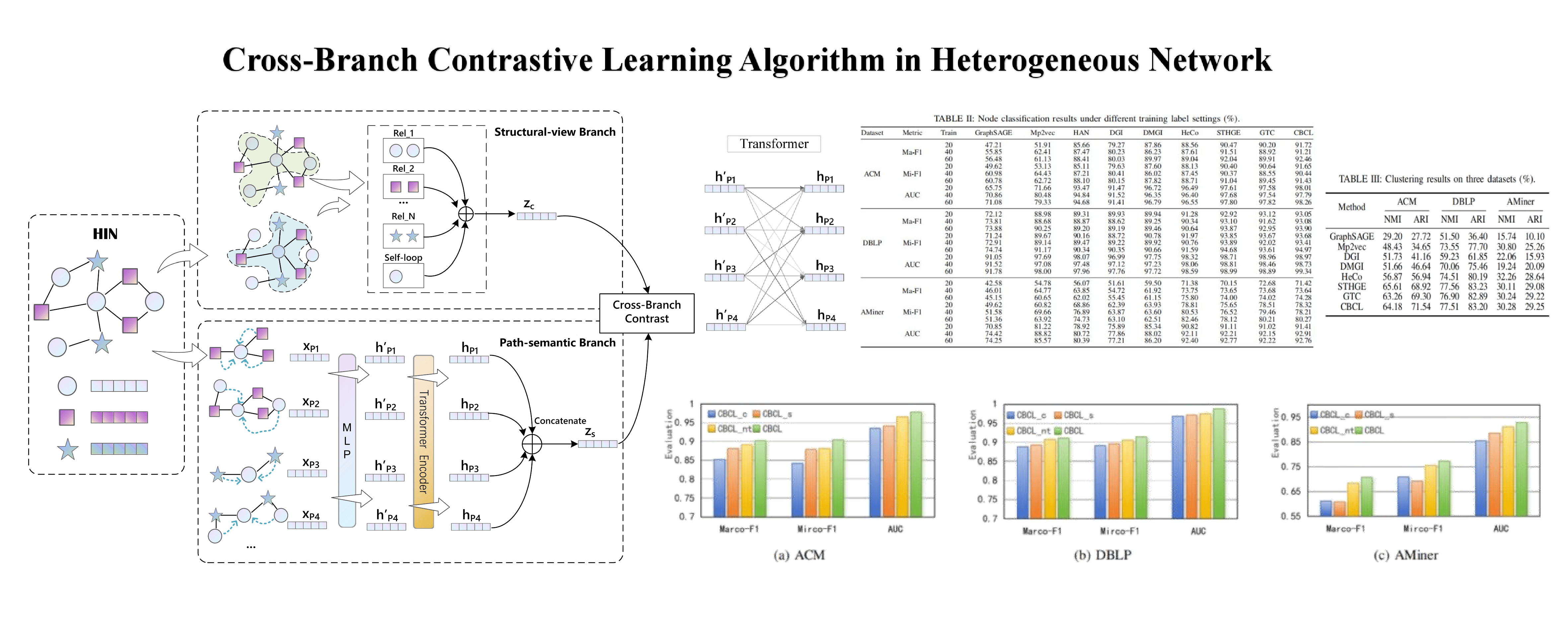
Heterogeneous information networks (HINs) provide a flexible graph representation for relational data with different entity and relation types. Such heterogeneity enriches semantic modeling, but also increases the difficulty of representation learning. Existing heterogeneous graph neural networks have achieved promising results on HIN data; however, many of them rely on supervised or semi-supervised training and require sufficient labeled nodes. Since reliable annotations are costly in large-scale networks, reducing label dependence remains an important issue. To address this problem, this paper develops Cross-Branch Contrastive Learning (CBCL), a self-supervised framework for HIN representation learning. CBCL learns node embeddings through two complementary branches. The structural-view branch models heterogeneous neighborhood relations and path-induced structural dependencies, while the path-semantic branch captures meta-path-level semantic information. A cross-branch contrastive objective aligns the two representations and transfers complementary information between them. Moreover, meta-path-based relevance is used to expand positive samples, allowing semantically related nodes to participate in contrastive optimization. By integrating structural modeling, semantic fusion, and cross-branch supervision, CBCL learns discriminative node representations without extensive labeled data.
Downloads
References
R. Jiang, Y. Li, H. Liu, and Y. Yu, “Incorporating attributes and multi-scale structures for heterogeneous graph contrastive learning,” Information Fusion, vol. 122, Art. no. 103220, 2025. DOI: 10.1016/j.inffus.2025.103220
M. Chen, C. Huang, L. Xia, W. Wei, Y. Xu, and R. Luo, “Heterogeneous graph contrastive learning for recommendation,” in Proceedings of the Sixteenth ACM International Conference on Web Search and Data Mining, pp. 544–552, 2023. DOI: 10.1145/3539597.3570484
L. Sang, Y. Wang, Y. Zhang, Y. Zhang, and X. Wu, “Intent-guided heterogeneous graph contrastive learning for recommendation,” IEEE Transactions on Knowledge and Data Engineering, vol. 37, no. 4, pp. 1915–1929, 2025. DOI: 10.1109/TKDE.2025.3536096
C. Huo, D. He, Y. Li, D. Jin, J. Dang, W. Zhang, W. Pedrycz, and L. Wu, “Heterogeneous graph neural networks using self-supervised reciprocally contrastive learning,” ACM Transactions on Intelligent Systems and Technology, vol. 16, no. 1, Art. no. 24, pp. 1–21, 2025. DOI: 10.1145/3706115
H. Wang, R. Wang, C. Wen, S. Li, Y. Jia, W. Zhang, and X. Wang, “Author name disambiguation on heterogeneous information network with adversarial representation learning,” in Proceedings of the AAAI Conference on Artificial Intelligence, vol. 34, no. 1, pp. 238–245, 2020. DOI: 10.1609/aaai.v34i01.5356
D. Jin, C. Huo, C. Liang, and L. Yang, “Heterogeneous graph neural network via attribute completion,” in Proceedings of The Web Conference, pp. 391–400, 2021. DOI: 10.1145/3442381.3449914
X. Wang, H. Ji, C. Shi, B. Wang, P. Cui, P. S. Yu, and Y. Ye, “Heterogeneous graph attention network,” in The World Wide Web Conference, pp. 2022–2032, 2019. DOI: 10.1145/3308558.3313562
X. Fu, J. Zhang, Z. Meng, and I. King, “MAGNN: metapath aggregated graph neural network for heterogeneous graph embedding,” in Proceedings of The Web Conference, pp. 2331–2341, 2020. DOI: 10.1145/3366423.3380297
Z. Hu, Y. Dong, K. Wang, and Y. Sun, “Heterogeneous graph transformer,” in Proceedings of The Web Conference, pp. 2704–2710, 2020. DOI: 10.1145/3366423.3380027
J. Zhao, X. Wang, C. Shi, Z. Liu, and Y. Ye, “Network schema preserving heterogeneous information network embedding,” in Proceedings of the 29th International Joint Conference on Artificial Intelligence, pp. 1366–1372, 2020. DOI: 10.24963/ijcai.2020/190
X. Liu, F. Zhang, Z. Hou, L. Mian, Z. Wang, J. Zhang, and J. Tang, “Self-supervised learning: generative or contrastive,” IEEE Transactions on Knowledge and Data Engineering, vol. 35, no. 1, pp. 857–876, 2023. DOI: 10.1109/TKDE.2021.3090866
Z. Wang, Q. Li, D. Yu, X. Han, X.-Z. Gao, and S. Shen, “Heterogeneous graph contrastive multi-view learning,” in Proceedings of the 2023 SIAM International Conference on Data Mining, pp. 136–144, 2023. DOI: 10.1137/1.9781611977653.ch16
X. Chen, Y. Wang, J. Fang, Z. Meng, and S. Liang, “Heterogeneous graph contrastive learning with metapath-based augmentations,” IEEE Transactions on Emerging Topics in Computational Intelligence, vol. 8, no. 1, pp. 1003–1014, 2024. DOI: 10.1109/TETCI.2023.3322341
Y. Mo, H. T. Shen, and X. Zhu, “Efficient self-supervised heterogeneous graph representation learning with reconstruction,” Information Fusion, vol. 117, Art. no. 102846, 2025. DOI: 10.1016/j.inffus.2024.102846
Y. Zhu, Y. Xu, H. Cui, C. Yang, Q. Liu, and S. Wu, “Structure-enhanced heterogeneous graph contrastive learning,” in Proceedings of the 2022 SIAM International Conference on Data Mining, pp. 82–90, 2022. DOI: 10.1137/1.9781611977172.10
J. Zhao, Q. Wen, S. Sun, Y. Ye, and C. Zhang, “Multi-view self-supervised heterogeneous graph embedding,” in Proceedings of the Joint European Conference on Machine Learning and Knowledge Discovery in Databases, pp. 319–334, 2021. DOI: 10.1007/978-3-030-86520-7_20
J. Yu and X. Li, “Heterogeneous graph contrastive learning with meta-path contexts and weighted negative samples,” in Proceedings of the 2023 SIAM International Conference on Data Mining, pp. 37–45, 2023. DOI: 10.1137/1.9781611977653.ch5
Y. Zhu, Y. Xu, H. Cui, C. Yang, Q. Liu, and S. Wu, “Structure-aware hard negative mining for heterogeneous graph contrastive learning,” arXiv preprint, arXiv:2108.13886, 2021. DOI: 10.48550/arXiv.2108.13886
J. Zeng and P. Xie, “Contrastive self-supervised learning for graph classification,” in Proceedings of the AAAI Conference on Artificial Intelligence, pp. 10824–10832, 2021. DOI: 10.1609/aaai.v35i12.17293
Y. Ren, B. Liu, C. Huang, P. Dai, L. Bo, and J. Zhang, “Heterogeneous deep graph infomax,” arXiv preprint, arXiv:1911.08538, 2019. DOI: 10.48550/arXiv.1911.08538
S. Yun, M. Jeong, R. Kim, J. Kang, and H. J. Kim, “Graph transformer networks,” in Advances in Neural Information Processing Systems, pp. 11983–11993, 2019. DOI: 10.48550/arXiv.1911.06455
K. Hassani and A. H. K. Ahmadi, “Contrastive multi-view representation learning on graphs,” in Proceedings of the International Conference on Machine Learning, pp. 4116–4126, 2020. DOI: 10.48550/arXiv.2006.05582
P. Velickovic, W. Fedus, W. L. Hamilton, P. Lio, Y. Bengio, and R. D. Hjelm, “Deep graph infomax,” in Proceedings of the International Conference on Learning Representations, pp. 1–17, 2019. DOI: 10.48550/arXiv.1809.10341
C. Park, D. Kim, J. Han, and H. Yu, “Unsupervised attributed multiplex network embedding,” in Proceedings of the AAAI Conference on Artificial Intelligence, vol. 34, no. 4, pp. 5371–5378, 2020. DOI: 10.1609/aaai.v34i04.5985
X. Wang, N. Liu, H. Han, and C. Shi, “Self-supervised heterogeneous graph neural network with co-contrastive learning,” in Proceedings of the ACM SIGKDD Conference on Knowledge Discovery and Data Mining, pp. 1726–1736, 2021. DOI: 10.1145/3447548.3467415
Y. Sun, D. Zhu, Y. Wang, Y. Fu, and Z. Tian, “GTC: GNN-transformer co-contrastive learning for self-supervised heterogeneous graph representation,” Neural Networks, vol. 181, Art. no. 106645, 2025. DOI: 10.1016/j.neunet.2024.106645
Y. Guo, Y. Xia, R. Wang, R. Duan, L. Li, and J. Li, “M2HGCL: multi-scale meta-path integrated heterogeneous graph contrastive learning,” in Proceedings of the International Conference on Advanced Data Mining and Applications, pp. 352–367, 2023. DOI: 10.1007/978-3-031-46671-7_24
D. Sun, C. Sun, Z. Ding, C. Wang, and B. Luo, “Multi-view interactive heterogeneous graph contrastive learning,” IEEE Transactions on Network Science and Engineering, vol. 13, pp. 1389–1405, 2026. DOI: 10.1109/TNSE.2025.3595875
Y. Sun, J. Han, X. Yan, P. S. Yu, and T. Wu, “PathSim: meta path-based top-k similarity search in heterogeneous information networks,” Proceedings of the VLDB Endowment, vol. 4, no. 11, pp. 992–1003, 2011. DOI: 10.14778/3402707.3402736
M. Schlichtkrull, T. N. Kipf, P. Bloem, R. van den Berg, I. Titov, and M. Welling, “Modeling relational data with graph convolutional networks,” in Proceedings of the European Semantic Web Conference, pp. 593–607, 2018. DOI: 10.1007/978-3-319-93417-4_38
X. Yang, M. Yan, S. Pan, X. Ye, and D. Fan, “Simple and efficient heterogeneous graph neural network,” in Proceedings of the AAAI Conference on Artificial Intelligence, vol. 37, no. 9, pp. 10816–10824, 2023. DOI: 10.1609/aaai.v37i9.26283
A. Vaswani, N. Shazeer, N. Parmar, J. Uszkoreit, L. Jones, A. N. Gomez, L. Kaiser, and I. Polosukhin, “Attention is all you need,” in Advances in Neural Information Processing Systems, pp. 5998–6008, 2017. DOI: 10.48550/arXiv.1706.03762
W. L. Hamilton, R. Ying, and J. Leskovec, “Inductive representation learning on large graphs,” in Advances in Neural Information Processing Systems, pp. 1024–1034, 2017. DOI: 10.48550/arXiv.1706.02216
Y. Dong, N. V. Chawla, and A. Swami, “Metapath2Vec: scalable representation learning for heterogeneous networks,” in Proceedings of the 23rd ACM SIGKDD International Conference on Knowledge Discovery and Data Mining, pp. 135–144, 2017. DOI: 10.1145/3097983.3098036
Y. He, D. Yan, Y. Zhang, Q. He, and Y. Yang, “Semantic tradeoff for heterogeneous graph embedding,” IEEE Transactions on Computational Social Systems, vol. 10, no. 3, pp. 1263–1276, 2023. DOI: 10.1109/TCSS.2022.3163471