Accessible Web Content Generation Using LLMs: An Empirical Study on Prompting Strategies and Template-Guided Remediation
Keywords:
Web accessibility, Large Language Models, Web scraping, Prompt engineering, GPT, GeminiAbstract
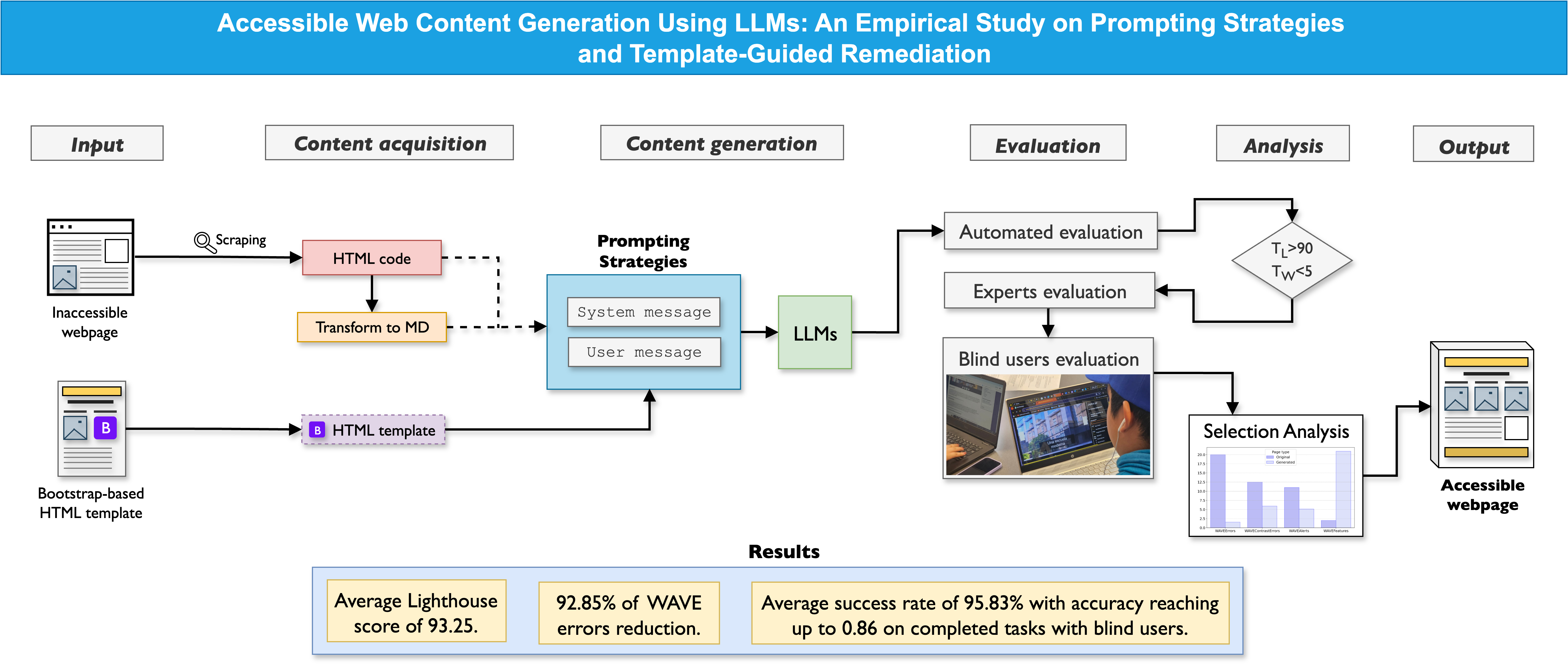
Web accessibility remains a persistent challenge, particularly for visually impaired users who rely on screen readers. This study investigates the potential of large language models (LLMs) to remediate accessibility issues only through structured prompt engineering without accessibility specialization. We evaluate GPT-4o and Gemini 2.0 Flash across 20 variants from two websites using different input formats (HTML, Markdown) and template-guided strategies. Outputs were assessed with automated tools, token efficiency metrics, and manual evaluations with experts and blind users. Results show an average Lighthouse score of 93.25, with WAVE errors reduced by 92.85%. Usability evaluation yielded an average success rate of 95.83% on completed tasks, with accuracy values reaching up to 0.86. GPT-4o demonstrated greater token efficiency, while Gemini produced more visually dynamic outputs. Certain violations persisted, confirming the need for human-in-the-loop validation. Overall, findings suggest that effectively guided LLMs can streamline remediation and foster more inclusive web experiences.Downloads
References
S. L. Henry, “WCAG 2 Overview,” 3 2024. [Online]. Available: https://www.w3.org/WAI/standards-guidelines/wcag/
WebAIM, “The WebAIM Million,” Institute for Disability Research, Policy, and Practice. Utah State University, Tech. Rep., 3 2025. [Online]. Available: https://webaim.org/projects/million/
——, “Screen Reader User Survey #10 Results ,” 2 2024. [Online]. Available: https://webaim.org/projects/screenreadersurvey10/
WHO, “World report on vision,” World Health Organization, Tech. Rep. 14, 2019. [Online]. Available: https://iris.who.int/bitstream/handle/10665/328717/9789241516570-eng.pdf?sequence=18
A. Hemmat et al., “Research directions for using LLM in software requirement engineering: a systematic review,” Frontiers in Computer Science, vol. 7, p. 1519437, 3 2025, doi: 10.3389/fcomp.2025.1519437.
W. Aljedaani et al., “Does ChatGPT Generate Accessible Code? Investigating Accessibility Challenges in LLM-Generated Source Code,” Proceedings of the 21st International Web for All Conference, pp. 165–176, 5 2024, doi:10.1145/3677846.3677854.
A. Ahmed et al., “From Code to Compliance: Assessing ChatGPT’s Utility in Designing an Accessible Webpage – A Case Study,” 1 2025, arXiv preprint arXiv.2501.03572.
K. S. Fuglerud et al., “Exploring the Use of AI for Enhanced Accessibility Testing of Web Solutions,” Studies in health technology and informatics, vol. 320, pp. 453–460, 11 2024, doi: 10.3233/SHTI241041.
A. Othman, A. Dhouib, and A. Nasser Al Jabor, “Fostering websites accessibility: A case study on the use of the Large Language Models ChatGPT for automatic remediation,” ACM International Conference Proceeding Series, pp. 707–713, 7 2023, doi: 10.1145/3594806.3596542.
J.-M. López-Gil and J. Pereira, “Turning manual web accessibility success criteria into automatic: an LLM-based approach,” Universal Access in the
Information Society, vol. 24, pp. 837–852, 3 2025, doi: 10.1007/s10209-024-01108-z.
J. Lazar, “A Framework for Born-Accessible Development of Software and Digital Content,” Lecture Notes in Computer Science, pp. 333–338, 2023, doi: 10.1007/978-3-031-42293-5_32.
S. L. Henry, “Introduction to Web Accessibility,” 3 2024. [Online]. Available: https://www.w3.org/WAI/fundamentals/accessibility-intro/
C. Power et al., “Guidelines are only half of the story: Accessibility problems encountered by blind users on the Web,” Conference on Human Factors in Computing Systems - Proceedings, pp. 433–442, 2012, doi: 10.1145/2207676.2207736.
M. Bajammal and A. Mesbah, “Semantic web accessibility testing via hierarchical visual analysis,” Proceedings - International
Conference on Software Engineering, pp. 1610–1621, 5 2021, doi: 10.1109/ICSE43902.2021.00143.
G. Brajnik, “Beyond Conformance: The Role of Accessibility Evaluation Methods,” in Web Information Systems Engineering – WISE
Workshops. Springer Berlin Heidelberg, 2008, pp. 63–80, doi: 10.1007/978-3-540-85200-1_9.
J. Wood and D. Joshi, “Conflict-RAG: Understanding Evolving Conflicts Using Large Language Models,” in 2024 IEEE International Conference on Big Data (BigData). IEEE, 12 2024, pp. 5459–5467, doi: 10.1109/BigData62323.2024.10825676.
I. Naing et al., “A Reference Paper Collection System Using Web Scraping,” Electronics, vol. 13, p. 2700, 7 2024, doi: 10.3390/electronics13142700.
P. Acosta-Vargas et al., “Generative Artificial Intelligence and Web Accessibility: Towards an Inclusive and Sustainable Future,” Emerging Science Journal, vol. 8, 2024, doi: 10.28991/ESJ-2024-08-04-021.
W. Alsakran and R. Alabduljabbar, “Exploring the Potential of LLMs and Attributed Prompt Engineering for Efficient Text Generation and Labeling,” in 2024 2nd International Conference on Foundation and Large Language Models (FLLM). IEEE, 11 2024, pp. 244–252, doi: 10.1109/FLLM63129.2024.10852475.
H. Du et al., “Interactive Rubric Generator for Instructor’s Assessment Using Prompt Engineering and Large Language Models,” in 2024 IEEE Frontiers in Education Conference (FIE). IEEE, 10 2024, pp. 1–9, doi: 10.1109/FIE61694.2024.10893448.
G. Delnevo, M. Andruccioli, and S. Mirri, “On the Interaction with Large Language Models for Web Accessibility: Implications and Challenges,” Proceedings - IEEE Consumer Communications and Networking Conference, CCNC, 2024, doi: 10.1109/CCNC51664.2024.10454680.
P. Acosta-Vargas, L. Antonio Salvador-Ullauri, and S. Lujan-Mora, “A Heuristic Method to Evaluate Web Accessibility for Users with Low Vision,” IEEE Access, vol. 7, 2019, doi: 10.1109/ACCESS.2019.2939068.
Y. Chang et al., “A Survey on Evaluation of Large Language Models,” ACM Transactions on Intelligent Systems and Technology, vol. 15, no. 3, Mar. 2024, doi: 10.1145/3641289.
W. X. Zhao et al., “A Survey of Large Language Models,” Mar. 2025, arXiv preprint arXiv.2303.18223.
G. Vera-Amaro and J. R. Rojano-Cáceres, “Towards accessible website design through artificial intelligence: A systematic literature review,” Information and Software Technology, vol. 186, no. C, Oct. 2025, doi: 10.1016/j.infsof.2025.107821.
C. Duarte et al., “Expanding Automated Accessibility Evaluations: Leveraging Large Language Models for Heading-Related Barriers,” in Companion Proceedings of the 30th International Conference on Intelligent User Interfaces. New York, NY, USA: ACM, Mar. 2025, pp. 39–42, 10.1145/3708557.3716329.
A. Namoun et al., “Web Design Scraping: Enabling Factors, Opportunities and Research Directions,” ICITEE 2020 - Proceedings of the 12th International Conference on Information Technology and Electrical Engineering, pp. 104–109, Oct. 2020, doi: 10.1109/ICITEE49829.2020.9271770.
E. Benavides-Astudillo et al., “Comparative Study of Deep Learning Algorithms in the Detection of Phishing Attacks Based on HTML and Text Obtained from Web Pages,” in Communications in Computer and Information Science, 2023, pp. 386–398, doi: 10.1007/978-3-031-24985-3_28.
S. K. Oswal and H. K. Oswal, “Examining the Accessibility of Generative AI Website Builder Tools for Blind and Low Vision Users: 21 Best Practices for Designers and Developers,” in 2024 IEEE International Professional Communication Conference (ProComm). IEEE, 2024, pp. 121–128.
J. He et al., “Does Prompt Formatting Have Any Impact on LLM Performance?” 2024, arXiv preprint arXiv:2411.10541v1.
M. Campoverde-Molina and S. Luján-Mora, “Artificial intelligence in web accessibility: A systematic mapping study,” Computer Standards & Interfaces, vol. 96, p. 104055, Mar. 2026, doi: 10.1016/j.csi.2025.104055.
C. Huang et al., “ACCESS: Prompt Engineering for Automated Web Accessibility Violation Corrections,” Jan. 2024, arXiv preprint arXiv.2401.16450.
A. Ahluwalia and S. Wani, “Leveraging Large Language Models for Web Scraping,” Jun. 2024, arXiv preprint arXiv.2406.08246.
E. Ha et al., “AI-based nanotoxicity data extraction and prediction of nanotoxicity,” Computational and Structural Biotechnology Journal, vol. 29, pp. 138–148, Jan. 2025, doi: 10.1016/j.csbj.2025.03.052.
Y. Song et al., “A Comprehensive Survey of Few-shot Learning: Evolution, Applications, Challenges, and Opportunities,” ACM Computing Surveys, vol. 55, no. 13s, pp. 1–40, Dec. 2023, doi: 10.1145/3582688.
G. Brajnik, “A Comparative Test of Web Accessibility Evaluation Methods,” in 10th international ACM SIGACCESS conference on Computers and accessibility, 2008, doi: 10.1145/1414471.1414494.
G. Vera-Amaro and J. R. Rojano-Cáceres, “Understanding Accessibility Needs of Blind Authors on CMS-Based Websites,” 2025, arXiv preprint arXiv.2508.15045.
T. Mahatody, M. Sagar, and C. Kolski, “State of the art on the cognitive walkthrough method, its variants and evolutions,” International Journal of Human-Computer Interaction, vol. 26, no. 8, pp. 741–785, Jul. 2010, doi: 10.1080/10447311003781409
G. Vera-Amaro and J. R. Rojano-Cáceres, “Dataset for Accessible Web Content Generation Using LLMs: An Empirical Study on Prompting Strategies and Template-Guided Remediation,” 2025, Mendeley Data, doi: 10.17632/zybws98spf.2.