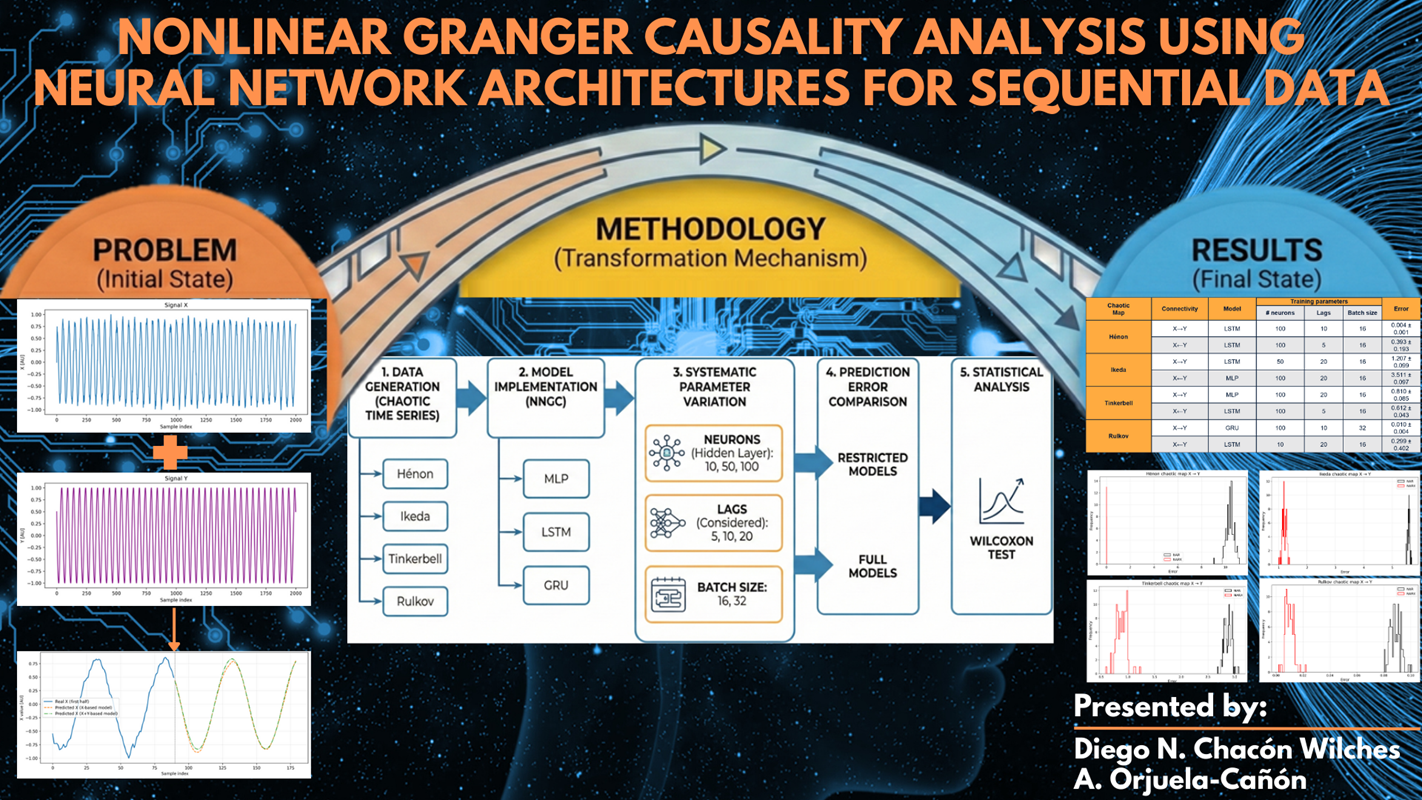
Nonlinear Granger Causality Analysis Using Neural Network Architectures for Sequential Data
Keywords:
Granger causality, nonlinear models, artificial neural networks, chaotic maps, sequential data forecasting, neural networks Granger causalityAbstract
This work presents an analysis of nonlinear Granger causality (NNGC) computation based on artificial neural networks (ANN) architectures. The study evaluates the impact of using computational intelligence models as ANN, and how the training parameters can modify the causality estimation. For this, the employing from three chaotic maps (Hénon, Ikeda, and Tinkerbell) and one neuron-like map (Rulkov) in bivariate scenarios were implemented. Three architectures from the ANN were used such as multilayer perceptron in a mode of the nonlinear autoregressive models, long-short memory term, and gated recurrent unit architectures were used to compute the NNGC, applying a forecasting on sequential data techniques. Results demonstrated that NNGC is highly sensitive to neural network parameters, such as the number of neurons, lag length, and batch size, with an optimal configuration by varying across chaotic maps. Comparisons with classical Granger causality were tested, revealing that neural networks effectively discover nonlinear relationships missed by linear methods, particularly in the Hénon and Rulkov maps.
Downloads
References
C. W. Granger, “Investigating causal relations by econometric models and cross-spectral methods,” Econometrica, vol. 37, no. 3, pp. 424–438, Jul. 1969, doi: 10.2307/1912791.
R. P. Maradana et al., “Innovation and economic growth in European Economic Area countries: The Granger causality approach,” IIMB Manag. Rev., vol. 31, no. 3, pp. 268–282, 2019, doi: 10.1016/j.iimb.2019.03.002.
S. Hu et al., “More discussions for granger causality and new causality measures,” Cogn. Neurodyn., vol. 6, no. 1, pp. 33–42, Feb. 2012, doi: 10.1007/s11571-011-9175-8.
M. Rosoł, M. Młyńczak, and G. Cybulski, “Granger causality test with nonlinear neural-network-based methods: Python package and simulation study,” Comput. Methods Programs Biomed., vol. 216, p. 106669, 2022, doi: 10.1016/j.cmpb.2022.106669.
A. D. Orjuela-Cañón, A. Cerquera, J. A. Freund, G. Juliá-Serdá, and A. G. Ravelo-García, “Sleep apnea: Tracking effects of a first session of CPAP therapy by means of Granger causality,” Comput. Methods Programs Biomed., vol. 187, p. 105235, Apr. 2020, doi: 10.1016/j.cmpb.2019.105235.
N. Nicolaou and T. G. Constandinou, “A nonlinear causality estimator based on non-parametric multiplicative regression,” Front. Neuroinformatics, vol. 10, p. 19, 2016, doi: 10.3389/fninf.2016.00019.
D. Marinazzo, M. Pellicoro, and S. Stramaglia, “Kernel method for nonlinear Granger causality,” Phys. Rev. Lett., vol. 100, no. 14, Apr. 2008, doi: 10.1103/physrevlett.100.144103.
T. Schreiber, “Measuring information transfer,” Phys. Rev. Lett., vol. 85, no. 2, pp. 461–464, Jul. 2000, doi: 10.1103/physrevlett.85.461.
A. Tank, I. Covert, N. Foti, A. Shojaie, and E. B. Fox, “Neural granger causality,” IEEE Trans. Pattern Anal. Mach. Intell., vol. 44, no. 8, pp. 4267–4279, Aug. 2022, doi: 10.1109/TPAMI.2021.3065601.
A. Montalto, L. Faes, and D. Marinazzo, “MuTE: a MATLAB toolbox to compare established and novel estimators of the multivariate transfer entropy,” PloS One, vol. 9, no. 10, p. e109462, 2014, doi: 10.1371/journal.pone.0109462.
M. Hénon, "A Two-dimensional Mapping with a Strange Attractor," in The Theory of Chaotic Attractors, B. R. Hunt, J. A. Kennedy, T. Sauer, and J. A. Yorke, Eds. New York, NY: Springer New York, 1976, pp. 94–102. doi: 10.1007/978-0-387-21830-4_8.
K. Ikeda, H. Daido, and O. Akimoto, “Optical turbulence: chaotic behavior of transmitted light from a ring cavity,” Phys. Rev. Lett., vol. 45, no. 9, pp. 709–712, Sep. 1980, doi: 10.1103/physrevlett.45.709.
A. Attanasio and U. Triacca, “Detecting human influence on climate using neural networks based Granger causality,” Theor. Appl. Climatol., vol. 103, no. 1–2, pp. 103–107, Jan. 2011, doi: 10.1007/s00704-010-0285-8.
A. Montalto, S. Stramaglia, L. Faes, G. Tessitore, R. Prevete, and D. Marinazzo, “Neural networks with non-uniform embedding and explicit validation phase to assess Granger causality,” Neural Netw., vol. 71, pp. 159–171, 2015, doi: 10.1016/j.neunet.2015.08.003.
N. Ancona, D. Marinazzo, and S. Stramaglia, “Radial basis function approach to nonlinear Granger causality of time series,” Phys. Rev. E, vol. 70, no. 5, Nov. 2004, doi: 10.1103/physreve.70.056221.
Y. Wang et al., “Estimating brain connectivity with varying-length time lags using a recurrent neural network,” IEEE Trans. Biomed. Eng., vol. 65, no. 9, pp. 1953–1963, 2018, doi: 10.1109/TBME.2018.2842769.
B. J. Koch, T. Sainburg, P. Geraldo Bastías, S. Jiang, Y. Sun, and J. G. Foster, “A Primer on Deep Learning for Causal Inference,” Sociol. Methods Res., vol. 54, no. 2, pp. 397–447, May 2025, doi: 10.1177/00491241241234866.
J.-S. Hwang, S.-S. Lee, J.-W. Gil, and C.-K. Lee, “Determination of Optimal Batch Size of Deep Learning Models with Time Series Data,” Sustainability, vol. 16, no. 14, p. 5936, Jul. 2024, doi: 10.3390/su16145936.
Josef Perktold et al., statsmodels/statsmodels: Release 0.14.2. (Apr. 17, 2024). Zenodo. doi: 10.5281/ZENODO.593847
G. Deshpande and X. Hu, “Investigating effective brain connectivity from fMRI data: past findings and current issues with reference to Granger causality analysis,” Brain Connect., vol. 2, no. 5, pp. 235–245, 2012, doi: 10.1089/brain.2012.0091.
S. Tripaldi, S. Scippacercola, A. Mangiacapra, and Z. Petrillo, “Granger causality analysis of geophysical, geodetic and geochemical observations during volcanic unrest: A case study in the campi flegrei caldera (Italy),” Geosciences, vol. 10, no. 5, p. 185, 2020, doi: 10.3390/geosciences10050185.