Generative Learning for Imputation of Univariate Time Series Using Images and GANs
Keywords:
Imputation, cGANs, mage of time seriesAbstract
Time series are widely used because they capture the relationship between events over time. However, when data is missing, this dependency is compromised. Traditional imputation techniques are being replaced by approaches based on neural networks, especially generative adversarial networks (GANs)
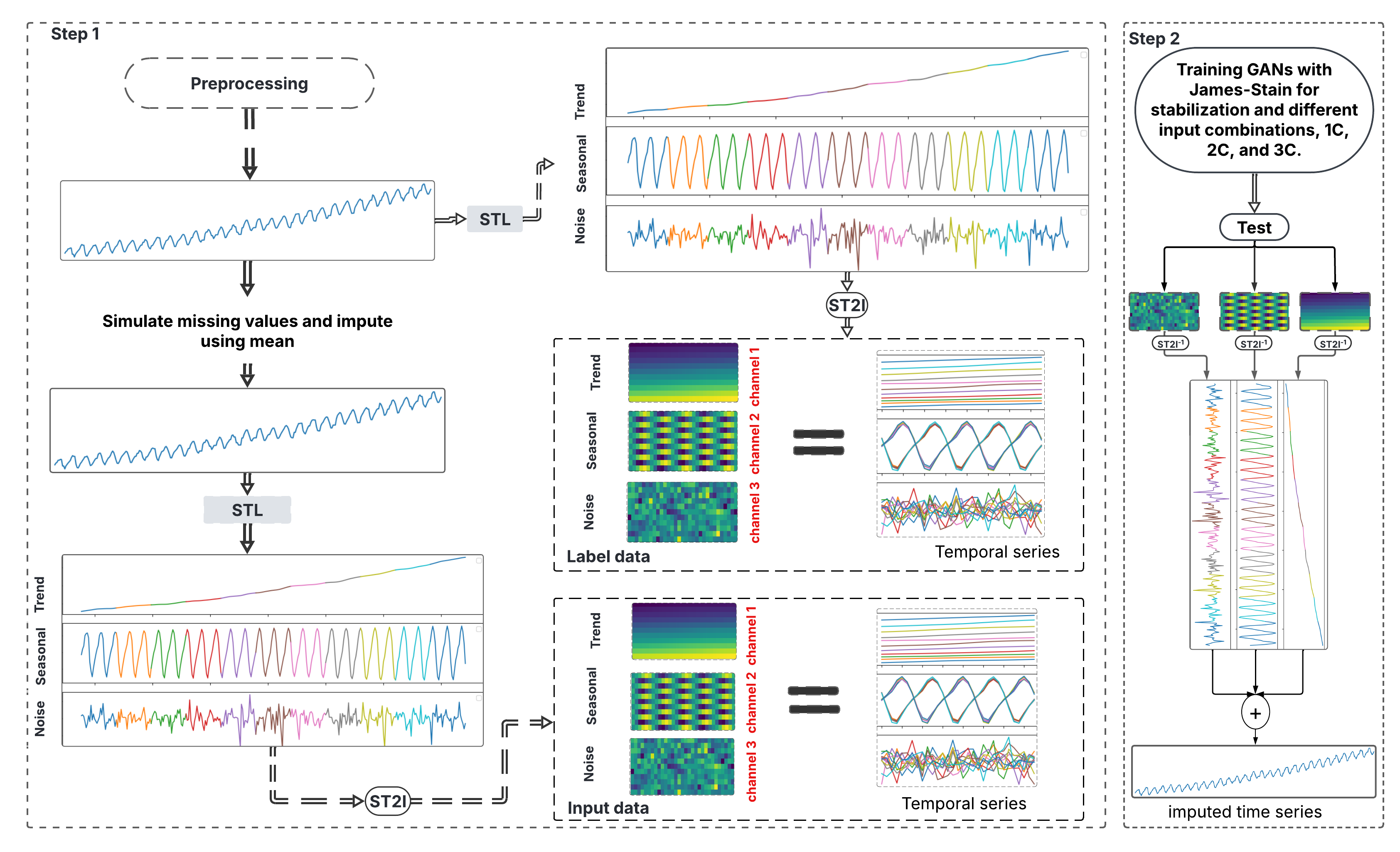
and conditional generative adversarial networks (cGANs), due to their high capacity for reconstructing complex patterns.In this research, we explore an innovative path: transforming time series into images to recover missing data. We propose a new version of this transformation, incorporating two channels,
trend and seasonality. We evaluated four generative architectures (CycleGAN, DCGAN, Pix2Pix, and DiscoGAN) in 240 models, covering different datasets and absence rates from 10% to 40%. We also introduced an unprecedented loss function to reduce the sensitivity of networks to anomalous data. The results show that the proposed two-channel approach produced the most stable imputations. Pix2Pix showed the best average performance: 75% of the Mean Absolute Percentage Error (MAPE) errors were below 0.21 (10% missing) and 2.66 (40% missing). For the Adapted Symmetric Mean Absolute Percentage Error (ASMAPE), the maximum third quartile values were 1.06 and 3.21, respectively. With the proposed loss function, the MAPE error fell from 12.95 to 3.21, and the ASMAPE from 2.86 to 2.66 in the best scenario, with a significant reduction that reinforces the effectiveness of the technique.
Downloads
References
L. A. Lynn, “Artificial intelligence systems for complex decision-making
in acute care medicine: a review,” Patient safety in Surgery, vol. 13,
no. 1, p. 6, 2019, DOI: https://doi.org/10.1186/s13037-019-0188-2.
O. B. Sezer, M. U. Gudelek, and A. M. Ozbayoglu, “Financial time
series forecasting with deep learning : A systematic literature review:
–2019,” Applied Soft Computing, vol. 90, p. 106181, 2020,
DOI:https://doi.org/10.1016/j.asoc.2020.106181. [Online]. Available:
https://www.sciencedirect.com/science/article/pii/S1568494620301216
S. Yang, H.-C. Chen, W.-C. Chen, and C.-H. Yang, “Student enroll-
ment and teacher statistics forecasting based on time-series analysis,”
Computational intelligence and neuroscience, vol. 2020, 2020, DOI:
https://doi.org/10.1155/2020/1246920.
M. I. Habadi and C. P. Tsokos, “Statistical forecasting models of
atmospheric carbon dioxide and temperature in the middle east,”
Journal of Geoscience and Environment Protection, 2017, DOI:
https://doi.org/10.4236/gep.2017.510002.
Y. Su, Y. Zhao, C. Niu, R. Liu, W. Sun, and D. Pei, “Robust anomaly
detection for multivariate time series through stochastic recurrent neural
network,” in Proceedings of the 25th ACM SIGKDD international
conference on knowledge discovery & data mining, 2019, pp. 2828–
, DOI: https://doi.org/10.1145/3292500.3330672.
A. A. Cook, G. Mısırlı, and Z. Fan, “Anomaly detection for iot time-
series data: A survey,” IEEE Internet of Things Journal, vol. 7, no. 7,
pp. 6481–6494, 2019, DOI: https://doi.org/0.1109/JIOT.2019.2958185.
R. J. Little and D. B. Rubin, Statistical analysis with missing data. John
Wiley & Sons, 2019, DOI: https://doi.org/10.1002/9781119482260.
H. Ahn, K. Sun, and K. Kim, “Comparison of missing data
imputation methods in time series forecasting,” Computers, Ma-
terials & Continua, vol. 70, no. 1, pp. 767–779, 2022, DOI:
https://doi.org/10.32604/cmc.2022.019369.
A. Y. Yıldız, E. Koç, and A. Koç, “Multivariate time series imputation
with transformers,” IEEE Signal Processing Letters, vol. 29, pp. 2517–
, 2022, DOI: https://doi.org/10.1109/LSP.2022.3224880.
J. Park, J. Müller, B. Arora, B. Faybishenko, G. Pastorello, C. Varad-
harajan, R. Sahu, and D. Agarwal, “Long-term missing value imputation
for time series data using deep neural networks,” Neural Comput-
ing and Applications, vol. 35, no. 12, pp. 9071–9091, 2023, DOI:
https://doi.org/10.1007/s00521-022-08165-6.
Z. Yang, Y. Li, and G. Zhou, “Ts-gan: Time-series gan for sensor-based
health data augmentation,” ACM Transactions on Computing for Health-
care, vol. 4, no. 2, pp. 1–21, 2023, DOI:https://doi.org/10.1145/3583593.
F. Huang and Y. Deng, “Tcgan: Convolutional generative adversarial
network for time series classification and clustering,” Neural Networks,
, DOI:https://doi.org/10.1016/j.neunet.2023.06.033.
L. Xu, L. Xu, and J. Yu, “Time series imputation with gan inver-
sion and decay connection,” Information Sciences, p. 119234, 2023,
DOI:https://doi.org/10.1016/j.ins.2023.119234.
M. M. Almeida, J. D. S. de Almeida, G. B. Junior, A. C. Silva, and A. C.
de Paiva, “Univariate time series missing data imputation using pix2pix
gan,” IEEE Latin America Transactions, vol. 21, no. 3, pp. 505–512,
, DOI:https://doi.org/10.1109/TLA.2023.10068853.
S. Barra, S. M. Carta, A. Corriga, A. S. Podda, and D. R. Recupero,
“Deep learning and time series-to-image encoding for financial fore-
casting,” IEEE/CAA Journal of Automatica Sinica, vol. 7, no. 3, pp.
–692, 2020, DOI:https://doi.org/10.1109/JAS.2020.1003132.
O. B. Sezer and A. M. Ozbayoglu, “Algorithmic financial trading
with deep convolutional neural networks: Time series to image con-
version approach,” Applied Soft Computing, vol. 70, pp. 525–538, 2018,
DOI:https://doi.org/10.1016/j.asoc.2018.04.024.
J. Kihoro, K. Athiany, W. KH et al., “Imputation of incomplete
nonstationary seasonal time series data,” Mathematical Theory and
Modeling, vol. 3, no. 12, pp. 142–154, 2013. [Online]. Available:
https://www.iiste.org/Journals/index.php/MTM/article/view/8446
M. M. Almeida, J. D. S. Almeida, D. B. P. Quintanilha, G. B. Júnior, and
A. C. Silva, “A meta-learning based neural network and lstm for univari-
ate time series missing data imputation,” Applied Soft Computing, vol.
, p. 112845, 2025, DOI:https://doi.org/10.1016/j.asoc.2025.112845.
E. Brophy, Z. Wang, Q. She, and T. Ward, “Generative ad-
versarial networks in time series: A systematic literature re-
view,” ACM Computing Surveys, vol. 55, no. 10, pp. 1–31, 2023,
DOI:https://doi.org/10.1145/3559540.
J. Yoon, J. Jordon, and M. van der Schaar, “GAIN: Missing Data Imputa-
tion using Generative Adversarial Nets,” Jun. 2018, p. arXiv:1806.02920,
DOI:https://doi.org/10.48550/arXiv.1806.02920.
T. Huang, P. Chakraborty, and A. Sharma, “Deep convolutional
generative adversarial networks for traffic data imputation encod-
ing time series as images,” International Journal of Transporta-
tion Science and Technology, vol. 12, no. 1, pp. 1–18, 2023,
DOI:https://doi.org/10.1016/j.ijtst.2021.10.007.
M. Mirza and S. Osindero, “Conditional genera-
tive adversarial nets,” CoRR, vol. abs/1411.1784, 2014,
DOI:https://doi.org/10.48550/arXiv.1411.1784 . [Online]. Available:
http://arxiv.org/abs/1411.1784
P. Isola, J. Zhu, T. Zhou, and A. A. Efros, “Image-to-image
translation with conditional adversarial networks,” CoRR, vol.
abs/1611.07004, 2016, DOI:https://doi.org/10.48550/arXiv.1611.07004.
[Online]. Available: http://arxiv.org/abs/1611.07004
J. Zhu, T. Park, P. Isola, and A. A. Efros, “Unpaired image-to-image
translation using cycle-consistent adversarial networks,” CoRR, vol.
abs/1703.10593, 2017, DOI:https://doi.org/10.48550/arXiv.1703.10593.
[Online]. Available: http://arxiv.org/abs/1703.10593
A. Radford, L. Metz, and S. Chintala, “Unsupervised
representation learning with deep convolutional generative
adversarial networks,” arXiv preprint arXiv:1511.06434, 2015,
DOI: https://doi.org/10.48550/arXiv.1511.06434.
T. Kim, M. Cha, H. Kim, J. K. Lee, and J. Kim, “Learning to discover
cross-domain relations with generative adversarial networks,” CoRR, vol.
abs/1703.05192, 2017, DOI:https://doi.org/10.48550/arXiv.1703.05192.
[Online]. Available: http://arxiv.org/abs/1703.05192
Andrews and Herzberg, “monthly-sunspots,” Dataset on GitHub, 1985,
available in: https://raw.githubusercontent.com/jbrownlee/Datasets/
master/monthly-sunspots.csv.
K. Dunn, “Electricityusage,” OpenMV.net Datasets, 2012, available in:
A. Trindade, “ElectricityLoadDiagrams20112014,” UCI Machine Learn-
ing Repository, 2015, DOI:https://doi.org/10.24432/C58C86.
H. Fanaee-T, “Bike Sharing Dataset,” UCI Machine Learning Reposi-
tory, 2013, DOI: https://doi.org/10.24432/C5W894.
K. Dunn, “Ammonia concentration,” OpenMV.net Datasets, 2018, avail-
able in: https://openmv.net/.
——, “Distillate flowrate,” OpenMV.net Datasets, 2014, available in:
U. Bandara, “Daily minimum temperatures in melbourne,” Dataset
on GitHub, 2023, available in: https://github.com/upul/WhiteBoard/tree/
master/data.
J. Tukey, “Exploratory data analysis,” 1977,
DOI:https://doi.org/10.1007/978-3-319-43742-2_15.
R. B. Cleveland, W. S. Cleveland, J. E. McRae, I. Terpenning et al.,
“Stl: A seasonal-trend decomposition,” J. off. Stat, vol. 6, no. 1, pp.
–73, 1990.