A Test Strategy for a Current Source Designed for Fast Field-Cycling Nuclear Magnetic Resonance
Keywords:
Analog test, Current source, Design for test, Oscillation-based test, Scientific instrumentationAbstract
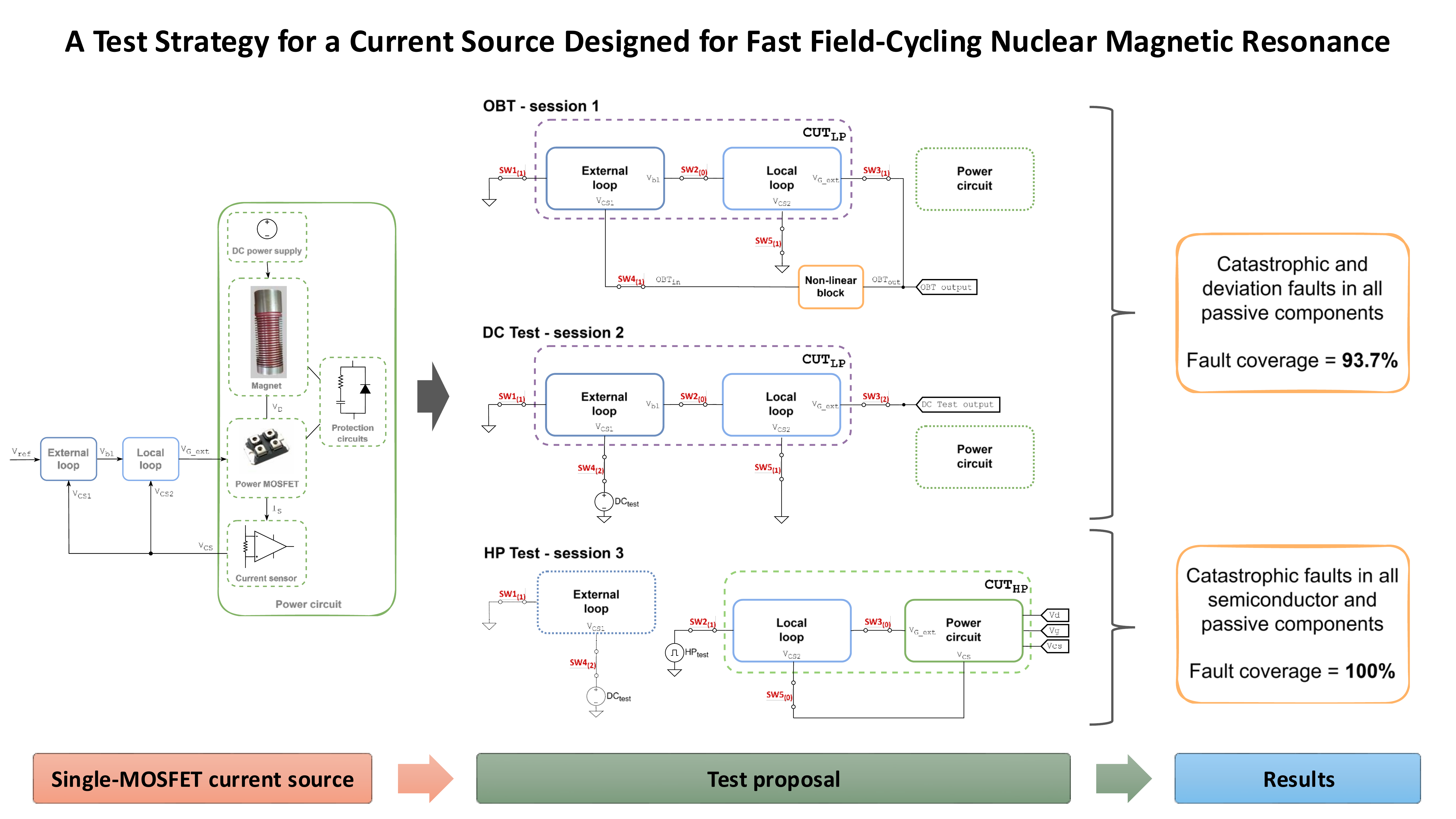
This article presents a novel structural test strategy for a single MOSFET (Metal-Oxide-Semiconductor Field-Effect Transistor) source designed for Fast Field-Cycling Nuclear Mag-netic Resonance (FFC-NMR) systems. The proposed methodolo-gy enables in-field fault detection during idle intervals or before experiment initiation, a critical step to ensure the reliability and validity of the experimental outcomes. The circuit under test is divided into two sections: low-power and high-power. Each one is evaluated using tailored analog testing techniques: OBT (Oscilla-tion-Based Test) and direct current testing are applied to the low-power section, while transient analysis with DTW (Dynamic Time Warping) is used for fault detection in the high-power section. This approach achieves high fault coverage—93.7% for the low-power section and 100% for the high-power section—without requiring complex signal processing. The effectiveness of the method is validated through simulation studies complement-ed by experimental fault injection on a scaled-down prototype. The results demonstrate that this test strategy significantly en-hances system reliability, offering a valuable contribution to the development of more robust and maintainable FFC-NMR in-strumentation for scientific and industrial applications.
Downloads
References
G. G. Rodriguez, A. Salvatori, and E. Anoardo, “Dual k-space and image-space post-processing for field-cycling MRI under low mag-netic field stability and homogeneity conditions.,” Magn Reson Im-aging, vol. 87, pp. 157–168, Apr. 2022, doi: 10.1016/j.mri.2022.01.008.
E. Anoardo and G. G. Rodriguez, “New challenges and opportuni-ties for low-field MRI,” J Magn Reson Open, vol. 14–15, p. 100086, 2023, doi: https://doi.org/10.1016/j.jmro.2022.100086.
Rainer Kimmich, Field-cycling NMR Relaxometry: Instrumentation, Model Theories and Applications . 2018. doi: 10.1039/9781788012966.
E. Anoardo, G. Galli, and G. Ferrante, “Fast-Field-Cycling NMR: Applications and Instrumentation,” Appl Magn Reson, vol. 20, no. 3, pp. 365–404, 2001, doi: 10.1007/BF03162287.
A. Consoli et al., “Thermal instability of low voltage power-MOSFET’s,” IEEE Trans Power Electron, vol. 15, no. 3, pp. 575–581, 2000, doi: 10.1109/63.844518.
M. L. Bushnell and V. D. Agrawal, Essentials of Electronic Testing for Digital, Memory and Mixed-Signal VLSI Circuits, vol. 17. in Frontiers in Electronic Testing, vol. 17. Boston, MA, USA, 2002. doi: 10.1007/b117406.
B. Vinnakota, Analog and Mixed-Signal Test, 1st editio. Upper Saddle River, NJ: Prentice Hall PTR, 1998.
G. W. Roberts, Friedrich. Taenzler, and Mark. Burns, An introduc-tion to mixed-signal IC test and measurement. Oxford University Press, 2012.
Y. Yu, Y. Jiang, and X. Peng, “Multi-frequency test generation for incipient faults in analog circuits based on the aliasing measuring model,” IEEE Access, vol. 6, pp. 34724–34735, 2018, doi: 10.1109/ACCESS.2018.2849697.
L. B. Zilch, M. S. Lubaszewski, and T. R. Balen, “Automatic tool for test set generation and DfT assessment in analog circuits,” Ana-log Integr Circuits Signal Process, vol. 112, no. 2, pp. 277–287, 2022, doi: 10.1007/s10470-022-02039-6.
A. Gómez-Pau, L. Balado, and . Figueras, “Analog Circuits Testing Using Digitally Coded Indirect Measurements,” 2015 10th Interna-tional Conference on Design & Technology of Integrated Systems in Nanoscale Era (DTIS), Ed., 2015. doi: 10.1109/DTIS.2015.7127357.
K. Arabi and B. Kaminska, “Oscillation-test strategy for analog and mixed-signal integrated circuits,” in Proceedings of 14th VLSI Test Symposium, 1996, pp. 476–482. doi: 10.1109/VTEST.1996.510896.
D. Arbet, V. Stopjaková, J. Brenkuš, G. Gyepes, M. Kováč, and L. Majer, “BIST architecture for oscillation test of analog ICs and in-vestigation of test hardware influence,” Microelectronics Reliability, vol. 54, no. 5, pp. 985–992, 2014, doi: 10.1016/j.microrel.2013.12.027.
G. H. Sánchez, D. Vázquez García de la Vega, A. Rueda, and J. L. Huertas Díaz, “Oscillation-Based Test Methodology,” in Oscilla-tion-based test in mixed-signal circuits, Springer, 2006. doi: 10.1007/1-4020-5315-0_1.
S. Callegari, “Bringing Data Converter Pairs into Chaotic Oscilla-tion for Built-in Self-Test and Entropy Generation,” in Nonlinear Systems and Matrix Analysis - Recent Advances in Theory and Ap-plications, IntechOpen, 2024. doi: 10.5772/intechopen.1005654.
E. Romero, G. Peretti, G. Huertas, and D. Vázquez, “Test of switched-capacitor ladder filters using OBT,” Microelectronics J, vol. 36, no. 12, pp. 1073–1079, Dec. 2005, doi: 10.1016/j.mejo.2005.04.061.
M. Hasan, Y. Zhu, and Y. Sun, “Oscillation-Based DFT for Second-Order Bandpass OTA-C Filters,” Circuits Syst Signal Process, vol. 37, no. 5, pp. 1807–1824, May 2018, doi: 10.1007/s00034-017-0648-9.
V. D. Vassios, A. T. Hatzopoulos, I. G. Intzes, D. Kyriakos Tsiakmakis, and D. K. Papakostas, “A Self-Trained, Low-Complexity Method for Detecting Faults in Analog Circuits,” IEEE Trans Instrum Meas, vol. 74, 2025, doi: 10.1109/TIM.2025.3542098.
P. Hekmati, I. Brown, and Z. Shen, “Open Circuit Switch Fault Detection in Flying Capacitor and Cascaded H-Bridge Multilevel Converters,” IEEE Trans Power Electron, vol. 36, no. 11, pp. 12332–12341, 2021, doi: 10.1109/TPEL.2021.3078158.
Z. Wu and J. Zhao, “Open-circuit fault diagnosis method for grid-connected bidirectional T-type converter based on geometrical simi-larity measurement,” IEEE Trans Power Electron, 2022, doi: 10.1109/TPEL.2022.3197404.
C. Li, Y. Yu, T. Tang, Q. Liu, and X. Peng, “A Robust Open-Circuit Fault Diagnosis Method for Three-Phase Interleaved Boost Con-verter,” IEEE Trans Power Electron, vol. 37, no. 9, pp. 11187–11198, Sep. 2022, doi: 10.1109/TPEL.2022.3169167.
H. Jia, Y. Deng, X. Hu, Z. Deng, and X. He, “A Concurrent Diag-nosis Method of IGBT Open-Circuit Faults in Modular Multilevel Converters,” IEEE J Emerg Sel Top Power Electron, vol. 5211041700, 2022, doi: 10.1109/JESTPE.2022.3208647.
J. Xu, S. Guo, H. Guo, and X. Tian, “A Novel Diagnostic Method for Single and Dual Power Switch Open-Circuit Faults of Six-Phase FTPMSM System Even in Fault Tolerant Operation,” IEEE Trans Power Electron, vol. 37, no. 8, pp. 9777–9789, 2022, doi: 10.1109/TPEL.2022.3161437.
M. Kumar, “Time-Domain Characterization and Detection of Open-Circuit Faults for the H-Bridge Power Cell,” IEEE Trans Power Electron, vol. 37, no. 2, pp. 2152–2164, 2022.
M. Chai, N. B. Y. Gorla, and S. K. Panda, “Fault Detection and Localization for Cascaded H-Bridge Multilevel Converter with Model Predictive Control,” IEEE Trans Power Electron, vol. 35, no. 10, pp. 10109–10120, Oct. 2020, doi: 10.1109/TPEL.2020.2978670.
M. Ashourloo et al., “Fault Detection in a Hybrid Dickson DC-DC Converter for 48-V Automotive Applications,” IEEE Trans Power Electron, vol. 36, no. 4, pp. 4254–4268, 2021, doi: 10.1109/TPEL.2020.3022764.
N. Ali, Q. Gao, P. Sovicka, P. Makys, M. Stulrajter, and K. Ma, “Power Converter Fault Detection and Isolation Using High-Frequency Voltage Injection in Switched Reluctance Motor Drives for Automotive Applications,” IEEE J Emerg Sel Top Power Elec-tron, vol. 10, no. 3, pp. 3395–3408, 2022, doi: 10.1109/JESTPE.2020.3022575.
S. Xu et al., “A Simultaneous Diagnosis Method for Power Switch and Current Sensor Faults in Grid-Connected Three-Level NPC In-verters,” IEEE Trans Power Electron, vol. 38, no. 1, pp. 1104–1118, 2023, doi: 10.1109/TPEL.2022.3200721.
J. Zhang, H. Li, D. Xiang, and X. Lei, “A Fast and Robust Open-Circuit Fault Detection Method for Voltage-Source-Inverter With Integrated High-Frequency Sensor,” IEEE J Emerg Sel Top Power Electron, vol. 13, no. 1, pp. 827–838, Feb. 2025, doi: 10.1109/JESTPE.2024.3459946.
M. M. K. P. Ramees and M. W. Ahmad, “A Robust Open Circuit Fault Detection and Localization Scheme for HERIC PV Inverter,” IEEE Transactions on Industrial Electronics, vol. 72, no. 8, pp. 8633–8645, 2025, doi: 10.1109/TIE.2025.3528481.
D. Piumatti, S. Borlo, M. S. Reorda, and I. R. Bojoi, “Assessing the Effectiveness of Different Test Approaches for Power Devices in a PCB,” IEEE J Emerg Sel Top Power Electron, vol. 9, no. 3, pp. 3671–3685, 2021, doi: 10.1109/JESTPE.2020.3013229.
N. Wassinger, R. G. Retegui, M. Funes, and M. Benedetti, “Digital control for a multiple-stage pulsed current source,” IEEE Trans In-dustr Inform, vol. 9, no. 2, pp. 1122–1129, May 2013, doi: 10.1109/TII.2012.2221723.
Y. Ma, D. Oslebo, A. Maqsood, and K. Corzine, “DC Fault Detec-tion and Pulsed Load Monitoring Using Wavelet Transform-Fed LSTM Autoencoders,” IEEE J Emerg Sel Top Power Electron, vol. 9, no. 6, pp. 7078–7087, 2021, doi: 10.1109/JESTPE.2020.3019382.
G. Huertas, D. Vazquez, E. J. Peralias, A. Rueda, and J. L. Huertas, “Practical oscillation-based test of integrated filters,” IEEE Design & Test of Computers, vol. 19, no. 6, pp. 64–72, 2002, doi: 10.1109/MDT.2002.1047745.
E. Dri, G. Peretti, and E. Romero, “Fault detection in configurable switched-capacitor filters using transient analysis and dynamic time warping,” Analog Integr Circuits Signal Process, vol. 108, no. 2, pp. 291–304, 2021, doi: 10.1007/s10470-021-01888-x.