The Role of Acceptance Criteria and Developer Expertise in Enhancing the Quality of Robustness Diagrams in Agile Software Development
Keywords:
user stories, acceptance criteria, robustness diagram, agile, UMLAbstract
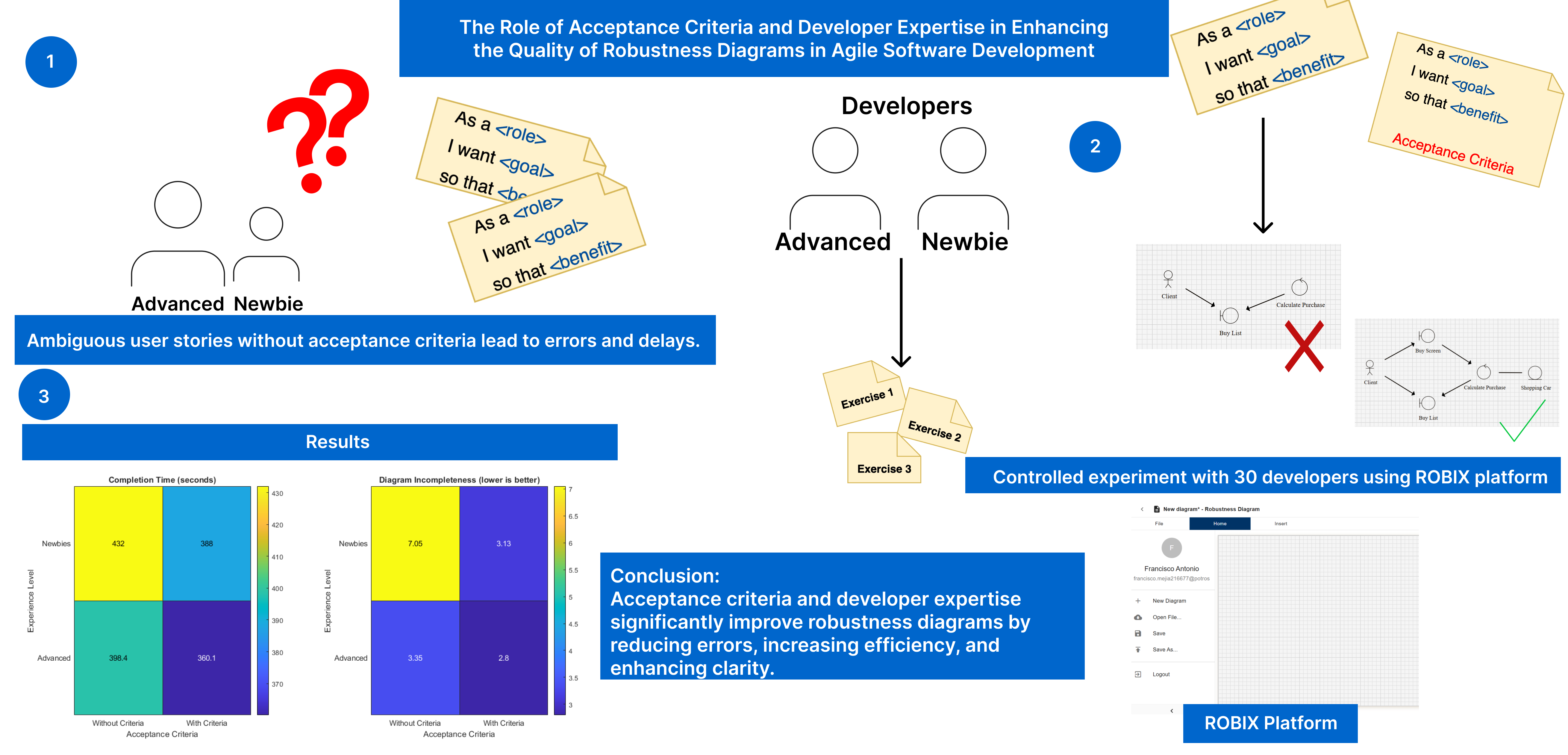
In agile software development, user stories are a common tool for capturing functional requirements, valued for their simplicity and user-centric approach. Nevertheless, their inherent informality can introduce ambiguity, especially when acceptance criteria are lacking or poorly defined. Such ambiguity may hinder early design activities, including the development of UML robustness diagrams. This study investigates the impact of acceptance criteria and developer experience on the accuracy and efficiency of robustness diagram construction.
A controlled experiment was conducted with thirty participants, divided into newbie and advanced developers, who were tasked with creating robustness diagrams from user stories both with and without acceptance criteria. Performance was assessed based on task duration and diagram completeness. Statistical analysis (Mann-Whitney U test) revealed that acceptance criteria significantly reduce errors and improve completion times, particularly among newbie developers. Experienced developers consistently produced higher-quality diagrams more efficiently, underscoring the role of expertise as a moderating factor.
The findings suggest that well-specified acceptance criteria mitigate ambiguity, facilitating more accurate requirements interpretation and improving early design outcomes. Additionally, the results highlight the value of structured requirement practices in agile methodologies, especially in teams with varying levels of experience. This research advances the understanding of how requirement clarity and developer expertise collectively influence software modeling, providing actionable recommendations for enhancing agile design processes.
Downloads
References
R. Klimek and P. Szwed, “Formal analysis of use case diagrams,” Computer Science, vol. 11, p. 115, 2013. [Online]. Available: https://doi.org/10.7494/csci.2010.11.0.115
J. A. R. Castillo and J. A. Malinao, “Model decomposition of robustness diagram with loop and time controls to petri net with considerations on resets,” in ITS 2024, Springer, 2024, pp. 193–201. [Online]. Available: https://doi.org/10.1007/978-3-031-63031-6_17
N. Seyff, F. Graf, and N. A. M. Maiden, “End-user requirements blogging with irequire,” in 2010 18th IEEE International Requirements Engineering Conference, 2010. [Online]. Available: https://doi.org/10.1109/RE.2010.35
G. Lucassen, F. Dalpiaz, and J. M. van der Werf, “Improving agile requirements: The case for user stories,” Requirements Engineering, vol. 21, no. 4, pp. 447–465, 2016. [Online]. Available: https://doi.org/10.1007/s00766-015-0232-7
V. Mahnič, “Planning user stories in agile software development,” Journal of Systems and Software, vol. 85, no. 11, pp. 2521–2532, 2012. [Online]. Available: https://doi.org/10.1016/j.jss.2012.05.018
R. Hoda, N. Salleh, and J. Grundy, “The rise and evolution of agile software development,” IEEE Software, vol. 35, no. 5, pp. 58–63, 2018. [Online]. Available: https://doi.org/10.1109/MS.2018.290111318
S. Fatima, U. Maqbool, and G. Rasool, “Improving software requirements reasoning by novices: A story-based approach,” IET Software, vol. 13, no. 6, pp. 546–556, 2019. [Online]. Available: https://doi.org/10.1049/iet-sen.2018.5379
F. Gilson, M. Galster, and F. Georis, “Generating use case scenarios from user stories,” in International Conference on Software and System Processes (ICSSP ’20), New York, NY, USA: ACM, Oct. 2020, pp. 10–11. [Online]. Available: https://doi.org/10.1145/3379177.3388895
S. Natarajan, M. Gunathilake, and P. Hettiarachchi, “Generating UML use case models from software requirements using natural language processing,” in 2019 ICACSIS, 2019, pp. 77–82. [Online]. Available: https://doi.org/10.1109/ICMSAO.2019.8880431
G. Borrego, A. L. Morán, R. R. Palacio, A. Vizcaíno, and F. O. García, “Towards a reduction in architectural knowledge vaporization during agile global software development,” Information and Software Technology, vol. 111, pp. 101–115, 2019. [Online]. Available: https://doi.org/10.1016/j.infsof.2019.04.008
S. Sonnentag, C. Niessen, and J. Volmer, “Expertise in software design,” in Handbook of Software Engineering and Knowledge Engineering, 2006, pp. 373–387. [Online]. Available: https://doi.org/10.1017/CBO9780511816796.021
J. S. Edwards, “Managing software engineers and their knowledge,” in Managing Software Engineering Knowledge, Berlin, Heidelberg: Springer Berlin Heidelberg, 2003, pp. 5–27. [Online]. Available: https://doi.org/10.1007/978-3-662-05129-0_1
D. Hallmann, “I don’t understand!: Toward a model to evaluate the role of user story quality,” in Agile Processes in Software Engineering and Extreme Programming, pp. 103–112, 2020. [Online]. Available: https://doi.org/10.1007/978-3-030-49392-9_7
X. Wang, K. Conboy, and O. Cawley, “Leagility in information systems development: An analysis based on agility and lean concepts,” Communications of the Association for Information Systems, vol. 30, no. 1, pp. 67–83, 2012. [Online]. Available: https://doi.org/10.17705/1CAIS.03009
S. Huang and S. Tilley, “Towards a documentation maturity model,” in Proceedings of the 21st Annual International Conference on Documentation, 2003, pp. 93–99. [Online]. Available: https://doi.org/10.1145/944868.944888
F. A. M. Domínguez, B. R. C. Esquer, R. R. P. Cinco, G. Borrego, and M. A. Q. García, “Evaluation of the robix UML web modeler: Assessing the level of usability,” in 2023 12th International Conference On Software Process Improvement (CIMPS), Cuernavaca, Morelos, Mexico, 2023, pp. 61–64. [Online]. Available: https://doi.org/10.1109/CIMPS61323.2023.10528815
F. F. J. Münch, “Developer experience: Concept and definition,” in 2012 ICSSP, 2012, pp. 73–77. [Online]. Available: https://doi.org/10.1109/ICSSP.2012.6225984
D. Zowghi and V. Gervasi, “The three Cs of requirements: Consistency, completeness, and correctness,” in Proceedings of the 8th International Workshop on Requirements Engineering: Foundation for Software Quality (REFSQ 2003), Apr. 2003.
C. Lange and M. Chaudron, “An empirical assessment of completeness in UML designs,” in 26th International Conference on Software Engineering, 2004. [Online]. Available: https://doi.org/10.1049/ic:20040404
M. Cohn, User Stories Applied: For Agile Software Development. Addison-Wesley Professional, 2004.
C. Wohlin, P. Runeson, M. Höst, M. C. Ohlsson, B. Regnell, and A. Wesslén, Experimentation in Software Engineering. Berlin, Heidelberg: Springer, 2024. ISBN: 978-3-662-69306-3. [Online]. Available: https://doi.org/10.1007/978-3-662-69306-3