Radio Coverage Analysis of a 4G Network in Ambato's Center
Keywords:
Mobile communication systems, Radio wave propagation, Radio signals, Wireless networks, Urban environment, Quality of service, SimulationAbstract
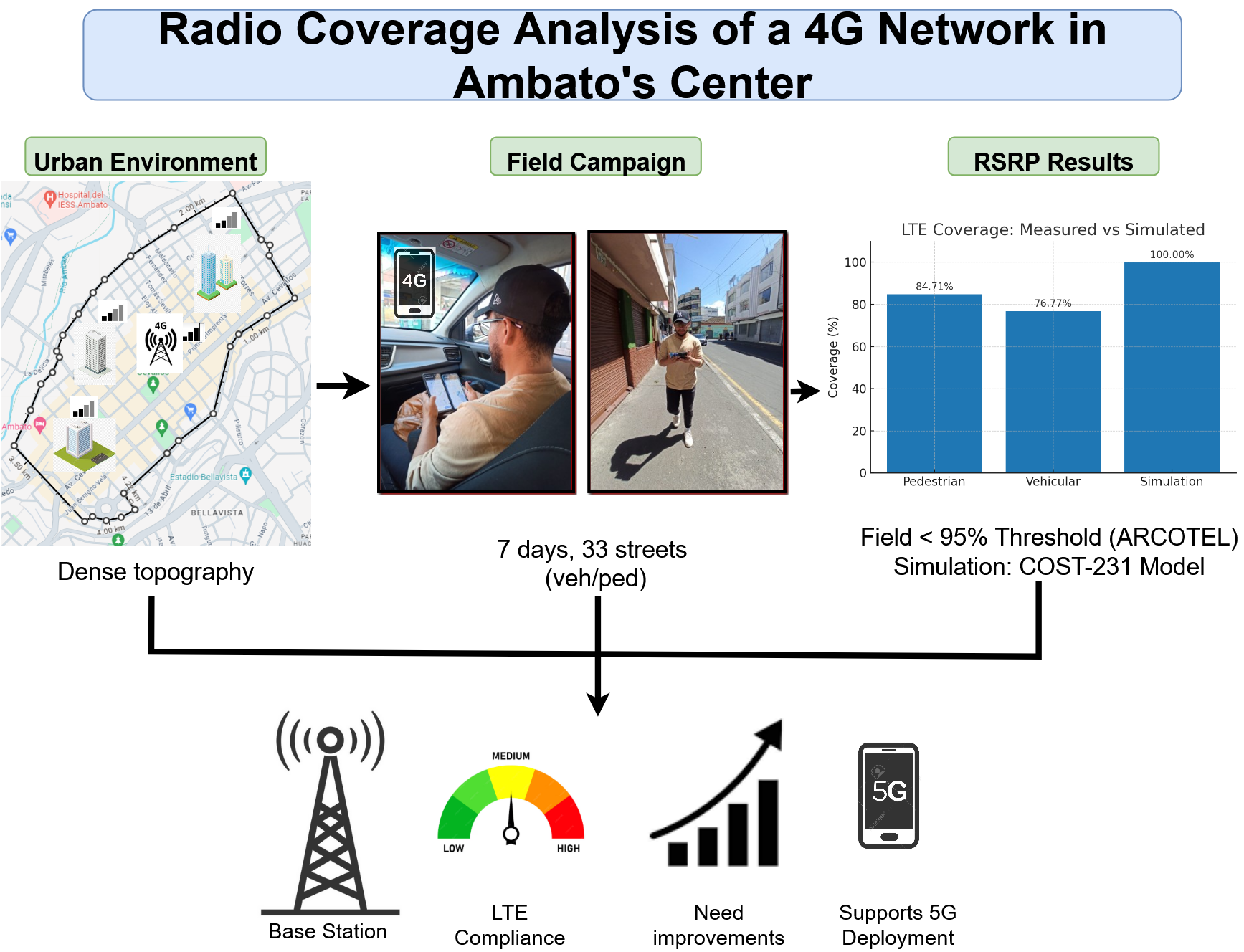
This study presents a radio coverage analysis of the 4G LTE network operated by Ecuador’s National Telecommunications Corporation (CNT) in Ambato’s Historic Center, a dense urban area with complex topography. Over a sevenday period, field measurements of the Reference Signal Received Power (RSRP) were collected along 13 primary and 19 secondary streets using two mobile devices—one mid-range and one lowend—equipped with the Network Cell Info Lite application. Both pedestrian and vehicular scenarios were evaluated, and compliance with the regulatory parameter SMA-QoS-9, established by Ecuador’s Telecommunications Regulation and Control Agency (ARCOTEL), was assessed based on minimum power (≥ −100 dBm) and location coverage (≥ 95%). Results revealed that measured coverage fell below the regulatory threshold, with average compliance levels of 84.71% for pedestrian data and 76.77% for vehicular data, while simulated results based on official base station parameters reached 100% coverage. A 2.43 dB discrepancy in RSRP was observed between pedestrian and vehicular measurements, attributed to Doppler effects, signal obstruction, and multipath propagation. The proposed low-cost and accessible methodology is shown to be effective for in assessing real-world LTE performance, enabling operators and regulators to identify critical coverage gaps and calibrate network simulators. These findings support service improvement strategies and provide a foundation for efficient 5G NR deployment in similar urban environments.
Downloads
References
S. Grau, “Medici´on y an´alisis de las redes de comunicaciones m´oviles 4g lte en cullera,” pp. 1–10, 2019, Trabajo de Titulaci´on. [Online]. Available: https://riunet.upv.es/bitstreams/99557135- a60a- 4b46- a639-e7356ddca06a/download.
MINTEL, Plan de servicio universal 2022-2025, Plan Anual, 2022. [Online]. Available: https://www.telecomunicaciones.gob.ec/wp-content/uploads/2022/06/Plan-de-Servicio-Universal-signed-signed-signed-signed-signed.pdf
ARCOTEL, Boletín Estadístico No. 2020-01, Boletín No. 2020-01, Dec. 2019. [Online]. Available: https://www.arcotel.gob.ec/wp-content/uploads/2015/01/boletin-febrero-2020-.pdf
D. Echeverría, “El teletrabajo y su aplicación en la emergencia de la COVID-19: Los desafíos y oportunidades en torno a su regulación,” Cálamo, vol. 14, pp. 65–82, 2020, ISSN: 1390-8863. DOI: https://doi.org/10.61243/calamo.14.142
L. Pazmiño, F. Flores, F. Becerra, G. Cevallos, and R. Rivera, “Challenges and Opportunities of 5G Deployment in Ecuador (extended version),” Kalpa Publications in Computing, vol. 15, pp. 58–70, 2023, Proceedings of The 2022 International Conference on Digital Transformation and Innovation Technology, ISSN: 2515-1762. DOI: https://doi.org/10.29007/d4tj
N. Makris, T. Korakis, V. Maglogiannis, et al., “A Platform for 4G/5G Wireless Networking Research, Targeting the Experimentally-Driven Research Approach,” in Sep. 2022, pp. 111–153, ISBN: 9781003337447. DOI: 10.1201/9781003337447-6
M. D. Mauro and A. Liotta, “An Experimental Evaluation and Characterization of VoIP over an LTE-A Network,” IEEE Transactions on Network and Service Management, vol. 17, pp. 1626–1639, 3 Sep. 2020, ISSN: 19324537. DOI: 10.1109/TNSM.2020.2995505
ARCOTEL, Infraestructura y Cobertura. Servicio Móvil Avanzado, Boletín N° 2020-02, May 2020. [Online]. Available: https://www.arcotel.gob.ec/wp-content/uploads/2015/01/BoletinEstadistico-May2020-SMACoberturaInfraestructura.pdf
A. Flores, H. Moreno, J. Ribadeneira, and D. Moreno, “Análisis comparativo de modelos de propagación en la telefonía móvil en la banda de 1900 MHz (LTE) a través de mediciones de campo eléctrico en la ciudad de Ambato,” MASKAY, vol. 13, pp. 1–8, 2 Apr. 2023. DOI: 10.24133/maskay.v13i2.2899
P. A. Fadhila and M. I. Nashiruddin, “Planning Simulation Analysis of 4G LTE-Advanced Mobile Network Deployment Using 2100 MHz Frequency Spectrum in Dense Urban Area: Case Study in Central Jakarta,” in Proceedings - 2021 IEEE Asia Pacific Conference on Wireless and Mobile (APWiMob 2021), Bandung, Indonesia: IEEE, Apr. 2021, pp. 8–14, ISBN: 9781728194752. DOI: 10.1109/APWiMob51111.2021.9435227
S. Shetty, S. Lacković, and S. Z. Pilinsky, “4G Coverage Analysis of Croatian Main Roads,” in 2017 International Symposium ELMAR, Zadar, Croatia, 2017, pp. 129–132. DOI: 10.23919/ELMAR.2017.8124451
J. Cao, M. Ma, H. Li, Y. Zhang, and Z. Luo, “A survey on security aspects for LTE and LTE-A networks,” IEEE Communications Surveys and Tutorials, vol. 16, pp. 283–302, 1 Mar. 2014, ISSN: 1553877X. DOI: 10.1109/SURV.2013.041513.00174
F. Krasniqi, A. Maraj, and E. Blaka, “Performance analysis of mobile 4G/LTE networks,” in 2018 South-Eastern European Design Automation, Computer Engineering, Computer Networks and Society Media Conference (SEEDA CECNSM), Kastoria, Greece, 2018, pp. 1–5. DOI: 10.23919/SEEDA-CECNSM.2018.8544937
A. Stafecka, A. Lizunovs, and V. Bobrovs, “Mobile LTE network signal and Quality of Service parameter evaluation from end-user premises,” in 2018 Advances in Wireless and Optical Communications (RTUWO), Riga, Latvia, 2018, pp. 209–212. DOI: 10.1109/RTUWO.2018.8587890
A. Gómez-Andrades, R. Barco, and I. Serrano, “A method of assessment of LTE coverage holes,” Eurasip Journal on Wireless Communications and Networking, vol. 2016, 1 Dec. 2016, ISSN: 16871499. DOI: 10.1186/s13638-016-0733-y
D. Micheli and R. Diamanti, “Statistical Analysis of Interference in a Real LTE Access Network by Massive Collection of MDT Radio Measurement Data from Smartphones,” in 2019 Photonics and Electromagnetics Research Symposium — Spring (PIERS — SPRING), Rome, Italy, Jun. 2019, pp. 1906–1916. DOI: 10.1109/PIERS-Spring46901.2019.9017353
H. Khzaali, J. Zec, and I. Kostanic, “Repeatability of Reference Signal Received Power Measurements in LTE Networks,” in 2018 International Conference on Wireless Communications, Signal Processing and Networking (WiSPNET), Chennai, India: IEEE, 2018, pp. 1–6. DOI: 10.1109/WiSPNET.2018.8538631
A. Gualli, L. Borja, A. Yanqui, and A. Leon, “Comparative Analysis Between LTE RSRP Measurements and Propagation Models in Open Area Over 2800 m.a.s.l in Riobamba-Ecuador,” Communications in Computer and Information Science, vol. 1937, pp. 391–405, Dec. 2024. DOI: 10.1007/978-3-031-48930-3_30
J. A. Aldhaibani, A. Yahya, and R. B. Ahmab, “Improvement of relay link capacity in a multi-hop system by using a directional Antenna in LTE-A cellular network,” PRZEGLĄD ELEKTROTECHNICZNY, vol. 89, pp. 195–201, 2013, ISSN: 0033-2097
S. Samaniego, D. Faubla, A. Bravo, and P. Romero, “Virtual Mapping of the LTE Signal at the Open Areas of the Department of Sciences of the ESPOCH,” in 2023 IEEE International Conference on Signal Processing, Communications and Computing (ICSPCC), Zhengzhou, China: IEEE, Nov. 2023, pp. 1–5, ISBN: 979-8-3503-1672-8. DOI: 10.1109/ICSPCC59353.2023.10400252
La Hora, Municipio intenta recuperar el centro histórico de Ambato, Newspaper article, Ambato, Ecuador, Jul. 2022
C. Murillo and C. Wilfredo, “Uso de las aplicaciones para dispositivos móviles en el proceso de enseñanza-aprendizaje de la cinemática en educación media,” [Online], Master Thesis, Universidad Nacional de Colombia, Bogotá, Colombia, 2015. [Online]. Available: https://repositorio.unal.edu.co/handle/unal/56390
G. M. Putra, E. Budiman, Y. Malewa, D. Cahyadi, M. Taruk, and U. Hairah, “4G LTE Experience: Reference Signal Received Power, Noise Ratio and Quality,” in 3rd 2021 East Indonesia Conference on Computer and Information Technology (EIConCIT 2021), Surabaya, Indonesia: IEEE, Apr. 2021, pp. 139–144, ISBN: 9781665405140. DOI: 10.1109/EIConCIT50028.2021.9431853
K. Michelle and C. Cartuche, “Análisis sobre la introducción y desarrollo del servicio móvil avanzado en el Ecuador: análisis de la evolución del marco legal y regulatorio del servicio móvil avanzado y los aspectos técnicos de los contratos de concesión suscritos para su prestación en el Ecuador en el período 1992–2021,” [Online], Engineering Thesis, Escuela Politécnica Nacional, Quito, Ecuador, 2022. Available: http://bibdigital.epn.edu.ec/handle/15000/23343
ARCOTEL, Resolución N° 03-03-ARCOTEL-2018, Sobre la Norma de Calidad para la Prestación de Servicio Móvil Avanzado, Mar. 2018. [Online]. Available: https://www.arcotel.gob.ec/wp-content/uploads/2018/08/Parametros-de-Calidad.pdf
B. Manzano, “Análisis de cobertura radioeléctrica para la red 4G de CNT utilizando dispositivos móviles en el centro histórico de Ambato,” [Online], Engineering Thesis, Escuela Superior Politécnica de Chimborazo, Riobamba, Ecuador, 2023. Available: https://dspace.espoch.edu.ec/items/87820264-8507-4094-bd70-7a3427f2c24d
S. Kazmierczyk, “Implementación de un Sistema de Análisis de Medidas de Cobertura en LTE mediante la herramienta Qualipoc,” [Online], Engineering Thesis, Universidad Politécnica de Madrid, Madrid, España, 2020. Available: https://oa.upm.es/57836/
G. Jaimes and G. A. Siles, “Methodology of Performance Measurement of LTE-A Networks Based on RSRP Coverage using a Mobile Application for Teaching Lab Activities,” Investigación y Desarrollo, vol. 22, pp. 135–144, 2022, ISSN: 2518-4431. DOI: https://doi.org/10.23881/idupbo.022.1-11i