CoroJA_RetinaNet: A Multiscale Attention-Guided Framework for Automated Coronary Plaque Detection in CTA Images
Keywords:
Coronary plaque detection, Coronary heart disease, Surface reconstruction, Attention mechanismAbstract
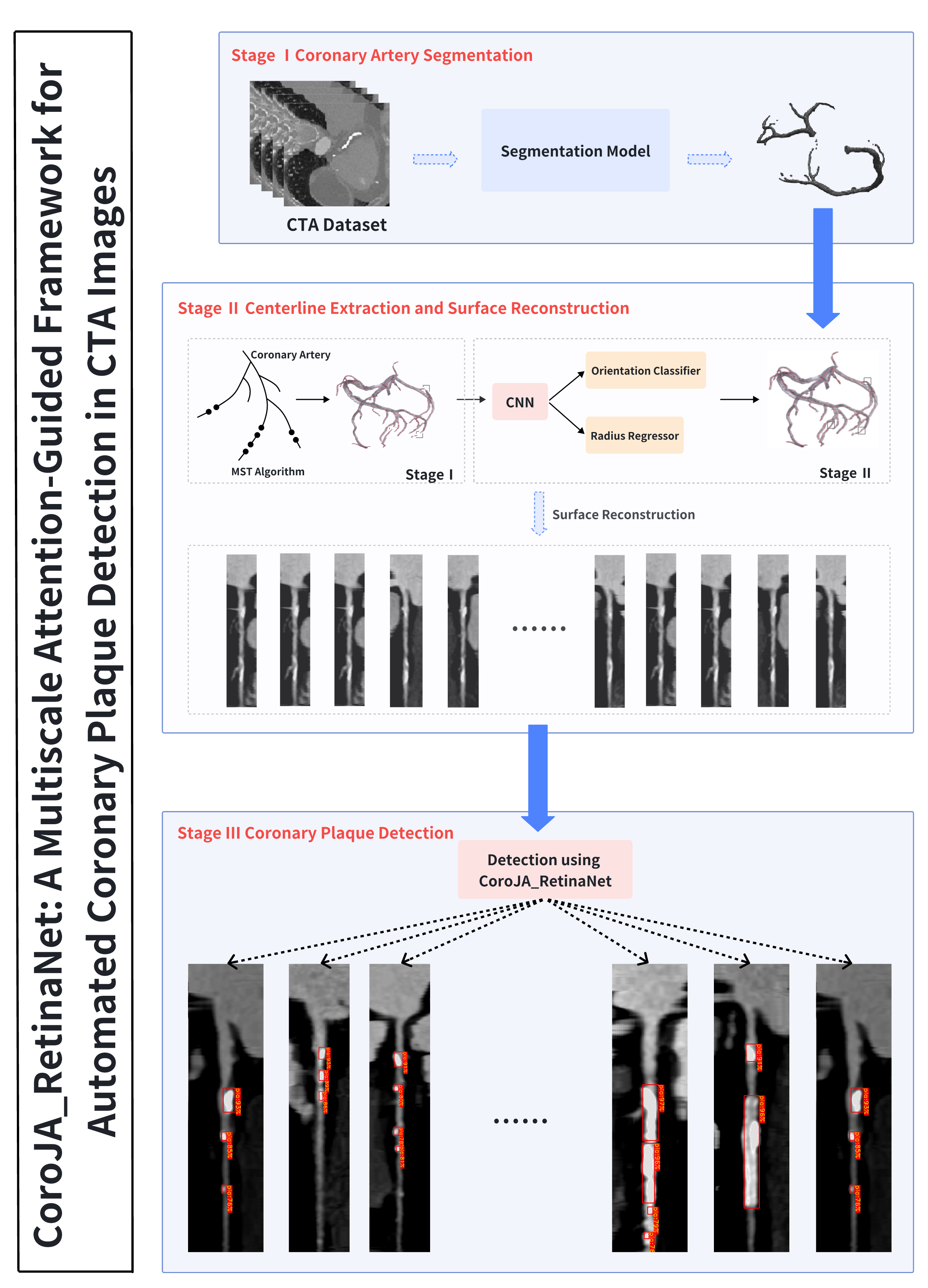
Coronary heart disease is one of the most common cardiovascular diseases. Currently, CTA imaging has become the most widely used modality for its diagnosis. The detection of coronary plaque is an important basis for accurate diagnosis. In order to further improve the accuracy and efficiency of coronary plaque detection, this study proposes a series of automatic detection methods for coronary plaque based on deep learning. The approach begins by segmenting coronary arteries using a Transformer model integrated with an multi-resolution overlapping attention mechanism, thereby reducing interference in plaque detection. Subsequently, a two-stage hybrid strategy is employed for centerline extraction and optimization, and a multi-angle straightened surface reconstruction method is proposed to generate high-quality data for plaque detection. An improved RetinaNet (CoroJA_RetinaNet) is developed, integrating an attention mechanism, enhanced feature pyramid networks, and optimized post-processing strategies. Experimental results demonstrate that the proposed method significantly improves the accuracy and efficiency of coronary plaque detection compared to traditional approaches.
Downloads
References
W. Huang, L. Huang, Z. Lin, S. Huang, Y. Chi, J. Zhou, J. Zhang, R.-S.Tan, and L. Zhong, “Coronary artery segmentation by deep learning neural networks on computed tomographic coronary angiographic images,”in 2018 40th Annual international conference of the IEEE engineering in medicine and biology society (EMBC). IEEE, 2018, pp. 608–611,doi:10.1109/EMBC.2018.8512328.
P. Feng and X. Peng, “A note on monge–kantorovich problem,” Statistics & Probability Letters, vol.84,pp. 204–211, 2014,https://doi.org/10.1016/j.spl.2013.10.011.
Z. Zhang, N. A. S. Janvekar, P. Feng, and N. BHASKAR, “Graph-based detection of abusive computational nodes,” Feb. 11 2025, uS Patent 12,223,056.
L. Sun, W. Shi, X. Tian, J. Li, B. Zhao, S. Wang, and J. Tan,“A plane stress measurement method for cfrp material based on array lcr waves,” NDT & E International, vol. 151, p. 103318, 2025, https://doi.org/10.1016/j.ndteint.2024.103318.
W. Lu, J. Wang, T. Wang, K. Zhang, X. Jiang, and H. Zhao,“Visual style prompt learning using diffusion models for blind face restoration,” Pattern Recognition, vol. 161, p. 111312, 2025,
https://doi.org/10.1016/j.patcog.2024.111312.
Y. Zhou, H. Xia, D. Yu, J. Cheng, and J. Li, “Outlier detection method based on high-density iteration,” Information Sciences, vol. 662, p.120286, 2024, https://doi.org/10.1016/j.ins.2024.120286.
H. Hao, E. Yao, L. Pan, R. Chen, Y. Wang, and H. Xiao, “Exploring heterogeneous drivers and barriers in maas bundle subscriptions based on the willingness to shift to maas in one-trip scenarios,” Transportation Research Part A: Policy and Practice, vol. 199, p. 104525, 2025,
https://doi.org/10.1016/j.tra.2025.104525.
M. J. Budoff, D. Dowe, J. G. Jollis, M. Gitter, J. Sutherland, E. Halamert,M. Scherer, R. Bellinger, A. Martin, R. Benton et al., “Diagnostic performance of 64-multidetector row coronary computed tomographic angiography for evaluation of coronary artery stenosis in individuals without known coronary artery disease: results from the prospective multicenter accuracy (assessment by coronary computed tomographic angiography of individuals undergoing invasive coronary angiography)trial,” Journal of the American College of Cardiology, vol. 52, no. 21,pp. 1724–1732, 2008, https://doi.org/10.1016/j.jacc.2008.07.031.
R. C. Cury, S. Abbara, S. Achenbach, A. Agatston, D. S. Berman,M. J. Budoff, K. E. Dill, J. E. Jacobs, C. D. Maroules, G. D. Rubin et al., “Cad-radstm coronary artery disease–reporting and data system. an expert consensus document of the society of cardiovascular computed tomography (scct), the american college of radiology (acr) and the north american society for cardiovascular imaging (nasci).
endorsed by the american college of cardiology,” Journal of cardiovascular computed tomography, vol. 10, no. 4, pp. 269–281, 2016,https://doi.org/10.1016/j.jcct.2016.04.005.
A. Arbab-Zadeh and J. Hoe, “Quantification of coronary arterial stenoses by multidetector ct angiography in comparison with conventional angiography: methods, caveats, and implications,”JACC: Cardiovascular Imaging, vol. 4, no. 2, pp. 191–202, 2011,https://doi.org/10.1016/j.jcmg.2010.10.011.
S.-C. Lo, S.-L. Lou, J.-S. Lin, M. T. Freedman, M. V. Chien, and S. K.Mun, “Artificial convolution neural network techniques and applications for lung nodule detection,” IEEE transactions on medical imaging,vol. 14, no. 4, pp. 711–718, 1995, doi: 10.1109/42.476112.
X. Nie, B. Chai, K. Zhang, C. Liu, Z. Li, R. Huang, Q. Wei,M. Huang, and W. Huang, “Improved cascade-rcnn for automatic detection of coronary artery plaque in multi-angle fusion cpr images,”Biomedical Signal Processing and Control, vol. 99, p. 106880, 2025, https://doi.org/10.1016/j.bspc.2024.106880.
M. M. Jawaid, A. Riaz, R. Rajani, C. C. Reyes-Aldasoro, andG. Slabaugh, “Framework for detection and localization of coronary non-calcified plaques in cardiac cta using mean radial profiles,” Computers in biology and medicine, vol. 89, pp. 84–95, 2017,
https://doi.org/10.1016/j.compbiomed.2017.07.021.
A. Abdolmanafi, L. Duong, R. Ibrahim, and N. Dahdah, “A deep learning-based model for characterization of atherosclerotic plaque in coronary arteries using optical coherence tomography images,” Medical Physics, vol. 48, no. 7, pp. 3511–3524, 2021,https://doi.org/10.1002/mp.14909.
X. Nie, Z. Yan, Q. Wei, B. Chai, M. Huang, L. Li, H. Dang, and Y. Liu, “Attention res-unet for coronary cpr image stenosis assessment,”in Seventh International Conference on Intelligent Medicine and Image Processing (IMIP 2025), vol. 13658. SPIE, 2025, pp. 66–75,https://doi.org/10.1117/12.3071669.
O. Petit, N. Thome, C. Rambour, L. Themyr, T. Collins, and L. Soler,“U-net transformer: Self and cross attention for medical image segmentation,” in Machine Learning in Medical Imaging: 12th International Workshop, MLMI 2021, Held in Conjunction with MICCAI 2021,Strasbourg, France, September 27, 2021, Proceedings 12. Springer,2021, pp. 267–276, https://doi.org/10.1007/978-3-030-87589-3 28.
X. Huang, Z. Deng, D. Li, and X. Yuan, “Missformer: An effective medical image segmentation transformer,” arXiv preprint arXiv:2109.07162,2021, https://doi.org/10.48550/arXiv.2109.07162.
H. Zhao, J. Shi, X. Qi, X. Wang, and J. Jia, “Pyramid scene parsing network,” in Proceedings of the IEEE conference on computer vision and pattern recognition, 2017, pp. 2881–2890, doi:10.1109/CVPR.2017.660.
H. Du, J. Wang, M. Liu, Y. Wang, and E. Meijering, “Swinpa-net: Swin transformer-based multiscale feature pyramid aggregation network for medical image segmentation,” IEEE Transactions on Neural Networks and Learning Systems, vol. 35, no. 4, pp. 5355–5366, 2022, doi:10.1109/TNNLS.2022.3204090.
Q. Cai, R. Chen, L. Li, C. Huang, H. Pang, Y. Tian, M. Di, M. Zhang,M. Ma, D. Kong et al., “The application of knowledge distillation toward fine-grained segmentation for three-vessel view of fetal heart ultrasound images,” Computational Intelligence and Neuroscience, vol. 2022, no. 1,p. 1765550, 2022, https://doi.org/10.1155/2022/1765550.
B. Murugesan, S. Vijayarangan, K. Sarveswaran, K. Ram, and M. Sivaprakasam, “Kd-mri: A knowledge distillation framework for image reconstruction and image restoration in mri workflow,” in Medical imaging with deep learning. PMLR, 2020, pp. 515–526, https://proceedings.mlr.press/v121/murugesan20a.html.
G. Hinton, O. Vinyals, and J. Dean, “Distilling the knowledge in a neural network,” arXiv preprint arXiv:1503.02531, 2015,https://doi.org/10.48550/arXiv.1503.02531.
L. Zhao, X. Qian, Y. Guo, J. Song, J. Hou, and J. Gong, “Mskd: Structured knowledge distillation for efficient medical image segmentation,” Computers in Biology and Medicine, vol. 164, p. 107284, 2023,https://doi.org/10.1016/j.compbiomed.2023.107284.
Y. Choi, M. A. Al-Masni, K.-J. Jung, R.-E. Yoo, S.-Y. Lee, and D.-H. Kim, “A single stage knowledge distillation network for brain tumor segmentation on limited mr image modalities,” Computer Methods and Programs in Biomedicine, vol. 240, p. 107644, 2023, doi:10.1016/j.cmpb.2023.107644.
J. Han, D. Zhang, G. Cheng, N. Liu, and D. Xu, “Advanced deeplearning techniques for salient and category-specific object detection: a survey,” IEEE Signal Processing Magazine, vol. 35, no. 1, pp. 84–100,2018, doi: 10.1109/MSP.2017.2749125.
J. M. Wolterink, R. W. van Hamersvelt, M. A. Viergever, T. Leiner, and I. Isgum, “Coronary artery centerline extraction in cardiac ct angiogra- ˇphy using a cnn-based orientation classifier,” Medical image analysis,vol. 51, pp. 46–60, 2019, https://doi.org/10.1016/j.media.2018.10.005.
G. Xu, H. Cao, J. K. Udupa, Y. Tong, and D. A. Torigian,“Disegnet: A deep dilated convolutional encoder-decoder architecture for lymph node segmentation on pet/ct images,” Computerized Medical Imaging and Graphics, vol. 88, p. 101851, 2021,https://doi.org/10.1016/j.compmedimag.2020.101851.
H. Yang, X. Zhen, Y. Chi, L. Zhang, and X.-S. Hua, “Cpr-gcn: conditional partial-residual graph convolutional network in automated anatomical labeling of coronary arteries,” in Proceedings of the IEEE/CVF conference on computer vision and pattern recognition, 2020, pp. 3803–3811, doi: 10.1109/CVPR42600.2020.00386.
Y. Wang, W. Zhou, T. Jiang, X. Bai, and Y. Xu, “Intra-class feature variation distillation for semantic segmentation,” in Computer Vision–ECCV 2020: 16th European Conference, Glasgow, UK, August 23–28, 2020, Proceedings, Part VII 16. Springer, 2020, pp. 346–362,https://doi.org/10.1007/978-3-030-58571-6_21.
A. Tejero-de Pablos, H. Yamane, Y. Kurose, J. Iho, Y. Tokunaga,M. Horie, K. Nishizawa, Y. Hayashi, Y. Koyama, and T. Harada,“Improving segmentation of calcified and non-calcified plaques on ccta-cpr scans via masking of the artery wall,” in Medical Imaging 2023:Computer-Aided Diagnosis, vol. 12465. SPIE, 2023, pp. 460–468,https://doi.org/10.1117/12.2652895.
Z. Gao, L. Wang, R. Soroushmehr, A. Wood, J. Gryak, B. Nallamothu, and K. Najarian, “Vessel segmentation for x-ray coronary angiography using ensemble methods with deep learning and filter based features,” BMC Medical Imaging, vol. 22, no. 1, p. 10, 2022,https://doi.org/10.1186/s12880-022-00734-4.
S. Ren, K. He, R. Girshick, and J. Sun, “Faster r-cnn: Towards real-time object detection with region proposal networks,” IEEE transactions on pattern analysis and machine intelligence, vol. 39, no. 6, pp. 1137–1149,2016, doi: 10.1109/TPAMI.2016.2577031.
Y. Luo, X. Cao, J. Zhang, P. Cheng, T. Wang, and Q. Feng, “Dynamic multi-scale loss optimization for object detection,” Multimedia Tools and Applications, vol. 82, no. 2, pp. 2349–2367, 2023,https://doi.org/10.1007/s11042-022-13164-9.
D. Zhang and H. Ma, “Yolodcc: Improved yolov8 combined with dynamic confidence compensation for lightweight moving object detection,” IET Image Processing, vol. 18, no. 12, pp. 3699–3715, 2024,https://doi.org/10.1049/ipr2.13207.
T.-Y. Lin, P. Dollar, R. Girshick, K. He, B. Hariharan, and S. Belongie, ´“Feature pyramid networks for object detection,” in Proceedings of the IEEE conference on computer vision and pattern recognition, 2017, pp.2117–2125, doi: 10.1109/CVPR.2017.106.
R. Li, M. Li, J. Li, and Y. Zhou, “Connection sensitive attention u-net for accurate retinal vessel segmentation,” arXiv preprint arXiv:1903.05558,2019, https://doi.org/10.48550/arXiv.1903.05558.
S. Woo, J. Park, J.-Y. Lee, and I. S. Kweon, “Cbam: Convolutional block attention module,” in Proceedings of the European conference on computer vision (ECCV), 2018, pp. 3–19.
R. Gu, G. Wang, T. Song, R. Huang, M. Aertsen, J. Deprest, S. Ourselin,T. Vercauteren, and S. Zhang, “Ca-net: Comprehensive attention convolutional neural networks for explainable medical image segmentation,”IEEE transactions on medical imaging, vol. 40, no. 2, pp. 699–711,2020, doi: 10.1109/TMI.2020.3035253.
Z. Jiang, C. Ou, Y. Qian, R. Rehan, and A. Yong, “Coronary vessel segmentation using multiresolution and multiscale deep learning,” Informatics in Medicine Unlocked, vol. 24, p. 100602, 2021,https://doi.org/10.1016/j.imu.2021.100602.
H. Rezatofighi, N. Tsoi, J. Gwak, A. Sadeghian, I. Reid, and S. Savarese,“Generalized intersection over union: A metric and a loss for bounding box regression,” in Proceedings of the IEEE/CVF conference on computer vision and pattern recognition, 2019, pp. 658–666, doi:10.1109/CVPR.2019.00075.
Y. Gong, X. Yu, Y. Ding, X. Peng, J. Zhao, and Z. Han, “Effective fusion factor in fpn for tiny object detection,” in Proceedings of the IEEE/CVF winter conference on applications of computer vision, 2021,pp. 1160–1168, doi: 10.1109/WACV48630.2021.00120.
R. B. Girshick, “Rich feature hierarchies for accurate object detection and semantic segmentation,” in Proceedings of the IEEE Conference on Computer Vision and Pattern Recognition (CVPR). Columbus, OH,USA: IEEE, 2014, pp. 580–587, doi: 10.1109/CVPR.2014.81.
R. Girshick, “Fast r-cnn,” in Proceedings of the IEEE international conference on computer vision, 2015, pp. 1440–1448, doi:10.1109/TPAMI.2016.2577031.
G. Jocher, “Yolov5: The next generation of object detection,” https://github.com/ultralytics/yolov5, 2020, accessed: 2025-04-14.
K. Duan, S. Bai, L. Xie, H. Qi, Q. Huang, and Q. Tian, “Centernet:Keypoint triplets for object detection,” in Proceedings of the IEEE/CVF international conference on computer vision, 2019, pp. 6569–6578, doi:10.1109/ICCV.2019.00667.