Design and Implementation of an IIoT-based Monitoring System for a Remote Radio Astronomy Station: The CASIRI Case Study
Keywords:
Data Monitoring, Education, Industrial Internet of Things, Industry 4.0, Radio Astronomy StationAbstract
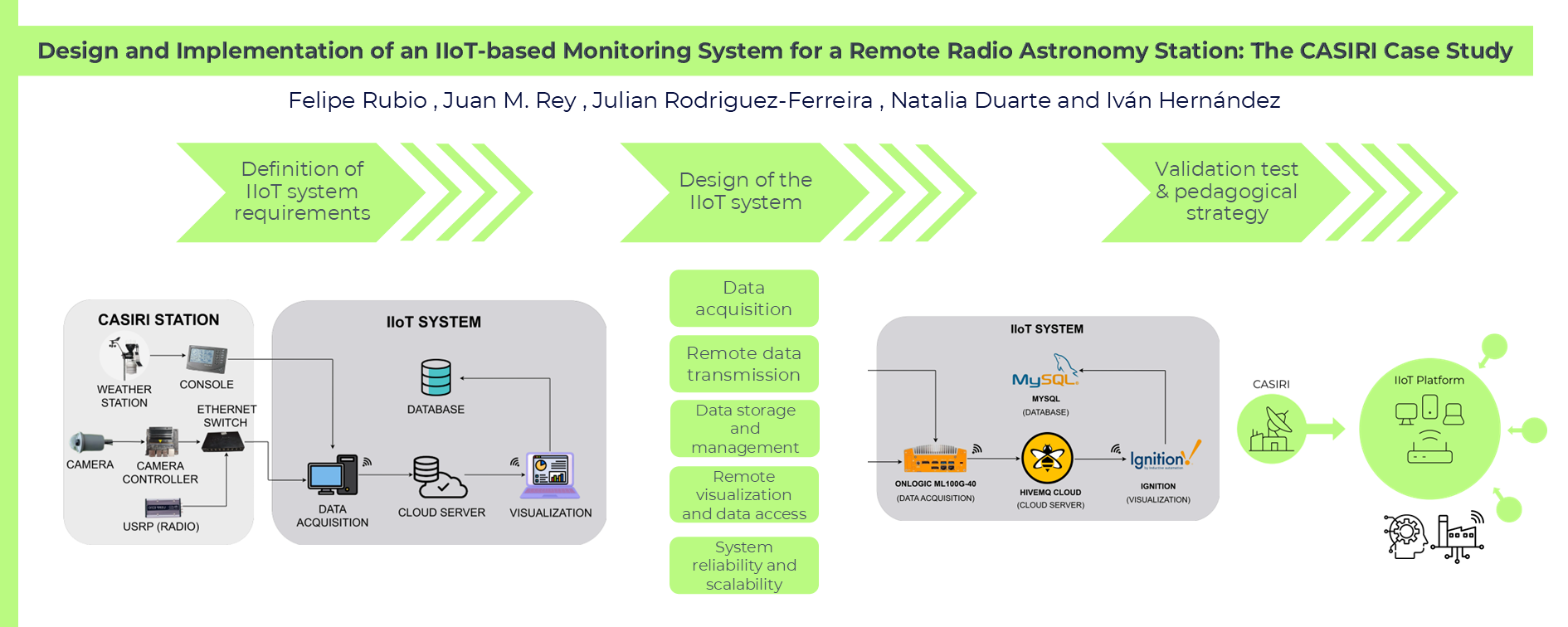
Industry 4.0 has progressed rapidly due to advances in the Internet of Things (IoT), which have significantly reduced implementation costs while enhancing technological capabilities. These developments have fostered the emergence of the Industrial Internet of Things (IIoT), particularly within scientific and industrial domains. In response to the growing demand for skilled professionals in this field, this paper presents the design and implementation of an IIoT-based monitoring system for the CASIRI radio astronomy station, a mobile platform used to characterize potential sites for radio observatories in Colombia and Antarctica. The proposed system is integrated into a broader IIoT platform designed to support both operational monitoring and educational activities. The IIoT solution features real-time data acquisition, robust hardware and software components, and reliable communication protocols within a modular and scalable architecture. Its performance and component interoperability were validated through a series of experimental tests under simulated conditions. Additionally, this work introduces educational guides to facilitate hands-on training in Fourth Industrial Revolution technologies.
Downloads
References
P. N. Stearns, “The industrial revolution in world history,” p. 1 – 318, 2018, 10.4324/9780429494475.
L. Volf, G. Dohnal, L. Beranek, and J. Kyncl, “Navigating the fourth industrial revolution: SBRI – a comprehensive digital maturity assessment tool and road to Industry 4.0 for small manufacturing enterprises,” Manufacturing Technology, vol. 24, no. 4, p. 668 – 680, 2024, 110.21062/mft.2024.074.
R. Drath and A. Horch, “Industry 4.0: Hit or hype? [industry forum],”IEEE Industrial Electronics Magazine, vol. 8, no. 2, pp. 56–58, 2014, 10.1109/MIE.2014.2312079.
Y. Liao, E. de Freitas Rocha Loures, and F. Deschamps, “Industrial internet of things: A systematic literature review and insights,” IEEE Internet of Things Journal, vol. 5, no. 6, pp. 4515–4525, 2018, 10.1109/JIOT.2018.2834151.
B. Dorsemaine, J.-P. Gaulier, J.-P. Wary, N. Kheir, and P. Urien, “Internet of things: A definition taxonomy,” in 2015 9th Int. Conf. on Next Generation Mobile App., Services and Tech., 2015, pp. 72–77, 10.1109/NGMAST.2015.71.
L. D. Xu, W. He, and S. Li, “Internet of things in industries: A survey,” IEEE Trans. Industrial Informatics, vol. 10, no. 4, pp. 2233–2243, 2014, 10.1109/TII.2014.2300753.
R. Minerva, A. Biru, and D. Rotondi, “Towards a definition of the internet of things (IoT),” IEEE Internet Initiative, vol. 1, no. 1, pp. 1–86, 2015.
S. Mumtaz, A. Alsohaily, Z. Pang, A. Rayes, K. F. Tsang, and J. Rodriguez, “Massive Internet of Things for industrial applications: Addressing wireless IIoT connectivity challenges and ecosystem fragmentation,” IEEE Industrial Electronics Magazine, vol. 11, no. 1, pp. 28–33, 2017, 10.1109/MIE.2016.2618724.
D. G. Pivoto, L. F. de Almeida, R. da Rosa Righi, J. J. Rodrigues, A. B. Lugli, and A. M. Alberti, “Cyber-physical systems architectures for industrial internet of things applications in industry 4.0: A literature review,” Journal of Manufacturing Systems, vol. 58, pp. 176–192, 2021, 10.1016/j.jmsy.2020.11.017.
E. Sisinni, A. Saifullah, S. Han, U. Jennehag, and M. Gidlund, “Industrial internet of things: Challenges, opportunities, and directions,” IEEE Trans. Industrial Informatics, vol. 14, no. 11, pp. 4724–4734, 2018, 10.1109/TII.2018.2852491.
J. Solano, I. Hernández, N. Duarte, and J. M. Rey, “Diseño, desarrollo e implementación de una plataforma IIoT para formación de profesionales
en tecnologías de la cuarta revolución industrial,” Encuentro Internacional de Educación en Ingeniería, 2021, 10.26507/ponencia.1940.
K. Cai, F. Tie, H. Huang, H. Lin, and H. Chen, “Innovative experiment platform design and teaching application of the internet of things,” Int. Journal of Online and Biomedical Eng. (iJOE), vol. 11, no. 6, p. pp. 28–32, Nov. 2015, 10.3991/ijoe.v11i6.5025.
A. Muhammad, D. Nur, M. Zakiah, F. Amar, and M. Nooriwati, “Computer assisted e-laboratory using LabVIEW and internet-of-things platform as teaching aids in the industrial instrumentation course,” Int. Journal of Online and Biomedical Eng. (iJOE), vol. 14, no. 12, p. pp. 26–42, Dec. 2018, 0.3991/ijoe.v14i12.8992.
R. Rodríguez-Calderón and R. Belmonte-Izquierdo, “Educational platform for the development of projects using internet of things,” IEEE Revista Iberoamericana de Tec. del Aprendizaje, vol. 16, no. 3, pp. 276–282, 2021, 10.1109/RITA.2021.3122971.
V. Terzieva, S. Ilchev, and K. Todorova, “The role of internet of things in smart education,” IFAC-PapersOnLine, vol. 55, no. 11, pp. 108–113, 2022, iFAC Workshop on Control for Smart Cities CSC 2022.
M. Al-Emran, S. I. Malik, and M. N. Al-Kabi, A Survey of Internet of Things (IoT) in Education: Opportunities and Challenges. Cham: Springer International Publishing, 2020, pp. 197–209, 110.1007/978-3-030-24513-9_12.
M. Mircea, M. Stoica, and B. Ghilic-Micu, “Investigating the impact of the internet of things in higher education environment,” IEEE Access, vol. 9, pp. 33 396–33 409, 2021, 10.1109/ACCESS.2021.3060964.
J.-H. Cheng, H.-H. Lin, J.-H. Shen, B.-C. Chen, and Z.-L. He, “IoT training system for smart manufacturing education,” in 2020 3rd IEEE Int. Conf. on Knowledge Innovation and Invention (ICKII), 2020, pp. 182–184, 10.1109/ICKII50300.2020.9318946.
H.-P. Phan, V.-D. Vo, Q.-H. Nguyen, V.-H. Duong, and H.-H. Hoang, “Building LoRaWAN IoT kits for stem education in interdisciplinary training programs,” in 2021 6th Int. STEM Education Conf. (iSTEM-Ed), 2021, pp. 1–4, 10.1109/iSTEM-Ed52129.2021.9625146.
M. A. Akbar, M. M. Rashid, and A. H. Embong, “Technology based learning system in internet of things (IoT) education,” in 2018 7th Int. Conf. on Computer and Communication Engineering (ICCCE), 2018, pp. 192–197, 10.1109/ICCCE.2018.8539334.
P. Jacko, M. Bereš, I. Kováˇcová, J. Molnár, T. Vince, J. Dziak, B. Fecko, Gans, and D. Kováˇc, “Remote IoT education laboratory for microcontrollers based on the STM32 chips,” Sensors, vol. 22, no. 4, 2022, 10.3390/s22041440.
D. Pirrone, C. Fornaro, and D. Assante, “Open-source multipurpose remote laboratory for IoT education,” in 2021 IEEE Global Eng. Education Conf. (EDUCON), 2021, pp. 1462–1468, 10.1109/E-DUCON46332.2021.9454034.
J. Krushnan and F. Schrödel, “Development of a modern, low cost, lab scale industry 4.0 plant for education,” IFAC-PapersOnLine 13th IFAC Symp. on Advances in Control Education ACE 2022, vol. 55, no. 17, pp. 156–161, 2022, 10.1016/j.ifacol.2022.09.273.
D. Antonelli, D. M. D’Addona, A. Maffei, V. Modrak, G. Putnik, D. Stadnicka, and C. Stylios, “Tiphys: An open networked platform for higher education on industry 4.0,” Procedia CIRP, vol. 79, pp. 706–711, 2019, 12th CIRP Conf. on Intelligent Computation in Manufacturing Eng., 18-20 July 2018.
R. Pastor-Vargas, L. Tobarra, A. Robles-Gómez, S. Martin, R. Hernández, and J. Cano, “A WoT platform for supporting full-cycle IoT solutions from edge to cloud infrastructures: A practical case,” Sensors, vol. 20, no. 13, 2020, 10.3390/s20133770.
M. Nykyri, M. Kuisma, T. J. Kärkkäinen, J. Hallikas, J. Jäppinen, K. Korpinen, and P. Silventoinen, “IoT demonstration platform for education and research,” in 2019 IEEE 17th Int. Conf. on Industrial Informatics (INDIN), vol. 1, 2019, pp. 1155–1162, 10.1109/INDIN41052.2019.8972280.
J. M. Rey, J. Gómez, N. Duarte, I. Hernández, M. A. Mantilla, and O. Quiroga, “Design and validation of an IoT system for an experimental laboratory microgrid,” IEEE Latin America Transactions, vol. 23, no. 1, pp. 25–35, 2025, 10.1109/TLA.2025.10810485.
A. Amjad, F. Azam, M. W. Anwar, and W. H. Butt, “A systematic review on the data interoperability of application layer protocols in industrial IoT,” IEEE Access, vol. 9, pp. 96 528–96 545, 2021, 10.1109/ACCESS.2021.3094763.