Machine Learning Assisted mm-Wave MIMO Antenna Design with High Isolation for 5G Applications
Keywords:
Decision Tree, Gradient Boosting Regressor, K-Nearest Neighbors, MAPE, MAE, MSE, Random Forest, XG-BoostAbstract
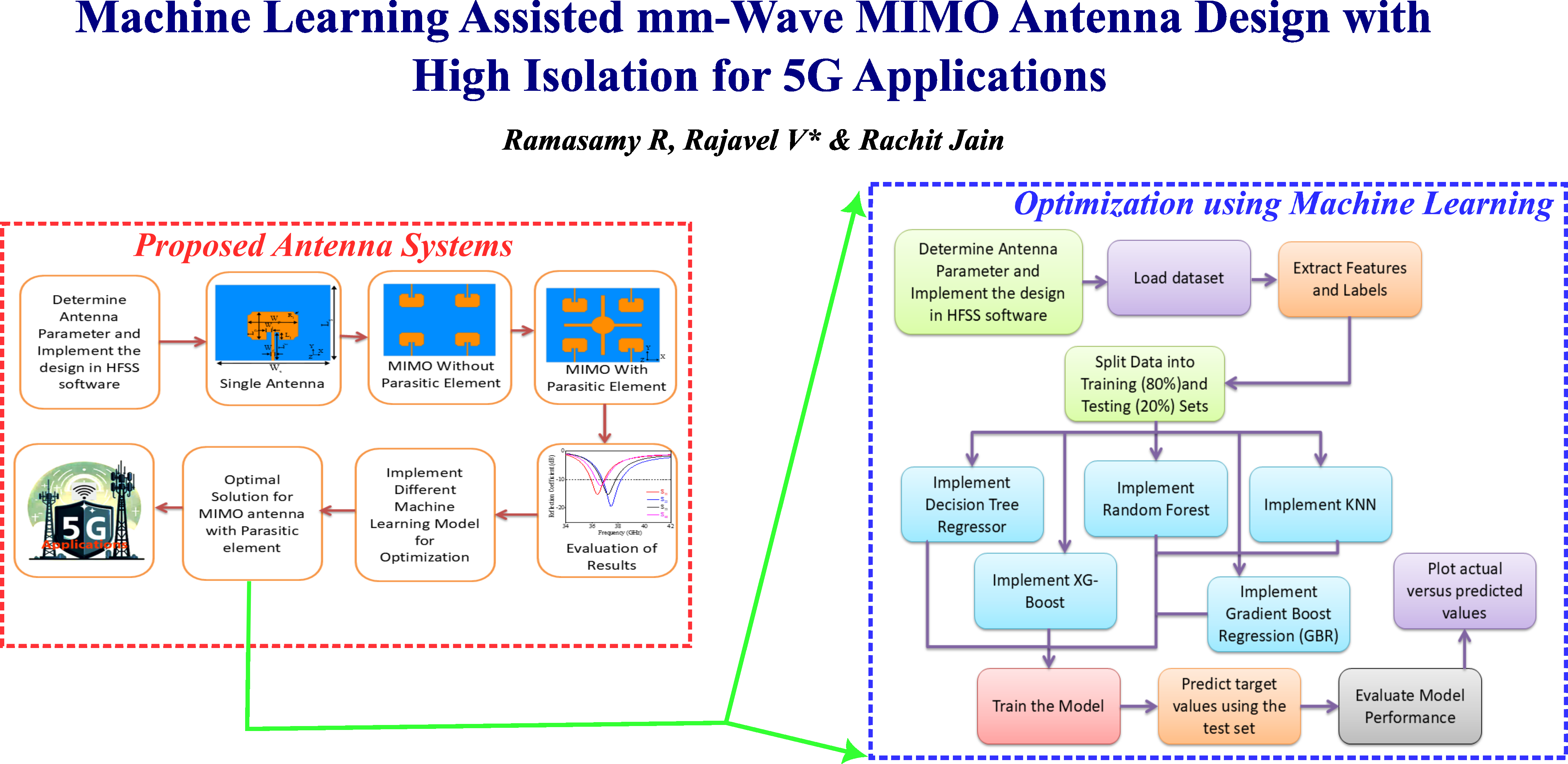
This study investigates the design and performance of millimeter-wave (mm-Wave) Multiple-Input Multiple-Output (MIMO) antennas for fifth-generation (5G) applications, with a particular focus on the consequences of incorporating a ring resonator within the antenna system. This study compares two design variations—one with a ring resonator and one without—to assess their impact on enhancing the antenna's performance characteristics. The research employs five machine learning algorithms, namely, Decision Tree, Random Forest, K-Nearest Neighbors (KNN), XG-Boost, and Gradient Boosting Regressor (GBR), to estimate return loss. Among these, the Random Forest algorithm demonstrates superior performance in terms of accuracy, Mean Squared Error (MSE), Mean Absolute Percentage Error (MAPE), Mean Absolute Error (MAE), and R-squared metrics. The proposed MIMO antenna system shows better performance in Envelope Correlation Coefficient (ECC), Diversity Gain (DG), Channel Capacity Loss (CCL) and Total Active Reflection Coefficient (TARC). The results indicate that including a ring resonator in the antenna design significantly improves the antenna's performance, and machine learning algorithms, particularly Random Forest, can effectively predict and optimize critical parameters for antenna design in 5G applications.
Downloads
References
K. Vasu Babu, S. Das, Gorre, S. K. Patel, M. Pardha Saradhi, and M.R.N. Tagore, “Design and development of miniaturized MIMO antenna using parasitic elements and Machine learning (ML) technique for lower sub 6 GHz 5G applications,” AEU - International Journal of Electronics and Communications, vol. 153, pp. 154281, Aug. 2022, doi: https://doi.org/10.1016/j.aeue.2022.154281
J. K. Rai, P. Ranjan, R. Chowdhury, and M. H. Jamaluddin, “Design and Optimization of Dual Port Dielectric Resonator Based Frequency Tunable MIMO Antenna with Machine Learning Approach for 5G New Radio Application,” International Journal of Communication Systems, vol. 37, no. 13, Jun. 2024, doi: https://doi.org/10.1002/dac.5856
Gorre, K. V. Babu, S. Das, and T. Islam, “Design and optimization of a deep learning algorithm assisted stub-loaded dual band four-port MIMO antenna for Sub-6 GHz 5G and X band satellite communication applications,” AEU - International Journal of Electronics and Communications, vol. 175, pp. 155074–155074, Dec. 2023, doi: https://doi.org/10.1016/j.aeue.2023.155074
K. V. Babu and G. N. J. Sree, “Design and Analysis of Four-Port MIMO System Optimization Methodology with Machine Learning Approaches of Validated Antenna Parameters,” Wireless Personal Communications, vol. 136, no. 1, pp. 213–232, May 2024, doi: https://doi.org/10.1007/s11277-024-11254-5
A. K. Dwivedi, S. K. Singh, P. Ranjan, A. Sharma, and V. Singh, “Machine learning assisted dual port metasurface loaded MIMO antenna with linearly polarized to circularly polarized conversion features for n257 band of 5G mm‐wave applications,” International Journal of Communication Systems, Feb. 2024, doi: https://doi.org/10.1002/dac.5737
J. K. Rai, S. Yadav, P. Ranjan, R. Chowdhury, and G. Das, “A compact quad element MIMO CPW fed ultra‐wideband antenna for future wireless communication using machine learning optimization,” International Journal of Communication Systems, Sep. 2024, doi: https://doi.org/10.1002/dac.5995
K. K. Agrawal, D. Mishra, N. K. Gaur, V. Yadav, and B. Mishra, “Machine learning driven four-elements high gain MIMO antenna for wireless connectivity,” Cluster Computing, Jun. 2024, doi: https://doi.org/10.1007/s10586-024-04613-1
A. Pandey, Akhilendra Pratap Singh, and V. Kumar, “Design and optimization of circularly polarized dielectric resonator-based MIMO antenna using machine learning for 5G Sub-6 GHz,” AEU - International Journal of Electronics and Communications, vol. 162, pp. 154558–154558, Apr. 2023, doi: https://doi.org/10.1016/j.aeue.2023.154558
H. Ahmed, X. Zeng, H. Bello, Y. Wang, and N. Iqbal, “Sub-6 GHz MIMO antenna design for 5G smartphones: A deep learning approach,” AEÜ. International journal of electronics and communications, vol. 168, pp. 154716–154716, Aug. 2023, doi: https://doi.org/10.1016/j.aeue.2023.154716
D. Sarkar, T. Khan, Jayadeva, and A. A. Kishk, “Machine Learning Assisted Hybrid Electromagnetic Modeling Framework and Its Applications to UWB MIMO Antennas,” IEEE Access, vol. 11, pp. 19645–19656, 2023, doi: https://doi.org/10.1109/access.2023.3248961.
Lahcen Sellak et al., “ANFIS-Based 4× 4 Dual Band Circular MIMO Antenna Design with Pretty-Small Size and Large Bandwidth for 5 G Millimeter-Wave Applications at 28/38 GHz,” Journal of Infrared, Millimeter, and Terahertz Waves, vol. 44, no. 7–8, pp. 551–601, Jul. 2023, doi: https://doi.org/10.1007/s10762-023-00924-3
H. Huang, X. Yang, and B. Wang, “Machine-Learning-Based Generative Optimization Method and Its Application to an Antenna Decoupling Design,” IEEE Transactions on Antennas and Propagation, vol. 71, no. 7, pp. 6243–6248, Jul. 2023, doi: https://doi.org/10.1109/tap.2023.3270716
Ajay Kumar Dwivedi, Nagesh Kallollu Narayanaswamy, K. Kanth, Suyash Kumar Singh, A. Sharma, and V. Singh, “Circularly polarized printed dual port MIMO antenna with polarization diversity optimized by machine learning approach for 5G NR n77/n78 frequency band applications,” Scientific Reports, vol. 13, no. 1, Aug. 2023, doi: https://doi.org/10.1038/s41598-023-41302-2
R. Yadav, A. Tripathi, S. Pathak, and H. Singh Gill, “5G and Beyond Networks for 3D MIMO Using Artificial Intelligence in 5G Network,” Journal of Physics: Conference Series, vol. 2273, no. 1, p. 012007, May 2022, doi: https://doi.org/10.1088/1742-6596/2273/1/012007
J. Undrakonda and R. K. Upadhyayula, “Isolation Analysis of Miniaturized Metamaterial-based MIMO Antenna for X-band Radar Applications Using Machine Learning Model,” Progress In Electromagnetics Research C, vol. 124, pp. 135–153, 2022, doi: https://doi.org/10.2528/pierc22080203
S. Hassan Ghadeer et al., “An innovative fractal monopole MIMO antenna for modern 5G applications,” AEU - International Journal of Electronics and Communications, vol. 159, p. 154480, Feb. 2023, doi: https://doi.org/10.1016/j.aeue.2022.154480
A. Al-Jumaily, A. Sali, M. Riyadh, S. Q. Wali, L. Li, and A. F. Osman, “Machine Learning Modeling for Radiofrequency Electromagnetic Fields (RF-EMF) Signals from mmWave 5G Signals,” IEEE Access, pp. 1–1, 2023, doi: https://doi.org/10.1109/access.2023.3265723
Y. Zhou, T. Jiang, H. Li, and F. Chen, “A 5G MIMO Multi-Band Low-Profile Antenna Design for Automotive Shark-Fin Systems,” IEEE Antennas and Wireless Propagation Letters, pp. 1–5, Jan. 2024, doi: https://doi.org/10.1109/lawp.2024.3363221
M. Hardman and S. Lindenmeier, “A Wideband Automotive 4x4-MIMO 5G Antenna System with Decoupling Circuit for a Single Shark Fin Cover,” pp. 1–5, Mar. 2023, doi: https://doi.org/10.23919/eucap57121.2023.10132927
M. Zhang, Y. Zhang, C. Cai, H. Cao, and Z. Zhang, “A Review on Modeling of Bionic Flow Control Methods for Large-Scale Wind Turbine Blades,” Journal of Thermal Science, vol. 30, no. 3, pp. 743–757, Apr. 2021, doi: https://doi.org/10.1007/s11630-021-1444-1
M. Aboualalaa and I. Mansour, “Dual-Band End-Fire Four-Element MIMO Antenna Array Using Split-Ring Structure for mm-Wave 5G Applications,” IEEE access, vol. 11, pp. 57383–57390, Jan. 2023, doi: https://doi.org/10.1109/access.2023.3282706
M. Sharma, R. Kumar, P. Kaur, Vigneswaran Dhasarathan, and Truong Khang Nguyen, “Design and analysis of on‐demand reconfigurable WiMAX / WLAN high isolation 2 × 2 MIMO antenna oriented adjacent/orthogonally for imaging applications in UWB‐X band,” International Journal of Rf and Microwave Computer-aided Engineering, vol. 32, no. 1, Oct. 2021, doi: https://doi.org/10.1002/mmce.22928
K.-L. Wong, M.-F. Jian, C.-J. Chen, and J.-Z. Chen, “Two-Port Same-Polarized Patch Antenna Based on Two Out-of-Phase TM10 Modes for Access-Point MIMO Antenna Application,” IEEE Antennas and Wireless Propagation Letters, vol. 20, no. 4, pp. 572–576, Apr. 2021, doi: https://doi.org/10.1109/lawp.2021.3057420
Z. Du, X. Zhang, P. Qin, Y. Pu, and X. Xi, “Intercoupling Suppression of very Closely Spaced MIMO Antenna Based on Current Cancellation Method,” IEEE Access, pp. 55103-55110, Nov. 2022, doi: https://doi.org/10.1109/access.2022.3224461
J. de D. Ntawangaheza, L. Sun, Z. Xie, Y. Pang, Z. Zheng, and G. Rushingabigwi, “A Single-Layer Low-Profile Broadband Metasurface Antenna Array for Sub-6 GHz 5G Communication Systems,” IEEE Transactions on Antennas and Propagation, vol. 69, no. 4, pp. 2061–2071, Apr. 2021, doi: https://doi.org/10.1109/tap.2020.3027042
Z. Wang and Y. Dong, “Compact MIMO antenna using stepped impedance resonator‐based metasurface for 5G and WIFI applications,” Microwave and Optical Technology Letters, vol. 63, no. 1, pp. 211–216, Aug. 2020, doi: https://doi.org/10.1002/mop.32560.
C. Chen, J. Li, V. Balasubramaniam, Y. Wu, Y. Zhang, and S. Wan, “Contention Resolution in Wi-Fi 6-Enabled Internet of Things Based on Deep Learning,” IEEE Internet of Things Journal, vol. 8, no. 7, pp. 5309–5320, Apr. 2021, doi: https://doi.org/10.1109/jiot.2020.3037774
D. Abbasi et al., “Higher Order MIMO Antenna Design Using Capacitively Coupled Meandered Loop Element for 5G Smartphone Applications,” IEEE Transactions on Circuits & Systems II Express Briefs, vol. 70, no. 8, pp. 2889–2893, Mar. 2023, doi: https://doi.org/10.1109/tcsii.2023.3253427
M. Alibakhshikenari et al., “An innovative antenna array with high inter element isolation for sub-6 GHz 5G MIMO communication systems,” Scientific Reports, vol. 12, no. 1, May 2022, doi: https://doi.org/10.1038/s41598-022-12119-2
C. Deng, D. Liu, and X. Lv, “Tightly Arranged Four-Element MIMO Antennas for 5G Mobile Terminals,” IEEE Transactions on Antennas and Propagation, vol. 67, no. 10, pp. 6353–6361, Oct. 2019, doi: https://doi.org/10.1109/tap.2019.2922757
M. I. Jordan and T. M. Mitchell, “Machine learning: Trends, perspectives, and prospects,” Science, vol. 349, no. 6245, pp. 255–260, Jul. 2015, doi: https://doi.org/10.1126/science.aaa8415
J. Biamonte, P. Wittek, N. Pancotti, P. Rebentrost, N. Wiebe, and S. Lloyd, “Quantum machine learning,” Nature, vol. 549, no. 7671, pp. 195–202, Sep. 2017, doi: https://doi.org/10.1038/nature23474
R. Jain, Vandana Vikas Thakare, and Pramod Kumar Singhal, “Design and Comparative Analysis of THz Antenna through Machine Learning for 6G Connectivity,” IEEE Latin America Transactions, vol. 22, no. 2, pp. 82–91, Feb. 2024, doi: https://doi.org/10.1109/tla.2024.10412032
R. Ramasamy and M. Anto Bennet, “An Efficient Antenna Parameters Estimation Using Machine Learning Algorithms,” Progress In Electromagnetics Research C, vol. 130, pp. 169–181, 2023, doi: https://doi.org/10.2528/pierc22121004
R. Jain, V. V. Thakare, and P. K. Singhal, “Employing Machine Learning Models to Predict Return Loss Precisely in 5G Antenna,” Progress In Electromagnetics Research M, vol. 118, pp. 151–161, 2023, doi: https://doi.org/10.2528/pierm23062505
R. Jain, V. V. Thakare, and P. K. Singhal, “Employing Machine Learning Models to Predict Return Loss Precisely in 5G Antenna,” Progress In Electromagnetics Research M, vol. 118, pp. 151–161, 2023, doi: https://doi.org/10.2528/pierm23062505
R. Jain, V. V. Thakare, and P. K. Singhal, “Design and analysis of UWB antenna using machine learning for next-generation communications,” Cluster Comput., vol. 28, no. 338, pp. 1-16, 2025, doi: https://doi.org/10.1007/s10586-024-05008-y
“Training and Test Sets: Splitting Data | Machine Learning Crash Course,” Google Developers, 2019. https://developers.google.com/machine-learning/crash-course/training-and-test-sets/splitting-data
scikit-learn, “scikit-learn: machine learning in Python — scikit-learn 0.16.1 documentation,” Scikit-learn.org, 2019. Available: https://scikit-learn.org/
“Google Colaboratory,” colab.research.google.com. https://research.google.com/colaboratory/.2024. [Online]. Available: https://www.infineon.com/cms/en/product/rf/rf-diode/rf-pin-diode/antenna-switch/bar64-02v/
Scikit learn, “3.1. Cross-validation: Evaluating Estimator Performance — scikit-learn 0.21.3 Documentation,” Scikit-learn.org, 2009 [Online]. Available: https://scikit-learn.org/stable/modules/cross_validation.html