Visual and Pupillary Behavior in Neonatal Pain Assessment using Eye-Tracking
Keywords:
Eye-tracking, Neonatal Pain Assessment, Visual BehaviorAbstract
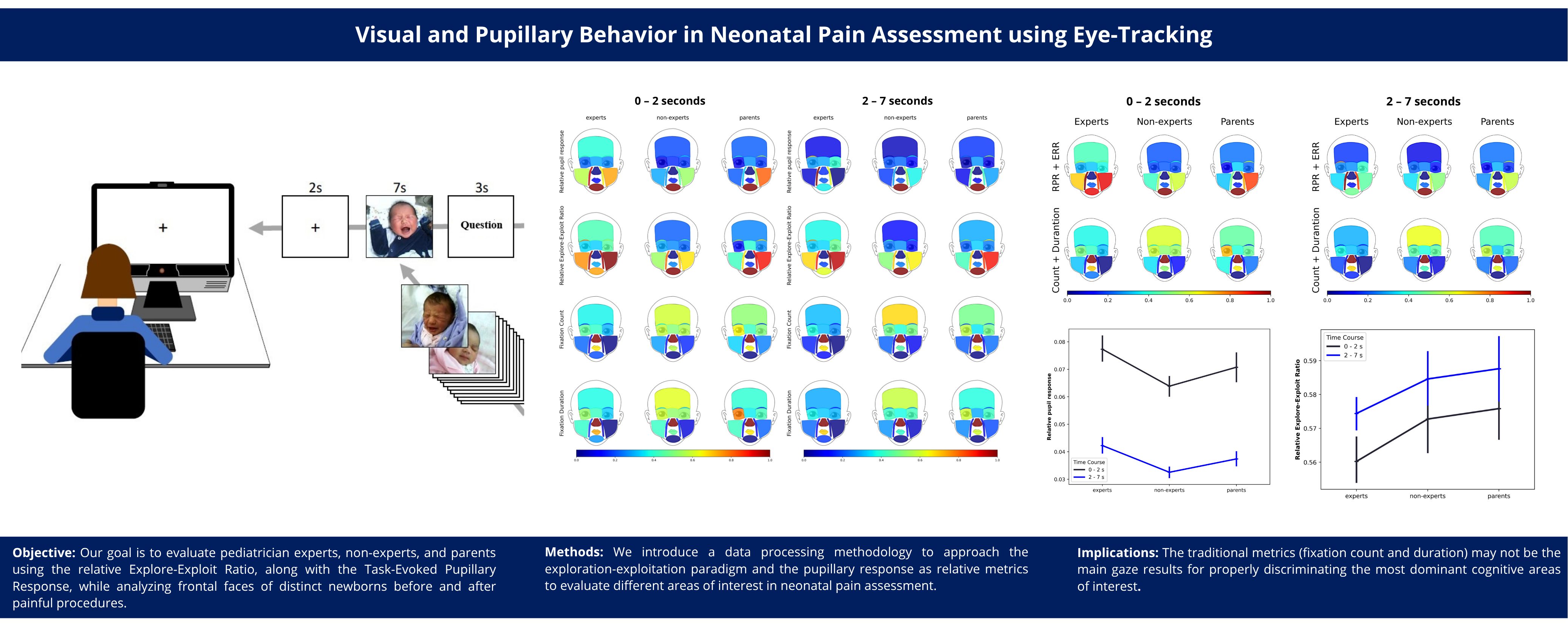
This paper introduces the application of novel eyetracking metrics to assess visual attention and cognitive load in neonatal pain assessment. Our goal is to evaluate pediatrician experts, non-experts, and parents using the relative Explore- Exploit Ratio, along with the Task-Evoked Pupillary Response, while analyzing the frontal faces of distinct newborns before and after painful procedures. All the experiments were based on a benchmark image dataset considering clinically relevant areas of interest. The Tobii TX300 system was used to record the eye-tracking data in a closed room with controlled lighting. Our results disclose that the visual attention described by the traditional metrics does not correspond directly to the respective fixation patterns and pupillary changes quantified for all the sample groups of participants investigated, highlighting statistically significant differences in the visual behavior between participants with or without clinical experience only when using the novel metrics proposed instead.
Downloads
References
K. A. Phillips, K. L. Bales, J. P. Capitanio, A. Conley, P. W. Czoty, B. A. Hart, et al., "Why primate models matter," American Journal of Primatology, vol. 76, pp. 801–827, 2014. [Online]. Available: https://doi.org/10.1002/ajp.22281
P. M. Fitts, R. E. Jones, and J. L. Milton, "Eye movements of aircraft pilots during instrument-landing approaches," Ergonomics, Major Writings, 2004, p. 56. [Online]. Available: https://www.semanticscholar.org/paper/227324185
V. Skaramagkas, G. Giannakakis, E. Ktistakis, D. Manousos, I. Karatzanis, N. S. Tachos, et al., "Review of eye-tracking metrics involved in emotional and cognitive processes," IEEE Reviews in Biomedical Engineering, vol. 16, pp. 260–277, 2021. [Online]. Available: https://doi.org/10.1109/RBME.2021.3066072
R. C. X. Balda and R. Guinsburg, "A linguagem da dor no recém-nascido," Documento Científico do Departamento de Neonatologia. Sociedade Brasileira de Pediatria, 2018.
G. Zamzmi, R. Kasturi, D. Goldgof, R. Zhi, T. Ashmeade, and Y. Sun, "A review of automated pain assessment in infants: features, classification tasks, and databases," IEEE Reviews in Biomedical Engineering, vol. 11, pp. 77–96, 2017. [Online]. Available: https://doi.org/10.1109/RBME.2017.2777907
R. V. E. Grunau and K. D. Craig, "Pain expression in neonates: facial action and cry," Pain, vol. 28, no. 3, pp. 395–410, 1987. [Online]. Available: https://doi.org/10.1016/0304-3959(87)90073-X
R. Guinsburg, "Avaliação e tratamento da dor no recém-nascido," Jornal de Pediatria (Rio J), vol. 75, no. 3, pp. 149–160, 1999. [Online]. Available: https://doi.org/10.25060/residpediatr
R. C. X. Balda and R. Guinsburg, "Perceptions of neonatal pain," Neoreviews, vol. 8, no. 12, pp. e533–e542, 2007. [Online]. Available: https://doi.org/10.1542/neo.8-12-e533
J. C. A. Soares, M. C. M. Barros, G. V. T. Silva, L. P. Carlini, T. M. Heiderich, R. N. Orsi, et al., "Looking at neonatal facial features of pain: do health and non-health professionals differ?," Jornal de Pediatria, vol. 98, no. 4, pp. 406–412, 2022. [Online]. Available: https://doi.org/10.1016/j.jped.2021.10.006
P. Majaranta and A. Bulling, "Eye-tracking and eye-based human-computer interaction," in Advances in Physiological Computing, pp. 39–65, 2014. [Online]. Available: https://doi.org/10.1007/978-1-4471-6392-3_3
R. R. Gameiro, K. Kaspar, S. U. Konig, S. Nordholt, and P. Konig, "Exploration and exploitation in natural viewing behavior," Scientific Reports, vol. 7, no. 1, p. 2311, 2017. [Online]. Available: https://doi.org/10.1038/s41598-017-02526-1
J. H. Goldberg and X. P. Kotval, "Computer interface evaluation using eye movements: methods and constructs," International Journal of Industrial Ergonomics, vol. 24, no. 6, pp. 631–645, 1999. [Online]. Available: https://doi.org/10.1016/S0169-8141(98)00068-7
N. Malem-Shinitski, M. Opper, S. Reich, L. Schwetlick, S. A. Seelig, and R. Engbert, "A mathematical model of exploration and exploitation in natural scene viewing," bioRxiv, 2020. [Online]. Available: https://doi.org/10.1101/2020.04.16.044677
V. Peysakhovich, "Study of pupil diameter and eye movements to enhance flight safety," Ph.D. dissertation, Université de Toulouse, Toulouse, France, 2016. [Online]. Available: https://doi.org/10.13140/RG.2.2.34241.35680
B. R. Manor and E. Gordon, "Defining the temporal threshold for ocular fixation in free-viewing visuocognitive tasks," Journal of Neuroscience Methods, vol. 128, no. 1, pp. 85–93, 2003. [Online]. Available: https://doi.org/10.1016/S0165-0270(03)00151-1
J. Beatty, "Task-evoked pupillary responses, processing load, and the structure of processing resources," Psychological Bulletin, vol. 91, pp. 276, 1982. [Online]. Available: https://pubmed.ncbi.nlm.nih.gov/7071262
R. N. Orsi, L. P. Carlini, T. M. Heiderich, G. V. T. da Silva, J. D. C. A. Soares, R. D. C. X. Balda, et al., "Visual attention during neonatal pain assessment: A 2‐s exposure to a facial expression is sufficient," Electronics Letters, vol. 59, no. 6, p. e12756, 2023. [Online]. Available: https://doi.org/10.1049/ell2.12756
A. Olsen, "The Tobii I-VT fixation filter." [Online]. Available: https://www.tobiipro.com/learn-and-support/learn/eye-tracking-essentials/
F. G. Tamanaka, L. P. Carlini, T. M. Heiderich, R. C. X. Balda, M. C. M. Barros, R. Guinsburg, and C. E. Thomaz, "Neonatal pain assessment: A Kendall analysis between clinical and visually perceived facial features," Computer Methods in Biomechanics and Biomedical Engineering: Imaging & Visualization, vol. 11, no. 3, pp. 331–340, 2022. [Online]. Available: https://doi.org/10.1080/21681163.2022.2044909
V. Peysakhovich, M. Causse, S. Scannella, and F. Dehais, "Frequency analysis of a task-evoked pupillary response: Luminance-independent measure of mental effort," International Journal of Psychophysiology, vol. 97, no. 1, pp. 30–37, 2015. [Online]. Available: https://doi.org/10.1016/j.ijpsycho.2015.04.019
R. H. C. Lopes, "Kolmogorov-Smirnov test," International Encyclopedia of Statistical Science, Springer, pp. 718–720, 2011. [Online]. Available: https://doi.org/10.1007/978-3-642-04898-2_326
J. W. Pratt, "Remarks on zeros and ties in the Wilcoxon signed rank procedures," Journal of the American Statistical Association, vol. 54, pp. 655–667, 1959. [Online]. Available: https://doi.org/10.1080/01621459.1959.10501526
L. P. Carlini, G. A. S. Coutrin, L. A. Ferreira, J. C. A. Soares, G. V. T. Silva, T. M. Heiderich, et al., "Human vs machine towards neonatal pain assessment: A comprehensive analysis of the facial features extracted by health professionals, parents, and convolutional neural networks," Artificial Intelligence in Medicine, vol. 147, p. 102724, 2024. [Online]. Available: https://doi.org/10.1016/j.artmed.2023.102724