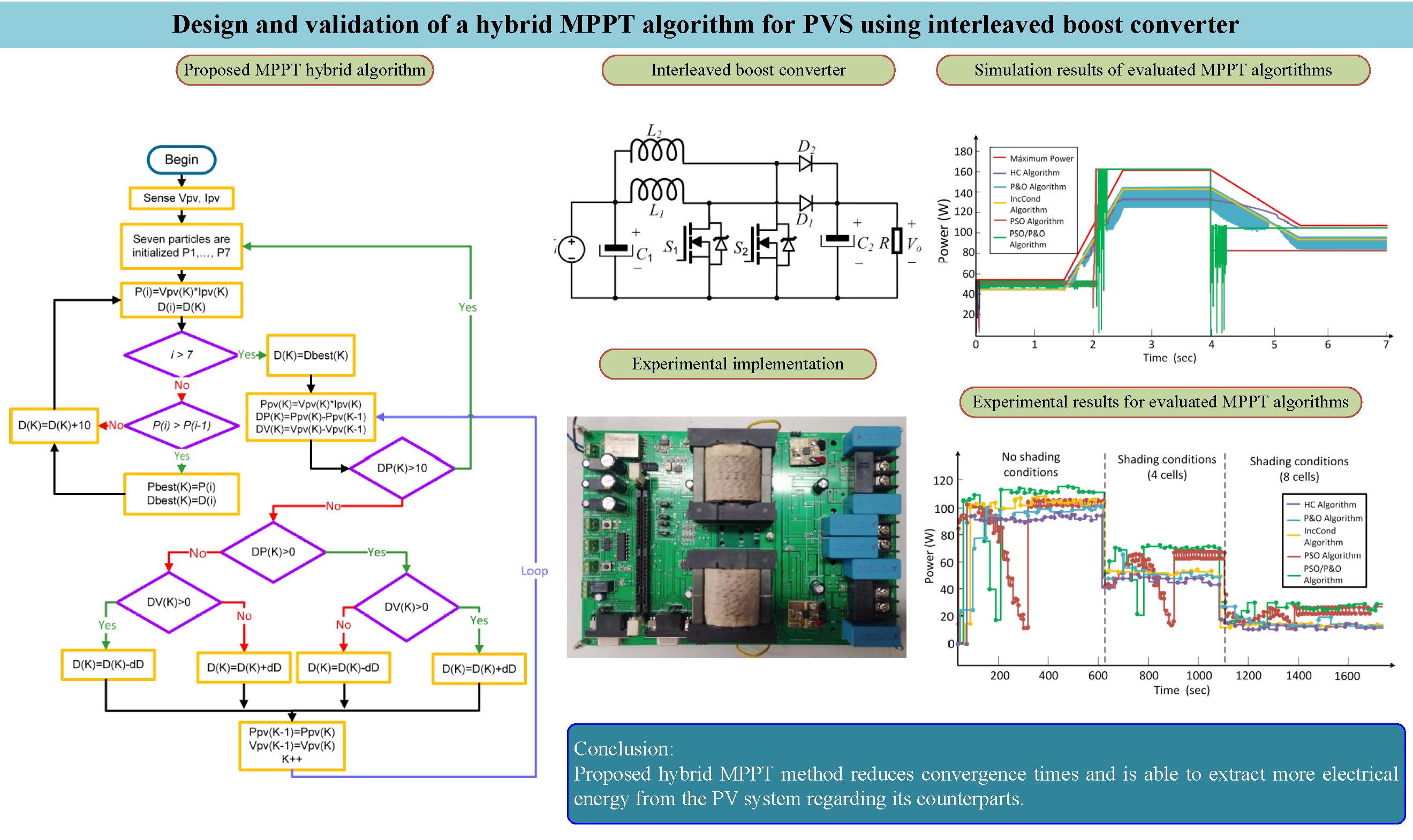
Design and validation of a hybrid MPPT algorithm for PVS using an interleaved boost converter
Keywords:
MPPT, Photovoltaic, DC-DC converterAbstract
Photovoltaic systems must be highly efficient to transfer the electric power generated to the local loads or to the electrical grid. In partial-shading conditions there are multiple local maximum power points which are not evaluated by conventional MPPT methods producing low efficiency in the photovoltaic system. In this paper a hybrid Particle Swarm Optimization (PSO) based method is proposed. The proposed method allows to locate the global maximum power point enhancing the availability of the generated electrical power and reducing the convergence time compared to the conventional PSO algorithm. The proposed method is compared with classical MPPT algorithms like Hill Climbing (HC), perturb and observe (P and O), incremental conductance (IncCond) and the conventional particle swarm optimization (PSO) method. The comparison is performed by means of numerical simulations and implementing an experimental platform with real photovoltaic panels.
Downloads
References
UN. Sustainable Development Objective. United Nations Organization. USA. 2024. https://sdgs.un.org/.
UN. Action Climate. United Nations Organization. USA. 2024. https://sdgs.un.org/.
Solar Power Europe (2023) Global Market Outlook For Solar Power 2023-2027. Belgium. 2022. http://www.solarpowereurope.org/.
A. Canchola, G. Vazquez, J. Sosa, P. Martinez, and M. Juarez. “Efficiency Based Comparative Analysis of Selected Classical MPPT
Methods,” in IEEE International Autumn Meeting on Power, Electronics and Computing (ROPEC), Ixtapa, M´exico, pp. 1-6, 2017. DOI: 10.1109/ROPEC.2017.8261657.
N. Karami, N. Moubayed and R. Outbib. “General review and classification of different MPPT Techniques,” in Renewable
and Sustainable Energy Reviews, vol. 68, pp. 624-630, 2017. https://doi.org/10.1016/j.rser.2016.09.132.
M. Sarvi, A. Azadian. “A comprehensive review and classified comparision of MPPT algortihms in PV sytems,” in Energy Systems, vol. 2, no. 13, pp. 281-320, 2021 https://doi.org/10.1007/s12667-021-00427-x.
F. Tahiri, K. Chikh, M. Khafallah, and A. Saad. “Comparative study between two Maximum Power Point Tracking techniques for photovoltaic system,” in International Conference on Electrical and Information Technologies (ICEIT), Tangiers, pp. 10, 2016. DOI: 10.1109/EITech. 2016.7519571.
V. Jately, et. al. ”Experimental Analysis of hill-climbing MPPT algorithms under low irradiance levels,” in Renewable
and Sustainable Energy Reviews, vol. 150, p. 111467, 2021. https://doi.org/10.1016/j.rser.2021.111467.
S. Figueiredo and R. Nayana. ”Hybrid MPPT Technique PSO-P&O Applied to Photovoltaic Systems Under Uniform and Partial Shading Conditions,” in IEEE Latin America Transactions, vol. 19, no. 10, pp. 1610–1617, 2021. DOI: 10.1109/TLA.2021.9477222.
L. Shang, H. Guo and H. Zhu. ”An improved MPPT control strategy based on incremental conductance algorithm,” in Protection and Control of Modern Power Systems, vol. 5, no. 2, pp. 1-8, 2020. https://doi.org/10.1186/s41601-020-00161-z.
A. Hassan, O. Bass, and M. Masoum. ”An improved genetic algorithm based fractional open circuit voltage MPPT for solar PV systems,” in Energy Reports vol. 9, pp. 1535-1548, 2023. https://doi.org/10.1016/j.egyr.2022.12.088.
T. Hassan, et. al. “A novel algorithm for MPPT of an isolated PV system using push pull converter with fuzzy logic controller,” in Energies, vol. 13, no. 15, p. 4007, 2020. https://doi.org/10.3390/en13154007.
B. Yang, et. al. ”Comprehensive overview of maximum power point tracking algorithms of PV systems under partial shading condition,” in Journal of Cleaner Production, vol. 268, p. 121983, 2020. https://doi.org/10.1016/j.jclepro.2020.121983.
F. Mumtaz, et al. “Review on non-isolated DC-DC converters and their control techniques for renewable energy applications,” in Ain Shams Engineering Journal, vol. 12, no. 4, pp. 3747-3763, 2021. https://doi.org/10.1016/j.asej.2021.03.022.
B. Revathi, and M. Prabhakar “Non isolated high gain DC-DC converter topologies for PV applications – A comprehensive review,” in Renewable and Sustainable Energy Reviews, vol. 66, pp. 920-933, 2016. https://doi.org/10.1016/j.rser.2016.08.057.
M. Chewale, R. Wanjari, V. Savakhande, and P. Sonawane “A Review on Isolated and Non-isolated DC-DC Converter for PV Application,” in International Conference on Control, Power, Communication and Computing Technologies (ICCPCCT), Kannur, India, pp. 399-404, 2018. DOI: 10.1109/ICCPCCT.2018.8574312.
G. Lepoldo, et al. “Flatness-Based Control for the Maximum Power Point Tracking in a Photovoltaic System,” in Energies, vol. 12, no. 10, 2019. https://doi.org/10.3390/en12101843.
J. Ingilala, and I. Vairavasundaram. “Investigation of high gain DC/DC converter for solar PV applications,” e-Prime-Advances in Electrical Engineering, Electronics and Energy, vol. 5, p. 100264, 2023. https://doi.org/10.1016/j.prime.2023.100264.
M. Kaouane, A. Boukhelifa, and A. Cheriti. “Regulated output voltage double switch Buck-Boost converter for photovoltaic energy application,” in International Journal of Hydrogen Energy , vol. 41, no. 45, pp. 20847- 20857, 2016. https://doi.org/10.1016/j.ijhydene.2016.06.140.
J. C. de Morais, J. L. de Morais and R. Gules. “Photovoltaic AC Module Based on a Cuk Converter with a Switched-Inductor Structure,” in IEEE Transactions on Industrial Electronics, vol. 66, no. 5, pp. 3881-3890, 2019. DOI: 10.1109/TIE.2018.2856202.
J. Ahmad, E. Ismail, and H. Behbehani. “High voltage step-up integrated double Boost-SEPIC-DC-DC converter for fuell-cell and photovoltaic applications,” in Renewable Energy, vol. 82, pp. 44-53, 2015. https://doi.org/10.1016/j.renene.2014.08.034.
N. Shanthi, et. al. “High Efficient Interleaved Boost Converter for Photovoltaic Applications ,” in 2018 Internacional Conference on Computation of Power, Energy, Information and Communication (ICCPEIC), vol. 188, pp. 305-309, 2018. DOI: 10.1109/ICCPEIC.2018.8525145.