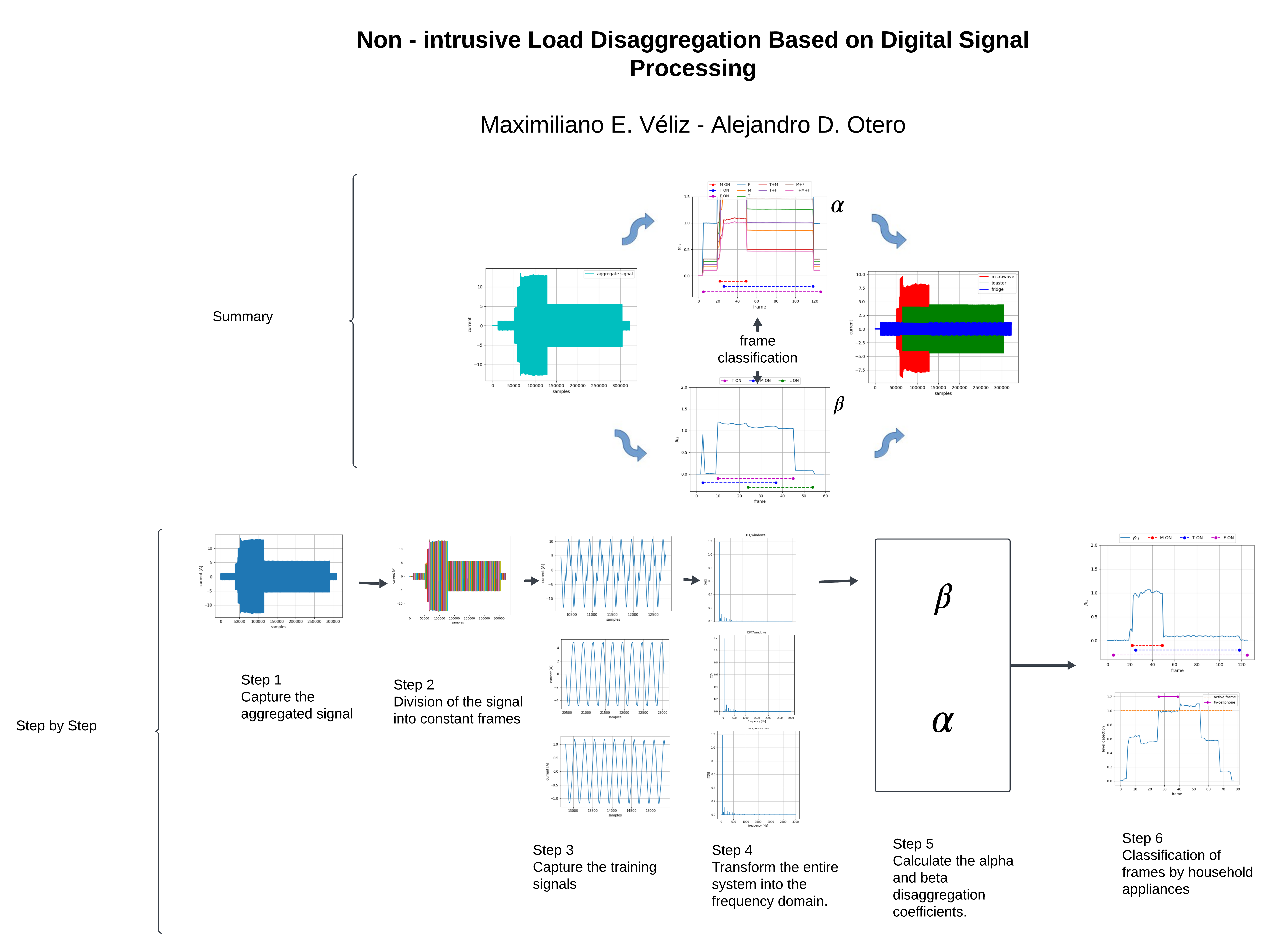
Non-intrusive load disaggregation based on digital signal processing for microcontroller application
Keywords:
Energy Disaggregation, low complexity NILM methodoly, Signal Processing, Household AppliancesAbstract
This paper presents a low complexity non-intrusive load monitoring (NILM) approach for residential electric power
based on digital signal processing. The aim is to identify the real operating frames of each household appliance from the aggregated current signal frames. In the methodology, two detection methods are derived. The first method, named direct method, identifies the active frames of each device by identifying the most probable combination between devices in the aggregated signal. The second method, termed indirect method, identifies the active frames of a particular device by means of a projection of the aggregated signal onto a Fourier subspace representing the characteristic footprint of the device. The methodology is tested on 4 datasets collected in Argentina. and high performance metrics are achieved. A pilot test is carried out with an ATSAMD21G18 microcontroller on the Itsy Bitsy M0 Express.
Downloads
References
G. W. Hart, “Nonintrusive appliance load monitoring,” Proceedings of
the IEEE, vol. 80, no. 12, pp. 1870–1891, 1992.
S. Darby et al., “The effectiveness of feedback on energy consumption,”
A Review for DEFRA of the Literature on Metering, Billing and direct
Displays, vol. 486, no. 2006, p. 26, 2006.
B. Neenan, J. Robinson, and R. Boisvert, “Residential electricity use
feedback: A research synthesis and economic framework,” Electric
Power Research Institute, vol. 3, 2009.
P. A. Schirmer and I. Mporas, “Non-intrusive load monitoring: A
review,” IEEE Transactions on Smart Grid, vol. 14, no. 1, pp. 769–784,
R. Gopinath, M. Kumar, C. P. C. Joshua, and K. Srinivas, “Energy
management using non-intrusive load monitoring techniques–state-ofthe-art and future research directions,” Sustainable Cities and Society,
vol. 62, p. 102411, 2020.
S. Dash and N. Sahoo, “Electric energy disaggregation via non-intrusive
load monitoring: A state-of-the-art systematic review,” Electric Power
Systems Research, vol. 213, p. 108673, 2022.
E. Aladesanmi and K. Folly, “Overview of non-intrusive load monitoring
and identification techniques,” IFAC-PapersOnLine, vol. 48, no. 30, pp.
–420, 2015.
H. K. Iqbal, F. H. Malik, A. Muhammad, M. A. Qureshi, M. N. Abbasi,
and A. R. Chishti, “A critical review of state-of-the-art non-intrusive
load monitoring datasets,” Electric Power Systems Research, vol. 192,
p. 106921, 2021.
M. Muller, ¨ Fundamentals of music processing: Audio, analysis, algorithms, applications. Springer, 2015, vol. 5.
J. B. Allen and L. R. Rabiner, “A unified approach to short-time fourier
analysis and synthesis,” Proceedings of the IEEE, vol. 65, no. 11, pp.
–1564, 1977.
A. V. Oppenheim, N. S. Hamid, and A. S. Willsky, Fourier series
representation of periodic signals. Prentice Hall, 1997.
A. Bj ˚ orck, “Numerics of gram-schmidt orthogonalization,” ¨ Linear Algebra and Its Applications, vol. 197, pp. 297–316, 1994.
B. Mulgrew, P. Grant, and J. Thompson, “Digital signal processing:
concepts and applications,” 2002.
P. Senin, “Dynamic time warping algorithm review,” Information and
Computer Science Department University of Hawaii at Manoa Honolulu,
USA, vol. 855, no. 1-23, p. 40, 2008.
A. Pinales and D. Valles, “Autonomous embedded system vehicle design
on environmental, mapping and human detection data acquisition for
firefighting situations,” in 2018 IEEE 9th Annual Information Technology, Electronics and Mobile Communication Conference (IEMCON).
IEEE, 2018, pp. 194–198.
M. E. Veliz, G. E. Real, and A. D. Otero, “Flexible and configurable ´
embedded electrical energy measurement system to acquire and process
high-frequency features,” HardwareX, p. e00539, 2024.
D. K. Fisher, R. S. Fletcher, and S. S. Anapalli, “Python software
integrates with microcontrollers and electronic hardware to ease development for open-source research and scientific applications,” Advances in Internet of Things, vol. 11, no. 1, pp. 42–58, 2021