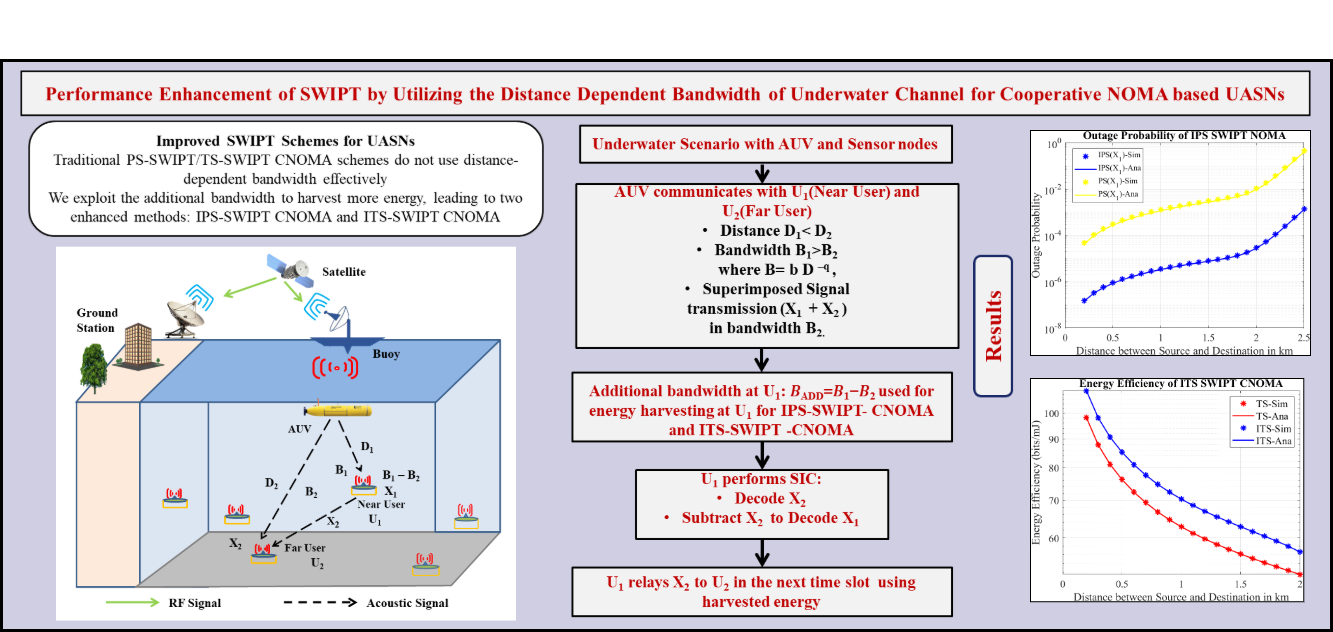
Performance Enhancement of SWIPT by Utilizing the Distance Dependent Bandwidth of Underwater Channel for Cooperative NOMA based UASNs
Keywords:
Average achievable rate, Energy efficiency, Nonorthogonal multiple access, Outage probability, Simultaneous wireless information and power transfer, Underwater acoustic sensor networksAbstract
Underwater acoustic sensor networks (UASNs) support a variety of oceanic applications but suffer from limited communication bandwidth, reliability, and energy efficiency. Cooperative non-orthogonal multiple access (CNOMA) with simultaneous wireless information and power transfer (SWIPT) schemes are proposed for UASNs to meet these constraints. The unique characteristic of underwater acoustic channels compared to terrestrial wireless channels is the distance-dependent bandwidth, which provides additional bandwidth to the near user compared to the far user in NOMA-based UASNs. In this research work, we propose to enhance the performance of power splitting (PS) and time switching (TS) SWIPT schemes by utilizing this additional bandwidth at the near user in NOMA-based UASNs. We consider a CNOMA-based UASN and derive closed-form expressions for average achievable rates, energy efficiency, and outage probability with improved PS-SWIPT and TS-SWIPT schemes. From the analytical results, it is evident that the average achievable rate, energy efficiency and outage probability performances are significantly improved with the proposed methods. The analytical results are corroborated with extensive simulation studies.
Downloads
References
I. F. Akyildiz, D. Pompili, and T. Melodia, ”Underwater acoustic sensor
networks: research challenges,” Ad Hoc Networks, vol. 3, no. 3, pp.
–279, 2005. DOI: 10.1016/j.adhoc.2005.01.003. [Online]. Available:
http://www.sciencedirect.com/science/article/pii/S1570870505000168.
K. Saeed, W. Khalil, A. S. Al-Shamayleh, S. Ahmed, A. Akhunzada, S.
Z. Alharthi, and A. Gani, ”A comprehensive analysis of security-based
schemes in underwater wireless sensor networks,” Sustainability, vol. 15,
no. 9, p. 7198, 2023. DOI: 10.3390/su15097198.
A. Al Guqhaiman, O. Akanbi, A. Aljaedi, and C. E. Chow, ”A survey
on MAC protocol approaches for underwater wireless sensor networks,”
IEEE Sensors Journal, vol. 21, no. 3, pp. 3916–3932, 2020. DOI:
1109/JSEN.2020.3024995.
V. Goutham and V. Harigovindan, ”Full-duplex cooperative relaying
with NOMA for the performance enhancement of underwater
acoustic sensor networks,” Engineering Science and Technology, an
International Journal, vol. 24, no. 6, pp. 1396–1407, 2021. DOI:
1016/j.jestch.2021.03.008.
H. H. Zuberi, S. Liu, M. Bilal, A. Alharbi, A. Jaffar, S. A. H. Mohsan,
A. Miyajan, and M. A. Khan, ”Deep-neural-network-based receiver
design for downlink non-orthogonal multiple-access underwater acoustic
communication,” Journal of Marine Science and Engineering, vol. 11,
no. 11, p. 2184, 2023. DOI: 10.3390/jmse11112184.
E. A. Makled, A. Yadav, O. A. Dobre, and R. D. Haynes, ”Hierarchical
full-duplex underwater acoustic network: A NOMA approach,”
in OCEANS 2018 MTS/IEEE Charleston, IEEE, 2018, pp. 1–6. DOI:
1109/OCEANS.2018.8604904.
B. Makki, K. Chitti, A. Behravan, and M.-S. Alouini, ”A survey of
NOMA: Current status and open research challenges,” IEEE Open Journal
of the Communications Society, vol. 1, pp. 179–189, 2020. DOI:
1109/OJCOMS.2020.2969899.
M. Zeng, W. Hao, O. A. Dobre, and Z. Ding, ”Cooperative NOMA: State
of the art, key techniques, and open challenges,” IEEE Network, vol. 34,
no. 5, pp. 205–211, 2020. DOI: 10.1109/MNET.011.1900601.
G. V. Goutham and V. P. Harigovindan, ”NOMA Based Cooperative Relaying
Strategy for Underwater Acoustic Sensor Networks Under Imperfect
SIC and Imperfect CSI: A Comprehensive Analysis,” IEEE Access,
vol. 9, pp. 32857–32872, 2021. DOI: 10.1109/ACCESS.2021.3060784.
J. Y. Pyun, Y. H. Kim, and K. K. Park, ”Design of piezoelectric acoustic
transducers for underwater applications,” Sensors, vol. 23, no. 4, p. 1821,
DOI: 10.3390/s23041821.
S. Bagchi and M. Behera, ”Microbial fuel cells: A sustainable
technology for pollutant removal and power generation,” Bioelectrochemical
Interface Engineering, pp. 91–116, 2019. DOI:
1002/9781119611103.ch6.
B. S. Srujana, P. Mathews, V P. Harigovindan, et al., ”Multisource
energy harvesting system for underwater wireless sensor networks,”
Procedia Computer Science, vol. 46, pp. 1041–1048, 2015. DOI:
1016/j.procs.2015.01.015.
A. Khan, M. Imran, A. Alharbi, E. M. Mohamed, and M. M.
Fouda, ”Energy harvesting in underwater acoustic wireless sensor networks:
Design, taxonomy, applications, challenges and future directions,”
IEEE Access, vol. 10, pp. 134606–134622, 2022. DOI: 10.1109/ACCESS.
3230600.
Q. Xia, Y. Chen, C. Yang, B. Chen, G. Muhammad, and X. Ma, ”Maximum
efficiency point tracking for an ocean thermal energy harvesting
system,” International Journal of Energy Research, vol. 44, no. 4, pp.
–2703, 2020. DOI: 10.1002/er.5055.
J. I. de Oliveira Filho, A. Trichili, B. S. Ooi, M.-S. Alouini, and K.
N. Salama, ”Toward self-powered internet of underwater things devices,”
IEEE Communications Magazine, vol. 58, no. 1, pp. 68–73, 2020. DOI:
1109/MCOM.001.1900413.
T. D. P. Perera, D. N. K. Jayakody, S. Affes, M. Chidambaranathan,
and C. Yury, ”Wireless-powered hybrid terrestrial and underwater cooperative
communication system,” in 2019 15th International Conference
on Distributed Computing in Sensor Systems (DCOSS), IEEE, 2019, pp.
–506. DOI: 10.1109/DCOSS.2019.00097.
Y. Tang, Q. Zhou, Z. Xie, Y. Pan, G. Ji, and X. L¨u, ”Research on multipath
performance of acoustic spread spectrum signals based on artificial
multipath experiments in an anechoic chamber,” Applied Acoustics, vol.
, p. 109893, 2024. DOI: 10.1016/j.apacoust.2024.109893.
M. Stojanovic, ”On the relationship between capacity and distance in an
underwater acoustic communication channel,” ACM SIGMOBILE Mobile
Computing and Communications Review, vol. 11, no. 4, pp. 34–43, 2007.
DOI: 10.1145/1327452.1327457.
D. E. Lucani, M. Stojanovic, and M. M´edard, ”On the relationship
between transmission power and capacity of an underwater acoustic communication
channel,” in OCEANS 2008-MTS/IEEE Kobe Techno-Ocean,
IEEE, 2008, pp. 1–6. DOI: 10.1109/OCEANSKOBE.2008.4531073.
E. M. Sozer, M. Stojanovic, and J. G. Proakis, ”Underwater acoustic
networks,” IEEE Journal of Oceanic Engineering, vol. 25, no. 1, pp.
–83, 2000. DOI: 10.1109/48.820738.
J. Singh, R. Kaur, and D. Singh, ”Energy harvesting in wireless
sensor networks: A taxonomic survey,” International Journal of Energy
Research, vol. 45, no. 11, pp. 15861–15885, 2021. DOI: 10.1002/er.5816.
H. Li, Z. D. Deng, Y. Yuan, and T. J. Carlson, ”Design parameters of a
miniaturized piezoelectric underwater acoustic transmitter,” Sensors, vol.
, no. 7, pp. 9098–9109, 2012. DOI: 10.3390/s120709098.
A. Alzahrani, ”High-voltage soil-based microbial fuel cells,” in 2020
IEEE Texas Power and Energy Conference (TPEC), IEEE, 2020, pp. 1–6.
DOI: 10.1109/TPEC48276.2020.9042502.
T. H. Nguyen et al., ”Energy outage analysis of aerial UAV-enabled
SWIPT deployments,” IEEE Access, vol. 12, pp. 27,147–27,157, 2024.
DOI: 10.1109/ACCESS.2024.3366660.
M. Liaqat, K. A. Noordin, T. A. Latef, K. Dimyati, T. Younas, F. Qamar,
and Z. Ding, ”Performance evaluation of multiple relay SWIPT-enabled
cooperative NOMA network in the presence of interference,” Wireless
Networks, pp. 1–14, 2024. DOI: 10.1007/s11276-024-03669-6.
N. Ashraf, S. A. Sheikh, S. A. Khan, I. Shayea, and M. Jalal, ”Simultaneous
wireless information and power transfer with cooperative relaying
for next-generation wireless networks: A review,” IEEE Access, vol. 9,
pp. 71,482–71,504, 2021. DOI: 10.1109/ACCESS.2021.3078703.
H. Sarkar, S. Sharma, and S. Kundu, ”Two-user cooperative NOMA
with a SWIPT-enabled relay,” in 5G and Beyond Wireless Networks, CRC
Press, 2024, pp. 51–64. ISBN: 9781003407836.
O. Alamu, T. O. Olwal, and K. Djouani, ”Sum-rate maximization for a
distributed space-time block code-aided cooperative NOMA with energy
harvesting,” Wireless Networks, pp. 1–18, 2024. DOI: 10.1007/s11276-
-03757-7.
S. K. Zaidi, S. F. Hasan, and X. Gui, ”Time switching based relaying for
coordinated transmission using NOMA,” in 2018 Eleventh International
Conference on Mobile Computing and Ubiquitous Network (ICMU),
IEEE, 2018, pp. 1–5. DOI: 10.1109/ICMU.2018.00016.
K. G. Omeke, M. Mollel, S. T. Shah, L. Zhang, Q. H. Abbasi, and
M. A. Imran, ”Towards a sustainable internet-of-underwater-things based
on AUVs, SWIPT and reinforcement learning,” IEEE Internet of Things
Journal, 2023. DOI: 10.1109/JIOT.2023.3319250.
H. Esmaiel, Z. A. Qasem, H. Sun, J. Qi, J. Wang, and Y. Gu, ”Wireless
information and power transfer for underwater acoustic time-reversed
NOMA,” IET Communications, vol. 14, no. 19, pp. 3394–3403, 2020.
DOI: 10.1049/iet-com.2020.0053.
A. Wibisono, M. H. Alsharif, H.-K. Song, and B. M. Lee, ”A survey
on underwater wireless power and data transfer system,” IEEE Access,
DOI: 10.1109/ACCESS.2024.3373791.
X. Yang, Z. Wang, T. Shen, and D. Zhao, ”Modulation classification of
underwater communication signals based on channel estimation,” Journal
of Marine Science and Engineering, vol. 12, no. 10, p. 1877, 2024. DOI:
3390/jmse12101877.
S. K. Gupta, R. C. S. Chauhan, and V. Kumar, ”Channel modelling
in underwater media: a wireless communication technique perspective,”
Physica Scripta, vol. 99, no. 11, p. 112003, 2024. DOI: 10.1088/1402-
/ad8282.
P. Casari, M. Stojanovic, and M. Zorzi, ”Exploiting the bandwidthdistance
relationship in underwater acoustic networks,” in OCEANS 2007.
IEEE, 2007, pp. 1–6. DOI: 10.1109/OCEANS.2007.4449255.
A. Bereketli and S. Bilgen, ”Remotely powered underwater acoustic
sensor networks,” IEEE Sensors Journal, vol. 12, no. 12, pp. 3467–3472,
DOI: 10.1109/JSEN.2012.2210401.
H. Q. Tran, C. V. Phan, and Q.-T. Vien, ”Power splitting versus
time switching based cooperative relaying protocols for SWIPT in
NOMA systems,” Physical Communication, vol. 41, p. 101098, 2020.
DOI:10.1016/j.phycom.2020.101098.
M. C. Domingo and R. Prior, ”Energy analysis of routing protocols for
underwater wireless sensor networks,” Computer Communications, vol.
, no. 6, pp. 1227–1238, 2008. DOI: 10.1016/j.comcom.2007.11.005.
H. Tran, C. Phan, and Q. Vien, ”Performance analysis of powersplitting
relaying protocol in SWIPT based cooperative NOMA systems,”
EURASIP Journal on Wireless Communications and Networking, vol.
, no. 110, pp. 1–26, 2021. DOI: 10.1186/s13638-021-01981-9.
V. Aswathi and A. V. Babu, ”Outage and throughput analysis of
full-duplex cooperative NOMA system with energy harvesting,” IEEE
Transactions on Vehicular Technology, vol. 70, no. 11, pp. 11648–11664,
DOI: 10.1109/TVT.2021.3112596.