A Comparative Between Artificial Neural Networks and Multiple Linear Regression for the Estimation of Mechanical Properties in Cast Aluminum
Keywords:
Artificial neural networks, chemical composition, mechanical properties, multiple linear regressionAbstract
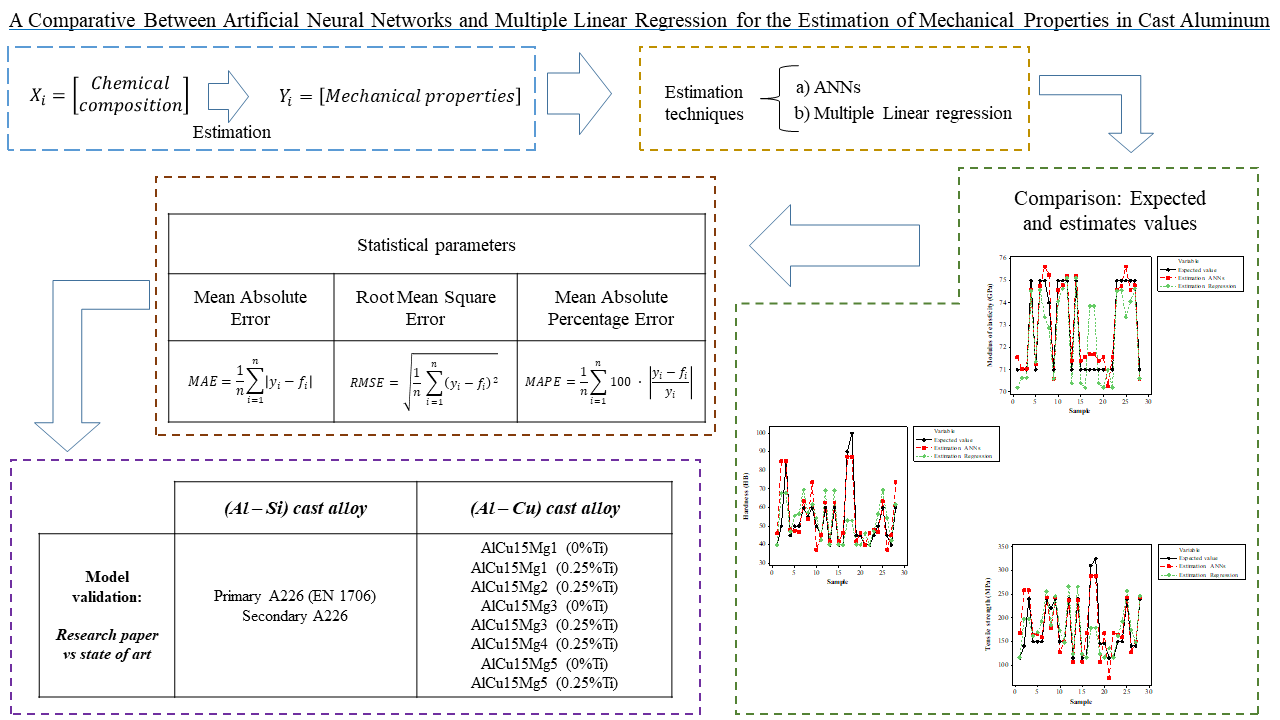
Metallic materials are composed of elements with defined chemical composition, and their intrinsic atomic arrangement confers them a distinctive crystalline structure. Thus, it is relevant to study of metallic materials, specifically cast aluminum alloys, whose physical and mechanical properties depend inherently on their chemical composition. Regarding the importance of mechanical properties, such as hardness, elastic modulus and ultimate tensile strength in optimizing industrial performance, it becomes essential to employ robust methods for their estimation. This study examines the computational estimation of mechanical properties from the chemical composition of various cast aluminum alloys. Two estimation modeling approaches were employed: Artificial Neural Networks (ANNs) and Multiple Linear Regression (MLR). Model performance was evaluated using three statistical metrics: Mean Absolute Error (MAE), which measures the average magnitude of errors; Root Mean Square Error (RMSE), which emphasizes larger error; and Mean Absolute Percentage Error (MAPE), which evaluates the percentage error relative to observed values. The results revealed that the ANN model exhibited superior estimation accuracy across all metrics when compared to the MLR approach. Specifically, the ANN model achieved lower values of MAE and RMSE, indicating more precise estimations and a significantly reduced MAPE, demonstrating improved reliability in estimating mechanical properties. These finding underscore the potential of ANNs as a more effective tool for estimating the mechanical performance of cast aluminum alloys based on their chemical composition. Additionally, the estimation capacity of both models was externally validated using experimental data reported in the literature, enhancing the reliability of the findings.
Downloads
References
S. Al-Alimi, N. K. Yusuf, A. M. Ghaleb, M. A. Lajis, S. Shamsudin, W. Zhou, Y. M. Altharan, H. S. Abdulwahab, Y. Saif, D. H. Didane, I. S T T and A. Adam. “Recycling aluminium for sustainable development: A review of different processing technologies in green manufacturing,” Results in Engineering, vol. 23, Sep. 2024, doi: 10.1016/j.rineng.2024.102566.
S. Samberger, P. V. Czarnowski, S. Pogatscher and J. Hirsch. “New strategies to improve recycling and reduce CO2-emission of Aluminum production and processing,” Journal of light metal welding, vol. 62, No. 3, pp. 119-132, 2024, doi: 10.11283/jlwa.62.119.
G. O. Barrionuevo and J. A. Ramos-Grez. “Machine Learning for Optimizing Technological Properties of Wood Composite Filament-Timberfill Fabricated by Fused Deposition Modeling,” Communications in Computer and Information Science, vol. 1194, pp. 119-132, Mar. 2020, doi: 10.1007/978-3-030-42520-3_10.
F. J. Pontes, J. R. Ferrerira, M. B. Silva and P. P. Balestrasse. “Artificial neural networks for machining processes Surface roughness modeling,” The International Journal of Advanced Manufacturing Technology, vol. 49, pp. 879-902, Aug. 2010, doi: 10.1007/s00170-009-2456-2.
S. Sahin, M. R. Tolun and R. Hassanpour. “Hybrid expert systems: A survey of current approaches and applications,” Expert Systems with Applications, vol. 39, pp. 4609-4617, Mar. 2012, doi: 10.1016/j.eswa.2011.08.130
V. Castellanos, A. Albiter, P. Hernández and G. Barrera. “Failure analysis expert system for onshore pipelines. Part-I: Structured database and knowledge acquisition,” Expert Systems with Applications, vol. 38, No. 9, pp. 11085–11090, Sep. 2011, doi: 10.1016/j.eswa.2011.02.153.
H. Varol Özkavak, M. Ince and E. E. Bicakli. “Prediction of Mechanical Properties of the 2024 Aluminum Alloy by Using Machine Learning Methods,” Arab J Sci Eng, vol. 48, pp. 2841-2850, Mar. 2023, doi: 10.1007/s13369-022-07009-8.
D. Merayo, A. Rodríguez-Prieto and A. M. Camacho. “Comparative analysis of artificial intelligence techniques for material selection applied to manufacturing in Industry 4.0,” Procedia Manufacturing, vol. 41, pp. 42–49, Oct. 2019, doi: 10.1016/j.promfg.2019.07.027.
D. Merayo, A. Rodríguez-Prieto and A. M. Camacho. “Prediction of the Bilinear Stress-Strain Curve of Aluminum Alloys Using Artificial Intelligence and Big Data,” Metals, vol. 10, No. 7, pp. 56-84, Jul. 2020, doi: 10.3390/met10070904.
D. Merayo, A. Rodríguez-Prieto and A. M. Camacho. “Prediction of Physical and Mechanical Properties for Metallic Materials Selection Using Big Data and Artificial Neural Networks,” IEEE Access., vol. 8, pp. 41-53, 2020, doi: 10.1109/ACCESS.2020.2965769.
I. Alcelay, E. Peña and A. Al Omar. “Study of the thermo-mechanical behavior of medium carbon microalloyed steel during hot forming process using an artificial neural network,” Revista de Metalurgia., vol. 52, No. 2, pp. 1-10, 2016, doi: 10.3989/revmetalm.066.
B. Zlaticanin, B. Radonjic and M. Filipovic. “Characterization of Structure and Properties of As-cast AlCuMg Alloys,” Materials Transactions, vol. 45, No. 2, pp. 440-446, 2004, doi: 10.2320/matertrans.45.440.
L. Kuchariková, E. Tillová and O. Bokuvka. “Recycling and properties of recycled aluminium alloys used in the transportation industry,” Transport Problems, vol. 11, pp. 117-122, 2016, doi: 10.20858/tp.2016.11.2.11.
M. Bachmayer. Matmatch, Accessed on: Nov. 23, 2022, [Online]. Available: https://matmatch.com.
S. García, S. Ramírez-Gallego, J. Luengo, J. M. Benítez and F. Herrera. “Big Data preprocessing: methods and prospects,” Big Data Analytics, vol. 1, pp. 9, Nov. 2016, doi: 10.1186/s41044-016-0014-0.
C. L. Hernández G. and J. E. Rodríguez R. “Preprocesamiento de datos estructurados,” Rev. Vínculos, vol. 4, pp. 27-48, Jul. 2008, doi: 10.14483/2322939X.4123.
M. T. Hagan and M. B. Menhaj. “Training Feedforward Networks with the Marquardt Algorithm,” IEEE Transactions on Neural Networks, vol. 5, No. 6, pp. 898-993, 1994, doi: 10.1109/72.329697.
E. A. Ruelas Santoyo and J. Cruz Salgado. “Statistical Control of Multivariant Processes throurh the Artificial Neural Network Multilayer Perceptron and the MEWMA Graphic Analysis,” IEEE Latin America Transactions, vol. 18, No. 06, pp. 1041-1048, Jun. 2020, doi: 10.1109/TLA.2020.9099681.
F. Bartolomeu, S. Faria, O. Carvalho, E. Pinto, N. Alves, F. S. Silva and G. Miranda. “Predictive models for physical and mechanical properties of Ti6Al4V produced by Selective Laser Melting,” Materials Science and Engineering: A, vol. 663, pp. 181-192, Apr. 2016, doi: 10.1016/j.msea.2016.03.113.
J. Mathew, J. Griffin, M. Alamaniotis, S. Kanarachos and M. E. Fitzpatrick. “Prediction of welding residual stresses using machine learning: Comparison between neural networks and neuro-fuzzy systems,” Applied Soft Computing, vol. 70, pp. 131-146, Sep. 2018, doi: 10.1016/j.asoc.2018.05.017.