Welfare Optimization in Energy Communities with P2P Markets
Optimización de bienestar en comunidades energéticas con mercados P2P
Keywords:
Energy Community, Energy Management System, Peer-to-Peer Market, Resource optimizationAbstract
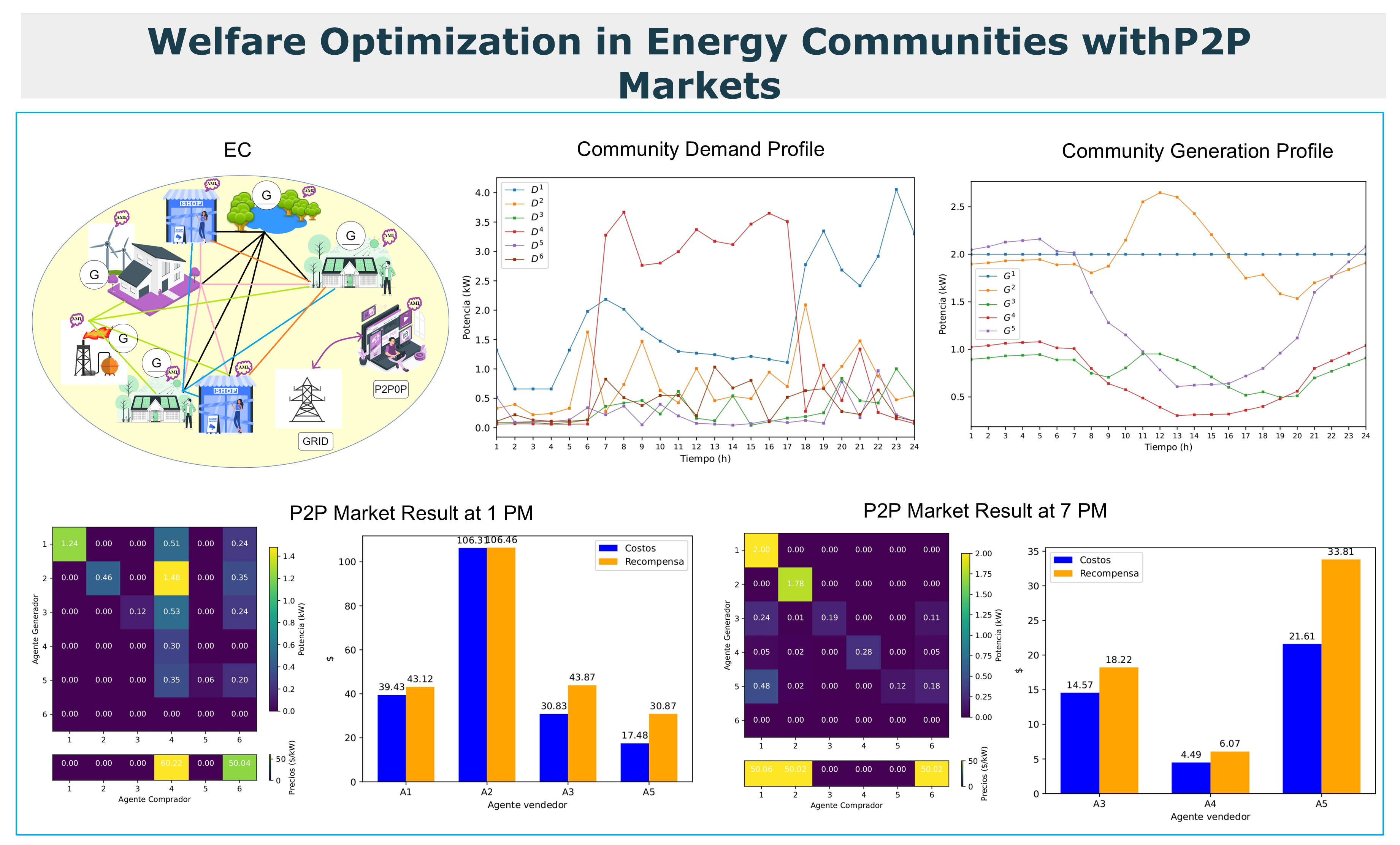
We address the requirement for Energy Communities (ECs) to integrate efficient Energy Management Systems (EMSs) that optimize resource operation and maximize the benefits for participants. In this work, we implement an EMS that considers the supply and demand profiles of agents, fostering their engagement and ensuring their continued involvement within the community. We establish a mathematical model of an EC composed of prosumers with different types of distributed energy resources and pure consumers. The EMS integrates game theory and optimization techniques to coordinate and schedule energy transactions using welfare functions. Through the developed algorithm, the maximization of community welfare is ensured. This method is compared with the traditional Interior-Point Method (IPM). The results indicate a normalized error average of 0.23%. We simulate a community with six agents and analyze two case studies. The results show that the EMS promotes agent participation by optimizing their resources and achieving more competitive buy and sell prices compared to the main grid. Furthermore, the EMS prioritizes energy dispatch within the EC over transactions with the main grid and accounts for generation costs. The implementation of the EMS improves community welfare, thus contributing to the sustainability of the EC.
Downloads
References
E. Barabino, D. Fioriti, E. Guerrazzi, I. Mariuzzo, D. Poli, M. Raugi, E. Razaei, E. Schito, and D. Thomopulos, “Energy communities: A review on trends, energy system modelling, business models, and opti-misation objectives,” Sustainable Energy, Grids and Networks, vol. 36,p. 101187, 2023. https://doi.org/10.1016/j.segan.2023.101187.
W. Tushar, T. K. Saha, C. Yuen, D. Smith, and H. V. Poor, “Peer-to-peer trading in electricity networks: An overview,” IEEE Transactions on Smart Grid, vol. 11, no. 4, pp. 3185–3200, 2020. 10.1109/TSG.2020.2969657.
B. Mao, D. Han, Y. Wang, X. Dong, and Z. Yan, “Pricing mechanism for community prosumers in decentralized electricity market,” CSEE Journal of Power and Energy Systems, vol. 9, no. 5, pp. 1905–1917, 2023. 10.17775/CSEEJPES.2020.06480.
A. Paudel, K. Chaudhari, C. Long, and H. B. Gooi, “Peer-to-peer energy trading in a prosumer-based community microgrid: A game-theoretic model,” IEEE Transactions on Industrial Electronics, vol. 66, no. 8, pp. 6087–6097, 2019. 10.1109/TIE.2018.2874578.
T. Perger, “Fair energy sharing in local communities: Dynamic participation of prosumers,” in 2020 17th International Conferen-ce on the European Energy Market (EEM), pp. 1–6, IEEE, 2020. 10.1109/EEM49802.2020.9221933.
T. Perger and H. Auer, “Dynamic participation in local energy communi- ties with peer-to-peer trading,” Open Research Europe, vol. 2, pp. 5–20, 2022. 10.12688/openreseurope.14332.2.
M. Tofighi-Milani, S. Fattaheian-Dehkordi, M. Gholami, M. Fotuhi- Firuzabad, and M. Lehtonen, “A novel distributed paradigm for energy scheduling of islanded multiagent microgrids,” IEEE Access, vol. 10, pp. 83636–83649, 2022. 10.1109/ACCESS.2022.3197160.
Y. Xia, Q. Xu, S. Li, R. Tang, and P. Du, “Reviewing the peer- to-peer transactive energy market: Trading environment, optimization methodology, and relevant resources,” Journal of Cleaner Production, vol. 383, p. 135441, 2023. 10.1016/j.jclepro.2022.135441.
S. Suthar, S. H. C. Cherukuri, and N. M. Pindoriya, “Peer-to-peer energy trading in smart grid: Frameworks, implementation methodologies, and demonstration projects,” Electric Power Systems Research, vol. 214, p. 108907, 2023. 10.1016/j.epsr.2022.108907.
A. L. Bukar, M. F. Hamza, S. Ayub, A. K. Abobaker, B. Modu, S. Mohseni, A. C. Brent, C. Ogbonnaya, K. Mustapha, and H. O. Idakwo, “Peer-to-peer electricity trading: A systematic review on current developments and perspectives,” Renewable Energy Focus, vol. 44, pp. 317–333, 2023. 10.1016/j.ref.2023.01.008.
S. Xuanyue, X. Wang, X. Wu, Y. Wang, Z. Song, B. Wang, and Z. Ma, “Peer-to-peer multi-energy distributed trading for interconnected microgrids: A general Nash bargaining approach,” International Journal of Electrical Power & Energy Systems, vol. 138, p. 107892, 2022. https://doi.org/10.1016/j.ijepes.2021.107892.
X. Yu, D. Pan, and Y. Zhou, “A Stackelberg game-based peer-to-peer energy trading market with energy management and pricing mechanism: A case study in Guangzhou,” Solar Energy, vol. 270, p. 112388, 2024. https://doi.org/10.1016/j.solener.2024.112388.
D. Erazo-Caicedo, A. Cusva-Garc´ıa, N. Quijano, G. Jim´enez-Est´evez, J. Revelo-Fuelag´an, and A. Pantoja, “Differentiation price mechanism for loss minimization in peer-to-peer local energy markets,”
in 2024 IEEE ANDESCON, pp. 1–6, 2024. 10.1109/ANDES-CON61840.2024.10755935.
M. Choobineh, A. Arabnya, A. Khodaei, and H. Zheng, “Game-theoretic peer-to-peer solar energy trading on blockchain-based transaction infrastructure,” e-Prime-Advances in Electrical Engineering, Electronics and Energy, vol. 5, p. 100192, 2023. https://doi.org/10.1016/j.prime.2023.100192.
M. Khorasany, A. Paudel, R. Razzaghi, and P. Siano, “A new method for peer matching and negotiation of prosumers in peer-to-peer energy markets,” IEEE Transactions on Smart Grid, vol. 12, no. 3, pp. 2472–2483, 2021. 10.1109/TSG.2020.3048397.
A. Thomas, M. P. Abraham, and A. M. G, “Analysis of peer-to-peer energy trading in a dynamic environment using Stackelberg game,” in 2021 Seventh Indian Control Conference (ICC), pp. 412–417, 2021. 10.1109/ICC54714.2021.9703159.
D. Yang, Z. He, Y. Sun, B. Li, D. Li, X. Liu, and C. Jiang, “Optimised operation of integrated community energy system con-sidering integrated energy pricing strategy: A two-layer stackelberg game approach,” Journal of Energy Storage, vol. 87, p. 111383, 2024. https://doi.org/10.1016/j.est.2024.111383.
J. Liu, S. Y. Samson, H. Hu, and H. Trinh, “A combinato-rial auction energy trading approach for VPPs consisting of in-terconnected microgrids in demand-side ancillary services market,” Electric Power Systems Research, vol. 224, p. 109694, 2023. https://doi.org/10.1016/j.epsr.2023.109694.
X. Zhu, J. Xue, M. Hu, Z. Liu, X. Gao, and W. Huang, “Low-carbon economy dispatching of integrated energy system with P2G-HGT coupling wind power absorption based on stepped carbon emission trading,” Energy Reports, vol. 10, pp. 1753–1764, 2023. https://doi.org/10.1016/j.egyr.2023.08.023.
Y. Yang, X. Xu, L. Pan, J. Liu, J. Liu, and W. Hu, “Distributed prosumer trading in the electricity and carbon markets considering user utility,” Renewable Energy, vol. 228, p. 120669, 2024. https://doi.org/10.1016/j.renene.2024.120669.
COMISI ´ON DE REGULACI ´ON DE ENERG´IA Y GAS, “Proyecto de resoluci´on CREG 701 051 de 2024,” 2024. https://gestornormativo.creg.gov.co/.