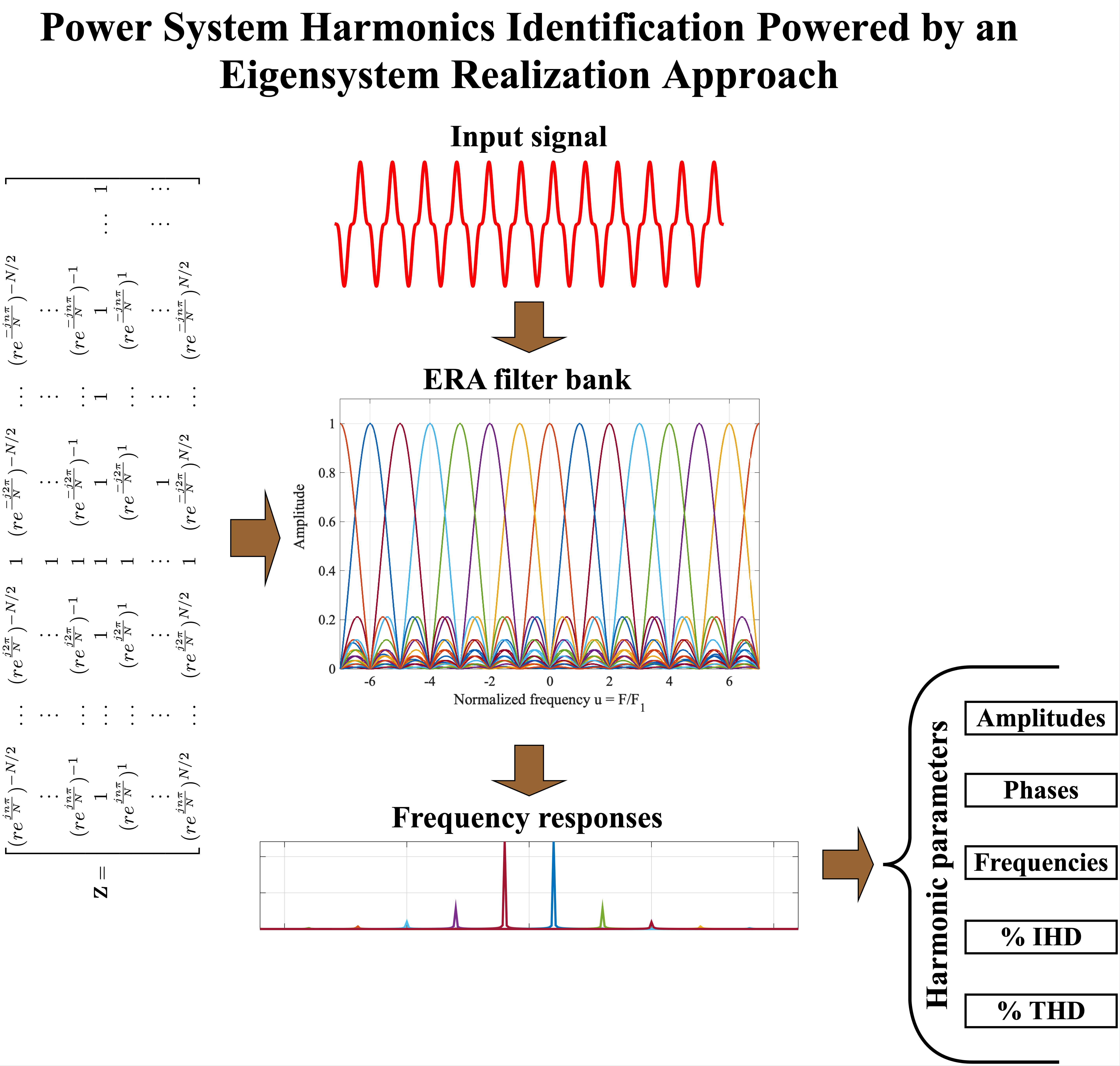
Power System Harmonics Identification Powered by an Eigensystem Realization Approach
Keywords:
Eigensystem realization algorithm, system identification, filter bank frequency response, power quality, total harmonic distortionAbstract
The proliferation of power electronic devices through the massive integration of renewable energy sources on the small and medium scales in power systems has unleashed high harmonic distortions visible in electrical variables such as voltages and currents. Besides the deteriorating power quality, this fact also imposes challenges in quantifying power quality indicators, advocating novel approaches that deal with this issue. In this context, this paper counteracts such challenges by proposing a strategy to effectively measure the individual and total harmonic distortions in modern power grids. The proposal conceives the well-known system identification technique, the eigensystem realization algorithm, as a filter bank to extract the harmonic components from actual measurements and simulated data. Simulation results of two test systems confirm the effectiveness of the proposed method in attaining reliable estimates for the power system transient harmonics, inter-harmonics, and sub-harmonics. Furthermore, actual measurements corresponding to the energizing of a bank of three single-phase transformers connected in grounded Wye-Delta in an isolated lab-scale system are used. The well-known fast Fourier transform (FFT) approach is also applied to validate the proposition, resulting in the proposed ERA-based method is up to 50 times more precise in some cases than FFT.
Downloads
References
L. Qi, L. Qian, S. Woodruff, and D. Cartes, “Prony analysis for power system transient harmonics,” EURASIP Journal on Advances in Signal
Processing, vol. 2007, no. 1, p. 048406, 2007. doi: 10.1155/2007/48406.
I. Kamwa, ed., Monitoring and Control using Synchrophasors in Power Systems with Renewables. Energy Engineering, Institution of Engineering and Technology, 2020.
S. A. Soliman and A. M. Alkandari, “Electric power systems harmonics - identification and measurements,” in Power Quality (G. R. Rey and L. M. Muneta, eds.), ch. 1, Rijeka: IntechOpen, 2011. doi: 10.5772/16412.
A. Alizade and J. B. Noshahr, “Evaluating noise and dc offset due to inter-harmonics and supra-harmonics caused by back-to-back converter of (dfig) in ac distribution network,” CIRED, vol. 2017, pp. 629–632, 2017. doi: 10.1049/oap-cired.2017.0045.
A. E. Arranz Gim´on, A. Zorita, D. Mor´ı ˜nigo Sotelo, and O. Duque, “A review of total harmonic distortion factors for the measurement of harmonic and interharmonic pollution in modern power systems,” Energies, vol. 14, p. 6467, 10 2021. doi: https://doi.org/10.3390/en14206467.
P. F. Ribeiro, C. A. Duque, P. M. Ribeiro, and A. S. Cerqueira, Power Systems Signal Processing for Smart Grids. Wiley, 2014. doi:
1002/9781118639283.
S. Ghosh and D. Chatterjee, “Non-intrusive identification of harmonic polluting loads in a smart residential system,” Sustainable
Energy, Grids and Networks, vol. 26, p. 100446, 2021. doi: https://doi.org/10.1016/j.segan.2021.100446.
V. Ravindran, S. K. R¨onnberg, and M. H. Bollen, “Interharmonics in pv systems: a review of analysis and estimation methods;
considerations for selection of an apt method,” IET Renewable Power Generation, vol. 13, no. 12, pp. 2023–2032, 2019. doi:
https://doi.org/10.1049/iet-rpg.2018.5697.
A. Andreotti, A. Bracale, P. Caramia, and G. Carpinelli, “Adaptive prony method for the calculation of power-quality indices in the presence of nonstationary disturbance waveforms,” IEEE Transactions on Power Delivery, vol. 24, no. 2, pp. 874–883, 2009. doi: 10.1109/TPWRD.2008.923992.
I. Y.-H. Gu and M. H. J. Bollen, “Estimating interharmonics by using sliding-window esprit,” IEEE Trans. Power Deliv., vol. 23, no. 1,
pp. 13–23, 2008. doi: 10.1109/TPWRD.2007.911130.
J.-Q. Lin, S.-C. Chan, and H.-C. Wu, “A robust past-based esprit algorithm with variable forgetting factor and regularization for
frequencies/harmonics estimation in impulsive noise,” IEEE Transactions on Instrumentation and Measurement, vol. 71, pp. 1–13, 2022. doi:
1109/TIM.2022.3173613.
H. C. Lin, “Development of interharmonics identification using enhancedfft algorithm,” The Journal of Engineering, vol. 2017, no. 7, pp. 333–342, 2017. doi: https://doi.org/10.1049/joe.2017.0133.
C. Altintasi, O. Aydin, M. C. Taplamacioglu, and O. Salor, “Power system harmonic and interharmonic estimation using vortex search
algorithm,” Electric Power Systems Research, vol. 182, p. 106187, 2020. doi: https://doi.org/10.1016/j.epsr.2019.106187.
R. A. de Oliveira, V. Ravindran, S. K. R¨onnberg, and M. H. Bollen, “Deep learning method with manual post-processing for identification
of spectral patterns of waveform distortion in pv installations,” IEEE Transactions on Smart Grid, vol. 12, no. 6, pp. 5444–5456, 2021. doi:
1109/TSG.2021.3107908.
C. Ge, R. A. Oliveira, I. Y. Gu, and M. H. Bollen, “Unsupervised deep learning and analysis of harmonic variation patterns using big data
from multiple locations,” Electric Power Systems Research, vol. 194, p. 107042, 2021. doi: https://doi.org/10.1016/j.epsr.2021.107042.
A. Eslami, M. Negnevitsky, E. Franklin, and S. Lyden, “Review of ai applications in harmonic analysis in power systems,” Renewable
and Sustainable Energy Reviews, vol. 154, p. 111897, 2022. doi: https://doi.org/10.1016/j.rser.2021.111897.
K. Sheshyekani, G. Fallahi, M. Hamzeh, and M. Kheradmandi, “A general noise-resilient technique based on the matrix pencil method for the assessment of harmonics and interharmonics in power systems,” IEEE Transactions on Power Delivery, vol. 32, no. 5, pp. 2179–2188, 2017. doi: 10.1109/TPWRD.2016.2625329.
Y. E. Vatankulu, Z. S¸ent ¨urk, and O. Salor, “Harmonics and interharmonics analysis of electrical arc furnaces based on spectral
model optimization with high-resolution windowing,” IEEE Transactions on Industry Applications, vol. 53, no. 3, pp. 2587–2595, 2017. doi:
1109/TIA.2017.2669328.
Z. Jin, H. Zhang, F. Shi, Y. Sun, and V. Terzija, “A robust and adaptive detection scheme for interharmonics in active distribution network,” IEEE Transactions on Power Delivery, vol. 33, no. 5, pp. 2524–2534, 2018. doi: 10.1109/TPWRD.2018.2815565.
T. Lobos, T. Kozina, and H.-J. Koglin, “Power system harmonics estimation using linear least squares method and svd,” in IMTC/99.
Proceedings of the 16th IEEE Instrumentation and Measurement Technology Conference (Cat. No.99CH36309), vol. 2, pp. 789–794 vol.2,
doi: 10.1109/IMTC.1999.776975.
N. K¨ose, ¨ Ozg¨ul Salor, and K. Leblebicio˘glu, “Interharmonics analysis of power signals with fundamental frequency deviation using kalman filtering,” Electric Power Systems Research, vol. 80, no. 9, pp. 1145–1153, 2010. doi: https://doi.org/10.1016/j.epsr.2010.03.006.
J. Sanchez-Gasca and D. Trudnowski, “Identification of electromechanical modes in power system,” tech. rep., IEEE Task Force on Identification of Electromechanical Modes of the Power System Stability, Power & Energy Society, June 2012. doi: 10.17023/2nn1-tn85.
J.-N. Juang and R. S. Pappa, “An eigensystem realization algorithm for modal parameter identification and model reduction,” Journal of
Guidance, Control, and Dynamics, vol. 8, no. 5, pp. 620–627, 1985. doi: https://doi.org/10.2514/3.20031.
J. A. de la O Serna, G. Castillo-Garc´ıa, M. R. Arrieta-Paternina, and A. Zamora-M´endez, “8 - power quality harmonic monitoring
by the o-splines-based multiresolution signal decomposition,” in Monitoring and Control of Electrical Power Systems Using
Machine Learning Techniques (E. Barocio Espejo, F. R. Segundo Sevilla, and P. Korba, eds.), pp. 191–217, Elsevier, 2023. doi:
https://doi.org/10.1016/B978-0-32-399904-5.00014-4.
“Electromagnetic compatibility (emc) - part 4-7: Testing and measurement techniques - general guide on harmonics and interharmonics measurement and instrumentation, for power supply systems and equipment connected thereto,” IEC 61000-4-7:2002+AMD1:2008 CSV 2008.
S. I. Inc., “Sas/stat® 15.1 user’s guide. cary, nc: Sas institute inc..” https://documentation.sas.com/doc/en/helpcenterwlcm/1.0/home.htm, 2018.
M. R. A. Paternina, J. M. Ramirez-Arredondo, J. D. Lara-Jimenez, and A. Zamora-Mendez, “Dynamic equivalents by modal decomposition of tie-line active power flows,” IEEE Transactions on Power Systems, vol. 32, pp. 1304–1314, March 2017. doi: 10.1109/TPWRS.2016.2572601.
S. Documentation, “Harmonic analysis of a three-phase rectifier.” https://www.mathworks.com/help/sps/ug/harmonic-analysis-of-a-threephase-rectifier.html, 2020.
P. Kundur, Power system stability and control. McGraw-hill, Inc., New York, 1994.
V. Preciado, M. Madrigal, E. Muljadi, and V. Gevorgian, “Harmonics in a wind power plant: Preprint,” 4 2015. doi: 10.1109/PESGM.2015.7285774.
M. B. Marz, “Interharmonics : What they are , where they come from and what they,” 2016.
P. Gnaci ´nski, D. Hallmann, P. Klimczak, A. Muc, and M. Pepli ´nski, “Effects of negative sequence voltage subharmonics on cage induction motors,” Energies, vol. 15, no. 23, 2022. doi: 10.3390/en15238797.
Z. Wen, S. Peng, J. Yang, J. Deng, H. He, and T. Wang, “Analysis of the propagation characteristic of subsynchronous oscillation in wind integrated power system,” Energies, vol. 12, no. 6, 2019. doi: 10.3390/en12061081