Data-Driven Power System Linear Model Identification via Quadrature-Based Balanced Truncation
Keywords:
Balanced truncation, quadrature rules, system identification, directional frequency data-set, power system linear modelAbstract
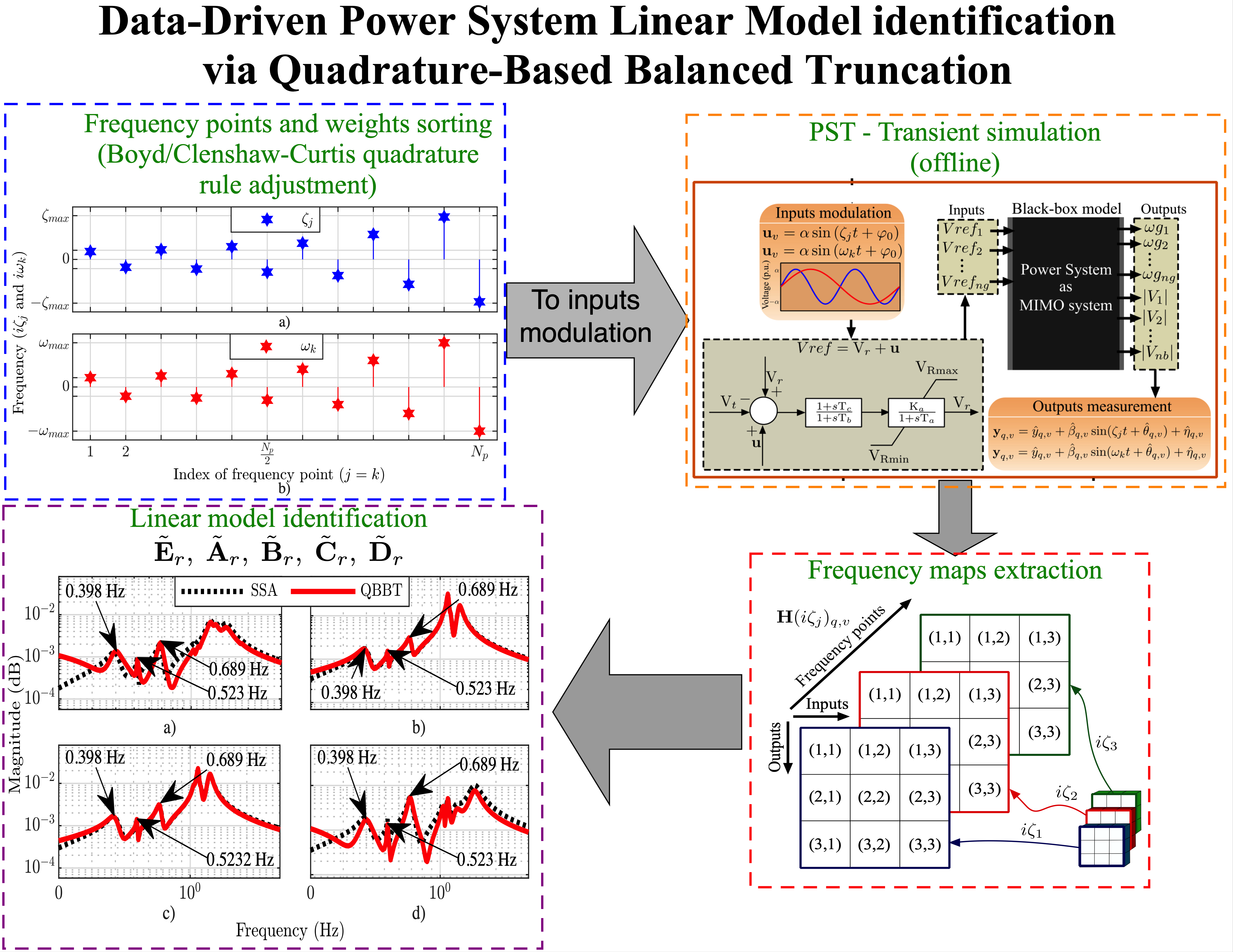
This paper introduces the novel formulation of the quadrature-based balanced truncation (QBBT) method to precisely identify large-scale power system linear models. The QBBT interpolates a directional frequency dataset that is extracted from a dynamic system, following a quadrature rule to be applied from weighted data to derive a linear system model based on approximations of Gramians, and providing an alternative approach to the classic balanced truncation (BT) formulation that makes use of the system model. In this investigation, an accurate theoretical framework is presented to achieve the application of QBBT considering power systems as black-box models. The Boyd/Clenshaw-Curtis (BCC) quadrature rule is implemented by using different adjustments to accurately identify linear models of different order. The attained results and their validation with analytical power system models confirm the method's potential to retail oscillatory dynamics. The QBBT's effectiveness is compared with the Loewner-based frequency interpolation (LBFI) approach and the BT method on the Klein-Rogers-Kundur (KRK) benchmark power system and the equivalent of the New England transmission system - New York power system (NETS-NYPS), achieving a small absolute error in the magnitude of the frequency response of the models of the order of 1x10⁻³ dB in comparison with other state-of-the-art methods.
Downloads
References
X.-F. Wang, Y. Song, and M. Irving, Modern power systems analysis. Springer Science & Business Media, 2010.
P. S. Kundur, N. J. Balu, and M. G. Lauby, “Power system dynamics and stability,” Power system stability and control, vol. 3, pp. 700–701, 2017.
N. Hatziargyriou, J. Milanovic, et al., “Definition and classification of power system stability–revisited & extended,” IEEE Trans. Power Systems, vol. 36, no. 4, pp. 3271–3281, 2020, doi: 10.1109/TPWRS.2020.3041774.
P. Kundur, Power system stability. CRC Press New York, 2007, vol. 10.
P. W. Sauer, M. A. Pai, and J. H. Chow, Power system dynamics and stability: with synchrophasor measurement and power system toolbox. John Wiley & Sons, 2017, ch. 8.
J. H. Chow and J. J. Sanchez-Gasca, Power system modeling, computation, and control. John Wiley & Sons, 2020, ch. 6.
P. Kundur and L. Wang, “Small signal stability analysis: experiences, achievements, and challenges,” in Proceedings. Intern. Conference on Power System Technology, vol. 1, 2002, pp. 6–12, doi: 10.1109/ICPST.2002.1053494.
B. Moore, “Principal component analysis in linear systems: Controllability, observability, and model reduction,” IEEE Trans. automatic control, vol. 26, no. 1, pp. 17–32, 1981, doi: 10.1109/TAC.1981.1102568.
F. D. Freitas, J. Rommes, and N. Martins, “Gramian-based reduction method applied to large sparse power system descriptor models,” IEEE Trans. Power Systems, vol. 23, no. 3, pp. 1258–1270, 2008, doi: 10.1109/TPWRS.2008.926693.
J. W. Pierre, D. Trudnowski, and et al., “Overview of system identification for power systems from measured responses,” IFAC Proceedings Volumes, vol. 45, no. 16, pp. 989–1000, 2012, doi: https://doi.org/10.3182/20120711-3-BE-2027.00412.
N. Zhou, J. W. Pierre, and J. F. Hauer, “Initial results in power system identification from injected probing signals using a subspace method,” IEEE Trans. power systems, vol. 21, no. 3, pp. 1296–1302, 2006, doi: 10.1109/TPWRS.2006.879292.
R. Chakraborty, H. Jain, et al., “A review of active probing-based system identification techniques with applications in power systems,” Intern. J. of Electrical Power & Energy Systems, vol. 140, p. 108008, 2022, doi: https://doi.org/10.1016/j.ijepes.2022.108008.
J. Sanchez-Gasca, D. Trudnowski, et al., “Identification of electromechanical modes in power systems,” in IEEE Task Force Report, Special Publication TP462, 2012, doi: 10.17023/2nn1-tn85.
A. Almunif, L. Fan, and Z. Miao, “A tutorial on data-driven eigenvalue identification: Prony analysis, matrix pencil, and eigensystem realization algorithm,” Intern. Trans. Electrical Energy Systems, vol. 30, no. 4, p. e12283, 2020, doi: https://doi.org/10.1002/2050-7038.12283.
M. L. Crow and A. Singh, “The matrix pencil for power system modal extraction,” IEEE Trans. Power Systems, vol. 20, no. 1, pp. 501–502,
, doi: 10.1109/TPWRS.2004.841158.
J.-N. Juang and R. S. Pappa, “An eigensystem realization algorithm for modal parameter identification and model reduction,” Journal of Guidance, Control, and Dynamics, vol. 8, no. 5, pp. 620–627, 1985, doi: https://doi.org/10.2514/3.20031.
C. F. Van Loan and G. H. Golub, Matrix computations. University Press Baltimore, 1983, vol. 3. Johns Hopkins.
J. Moreno-Corbea, M. Paternina, et al., “On-line system identification of power system linear models,” in 2023 IEEE Power & Energy Society General Meeting (PESGM), 2023, pp. 1–5, doi: 10.1109/PESGM52003.2023.10252494.
H. Ma, D. Yang, et al., “Power system equivalent inertia estimation method using system identification,” in IEEE 5th Intern. Conf. on Electron. Tech. (ICET), 2022, pp. 360–365, doi: 10.1109/ICET55676.2022.9824227.
G. E. Mejia-Ruiz, M. R. A. Paternina, et al., “Real-time co-simulation of transmission and distribution networks integrated with distributed energy resources for frequency and voltage support,” Applied Energy, vol. 347, p. 121046, 2023, doi: https://doi.org/10.1016/j.apenergy.2023.121046.
A. Mayo and A. Antoulas, “A framework for the solution of the generalized realization problem,” Linear algebra and its applications, vol. 425, no. 2-3, pp. 634–662, 2007, doi: https://doi.org/10.1016/j.laa.2007.03.008.
G. Gurrala, “Loewner matrix approach for modelling fdnes of power systems,” Electric Power Systems Research, vol. 125, pp. 116–123, 2015, doi: https://doi.org/10.1016/j.epsr.2015.03.016.
C. Rergis, I. Kamwa, et al, “A Loewner interpolation method for power system identification and order reduction,” IEEE Trans. Power Systems, vol. 34, no. 3, pp. 1834–1844, 2018, doi: 10.1109/TPWRS.2018.2884655.
F. Zelaya-A, J. H. Chow, et al., “Data-driven power system linear model identification for selective modal analysis by frequency interpolations,” IET Generation, Transmission & Distribution, vol. 15, no. 6, pp. 1107–1121, 2021, doi: https://doi.org/10.1049/gtd2.12084.
I. V. Gosea, S. Gugercin, and C. Beattie, “Data-driven balancing of linear dynamical systems,” SIAM Journal on Scientific Computing, vol. 44, no. 1, pp. A554–A582, 2022, doi: https://doi.org/10.1137/21M1411081.
A. Morched, B. Gustavsen, and M. Tartibi, “A universal model for accurate calculation of electromagnetic transients on overhead lines and underground cables,” IEEE Trans. Power Delivery, vol. 14, no. 3, pp. 1032–1038, 1999, doi: 10.1109/61.772350.
B. Gustavsen and A. Semlyen, “A robust approach for system identification in the frequency domain,” IEEE Trans. power delivery, vol. 19, no. 3, pp. 1167–1173, 2004, doi: 10.1109/TPWRD.2003.822530.
B. Gustavsen, “Wideband modeling of power transformers,” IEEE Trans. Power Delivery, vol. 19, no. 1, pp. 414–422, 2004, doi: 10.1109/TPWRD.2003.820197.
M. Dehghani and S. K. Y. Nikravesh, “State-space model parameter identification in large-scale power systems,” IEEE Trans. Power Systems, vol. 23, no. 3, pp. 1449–1457, 2008, doi: 10.1109/TPWRS.2008.922632.
M. R. A. Paternina, C. Castrillón-Franco, et al., “Enhancing wide-area damping controllers via data-assisted power system linear models,” Electric Power Systems Research, vol. 217, p. 109085, 2023, doi: https://doi.org/10.1016/j.epsr.2022.109085.
J. H. Chow, Power system coherency and model reduction. 2013, vol. 84. Springer,
N. Sarkar, K. Rao, and K. Shubhanga, “A comparative study between prony and eigensystem realization algorithm for identification of electromechanical modes,” in 2018 20th National Power Systems Conference (NPSC), 2018, pp. 1–6, doi: 10.1109/NPSC.2018.8771722.
S. Ghosh and N. Senroy, “Balanced truncation approach to power system model order reduction,” Electric Power Components and Systems, vol. 41, no. 8, pp. 747–764, 2013, doi: https://doi.org/10.1080/15325008.2013.769031.
S. K. Suman and A. Kumar, “Model reduction of power system by modified balanced truncation method,” Univers. J. Control Autom, vol. 8, no. 3, pp. 41–52, 2020, doi: 10.13189/ujca.2020.080301.
C. E. Grosch and S. A. Orszag, “Numerical solution of problems in unbounded regions: coordinate transforms,” Journal of Computational Physics, vol. 25, no. 3, pp. 273–295, 1977, doi: https://doi.org/10.1016/0021-9991(77)90102-4.
J. P. Boyd, “The optimization of convergence for Chebyshev polynomial methods in an unbounded domain,” Journal of computational physics, vol. 45, no. 1, pp. 43–79, 1982, doi: https://doi.org/10.1016/0021-9991(82)90102-4.
——, “Exponentially convergent Fourier-Chebyshev quadrature schemes on bounded and infinite intervals,” Journal of Scientific Computing, vol. 2, pp. 99–109, 1987, doi: https://doi.org/10.1007/BF01061480.
G. Strang, Linear algebra and its applications, 2012.
P. S. Kundur and O. P. Malik, Power system stability and control. McGraw-Hill Education, 2022.
J. H. Chow and K. W. Cheung, “A toolbox for power system dynamics and control engineering education and research,” IEEE Trans. Power Systems, vol. 7, no. 4, pp. 1559–1564, 1992, doi: 10.1109/59.207380.
M. Jonsson, M. Begovic, and J. Daalder, “A new method suitable for real-time generator coherency determination,” IEEE Trans. Power Systems, vol. 19, no. 3, pp. 1473–1482, 2004, doi: 10.1109/TPWRS.2004.826799.
H. Min and E. Mallada, “Spectral clustering and model reduction for weakly-connected coherent network systems,” in 2023 American Control Conference (ACC), 2023, pp. 2957–2962, doi: 10.23919/ACC55779.2023.10156212.