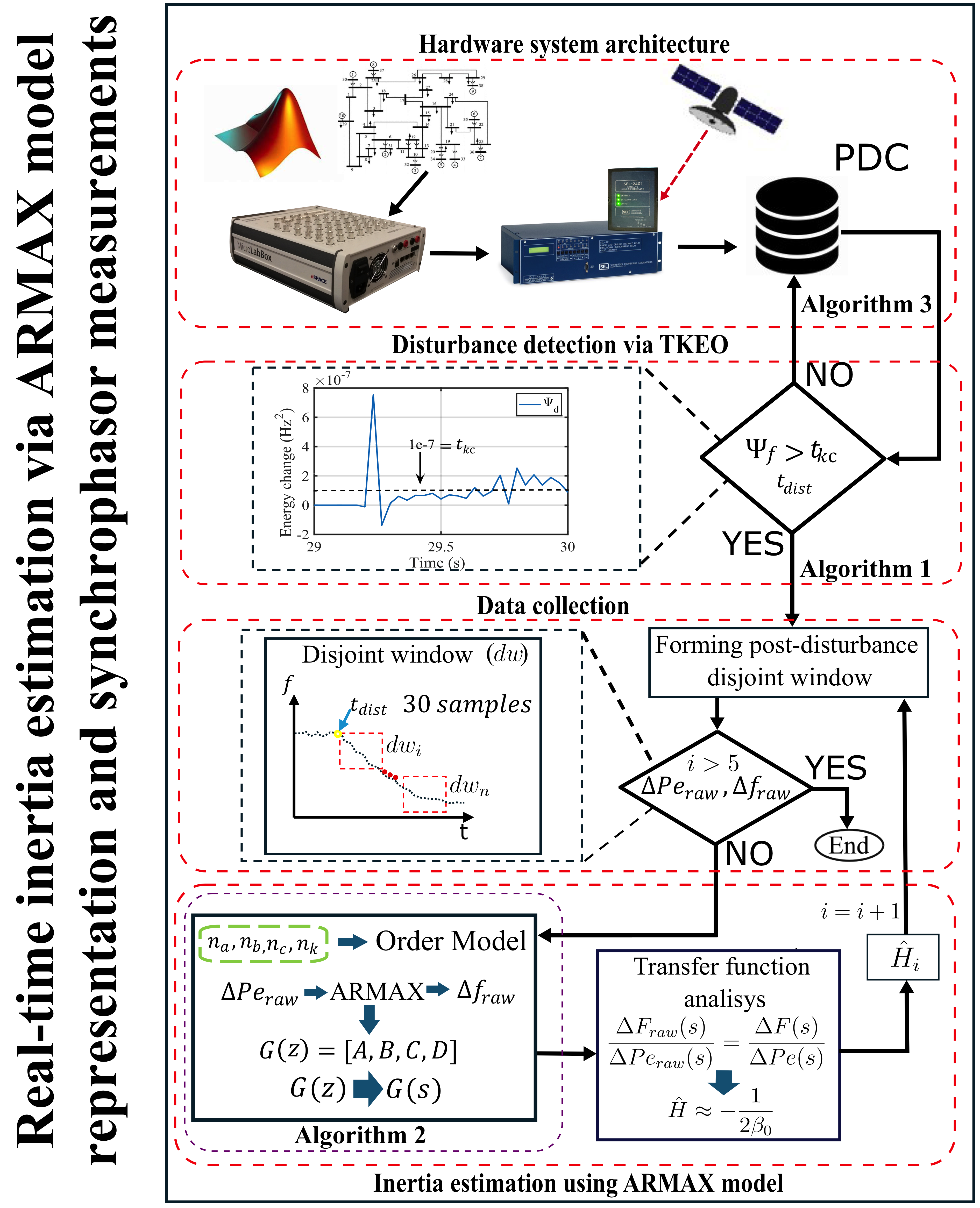
Real-time inertia estimation via ARMAX model representation and synchrophasor measurements
Keywords:
Inertia estimation, Frequency response, PMU, Online estimationAbstract
This paper introduces the real-time implementation with the actual hardware architecture environment (HAE) of an online estimation method that tracks the equivalent time-varying inertia in power systems. The proposed method enables automated and accurate inertia estimation, exploiting the ARMAX model representation and the Teager-Kaiser energy operator (TKEO) disturbance time detector. The effectiveness and high accuracy of the proposed framework are successfully validated in laboratory conditions with actual synchronised measurements from Phasor Measurement Units (PMUs) over a real-time emulated New England 39-bus system.
The estimate is achieved with a relative error ranging from 0.1% to 7%, even under noisy conditions and atypical measurement values. The literature reviewed does not report any estimation method that is more accurate than the one proposed in this work.
Downloads
References
K. S. Ratnam, K. Palanisamy, and G. Yang, “Future low-inertia power systems: Requirements, issues, and solutions - a review,” Renewable
and Sustainable Energy Reviews, vol. 124, p. 109773, 2020, doi: https://doi.org/10.1016/j.rser.2020.109773.
A. Fernández-Guillamón and et al, “Power systems with high renewable energy sources: A review of inertia and frequency control strategies over time,” Renewable and Sustainable Energy Reviews, vol. 115, p. 109369, 2019, doi: https://doi.org/10.1016/j.rser.2019.109369.
Y. Su and et al, “An adaptive pv frequency control strategy based on real-time inertia estimation,” IEEE Trans. Smart Grid, vol. 12, no. 3, pp. 2355–2364, 2021, doi: 10.1109/TSG.2020.3045626.
B. Wang and et al, “An improved electromechanical oscillation-based inertia estimation method,” IEEE Trans. Power Systems, vol. 37, no. 3, pp. 2479–2482, 2022, doi: 10.1109/TPWRS.2022.3156441.
W. Zhang and et al, “Impedance-based online estimation of nodal inertia and primary frequency regulation capability,” IEEE Trans. Power Systems, vol. 38, no. 3, pp. 2748–2760, 2023, doi: 10.1109/TPWRS.2022.3186525.
J. Schiffer, P. Aristidou, and R. Ortega, “Online estimation of power system inertia using dynamic regressor extension and mixing,” IEEE
Trans. Power Systems, vol. 34, no. 6, pp. 4993–5001, 2019, doi: 10.1109/TPWRS.2019.2915249.
A. Gorbunov, A. Dymarsky, and J. Bialek, “Estimation of parameters of a dynamic generator model from modal PMU measurements,”
IEEE Trans. Power Systems, vol. 35, no. 1, pp. 53–62, 2020, doi: 10.1109/TPWRS.2019.2925127.
D. Li and et al, “Area inertia estimation of power system containing wind power considering dispersion of frequency response based on measured area frequency,” IET Generation, Transmission & Distribution, vol. 16, no. 22, pp. 4640–4651, 2022, doi: https://doi.org/10.1049/gtd2.12628.
H. Yin and et al, “Precise rocof estimation algorithm for low inertia power grids,” Electric Power Systems Research, vol. 209, p. 107968,
, doi: https://doi.org/10.1016/j.epsr.2022.107968.
T. Kerdphol and et al, “Inertia estimation of the 60 hz japanese power system from synchrophasor measurements,” IEEE Trans. Power Systems, pp. 1–1, 2022, doi: 10.1109/TPWRS.2022.3168037.
G. Cai and et al, “Inertia estimation based on observed electromechanical oscillation response for power systems,” IEEE Trans. Power Systems, vol. 34, no. 6, pp. 4291–4299, 2019, doi: 10.1109/TPWRS.2019.2914356.
C. Phurailatpam and et al, “Measurement-based estimation of inertia in ac microgrids,” IEEE Trans. Sustainable Energy, vol. 11, no. 3, pp. 1975–1984, 2019, doi: 10.1109/TSTE.2019.2948224.
C. Phurailatpam, Z. H. Rather, B. Bahrani, and S. Doolla, “Estimation of non-synchronous inertia in ac microgrids,” IEEE
Trans. Sustainable Energy, vol. 12, no. 4, pp. 1903–1914, 2021, doi: 10.1109/TSTE.2021.3070678.
L. Lugnani and et al, “Armax-based method for inertial constant estimation of generation units using synchrophasors,” Electric
Power System Research, vol. 180, p. 106097, 2020, doi: https://doi.org/10.1016/j.epsr.2019.106097.
B. Wang and et al, “Online inertia estimation using electromechanical oscillation modal extracted from synchronized ambient data,” Journal of Modern Power Systems and Clean Energy, vol. 10, no. 1, pp. 241–244, 2022, doi: 10.35833/MPCE.2020.000105.
F. Allella and et al, “On-line estimation assessment of power systems inertia with high penetration of renewable generation,” IEEE Access, vol. 8, pp. 62 689–62 697, 2020, doi: 10.1109/ACCESS.2020.2983877.
D. Yang and et al, “Data-driven estimation of inertia for multiarea interconnected power systems using dynamic mode decomposition,”
IEEE Trans. Industrial Informatics, 2020, doi: 10.1109/TII.2020.2998074.
P. Makolo, R. Zamora, and T.-T. Lie, “Online inertia estimation for power systems with high penetration of res using recursive
parameters estimation,” IET Renewable Power Generation, 2021, doi: https://doi.org/10.1049/rpg2.12181.
B. Wang and et al, “Power system inertia estimation method based on maximum frequency deviation,” IET Renewable Power Generation, vol. 16, no. 3, pp. 622–633, 2022, doi: https://doi.org/10.1049/rpg2.12367.
P. Wall and V. Terzija, “Simultaneous estimation of the time of disturbance and inertia in power systems,” IEEE Trans. Power Del., vol. 29, no. 4, 2014, doi: 10.1109/TPWRD.2014.2306062.
P. M. Ashton, C. S. Saunders, G. A. Taylor, A. M. Carter, and M. E. Bradley, “Inertia estimation of the GB power system using
synchrophasor measurements,” IEEE Trans. on PS, vol. 30, no. 2, 2015, doi: 10.1109/TPWRS.2014.2333776.
W. Wang and et al, “Fast and accurate frequency response estimation for large power system disturbances using second derivative of frequency data,” IEEE Trans. Power Systems, vol. 35, no. 3, pp. 2483–2486, 2020, doi: 10.1109/TPWRS.2020.2977504.
F. Zeng and et al, “Online estimation of power system inertia constant under normal operating conditions,” IEEE Access, vol. 8, pp. 101 426–101 436, 2020, doi: 10.1109/ACCESS.2020.2997728.
Y. Cui, S. You, and Y. Liu, “Ambient synchrophasor measurement based system inertia estimation,” in 2020 IEEE Power &
Energy Society General Meeting (PESGM), 2020, pp. 1–5, doi: 10.1109/PESGM41954.2020.9281662.
J. Liu and et al, “Online estimation of poi-level aggregated inertia considering frequency spatial correlation,” IEEE Trans. Power Systems, pp. 1–13, 2022, doi: 10.1109/TPWRS.2022.3197129.
B. Tan, J. Zhao, V. Terzija, and Y. Zhang, “Decentralized datadriven estimation of generator rotor speed and inertia constant
based on adaptive unscented kalman filter,” Intern. J. of Electrical Power & Energy Systems, vol. 137, p. 107853, 2022, doi:
https://doi.org/10.1016/j.ijepes.2021.107853.
J. Guo, X. Wang, and B.-T. Ooi, “Estimation of inertia for synchronous and non-synchronous generators based on ambient measurements,” IEEE Trans. Power Systems, vol. 37, no. 5, pp. 3747–3757, 2022, doi:
1109/TPWRS.2021.3134818.
——, “Online purely data-driven estimation of inertia and center-of inertia frequency for power systems with vsc-interfaced energy sources,” Intern. J. of Electrical Power & Energy Systems, vol. 137, p. 107643, 2022, doi: https://doi.org/10.1016/j.ijepes.2021.107643.
K. Tuttelberg and et al, “Estimation of power system inertia from ambient wide area measurements,” IEEE Trans. Power Systems, vol. 33, no. 6, pp. 7249–7257, 2018, doi: 10.1109/TPWRS.2018.2843381.
J. Zhao, Y. Tang, and V. Terzija, “Robust online estimation of power system center of inertia frequency,” IEEE Trans. Power Systems, vol. 34, no. 1, pp. 821–825, 2019, doi: 10.1109/TPWRS.2018.2879782.
R. K. Panda and et al, “Online estimation of system inertia in a power network utilizing synchrophasor measurements,” IEEE Trans. Power Systems, vol. 35, no. 4, pp. 3122–3132, 2020, doi: 10.1109/TPWRS.2019.2958603.
Y. Li and et al, “Real-time estimation of time-varying inertia for nonsynchronous devices using streaming dynamic mode decomposition,” Intern. J. of Electrical Power & Energy Systems, vol. 157, p. 109847, 2024, doi: https://doi.org/10.1016/j.ijepes.2024.109847.
J. Zhao and et al, “Roles of dynamic state estimation in power system modeling, monitoring and operation,” IEEE Trans. Power Systems, vol. 36, no. 3, pp. 2462–2472, 2021, ddoi: 10.1109/TPWRS.2020.3028047.
“IEEE standard for synchrophasor measurements for power systems,” IEEE Std C37.118.1-2011 (Revision of IEEE Std C37.118-2005), pp.
–61, 2011, doi: 10.1109/IEEESTD.2011.6111219.
H. M. Teager and S. M. Teager, “Evidence for nonlinear sound production mechanisms in the vocal tract,” in Speech Production and Modelling, vol. 55. ser. NATO Advanced Study Institute Series D, W. J. Hardcastle and A. Marchal, Eds. Boston, MA: Kluwer, Jul 1989, pp. 17–29, doi: https://doi.org/10.1007/978-94-009-2037-8_10.
J. Kaiser, “On a simple algorithm to calculate the ’energy’ of a signal,” in International Conference on Acoustics, Speech, and Signal Processing, 1990, pp. 381–384 vol.1, doi: 10.1109/ICASSP.1990.115702.
P. Maragos and A. Potamianos, “Higher order differential energy operators,” IEEE Signal Processing Letters, vol. 2, no. 8, pp. 152–154,
, doi: 10.1109/97.404130.
D. Rodales, , and et al., “Model-free inertia estimation in bulk power grids through o-splines,” Intern. J. of Electrical Power & Energy Systems, vol. 153, p. 109323, 2023, doi: https://doi.org/10.1016/j.ijepes.2023.109323.
T. Athay, R. Podmore, and S. Virmani, “A practical method for the direct analysis of transient stability,” IEEE Trans. Power Apparatus and Systems, vol. PAS-98, no. 2, pp. 573–584, 1979, doi: 10.1109/TPAS.1979.319407.
A. Sanchez-Ocampo and et al, Real-time inertia estimation, 2024 (accessed Feb 27, 2024), https://github.com/Alo991/Real-time-inertiaestimation.git.
M. Liu, J. Chen, and F. Milano, “On-line inertia estimation for synchronous and non-synchronous devices,” IEEE Transactions
on Power Systems, vol. 36, no. 3, pp. 2693–2701, 2021, doi: 10.1109/TPWRS.2020.3037265.