Bidirectional Step-Up Multi-Input Converter with Improved Voltage Gain for DC Microgrids
Keywords:
multiport, multi-input single output, bidirectional, ConverterAbstract
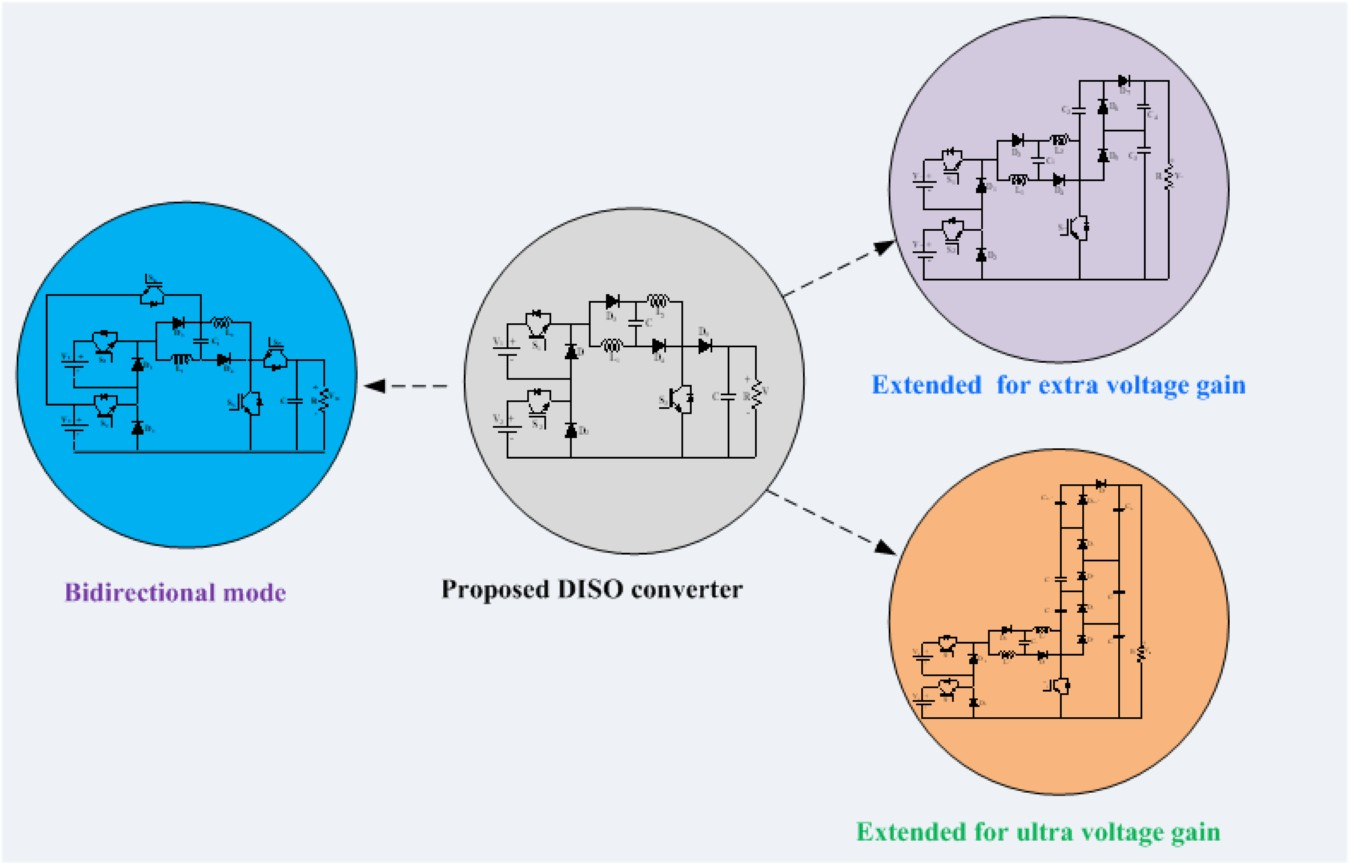
High-gain converters are well-established circuit designs that find practical use in industrial and commercial settings, particularly in applications demanding high power ratings, such as Fuel Cell Electric Vehicles (FCEV) and grid-connected Renewable Energy Sources (RES). High-gain topologies from a single source pose reliability issue in RES applications due to increased device count and stress. In the event of source failure, these topologies may lead to an energy supply gap for the loads. Addressing this challenge, integrating diverse energy sources with step-up voltage capability stands as a promising solution for both DC microgrid and Electric Vehicle (EV) applications. In this study, a Dual-Input Single-Output (DISO) converter is introduced to integrate various sources and achieve an increased output voltage gain by charging the inductors in parallel and discharging them in series. Moreover, if any sources fail, the converter can supply the energy to the load from the available source and it can be operated in bidirectional mode. This paper also extensively discusses theoretical analysis, considerations related to design and circuit modeling. Furthermore, include a comparison of this converter with several other topologies. It examined to validated with a 250 W laboratory prototype.
Downloads
References
E. Martinez-Vera and P. Bañuelos-Sanchez, “Review of Bidirectional DC-DC Converters and Trends in Control Techniques for Applications in Electric Vehicles”, IEEE Latin America Tans. vol. 22, no. 2, pp. 144-155, Feb. 2024, dio: 10.1109/TLA.2024.10412031.
K. Manikanta, and R. Chinthamalla, “A Novel Transformerless Ultra Gain DC-DC Converter for Renewable Micro Energy Sources”, IEEE Latin America Tans. vol. 22, no. 8, pp. 695-704, Aug. 2024, dio: 10.1109/TLA.2024.10620415.
R. Sundarakamath, S. Natarajan, “Integration of multiple sources for fuel cell hybrid electric vehicles using single inductor multi-input converter”, I. J. Hydrogen Energy. vol. 53, pp. 503-516, Jan. 2024, doi.org/10.1016/j.ijhydene.2023.12.037.
S. P. Yalla, P. S. Subudhi, and V. K. Ramachandaramurthy, “Topological review of hybrid RES based multi-port converters”, IET Renewable Power Generation, vol. 16, no. 6, pp. 1087--1106, Oct. 2022, doi.org/10.1049/rpg2.12356.
S. Hou, J. Chen, T. Sun and X. Bi, "Multi-input Step-Up Converters Based on the Switched-Diode-Capacitor Voltage Accumulator", IEEE Trans. Power Electron., vol. 31, no. 1, pp. 381-393, Jan. 2016, dio:10.1109/TPEL.2015.2399853.
J. Sebastian, P. Villegas, F. Nuno and M. Hernando, "High-efficiency and wide-bandwidth performance obtainable from a two-input buck converter", IEEE Tran. Power Electron., vol. 13, no. 4, pp. 706- 717, July 1998, dio:10.1109/63.704143.
A. Urtasun and D. Lu, "Control of a Single-Switch Two-Input Buck Converter for MPPT of Two PV Strings", IEEE Trans. Ind. Electron., vol. 62, no. 11, pp. 7051-7060, Nov. 2015, dio: 10.1109/TIE.2015.2432097.
M. Banaei, H. Ardi, R. Alizadeh and A. Farakhor, "Non‐isolated multiinput–single‐output DC/DC converter for photovoltaic power generation systems", IET Power Electron., vol. 7, no. 11, pp. 2806-2816, Nov. 2014, doi.org/10.1049/iet-pel.2013.0977.
P. Mohseni, S. Hosseini, M. Sabahi and M. Maalandish, "A multiinput‐single‐output high step‐up DC‐DC converter with low‐voltage stress across semiconductors", I. Trans. Electrical Energy Systems, vol. 29, no. 12, pp. 1-10July 2019, doi.org/10.1002/2050-7038.12123.
K. Varesi, S. Hosseini, M. Sabahi and E. Babaei, "A high-voltage gain nonisolated noncoupled inductor based multi-input DC-DC topology with reduced number of components for renewable energy systems", I. Journal of Circuit Theory and Applications, vol. 46, no. 3, pp. 505-518, Nov. 2017, doi.org/10.1002/cta.2428.
E. Amiri, R. R. Khorasani, E. Adib , and A. Khoshkbar-Sadigh, “Multi-Input High Step-Up DC–DC Converter With Independent Control of Voltage and Powerfor Hybrid Renewable Energy Systems”, IEEE Trans. Ind. Electron., vol. 68, no. 12, pp. 12079-12087, Dec. 2021, dio: 10.1109/TIE.2020.3047038.
T. Jalilzadeh and N. Rostami, “New Multi-Operational Multi-Port DC–DC Converter with Bidirectional Capability”, IET Renew. Power Gener. vol. 17, no. 6, pp.1518-1534, Feb. 2023, doi.org/10.1049/rpg2.12691.
M. Alsolami, “A multi-input, multi-stage step-up DC-DC converter for PV applications”, Alexandria Engineering J., vol.60, no. 2, pp. 2315-2324, Apr.2021, doi.org/10.1016/j.aej.2020.12.030.
A Rajulapati, P Mahalingam “High gain multi-input converter with inherent current sharing mechanism for photovoltaic applications”, Solar Energy, vol. 233, pp. 118-133, Feb. 2022, doi.org/10.1016/j.solener.2022.01.028.
F. Akar, “Decoupled control of a high step-up multi-input converter for renewable energy applications”, AEU-I. J. Electronics and Communications, vol. 163, pp 154597, May 2023, doi.org/10.1016/j.aeue.2023.154597.
A. Deihimi, M. E. S. Mahmoodieh, R. Iravani, “A new multi-input step-up DC–DC converter for hybrid energy systems”, J. Electric Power Systems Research, vol. 149, pp. 111–124, Aug. 2017, doi.org/10.1016/j.epsr.2017.04.017.
P. Mohseni, S. Hosseini, M. Sabahi, T. Jalilzadeh and M. Maalandish, "A New High Step-Up Multi-Input Multi-Output DC–DC Converter", IEEE Trans. Ind. Electron., vol. 66, no. 7, pp. 5197-5208, July 2019, dio: 10.1109/TIE.2018.2868281.
T. Jalizadeh, N. Rostami, E. Babaei and S. Hosseini, "Multiport DC–DC Converter with Step-Up Capability and Reduced Voltage Stress on Switches/Diodes", IEEE Trans. Power Electron.,, vol. 35, no. 11, pp. 11902-11915, Nov. 2020, dio: 10.1109/TPEL.2020.2982454.
S. Harini, N. Chellammal, C. Bharatiraja and M. Lucian, “A Novel High Gain Dual Input Single Output Z-Quasi Resonant (ZQR) DC/DC Converter for Off-Board EV Charging”, IEEE Access, vol. 10, pp. 83350-83367, Aug. 2022, dio: 10.1109/ACCESS.2022.3195936
B. Saikumar and S. Balamurugan, “Design and Validation of a SEPIC-Based Novel Multi-Input DC-DC Converter for Grid-Independent Hybrid Electric Vehicles”, Energies, vol. 15, no. 15, pp. 5663, Aug. 2022, doi.org/10.3390/en15155663.
A. Sivaprasad, C. Bharatiraja G. Saravana Ilango and L. Brad and L. Telles Brunelli, “Performance Evaluation of a Dual-Input Hybrid Step-Up DC–DC Converter”, IEE Trans Ind. Appl. vol. 58, no. 3, pp. 3769-3782, May-June 2022, 10.1109/TIA.2022.3152973.
B. Zhu, Q. Zeng, Y. Chen, Y. Zhao, and S. Liu, “A dual-input high stepup DC/DC converter with ZVT auxiliary circuit,” IEEE Trans. Energy Convers., vol. 34, no. 1, pp. 161–169, Mar. 2019, DOI: 10.1109/TEC.2018.2876303
M. Dhananjaya, M. Vellingiri, M. Z. Alaas, M. Rawa, M. J. Sathik, D. Almakhles, P. Devendra, “New multi-source DC-DC boost converter and its generalized structure with experimental validation”, Ain Shams Engineering J. vol. 14, no. 10, pp. 102173, Oct. 2023, doi.org/10.1016/j.asej.2023.102173.
V. Ramanarayanan, “Course Material on Switched Mode Power Conversion”, IISc., Bangalore, vol. 560012, pp. 1-460, Jan. 2008 DOI:10.1013/687090706140.
K. Marian, K. Czuk. Pulse-Width Modulated DC–DC Power Converters. New York: Wiley & Sons; pp. 1-800, 2008, DOI:10.1002/9780470694640.