Obtaining Frequency Responses of User-Defined Models in the ATP
Keywords:
ATP Models, Frequency-Dependent Network Equivalent (FDNE), Frequency response, Numerical Fourier transform, Symmetrical components of non-sinusoidal inputsAbstract
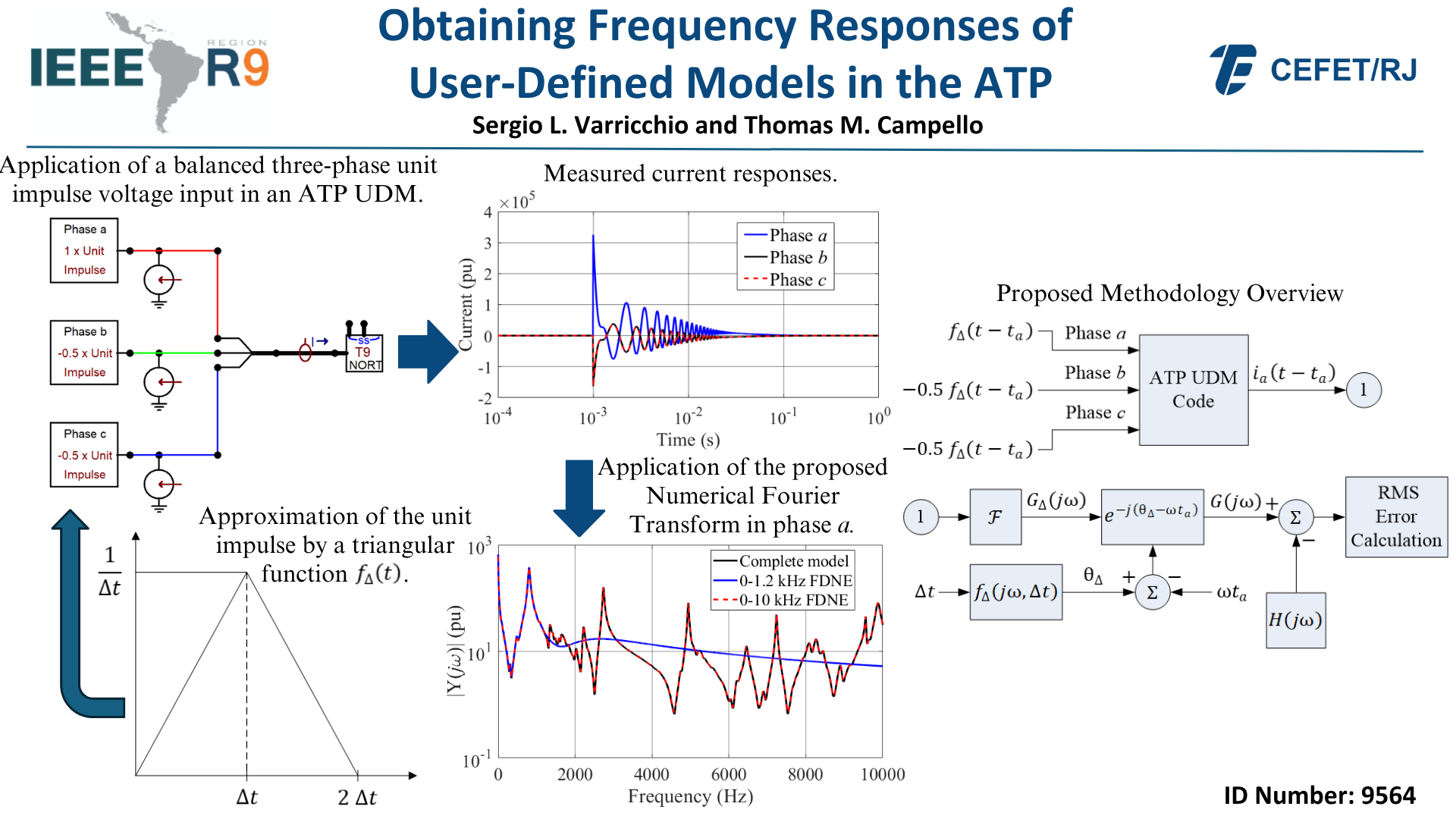
User-Defined Models (UDMs) in the Alternative Transients Program (ATP) are valuable tools. However, its creation using the ATP MODELS language is not simple. One type of UDM of particular importance is the high-fidelity Frequency-Dependent Network Equivalent (FDNE), assembled, in general, by fitting the Frequency Responses (FRs) of the self-and transfer admittances seen from the boundary buses of the external area (part of the system to be substituted by the FDNE). The correctness of the FDNE implementation can be verified by comparing its FRs with those of the external area. Unfortunately, obtaining the FRs of a UDM is not a simple task as in the case of the ATP built-in components. Thus, this work proposes a method for calculating the FRs of the UDMs implemented with the MODELS in the ATP. The proposal is based on the UDM time responses to the unit impulse in symmetric components and the Fourier transform.
Downloads
References
L. Dube e I. Bonfanti, “MODELS: A new simulation tool in the EMTP,” European Transactions on Electrical Power Engineering, vol. 2, nº 1, pp. 45-50, 1992.
L. Dubé, I. Bonfanti, M. T. Correia de Barros e V. Vanderstockt, “Using the Simulation Language "MODELS" With EMTP,” em Proc. 11th Power Systems Computation Conference, Avignon, France, 1993.
L. Prikler e H. K. Hoidalen, “ATPDraw Users Manual,” 2009.
R. G. F. E., F. B. Leao e J. R. S. Mantovani, “Simulation Environment of Distance Protection with ATP and Foreign Models,” em IEEE Electrical Power and Energy Conference, Winnipeg, Canada, 2011.
A. I. Chrysochos, A. I. Nousdilis, T. A. Papadopoulos e G. K. Papagiannis, “A Wide Band Black-Box Model of Power Transformers in ATP/MODELS,” em 49th International Universities Power Engineering Conference (UPEC), Cluj-Napoca, Romania, 2014.
E. P. A. Ribeiro, F. V. Lopes, J. P. G. Ribeiro e E. J. S. Leite Jr., “ATP/MODELS Differentiator-Smoother Filter Model Validated Using Actual Time-Domain Relay,” em Workshop on Communication Networks and Power Systems (WCNPS), Brasília, Brazil, 2018 .
R. Musca, G. Zizzo e A. Manunza, “Grid-Following and Grid-Forming MODELS in ATP-EMTP for Power Systems Simulation,” em AEIT International Annual Conference (AEIT), Rome, Italy, 2022.
T. M. Campello, S. L. Varricchio and G. N. Taranto, "Representation of Multiport Rational Models in an Electromagnetic Transients Program: Networks with Lumped and Distributed Parameters," Electric Power System Research, vol. 178, 2020.
T. M. Campello, S. L. Varricchio e G. N. Taranto, “Three Phase Frequency Dependent Network Equivalents in the ATP for Lumped Parameter Systems Using Descriptor Formulation, Rational Models, and Symmetrical Component Data,” Journal of Control, Automation and Electrical Systems, vol. 32, pp. 1690-1703, 2021.
T. M. Campello, F. N. F. Dicler, S. L. Varricchio, H. M. de Barros, C. O. Costa, A. C. S. Lima e G. N. Taranto, “Reviewing the Large Electrical Network Equivalent Methods under Development for Electromagnetic Transient Studies in the Brazilian Interconnected Power System,” International Journal of Electrical Power and Energy Systems, vol. 151, p. 109033, 2023.
B. Gustavsen e A. Semlyen, “Rational Approximation of Frequency Domain Responses by Vector Fitting,” IEEE Transactions on Power Delivery, vol. 14, nº 3, pp. 1052 - 1061, Julho 1999.
B. Gustavsen e H. M. J. D. Silva, “Inclusion of Rational Models in an Electromagnetic Transient Program: Y-Parameters, Z-Parameters, S-Parameters, Transfer Functions,” IEEE Transactions on Power Delivery, vol. 28, nº 2, pp. 1164 - 1174, 2013.
J. M. Rodriguez, E. Medina, J. Mahseredjian, A. Ramirez, K. Sheshyekani e I. Kocar, “Frequency-Domain Fitting Techniques: A Review,” IEEE Transactions on Power Delivery, vol. 35, nº 3, pp. 1102-11010, 2020.
W. Bolton, Instrumentation and Control Systems, Elsevier Ltd, 2006.
M. Frigo e S. Johnson, “FFTW: An Adaptive Software Architecture for the FFT,” em IEEE International Conference on Acoustics, Speech and Signal Processing, ICASSP, Seattle, USA, 1998.
S. G. Johnson e M. Frigo, “A Modified Split-Radix FFT with Fewer Arithmetic Operations,” IEEE Transactions on Signal Processing, vol. 55, nº 1, pp. 111-119, 2007.
MathWorks, “Matlab,” [Online]. Available: https://www.mathworks.com/products/matlab.html.
Y. Du, S. C. Liew e Y. Shao, “Efficient FFT Computation in IFDMA Transceivers,” IEEE Transactions on Wireless Communications, vol. 22, nº 10, pp. 6594-6607, 2023.
N. Malladhi, K. N. Reddy e R. R. Vallabhuni, “Novel architecture of FFT implementation for 5G module using machine learning algorithms,” International Journal of System Assurance Engineering and Management, vol. 14, p. 2387–2394, 2023.
H. Ogata, “Numerical calculation of Fourier transforms based on hyperfunction theory,” Journal of Computational and Applied Mathematics, vol. 378, p. 112921, 2020.
S. L. Varricchio, S. Gomes Jr. e R. D. Rangel, “Three Winding Transformer s-Domain Model for Modal Analysis,” International Jounal of Electrical Power and Energy Systems, pp. 420-429, 2011.
C. M. Close, The Analysis of Linear Circuits, San Diego, USA: Hard-Court Brace Jovanovich Inc., 1966.
M. R. Spiegel and J. Liu, Mathematical handbook of formulas and tables, 2nd ed., New York, USA: Mc-Graw Hill, 1998.
ONS, "SINtegre: Portal de Relacionamento," [Online]. Available: https://sintegre.ons.org.br. [Accessed 05 05 2024].