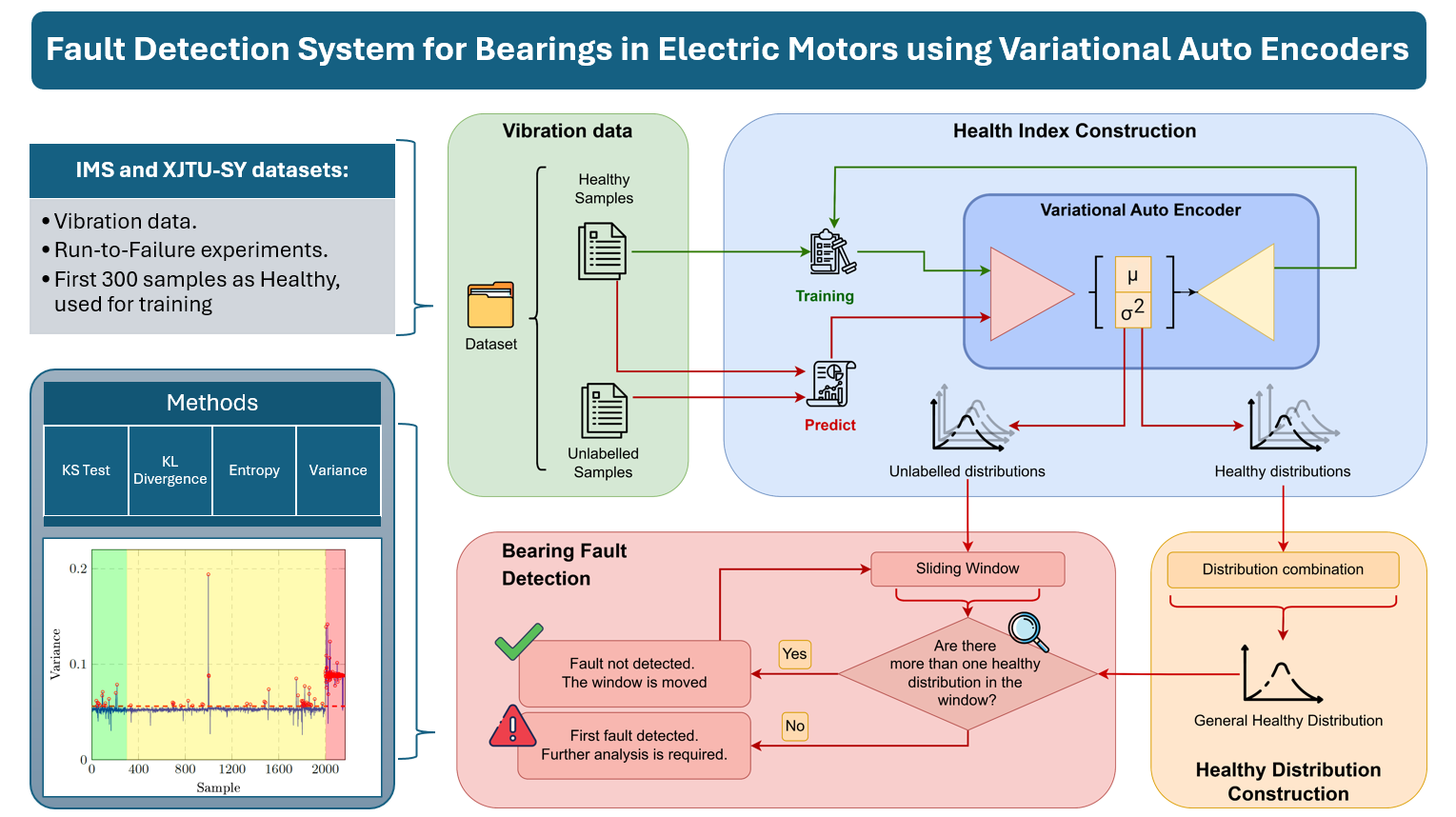
Fault Detection System for Bearings in Electric Motors using Variational Auto Encoders
Keywords:
Electric motors, Prognostics and Health Management, Bearing fault detection, Variational Auto EncodersAbstract
Electric motors play a fundamental role in essential industries such as energy, transport and aeronautics, which require efficient maintenance to ensure productivity. Bearings are the most common failure point, making Prognostics and Health Management of this component crucial for Industry 4.0. This paper introduces a Fault Detection System based on Variational Auto Encoders (VAEs) trained exclusively on healthy vibration data from two public datasets. By analysing the resultant Gaussian distributions the system identifies early indicators of faults. This approach overcomes the common challenge of requiring faulty data for training, while also making it applicable to any other dataset. The study reveals an initial degradation stage in the training datasets, a critical oversight in previous studies, providing a more accurate depiction of bearing degradation profiles.
Downloads
References
T. Zonta, C. A. da Costa, R. da Rosa Righi, M. J. de Lima, E. S. da Trindade, and G. P. Li, “Predictive maintenance in the industry 4.0: A systematic literature review,” Computers & Industrial Engineering, vol. 150, p. 106889, 2020. doi: https://doi.org/10.1016/j.cie.2020.106889 .
L. Magad´an, F. J. Su´arez, J. C. Granda, F. J. delaCalle, and D. F. Garc´ıa, “A robust health prognostics technique for failure diagnosis and the remaining useful lifetime predictions of bearings in electric motors”, Applied Sciences, 2023. doi: https://doi.org/10.3390/app13042220 .
A. Gholaminejad, F. S. Bidgoli, J. Poshtan, and M. Poshtan, “A novel kurtogram-based health index for induction motor fault diagnosis,” 2019 International Aegean Conference on Electrical Machines and Power Electronics (ACEMP) & 2019 International Conference on Optimization of Electrical and Electronic Equipment (OPTIM), pp. 85–92, 2019. doi: https://doi.org/10.1109/acemp-optim44294.2019.9007198 .
A. J. Bazurto, E. C. Quispe, and R. C. Mendoza, “Causes and failures classification of industrial electric motor,” 2016 IEEE ANDESCON, pp. 1–4, 2016. doi: https://doi.org/10.1109/andescon.2016.7836190 . [5] I. O. for Standardization, “Mechanical vibration - evaluation of machine vibration by measurements on non-rotating parts,” 1995. doi: https://doi.org/10.3403/bs7854 .
International Organization for Standardization, “Mechanical vibration – measurement and evaluation of machine vibration – part 1: General guidelines,” International Organization for Standardization, Geneva, CH, Standard, 2016. doi: https://doi.org/10.3403/30328957 .
Y. Xu, K. Feng, X. Yan, R. Yan, Q. Ni, B. Sun, Z. Lei, Y. Zhang, and Z. Liu, “Cfcnn: A novel convolutional fusion framework for collaborative fault identification of rotating machinery,” Information Fusion, vol. 95, pp. 1–16, 2023. doi: https://doi.org/10.1016/j.inffus.2023.02.012 .
P. Liang, Z. Yu, B. Wang, X. Xu, and J. Tian, “Fault transfer diagnosis of rolling bearings across multiple working conditions via
subdomain adaptation and improved vision transformer network,” Advanced Engineering Informatics, vol. 57, p. 102075, 2023. doi:
https://doi.org/10.1016/j.aei.2023.102075 .
J. Lee, F. Wu, W. Zhao, M. Ghaffari, L. Liao, and D. Siegel, “Prognostics and health management design for rotary machinery systems—reviews, methodology and applications,” Mechanical Systems and Signal Processing, vol. 42, no. 1, pp. 314–334, 2014. doi: https://doi.org/10.1016/j.ymssp.2013.06.004 .
M. Tian, X. Su, C. Chen, and W. An, “A novel method for multistage degradation predicting the remaining useful life of wind turbine generator bearings based on domain adaptation,” Applied Sciences, vol. 13, no. 22, 2023. doi: 10.3390/app132212332 .
H. Qiu, J. Lee, J. Lin, and G. Yu, “Wavelet filter-based weak signature detection method and its application on rolling element bearing prognostics,” Journal of Sound and Vibration, vol. 289, no. 4, pp. 1066–1090, 2006. doi: https://doi.org/10.1016/j.jsv.2005.03.007 .
B. Wang, Y. Lei, N. Li, and N. Li, “A hybrid prognostics approach for estimating remaining useful life of rolling element bearings,” IEEE
Transactions on Reliability, vol. 69, no. 1, pp. 401–412, 2020. doi: 10.1109/TR.2018.2882682 .
L. Magad´an, C. Ruiz-C´arcel, J. Granda, F. Su´arez, and A. Starr, “Explainable and interpretable bearing fault classification and diagnosis
under limited data,” Advanced Engineering Informatics, vol. 62, p. 102909, Oct. 2024. doi: 10.1016/j.aei.2024.102909 .
S. Chauhan, G. Vashishtha, R. Kumar, R. Zimroz, M. K. Gupta, and P. Kundu, “An adaptive feature mode decomposition based on a novel health indicator for bearing fault diagnosis,” Measurement, vol. 226, p. 114191, 2024. doi: https://doi.org/10.1016/j.measurement.2024.114191 .
H. Wang, X. Zhang, X. Guo, T. Lin, and L. Song, “Remaining useful life prediction of bearings based on multiple-feature fusion health indicator and weighted temporal convolution network,” Measurement Science and Technology, vol. 33, no. 10, p. 104003, jul 2022. doi: 10.1088/1361- 6501/ac77d9 .
W. Guo, X. Li, and X. Wan, “A novel approach to bearing prognostics based on impulse-driven measures, improved morphological
filter and practical health indicator construction,” Reliability Engineering & System Safety, vol. 238, p. 109451, 2023. doi: https://doi.org/10.1016/j.ress.2023.109451 .
T. Yan, D. Wang, J.-Z. Kong, T. Xia, Z. Peng, and L. Xi, “Definition of signal-to-noise ratio of health indicators and its analytic optimization for machine performance degradation assessment,” IEEE Transactions on Instrumentation and Measurement, vol. 70, pp. 1–16, 2021. doi: 10.1109/TIM.2021.3075779 .
Y. Zhou, A. Kumar, C. P. Gandhi, G. Vashishtha, H. Tang, P. Kundu, M. Singh, and J. Xiang, “Discrete entropy-based health indicator and
LSTM for the forecasting of bearing health,” Journal of the Brazilian Society of Mechanical Sciences and Engineering, vol. 45, no. 2, p. 120,
Feb. 2023. doi: https://doi.org/10.1007/s40430-023-04042-y .
H. Wei, Q. Zhang, and Y. Gu, “Remaining useful life prediction of bearings based on self-attention mechanism, multi-scale dilated causal convolution, and temporal convolution network,” Measurement Science and Technology, vol. 34, no. 4, p. 045107, jan 2023. doi: 10.1088/1361- 6501/acb0e9 .
Y. Deng, S. Du, D. Wang, Y. Shao, and D. Huang, “A calibration-based hybrid transfer learning framework for rul prediction of rolling bearing across different machines,” IEEE Transactions on Instrumentation and Measurement, vol. 72, pp. 1–15, 2023. doi: 10.1109/TIM.2023.3260283 .
Z. Li, P. Xu, and X.-B. Wang, “Online anomaly detection and remaining useful life prediction of rotating machinery based on cumulative summation features,” Measurement and Control, vol. 56, no. 3-4, pp. 615–629, 2023. doi: 10.1177/00202940221098048 .