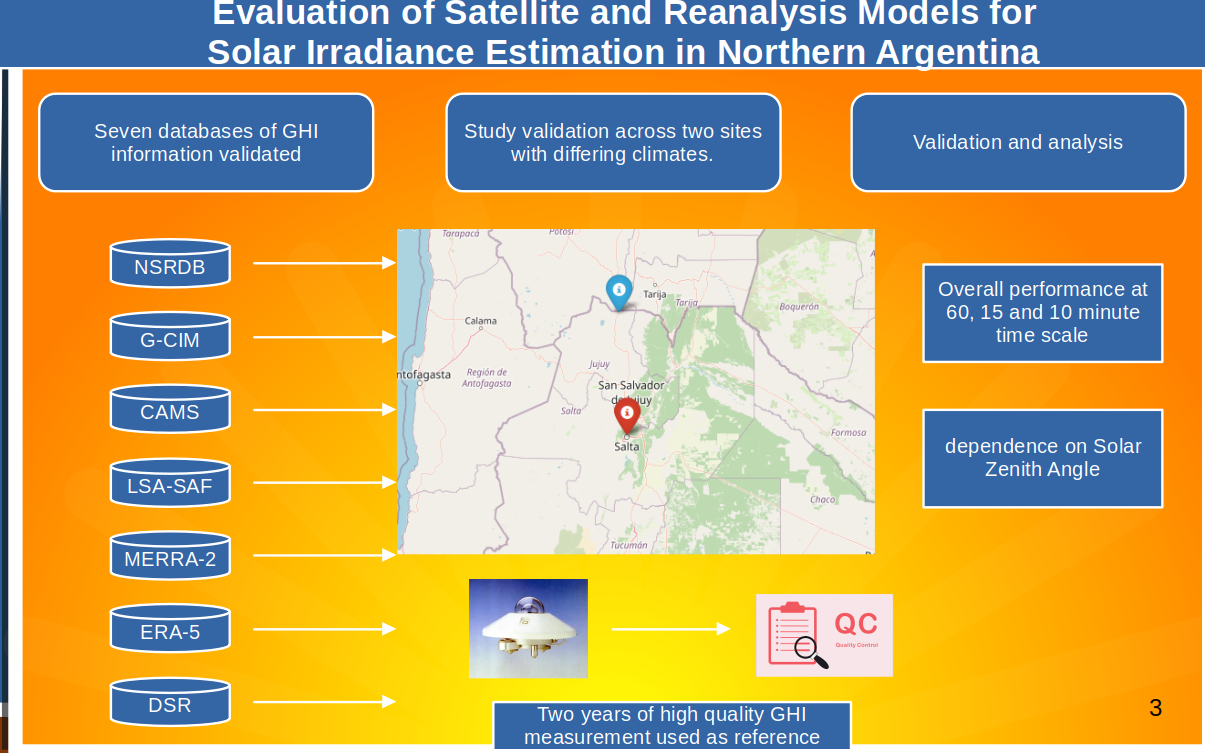
Evaluation of Satellite and Reanalysis Models for Solar Irradiance Estimation in Northwest Argentina
Keywords:
Global Horizontal Solar Irradiance, Satellite Models, Reanalysis Data, Solar Resource Assessment, Northwest ArgentinaAbstract
Accurate solar resource assessment is critical for the development of solar energy projects, especially in regions with complex climatic and geographic conditions. This study evaluates the performance of various satellite-based and reanalysis models in estimating global horizontal irradiance (GHI) in Northwestern Argentina, focusing on two locations characterized by different environmental conditions: La Quiaca and Salta. Five satellite-based models (CAMS Heliosat-4, NREL NSRDB, GOES DSR, LSA-SAF MDSSFTD, and GOES G-CIM) and two reanalysis datasets (MERRA-2 and ERA-5) were analysed and compared with high-quality ground-based measurements recorded between 2020 and 2023. The results show that the G-CIM and NSRDB models provide the most accurate irradiance estimates, effectively
minimising errors even in challenging environments with extreme altitude or variable terrain reflectivity. At the 10-minute time scale in Salta, the G-CIM model yields a root mean squared deviation (RMSD) of 23.4% and a mean bias of 4.8%, whereas the NSRDB model records an RMSD of 26.6% and a mean bias of –4.2%. In La Quiaca, both models achieve RMSD values below 20% and mean biases under 1%. At the 60-minute scale, in Salta, G-CIM and NSRDB exhibit RMSDs of 20.7% and 19.7%, with corresponding mean biases of 5.4% and –3.6%, respectively, while in La Quiaca they maintain mean biases below 1% and RMSDs of 13.2% for G-CIM and 12.6% for NSRDB. Conversely, the MERRA-2 and ERA-5 reanalysis models showed higher uncertainties, particularly in areas with significant microclimatic variations. The study highlights the importance of using locally validated satellite data for accurate solar resource assessment and emphasises the need for site-specific adjustments when applying global irradiance models. These findings contribute to improved planning and decision-making for solar energy projects in Northwest Argentina and provide valuable insights for researchers, policy makers and industry professionals.
Downloads
References
M. Schnitzer, C. Thuman, and P. Johnson, “The impact of solar uncertainty on project financeability: mitigating energy risk through on-site monitoring,” Proceedings of the American Solar Energy Society (ASES), pp. 1–5, 2012.
A. McMahan, C. Grover, and F. Vignola, “Evaluation of resource risk in solar-project financing,” Solar Energy Forecasting and Resource Assessment, pp. 81–95, 07 2013. Available: https://doi.org/10.1016/B978-0-12-397177-7.00004-8.
R. Perez, R. Seals, and A. Zelenka, “Comparing satellite remote sensing and ground network measurements for the production of site/time specific irradiance data,” Solar Energy, vol. 60, no. 2, pp. 89–96, 1997. Available: https://doi.org/10.1023/A:1008202821328.
A. Zelenka, R. Perez, R. Seals, and D. Renné, “Effective accuracy of satellite-derived hourly irradiances,” Theoretical and Applied Climatology, vol. 62, no. 3, pp. 199–207, 1999. Available: https://doi.org/10.
/A:1008202821328.
T. Huld, R. Müller, and A. Gambardella, “A new solar radiation database for estimating pv performance in europe and africa,” Solar Energy, vol. 86, no. 6, pp. 1803–1815, 2012. Available: https://doi.org/10.1016/
j.solener.2012.03.006.
C. Vernay, S. Pitaval, and P. Blanc, “Review of satellite-based surface solar irradiation databases for the engineering, the financing and the operating of photovoltaic systems,” Energy Procedia, vol. 57, pp. 1383–
, 2014. Available: https://doi.org/10.1016/j.egypro.2014.10.129.
M. Marchand, A. Ghennioui, E. Wey, and L. Wald, “Comparison of several satellite-derived databases of surface solar radiation against ground measurement in morocco,” Advances in Science and Research, vol. 15,pp. 21–29, 2018. Available: https://doi.org/10.5194/asr-15-21-2018.
M. C. Bueso, J. M. Paredes-Parra, A. Mateo-Aroca, and A. MolinaGarcía, “A characterization of metrics for comparing satellite-based and ground-measured global horizontal irradiance data: A principal
component analysis application,” Sustainability, vol. 12, no. 6, 2020. Available: https://doi.org/10.3390/su12062454.
G. Salazar, C. Gueymard, J. Galdino, O. Vilela, and N. Fraidenraich, “Solar irradiance time series derived from high-quality measurements, satellite-based models, and reanalyses at a near-equatorial site in Brazil,” Renewable and Sustainable Energy Reviews, vol. 117, p. 109478, 012020. Available: https://10.1016/j.rser.2019.109478
A. S. Altamirano, R. Calleja, R. Alonso-Suárez, and R. CabanillasLópez, “Uncertainty assessment of satellite-based solar radiation data in the southeastern sonoran desert,” in 2024 IEEE 52nd Photovoltaic
Specialist Conference (PVSC), pp. 1008–1014, 2024. Available: https://doi.org/10.1109/PVSC57443.2024.10749660.
I. Sarazola, A. Laguarda, J. C. Ceballos, and R. Alonso-Suárez, “Benchmarking of modeled solar irradiation data in Uruguay at a daily time scale,” IEEE Latin America Transactions, vol. 21, p. 1040–1048, Aug. 2023. Available: https://doi.org/10.1109/TLA.2023.10251811.
D. Yang and J. Bright, “Worldwide validation of 8 satellite-derived and reanalysis solar radiation products: A preliminary evaluation and overall metrics for hourly data over 27 years,” Solar Energy, vol. 210, pp. 3–19, 2020. Available: https://doi.org/10.1016/j.solener.2020.04.016.
C. Gueymard, “Solar radiation resource: measurement, modeling, and methods,” in Comprehensive Renewable Energy (T. Letcher, ed.), pp. 176–212, Oxford: Elsevier, second ed., 2022. Available: https://doi.org/10.1016/B978-0-12-819727-1.00101-1.
G. Huang, Z. Li, X. Li, S. Liang, K. Yang, D. Wang, and Y. Zhang, “Estimating surface solar irradiance from satellites: Past, present, and future perspectives,” Remote Sensing of Environment, vol. 233, p. 111371, 2019. Available: https://doi.org/10.1016/j.rse.2019.111371.
R. Perez, P. Ineichen, K. Moore, M. Kmiecik, C. Chain, R. George, F., and Vignola, “A new operational model for satellite-derived irradiances: description and validation,” Solar Energy, vol. 73, pp. 307–317, 2002. Available: https://doi.org/10.1016/S0038-092X(02)00122-6.
Z. Q. et al., “Fast radiative transfer parameterisation for assessing the surface solar irradiance: the Heliosat-4 method,” Meteorologische Zeitschrift, vol. 26, pp. 33–57, 02 2017. Available: https://doi.org/10.1127/metz/2016/0781.
A. Laguarda, G. Giacosa, R. Alonso-Suárez, and G. Abal, “Performance of the site-adapted CAMS database and locally adjusted cloud index models for estimating global solar horizontal irradiation over the Pampa Húmeda,” Solar Energy, vol. 199, pp. 295–307, 2020. Available: https://doi.org/10.1016/j.solener.2020.02.005.
R. D. Ledesma, G. A. Salazar, and O. de Castro Vilela, “Avances en la estimación de irradiancia solar en las provincias de Salta y Jujuy mediante imágenes satelitales GOES-16,” Avances en Energías Renovables y Medio Ambiente (AVERMA), 2023. Available: https://doi.org/2796-8111.
G. A. Salazar, R. Alonso-Suárez, A. Laguarda Cirigliano, and R. D. Ledesma, “Evaluación del proceso de adaptación al sitio aplicado a la irradiancia solar global medida en la ciudad de Salta, Argentina,”
Avances en Energías Renovables y Medio Ambiente - AVERMA, vol. 25, p. 353–362, may 2022. DOI: 2796-8111.
N. Sarmiento, S. Belmonte, P. Dellicompagni, J. Franco, K. Escalante, and J. Sarmiento, “A solar irradiation GIS as decision support tool for the Province of Salta, Argentina,” Renewable Energy, vol. 132, pp. 68–80, 2019. Available: https://doi.org/10.1016/j.renene.2018.07.081.
M. Peel, B. Finlayson, and T. Mcmahon, “Updated world map of the Köppen-Geiger climate classification,” Hydrology and Earth System Sciences Discussions, vol. 11, pp. 1633–1644, 2007. Available:
https://doi.org/10.5194/hess-11-1633-2007.
F. M. Nollas, G. A. Salazar, and C. A. Gueymard, “Quality control procedure for 1-minute pyranometric measurements of global and shadowband-based diffuse solar irradiance,” Renewable Energy, vol. 202, pp. 40–55, 2023. Available: https://doi.org/10.1016/j.renene.2022.11.056.
D. M. Hawkins, “Testing a sequence of observations for a shift in location,” Journal of the American Statistical Association, vol. 72, no. 357, pp. 180–186, 1977. Available: https://doi.org/10.2307/2286934.
R. Perez, P. Ineichen, K. Moore, M. Kmiecik, C. Chain, R. George, and F. Vignola, “A new operational model for satellite-derived irradiances description and validation,” Solar Energy, vol. 73, pp. 307–317, 11 2002.Available: https://doi.org/10.1023/A:1008202821328.
A. Laguarda, G. Giacosa, R. Alonso-Suárez, and G. Abal, “Performance of the site-adapted CAMS database and locally adjusted cloud index models for estimating global solar horizontal irradiation over the Pampa Húmeda,” Solar Energy, vol. 199, pp. 295–307, 2020. Available: https://doi.org/10.1016/j.solener.2020.02.005.
Z. Qu et al., “Fast radiative transfer parameterisation for assessing the surface solar irradiance: The Heliosat-4 method,” Meteorologische Zeitschrift, vol. 26, pp. 33–57, 02 2017. Available: https://doi.org/10.
/metz/2016/0781.
B. Mayer and A. Kylling, “Technical note: The libradtran software package for radiative transfer calculations - description and examples of use,” Atmospheric Chemistry and Physics, vol. 5, no. 7, pp. 1855–1877, 2005. Available: https://doi.org/10.5194/acp-5-1855-2005
M. K. K. T. Kriebel, G. Gesell and H. Mannstein, “The cloud analysis tool apollo: Improvements and validations,” International Journal of Remote Sensing, vol. 24, no. 12, pp. 2389–2408, 2003. Available:
https://doi.org/10.1080/01431160210163065.
M. Sengupta, Y. Xie, A. Lopez, A. Habte, G. Maclaurin, and J. Shelby, “The National Solar Radiation Data Base (NSRDB),” Renewable and sustainable energy reviews, vol. 89, pp. 51–60, 2018. Available: https:
//doi.org/10.1016/j.rser.2018.03.003.
Y. Xie, M. Sengupta, and J. Dudhia, “A fast all-sky radiation model for solar applications (FARMS): Algorithm and performance evaluation,” Solar Energy, vol. 135, pp. 435–445, 2016. Available: https://doi.org/10.1016/j.solener.2016.06.003.
I. Laszlo, H.-Y. Kim, and H. Liu, Algorithm Theoretical Basis Document For Downward Shortwave Radiation (Surface), and Reflected Shortwave Radiation (TOA), Enterprise Processing System (EPS) Version.
NOAA/NESDIS/STAR, 2020.
D. Rutan, S. Kato, D. Doelling, F. Rose, L. Nguyen, T. Caldwell, and N. Loeb, “CERES synoptic product: Methodology and validation of surface radiant flux,” Journal of Atmospheric and Oceanic Technology,
vol. 32, no. 6, pp. 1121 – 1143, 2015. Available: https://doi.org/10.1023/A:1008202821328.
D. Fillmore, D. Rutan, S. Kato, F. Rose, and T. Caldwell, “Evaluation of aerosol optical depths and clear-sky radiative fluxes of the CERES Edition 4.1 SYN1deg data product,” Atmospheric Chemistry and Physics, vol. 22, no. 15, pp. 10115–10137, 2022. Available: https://doi.org/10.1023/A:1008202821328.
R. Alonso-Suárez, Estimación del recurso solar en Uruguay mediante imágenes satelitales. Tesis de doctorado. Universidad de la República (Uruguay). PhD thesis, Universidad de la República (Uruguay).
Facultad de Ingeniería., 2017. Available: https://doi.org/10.1023/A:1008202821328.
M. Derrien and H. L. Gléau, “MSG/SEVIRI cloud mask and type from SAFNWC,” International Journal of Remote Sensing, vol. 26, no. 21, pp. 4707–4732, 2005. Available: https://doi.org/10.1080/01431160500166128.
N. SAF, “User manual for the cloud product processors of the nwc/geo: Science part,” tech. rep., Météo-France / Centre d’études en Météorologie Satellitaire, 2022.
X. Ceamanos, D. Carrer, and J.-L. Roujean, “Improved retrieval of direct and diffuse downwelling surface shortwave flux in cloudless atmosphere using dynamic estimates of aerosol content and type: application to the LSA-SAF project,” Atmospheric Chemistry and Physics, vol. 14, no. 15, pp. 8209–8232, 2014. Available: https://doi.org/10.5194/ acp-14-8209-2014.
B. Geiger, C. Meurey, D. Lajas, L. Franchistéguy, D. Carrer, and J.-L. Roujean, “Near real-time provision of downwelling shortwave radiation estimates derived from satellite observations,” Meteorological Applications, vol. 15, no. 3, pp. 411–420, 2008. Available: https: //doi.org/10.1002/met.84.
R. D. Ledesma, G. A. Salazar, and O. de Castro Vilela, “ARGP-V2: un modelo práctico para la estimación de irradiancia global horizontal en condiciones de cielo claro para sitios de altura,” Avances en Energías Renovables y Medio Ambiente (AVERMA), 2022. DOI: 2796-8111.
D. Cano, J. Monget, M. Albuisson, H. Guillard, N. Regas, and L. Wald, “A method for the determination of the global solar radiation from meteorological satellite data,” Solar Energy, vol. 37, no. 1, pp. 31–39,
Available: https://doi.org/10.1023/A:1008202821328.
A. Laguarda, G. Abal, and R. Alonso-Suaréz, “Modelo semi-empírico simple de irradiación solar global a partir de imágenes satelitales GOES,” in Anais Congresso Brasileiro de Energia Solar-CBENS, 2018.
Available: https://doi.org/10.59627/cbens.2018.707.
R. Gelaro et al., “The Modern-Era Retrospective Analysis for Research and Applications, Version 2 (MERRA-2),” Journal of Climate, vol. 30, no. 14, pp. 5419–5454, 2017. Available: https://doi.org/10.1175/
JCLI-D-16-0758.1.
M. Rienecker, The GEOS-5 data assimilation system: documentation of versions 5.0.1, 5.1.0, and 5.2.0. NASA technical memorandum, National Aeronautics and Space Administration, Goddard Space Flight Center,2008.
A. Molod, L. Takacs, M. Suárez, and J. Bacmeister, “Development of the GEOS-5 atmospheric general circulation model: Evolution from MERRA to MERRA2,” Geoscientific Model Development, vol. 8,
pp. 1339–1356, 2015.
M. Rienecker et al., “MERRA: NASA’s Modern-Era Retrospective Analysis for Research and Applications,” Journal of Climate, vol. 24, no. 14, pp. 3624–3648, 2011. Available: https://doi.org/10.1175/
JCLI-D-11-00015.1.
F. Feng and K. Wang, “Does the modern-era retrospective analysis for research and applications-2 aerosol reanalysis introduce an improvement in the simulation of surface solar radiation over China?,” International Journal of Climatology, vol. 39, pp. 1305–1318, 10 2018. Available: https://doi.org/10.1002/joc.5881.
H. Hersbach et al., “The era5 global reanalysis,” Quarterly Journal of the Royal Meteorological Society, vol. 146, no. 730, pp. 1999–2049, 2020. Available: https://doi.org/10.1023/A:1008202821328.
L. Hoffmann, G. Günther, D. Li, O. Stein, X. Wu, S. Griessbach, Y. Heng, P. Konopka, R. Müller, B. Vogel, and J. S. Wright, “Fromera-interim to era5: the considerable impact of ecmwf’s next-generation reanalysis on lagrangian transport simulations,” Atmospheric Chemistry and Physics, vol. 19, no. 5, pp. 3097–3124, 2019. Available: https://doi.org/10.1023/A:1008202821328.
M. Nogueira, “Inter-comparison of era-5, era-interim and gpcp rainfall over the last 40 years: Process-based analysis of systematic and random differences,” Journal of Hydrology, vol. 583, p. 124632, 2020. Available: https://doi.org/10.1023/A:1008202821328.
J. Zhang, A. Florita, B.-M. Hodge, S. Lu, H. F. Hamann, V. Banunarayanan, and A. M. Brockway, “A suite of metrics for assessing the performance of solar power forecasting,” Solar Energy, vol. 111, pp. 157–175, 2015. Available: https://doi.org/10.1016/j.solener.2014.10.016.
B. Espinar, L. Ramírez, A. Drews, H. G. Beyer, L. F. Zarzalejo, J. Polo,
and L. Martín, “Analysis of different comparison parameters applied
to solar radiation data from satellite and german radiometric stations,”
Solar Energy, vol. 83, no. 1, pp. 118–125, 2009. Available: https://doi.
org/10.1016/j.solener.2008.07.009.
A. H. Murphy and E. S. Epstein, “Skill scores and correlation coefficients in model verification,” Monthly Weather Review, vol. 117,
no. 3, pp. 572 – 582, 1989. Available: https://doi.org/10.1175/
-0493(1989)117<0572:SSACCI>2.0.CO;2.
R. Ledesma, R. Alonso-Suárez, A. Monetta, A. Laguarda, O. Vilela,
and G. Salazar, “Evaluación en uruguay del producto dsr goes-16 de
irradiancia solar global horizontal,” Avances en Energías Renovables y
Medio Ambiente (AVERMA), 2023. DOI: 2796-8111.
D. Rodrigues de Miranda, J. V. de Medeiros, O. Vilela, N. Fraidenraich,
and G. Salazar, “Simulación de generación de módulo FV en la ciudad
de Salta utilizando valores estadísticamente representativos de radiación
solar y temperatura adaptados de bases de datos satelitales,” in Avances
en Energías Renovables y Medio Ambiente, vol. 26, pp. 335–343, 2022.
DOI: 2796-8111