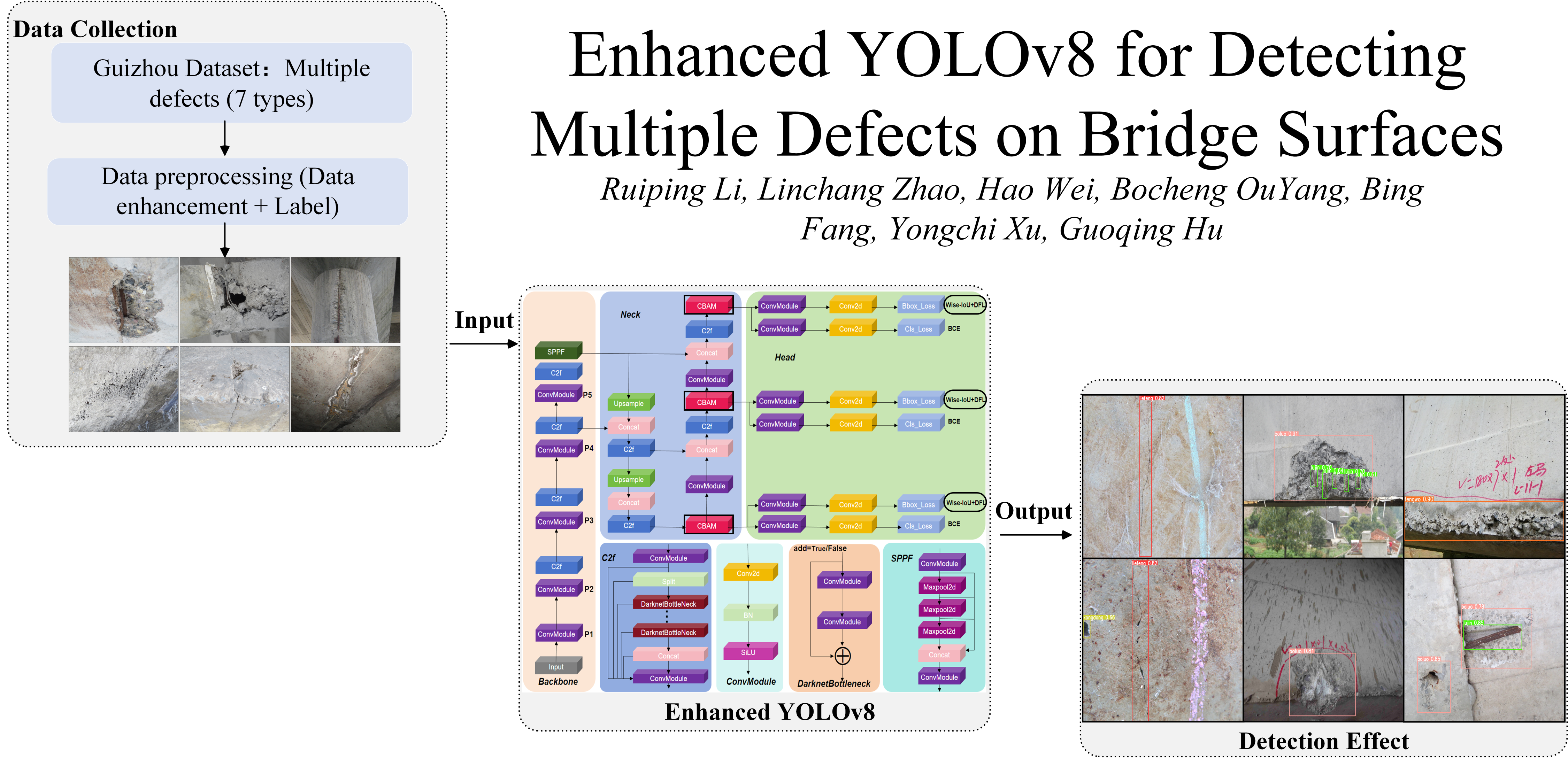
Enhanced YOLOv8 for Detecting Multiple Defects on Bridge Surfaces
Keywords:
CBAM, Wise-IoU, YOLOv8-CBAM-Wise-IoU, Bridge Surface DefectAbstract
With the advancement of machine vision, numerous models have been created to detect imperfections in bridges. However, the bulk of these models are designed for single defect detection and are not adept at managing cases with concurrent multiple defects. As a result, quickly recognizing the array of defects on bridge surfaces is still a major obstacle. In response to this challenge, the current research introduces the YOLOv8-CBAM-Wise-IoU model, specifically crafted for the detection of seven distinct bridge surface defect categories. This model integrates the CBAM mechanism for focusing attention and the Wise-IoU for calculating loss, with its effectiveness measured by metrics including accuracy, retrieval rate, F1 measure, and mAP50. Rigorous ablation analyses and benchmarking against both single-tier and multi-tier deep learning frameworks were performed to substantiate the model’s utility. The YOLOv8-CBAM-Wise-IoU model exhibited formidable performance, recording an accuracy rate of 97.9%, a retrieval rate of 76%, an F1 measure of 58%, an mAP50 of 55.4%, and an mAP50-95 of 32.4%. These results outstrip those of standard models and other ablation variations, emphasizing the model’s ability to boost the precision and robustness of detecting various defect types on bridge surfaces. Code is available at https://github.com/IamSunday/Enhanced-YOLOv8-for-Detecting-Multiple-Defects-on-Bridge-Surfaces.
Downloads
References
M. Morgese, et al., "Distributed detection and quantification of cracks in operating large bridges," Journal of Bridge Engineering, vol. 29, no. 1, p. 04023101, 2024, doi: 10.1061/JBENF2.BEENG-6454.
R. S. Tozetto, et al., "Development of a vibration measurement system for bridges," IEEE Latin America Transactions, vol. 19, no. 5, pp. 790-797, 2021, doi: 10.1109/TLA.2021.9448313.
Q. Liu, et al., "ViTR-Net: An unsupervised lightweight transformer network for cable surface defect detection and adaptive classification," Engineering Structures, vol. 313, p. 118240, 2024, doi: 10.1016/j.engstruct.2024.118240.
E. M. Abdelkader, T. Zayed, and N. Faris, "Synthesized evaluation of reinforced concrete bridge defects, their non-destructive inspection and analysis methods: a systematic review and bibliometric analysis of the past three decades," Buildings, vol. 13, no. 3, p. 800, 2023, doi: 10.3390/buildings13030800.
J. P. Liu, et al., "Recent application of and research on concrete arch bridges in China," Structural Engineering International, vol. 33, no. 3, pp. 394-398, 2023, doi: 10.1080/10168664.2022.2058441.
D. Su, Y. S. Liu, X. T. Li, X. Y. Chen, and D. H. Li, "Management path of concrete beam bridge in China from the perspective of sustainable development," Sustainability, vol. 12, no. 17, p. 7145, 2020, doi: 10.3390/su12177145.
Z. Nie, et al., "Damage Detection in Bridge via Adversarial‐Based Transfer Learning," Structural Control and Health Monitoring, vol. 2024, p. 5548218, 2024, doi: 10.1155/stc/5548218.
E. Bianchi and M. Hebdon, "Visual structural inspection datasets," Automation in Construction, vol. 139, p. 104299, 2022, doi: 10.1016/j.autcon.2022.104299.
H. Zoubir, et al., "Pixel-level concrete bridge crack detection using Convolutional Neural Networks, gabor filters, and attention mechanisms," Engineering Structures, vol. 314, p. 118343, 2024, doi: 10.1016/j.engstruct.2024.118343.
Y. Wang, et al., "Real-time spatial contextual network based on deep learning for bridge exposed rebar segmentation," Construction and Building Materials, vol. 449, p. 138379, 2024, doi: 10.1016/j.conbuildmat.2024.138379.
B. Sezen and C. C. Cerasi, "Solar cell busbars surface defect detection based on deep convolutional neural network," IEEE Latin America Transactions, vol. 21, no. 2, pp. 242-250, 2023, doi: 10.1109/TLA.2023.10015216.
C. Xiang, A. Chen, and D. Wang, "Real-time stress-based topology optimization via deep learning," Thin-Walled Structures, vol. 181, p. 110055, 2022, doi: 10.1016/j.tws.2022.110055.
T. S. Tran, S. D. Nguyen, H. J. Lee, et al., "Advanced crack detection and segmentation on bridge decks using deep learning," Construction and Building Materials, vol. 400, p. 132839, 2023.
X. Zhang, et al., "Intelligent surface cracks detection in bridges using deep neural network," International Journal of Structural Stability and Dynamics, vol. 24, no. 05, p. 2450046, 2024, doi: 10.1142/S0219455424500469.
I. Abdel-Qader, O. Abudayyeh, M. Asce, and M. E. Kelly, "Analysis of edge-detection techniques for crack identification in bridges," Journal of Bridge Engineering, vol. 17, pp. 255–263, 2003, doi: 10.1061/(ASCE)0887-3801(2003)17:4(255).
J. H. Lee, J. M. Lee, H. J. Kim, and Y. S. Moon, "Machine vision system for automatic inspection of bridges," in Proc. 1st Int. Congress on Image and Signal Processing, vol. 3, pp. 363–366, 2008, doi: 10.1109/CISP.2008.672.
V. Vivekananthan, R. Vignesh, S. Vasanthaseelan, E. Joel, and K. S. Kumar, "Concrete bridge crack detection by image processing technique by using the improved OTSU method," Materials Today: Proceedings, vol. 74, pp. 1002–1007, 2023, doi: 10.1016/j.matpr.2022.11.356.
F. Scozzese and A. Dall'Asta, "Nonlinear response characterization of post-tensioned RC bridges through Hilbert–Huang transform analysis," Structural Control and Health Monitoring, 2024, doi: 10.1155/2024/5960162.
G. Tan and Z. Yang, "Autonomous bridge detection based on ResNet for multiple damage types," in Proc. 2021 IEEE 11th Annual Int. Conf. on CYBER Technology in Automation, Control, and Intelligent Systems (CYBER), pp. 555–559, 2021, doi: 10.1109/CYBER53097.2021.9588187.
R. Li, J. Yu, F. Li, R. Yang, Y. Wang, and Z. Peng, "Automatic bridge crack detection using unmanned aerial vehicle and Faster R-CNN," Construction and Building Materials, vol. 362, pp. 1–14, 2023, doi: 10.1016/j.conbuildmat.2022.129659.
Z. Yu, "YOLO V5s-based deep learning approach for concrete cracks detection," SHS Web of Conferences, vol. 144, pp. 1–9, 2022, doi: 10.1051/shsconf/202214403015.
Y. Ni, J. Mao, H. Wang, Z. Xi, and Y. Xu, "Toward high-precision crack detection in concrete bridges using deep learning," Journal of Performance of Constructed Facilities, vol. 37, no. 3, pp. 1–13, 2023, doi: 10.1061/JPCFEV.CFENG-4275.
S. Teng, Z. Liu, and X. Li, "Improved YOLOv3-based bridge surface defect detection by combining high-and low-resolution feature images," Buildings, vol. 12, no. 8, p. 1225, 2022, doi: 10.3390/buildings12081225.
Y. A. S. M. Chen, S. Sharifuzzaman, H. Wang, Y. Li, L. M. Dang, H.-K. Song, and H. Moon, "Deep learning based underground sewer defect classification using a modified RegNet," Computers, Materials & Continua, vol. 75, no. 3, pp. 5455–5473, 2023, doi: 10.32604/cmc.2023.033787.
Y. H. Ni, et al., "Quantitative detection of typical bridge surface damages based on global attention mechanism and YOLOv7 network," Structural Health Monitoring, vol. 24, no. 2, pp. 941–962, 2025, doi: 10.1177/14759217241246953.
K. Luo, et al., "Computer vision-based bridge inspection and monitoring: A review," Sensors, vol. 23, no. 18, p. 7863, 2023, doi: 10.3390/s23187863.
G. Oh and S. Lim, "One-stage brake light status detection based on YOLOv8," Sensors, vol. 23, no. 17, pp. 1–18, 2023, doi: 10.3390/s23177436.
D. Reis, et al., "Real-time flying object detection with YOLOv8," arXiv preprint arXiv:2305.09972, 2023, doi: 10.48550/arXiv.2305.09972.
S. Woo, et al., "CBAM: Convolutional Block Attention Module," in Proc. European Conference on Computer Vision (ECCV), pp. 618–626, 2018, doi: 10.48550/arXiv.1807.06521.
Z. Tong, Y. Chen, Z. Xu, and R. Yu, "Wise-IoU: Bounding box regression loss with dynamic focusing mechanism," arXiv preprint arXiv:2301.10051, pp. 1–8, 2023, doi: 10.48550/arXiv.2301.10051.
S. M. Park, J. H. Lee, and L. S. Kang, "A framework for improving object recognition of structural components in construction site photos using deep learning approaches," KSCE Journal of Civil Engineering, vol. 27, no. 1, pp. 1–12, 2023, doi: 10.1007/s12205-022-2318-0.
J. Zhang, X. Yang, W. Li, S. Zhang, and Y. Jia, "Automatic detection of moisture damages in asphalt pavements from GPR data with deep CNN and IRS method," Automation in Construction, vol. 113, pp. 1–11, 2020, doi: 10.1016/j.autcon.2020.103119.
D. Valencia, E. Muñoz España, and M. Muñoz Añasco, "Impact of the preprocessing stage on the performance of offline automatic vehicle counting using YOLO," IEEE Latin America Transactions, vol. 22, no. 9, pp. 723-732, 2024, doi: 10.1109/TLA.2024.10669248.
K. Su, et al., "N-IoU: Better IoU-based bounding box regression loss for object detection," Neural Computing and Applications, vol. 36, no. 6, pp. 3049-3063, 2024, doi: 10.1007/s00521-023-09133-4.
M. Hussain, "YOLOv1 to v8: Unveiling each variant–a comprehensive review of YOLO," IEEE Access, vol. 12, pp. 42816-42833, 2024, doi: 10.1109/ACCESS.2024.3378568.
T. Li, G. Liu, and S. Tan, "Superficial defect detection for concrete bridges using YOLOv8 with attention mechanism and deformation convolution," Applied Sciences, vol. 14, no. 13, p. 5497, 2024, doi: 10.20944/preprints202405.1498.v1.
R. R. Selvaraju, M. Cogswell, A. Das, R. Vedantam, D. Parikh, and D. Batra, "Grad-CAM: Visual explanations from deep networks via gradient-based localization," in Proc. IEEE International Conference on Computer Vision, pp. 618–626, 2017, doi: 10.1007/s11263-019-01228-7.
Q. Hou, D. Zhou, and J. Feng, "Coordinate attention for efficient mobile network design," Proc. IEEE/CVF Conference on Computer Vision and Pattern Recognition, 2021, doi: 10.48550/arXiv.2103.02907.
J. Hu, S. Li, and S. Gang, "Squeeze-and-excitation networks," Proc. IEEE Conference on Computer Vision and Pattern Recognition, 2018, doi: 10.48550/arXiv.2308.13343.
Y. Liu, Z. Shao, and N. Hoffmann, "Global attention mechanism: Retain information to enhance channel-spatial interactions," arXiv preprint arXiv:2112.05561, 2021, doi: 10.48550/arXiv.2112.05561.