Dosimetry Strategies for Non-Autonomous UV-C Robots
Keywords:
non-autonomous robot, antimicrobial resistance, dosimetric films, hospital infection control, UV-C disinfectionAbstract
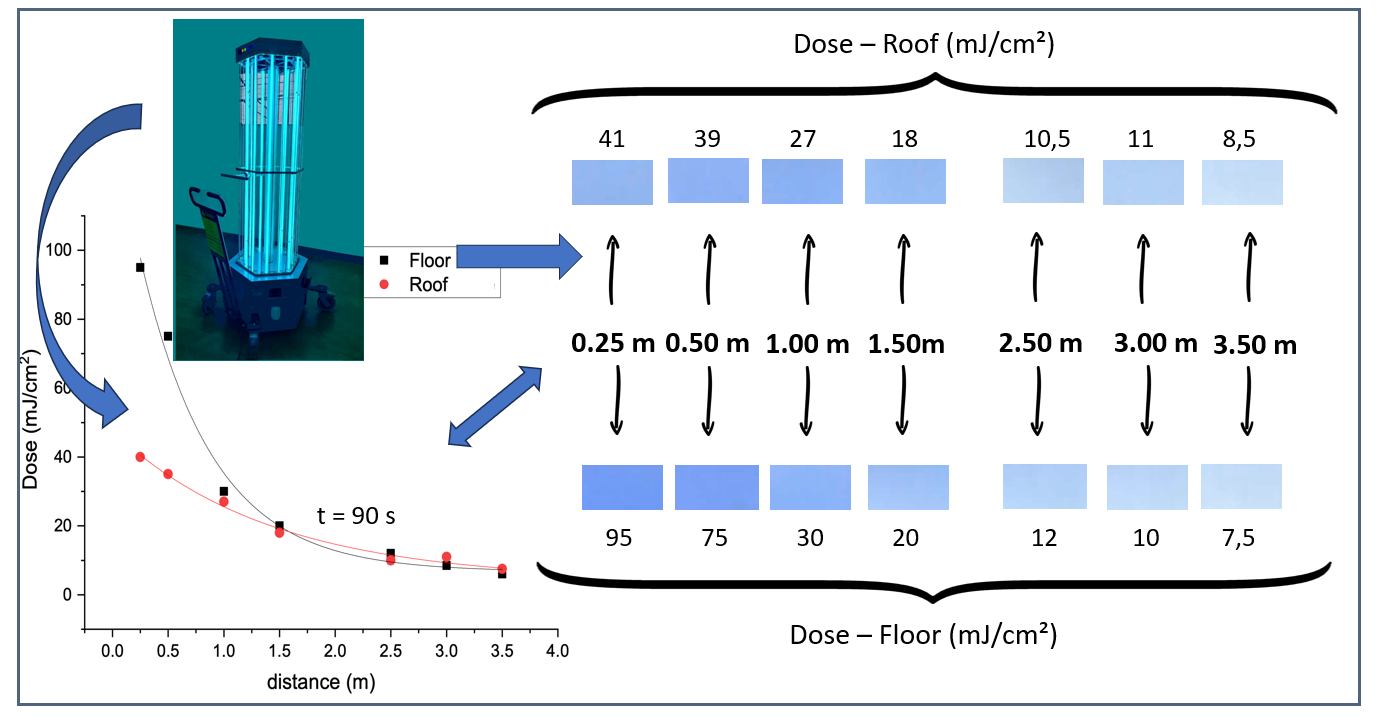
This study aimed to evaluate the coverage and disinfection effectiveness of SIDUV-C, a non-autonomous UV-C robot operating at a wavelength of 254 nm and a power output of 3900 W, which made it the most powerful in its category. Experimental methods included the determination of UV irradiation doses, UV-Vis spectral analysis, and modeling of irradiance fields to estimate the system’s ability to deliver adequate doses of UV energy to target surfaces or airborne pathogens. Commercially available dosimetric films sensitive to UV-C radiation were employed to quantify doses across different spatial regions, and their accuracy was validated against UV spectroradiometry techniques and microbiological assays with methicillin-resistant Staphyloccoccus aureus (MRSA). The results demonstrated that both dosimetric films and spectroradiometer measurements consistently indicated the robot's rapid and effective disinfection performance across an unshaded area of 12.25 m2. The doses delivered were sufficient to neutralize a wide range of bacterial species commonly found in hospital environments across Latin America, including multidrug-resistant pathogens, thus underscoring the potential of UV-C disinfection robots as a critical tool in mitigating antimicrobial resistance in healthcare settings.
Downloads
References
G. H. Marin, L. Giangreco, C. Dorati, P. Mordujovich, S. Boni, H. Mantilla-Ponte, M. J. A. Arvez, M. L. Pe˜na, M. F. A. Gonz´alez, S. M. C. Fung, L. Barcelona, L. Campa˜na, A. V. Orellana, T. O. Rodr´ıguez, L. G. Cantero, R. A. Villar, N. S. Fuentes, E. Melero, H. Marin-Piva, G. Soler, F. Gabriel, L. P.Velandia, C. O. Florent´ın, S. R. Patron, M. O. Rivas, C. M. Ben´ıtez, R. Mellado, V. Ivanovska, A. Muller, R. Rojas, and J. L. Castro, “Antimicrobial consumption in latin american countries: First steps of a long road ahead,” Journal of Primary Care & Community Health, vol. 13, p. 21501319221082346, 2022, https://doi.org/10.1177/21501319221082346.
United Nations, “Goal 3: Good Health and Well-Being,” 2015, accessed: 2024-11-29. [Online]. Available: https://sdgs.un.org/goals/goal3
G. B. Aguilar, L. R. Swetschinski, N. D. Weaver, and et al.,“The burden of antimicrobial resistance in the americas in 2019: a cross-country systematic analysis," The Lancet Regional Health - Americas, vol. 25, p. 100561, 2023, https://doi.org/10.1016/j.lana.2023.100561.
P. Dadgostar, “Antimicrobial resistance: Implications and costs”, Infection and Drug Resistance, vol. 12, pp. 3903 - 3910, 2019, https://doi.org/10.2147/IDR.S234610.
M. Ferri, E. Ranucci, P. Romagnoli, and V. Giaccone, “Antimicrobial resistance: A global emerging threat to public health systems,” Critical Reviews in Food Science and Nutrition, vol. 57, pp. 2857 – 2876, 2017, https://doi.org/10.1080/10408398.2015.1077192.
F. Prestinaci, P. Pezzotti, and A. Pantosti, “Antimicrobial resistance: a global multifaceted henomenon,” Pathogens and Global Health, vol. 109, pp. 309 – 318, 2015, https://doi.org/10.1179/2047773215Y.0000000030.
N. V. Doremalen, T. Bushmaker, D. Morris, M. Holbrook, A. Gamble, B. Williamson, A. Tamin, J. Harcourt, N. Thornburg, and S. G. et al.,“ Aerosol and surface stability of SARS-CoV-2 as compared with SARS-CoV-1”, N. Engl. J. Med., vol. 382, pp. 1564–1567, 2020, https://doi.org/ 10.1056/NE-JMc2004973.
T. Jiang and X. Chen, “Outcome impacts due to pathogen-specific antimicrobial resistance: A narrative review of published literature,” International Journal of Environmental Research and Public Health, vol. 17, 2020, https://doi.org/10.3390/ijerph17041395.
M. M. Aljeldah, “Antimicrobial resistance and its spread is a global threat,” Antibiotics, vol. 11, 2022, https://doi.org/10.3390/antibiotics11081082.
I. Mehta, H.-Y. Hsueh, S. Taghipour, W. Li, and S. Saeedi, “UV disinfection robots,” Robotics and Autonomous Systems, vol. 161, p. 104332, 2023, https://doi.org/10.1016/j.robot.2022.104332.
P. Abedini and N. Soleimani, “A review of designing new vaccines to prevent Hospital-Acquired Antibiotic-Resistant Infections," Disease and Diagnosis, vol. 7, pp. 21–29, 2018, https://doi.org/10.31661/IEJM861.
I. Bekeredjian-Ding, “Challenges for clinical development of vaccines for prevention of hospital-acquired bacterial infections," Frontiers in Immunology, vol. 11, 2020, https://doi.org/10.3389/fimmu.2020.01755.
E. G. Souza, C. D. Nascimento, C. Aguzzoli, E. S. B. Santill´an, C. E. Cuevas-Su´arez, P. S. Nascente, E. Piva, and R. G. Lund, “Enhanced antibacterial properties of titanium surfaces through diversified ion plating with silver atom deposition,” Journal of Functional Biomaterials, vol. 15, no. 6, p. 164, 2024, https://doi.org/10.3390/jfb15060164.
Z. X. Tang and B. F. Lv, “MgO nanoparticles as antibacterial agent: Preparation and activity,” Brazilian Journal of Chemical Engineering, p. 246003, 2011, https://doi.org/10.1590/01046632.20140313s00002813.
A. Edwards, S. Karim, R. Pascual, L. Jowhar, S. Anderson, and S. McBride, “Chemical and stress resistances of Clostridium difficile spores and vegetative cells,” Front. Microbial., vol. 7, p. 1698, 2016, https://doi.org/10.3389/fmicb.2016.01698.
G. Moccia, O. Motta, C. Pironti, A. Proto, M. Capunzo, and F. D. Caro, “An alternative approach for the decontamination of hospital settings,” Journal of Infection and Public Health, vol. 13, pp. 2038-2044, 2020, https://doi.org/10.1016/j.jiph.2020.09.020.
G. French, J. Otter, K. Shannon, N. Adams, D. Watling, and M. Parks, “Tackling contamination of the hospital environment by methicillin-resistant Staphylococcus aureus (MRSA): a comparison between conventional terminal cleaning and hydrogen peroxide vapour decontamination,” The Journal of Hospital infection, vol. 57 1, pp. 31–7, 2004, https://doi.org/10.1016/J.JHIN.2004.03.006.
S. Dancer, “Controlling Hospital-Acquired Infection: Focus on the role of the environment and new technologies for decontamination,” Clinical Microbiology Reviews, vol. 27, pp. 665 – 690, 2014, https://doi.org/10.1128/CMR.00020-14.
S. de Souza, A. Cardoso Jr, and A. Sarmento et al., “Effectiveness of a UVC air disinfection system for the HVAC of an ICU,” Eur. Phys. J. Plus, vol. 137, p. 37, 2022, https://doi.org/10.1140/epjp/s13360-021-02240-y.
T.-C. Hsu, Y.-T. Teng, Y.-W. Yeh, X. Fan, K.-H. Chu, S.-H. Lin, K.-K. Yeh, P.-T. Lee, Y. Lin, and Z. Chen et al., “Perspectives on UVC LED: Its progress and application,” Photonics, vol. 8, p. 196, 2021, https://doi.org/10.3390/photonics8060196.
H. D. M. Tran, S. Boivin, H. Kodamatani, K. Ikehata, and T. Fujioka, “Potential of UV-B and UV-C irradiation in disinfecting microorganisms and removing N-nitrosodimethylamine and 1,4-dioxane for potable water reuse: A review,” Chemosphere, vol. 286 Pt 2, p. 131682, 2021, https://doi.org/10.1016/j.chemosphere.2021.131682.
P. Nyangaresi, Y. Qin, G. Chen, B. Zhang, Y. Lu, and L. Shen, “Comparison of the performance of pulsed and continuous UVC-LED irradiation in the inactivation of bacteria,” Water research, vol. 157, pp. 218–227, 2019, https://doi.org/10.1016/j.watres.2019.03.080.
A. Panzures, “222-nm UVC light as a skin-safe solution to antimicrobial resistance in acute hospital settings with a particular focus on methicillin-resistant Staphylococcus aureus and surgical site infections: a review,” J Appl Microbiol., vol. 1, p. 134, 2023, https://doi.org/10.1093/jambio/lxad046.
R. Yin, T. Dai, P. Avci, A. E. Jorge, W. C. de Melo, D. Vecchio,Y. Y. Huang, A. Gupta, and M. R. Hamblin, “Light based anti-infectives: ultraviolet irradiation, photodynamic therapy, blue light, and beyond,” Curr Opin Pharmacol., vol. 13, pp. 731–62, 2013, https://doi.org/10.1016/j.coph.2013.08.009.
F. Astrid, Z. Beata, and M. Van den Nest et al., “The use of a UV-C disinfection robot in the routine cleaning process: a field study in an academic hospital,” Antimicrob Resist Infect Control, vol. 10, p. 84, 2021, https://doi.org/10.1186/s13756-021-00945-4.
M. Mantelli, L. D. Santos, L. de F., G. Miotto, A. Bergamin, E. Cardoso, M. Serrano, R. Maffei, E. Prestes, J. Netto, and M. Kolberg, “Autonomous environment disinfection based on dynamic UV-C irradiation map," IEEE Robotics and Automation Letters, vol. 7, pp. 4789–4796, 2022, https://doi.org/10.1109/LRA.2022.3152719.
J. Cadnum, A. Jencson, S. Redmond, T. Sankar Chittoor Mana, and C. Donskey, “Ultraviolet-C (UV-C) monitoring made ridiculously simple: UV-C dose indicators for convenient measurement of UV-C dosing,” Open Forum Infectious Diseases, vol. 6, no. Suppl 2, p. S437, October 23 2019.
J.-H. Yang, U.-I. Wu, H.-M. Tai, and W.-H. Sheng, “Effectiveness of an ultraviolet-c disinfection system for reduction of healthcare-associated pathogens,” Journal of Microbiology, Immunology and Infection, vol. 52, no. 3, pp. 487–493, 2019. https://doi.org/10.1016/j.jmii.2017.08.017
M. Raeiszadeh and B. Adeli, “A critical review on ultraviolet disinfection sustems against COVID-19 outbreak: Applicability, validation, and safety considerations,” ACS Photonics, vol. 7, no. 11, pp. 2941–2951, 2020, https://doi.org/10.1021/acsphotonics.0c01245.
Y. Matsumura and H. N. Ananthaswamy, “Toxic effects of ultraviolet radiation on the skin,” Toxicol. Appl. Pharmacol, vol. 195, pp. 298–308, 2004, https://doi.org/10.1016/j.taap.2003.08.019.
P. Vecchia, M. Hietanen, B. E. Stuck, E. van Deventer, and S. Niu, “Protecting Workers from Ultraviolet Radiation”. Citeseer, 2007.
E. G. Souza, K. Kruger, C. D. Nascimento, C. Aguzzoli, G. Hoff, A. Moraes, R. Lund, P. Nascente, C. Cuevas-Su´arez, E. Piva et al., "Development of lead-free radiation shielding material utilizing barium sulfate and magnesium oxide as fillers in addition cure liquid silicone rubber," Polymers, vol. 15, p. 4382, 2023. https://doi.org/10.3390/polym15224382
M. M. Pires, C. D. Nascimento, E. G. Souza, K. Kruger, and G. Hoff, “Utilização de sulfato de b´ario como constituinte de concreto para blindagem de salas de radiologia,” Mat´eria (Rio de Janeiro), vol. 26, no. 4, p. e13103, 2021. Available: https://doi.org/10.1590/S1517-707620210004.1303
G. Hoff, E. E. Streck, A. Lai, V. Fanti, B. Golosio, C. D. Nascimento, and E. G. Souza, “Using geant4 monte carlo toolkit to evaluate a low power x-ray tube generator configuration,” Applied Radiation and Isotopes, vol. 168, p. 109487, 2021. https://doi.org/10.1016/j.apradiso.2020.109487
W. Kowalski, “Ultraviolet Germicidal Irradiation Handbook: UVGI for Air and Surface Disinfection”. Springer, 2010.
B. A. De Moraes, C. A. N. Cravo, M. M. Loureiro, C. A. Solari, and M. D. Asensi, “Epidemiological analysis of bacterial strains involved in hospital infection in a university hospital from Brazil,” Rev. Inst. Med. Trop., vol. 42, pp. 201–207, 2000, https://doi.org/10.1590/S0036-46652000000400005.
A. Ciapponi, A. Bardach, M. M. Sandoval, M. C. Palermo, E. Navarro, C. Espinal, and R. Quir´os, “Systematic review and meta-analysis of deaths attributable to antimicrobial resistance, Latin America,” Emerging Infectious Diseases, vol. 29, pp. 2335 – 2344, 2023, https://doi.org/10.3201/eid2911.230753.
S. G. Cerezo, J. S. Preciado, M. M. Otero, F. J. T. L´opez, and M. D. A.Curiel, “Antimicrobial resistance. Its importance and efforts to control it,” Gaceta medica de Mexico, vol. 156 2, pp. 171–178, 2020, https://doi.org/10.24875/gmm.m20000358.
M. T. Valenzuela and C. D. de Quadros, “Antibiotic resistance in Latin America: a cause for alarm,” Vaccine, vol. 27 Suppl 3, pp. C25–8, 2009, https://doi.org/10.1016/j.vaccine.2009.06.005.
G. B. Aguilar, L. R. Swetschinski, N. D. Weaver, and et al., “Ultraviolet radiation for the sterilization of contact lenses,” CLAO J., vol. 16, pp. 294–298, 1990.
A. Hollaender, “Radiation Biology, Volume II: Ultraviolet and Related Radiations”. New York: McGraw-Hill, 1955.
V. K. Rastogi, L. Wallace, and L. S. Smith, “Disinfection of acinetobacter baumannii-contaminated surfaces relevant to medical treatment facilities with ultraviolet C light,” Mil Med., vol. 172, pp. 1166–1169, 2007, https://doi.org/10.7205/milmed.172.11.1166.
F. L. Gates, “A study of the bactericidal action of ultraviolet light : I. the reaction to monochromatic radiations,” Mil Med., vol. 13, pp. 231–248, 1929, https://doi.org/10.1085/jgp.13.2.231.
T. Endo, A. Gemma, R. Mitsuyoshi et al., “Discussion on effect of material on uv reflection and its disinfection with focus on japanese stucco for interior wall,” Scientific Reports, vol. 11, p. 21840, 2021. https://doi.org/10.1038/s41598-021-01315-1
P. Venkateswaran, S. Vasudevan, H. David, A. Shaktivel, K. Shanmugam, P. Neelakantan, and A. P. Solomon, “Revisiting eskape pathogens: virulence, resistance, and combating strategies focusing on quorum sensing,” Frontiers in Cellular and Infection Microbiology, vol. 13, p. 1159798, June 2023,
https://doi.org/10.3389/fcimb.2023.1159798.
M. M. Nerandzic, J. L. Cadnum, M. J. Pultz, and C. J. Donskey, “Evaluation of an automated ultraviolet radiation device for decontamination of Clostridium difficile and other healthcare-associated pathogens in hospital rooms,” BMC Infectious Diseases, vol. 10, p. 197, 2010, https://doi.org/10.1186/1471-2334-10-197.