The Radio Duty-Cycle Aloha Protocol
A ContikiMAC Redesign for Tmote Sky Simulated in Cooja
Keywords:
Aloha, Contiki, Cooja, Energy consumption, IoT, Tmote Sky, WSNAbstract
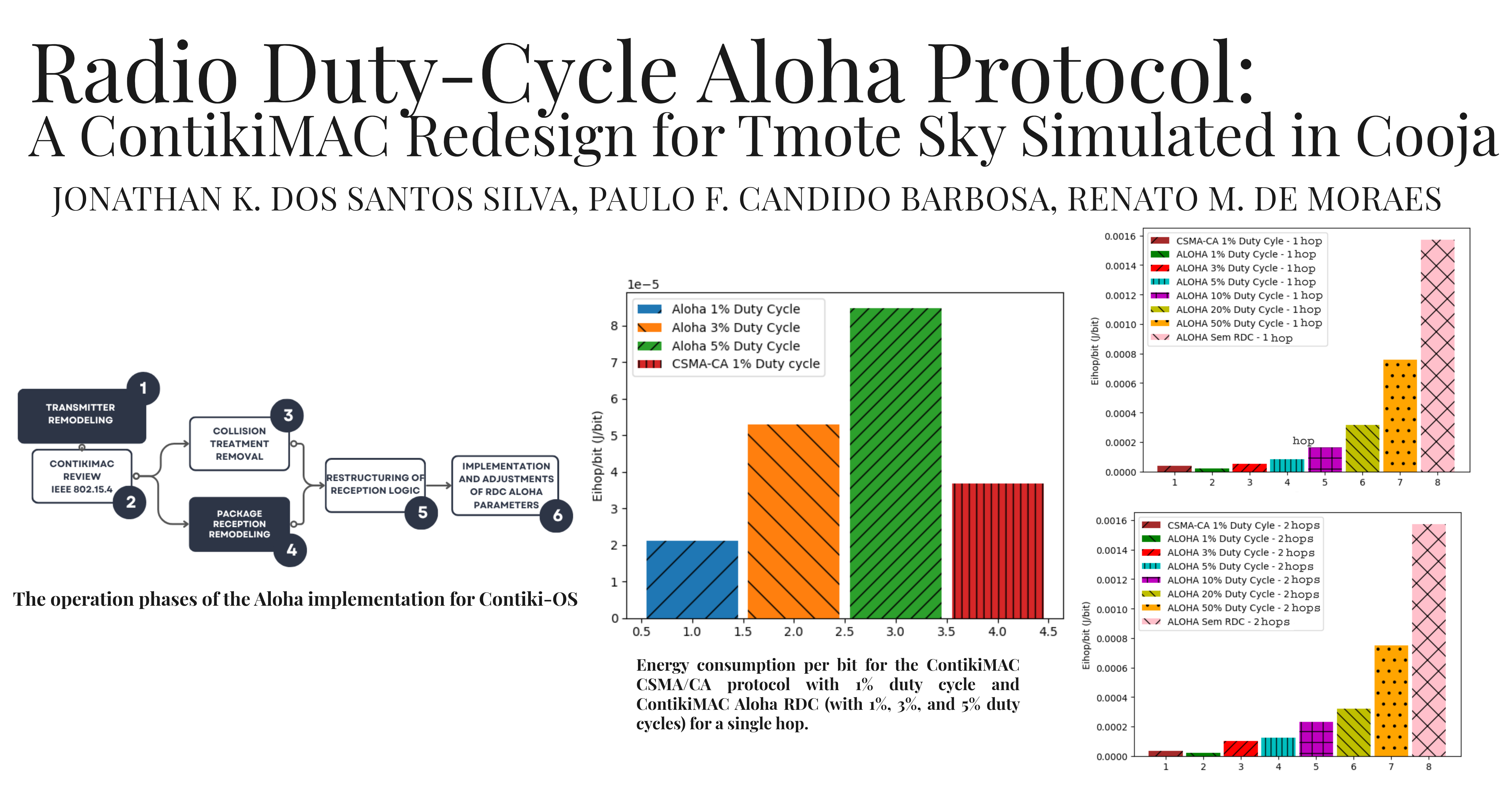
In IoT (Internet of Things) networks, the energy consumption of a device is often one of the limiting factors for its operation, as these devices are typically battery-powered. Much of an IoT device's energy consumption is used to transmit and receive data. Therefore, to reduce energy consumption, efficient radio management is essential. One approach is to employ medium access control (MAC) protocols with radio duty-cycle (RDC). This article proposes a redesign of the MAC sublayer for the Tmote Sky device, rewriting part of its native medium access control (which employs the IEEE 802.15.4 standard) with an implementation of the pure Aloha protocol compatible with the Contiki operating system. By running simulations in the Cooja simulator-emulator, the energy consumption impact of this MAC protocol redesign was analyzed and compared to that of the native MAC. The proposed RDC Aloha protocol resulted in lower energy consumption than the CSMA/CA (Carrier Sense Multiple Access with Collision Avoidance) native protocol. Due to its Aloha-based design, the proposed protocol showed a reduced delivery rate. Still, it can be used in applications that prioritize energy savings and handle low volume of data as in wireless sensor networks (WSNs).
Downloads
References
L. Farhan, R. Kharel, O. Kaiwartya, M. Quiroz-Castellanos, A. Alissa,
and M. Abdulsalam, “A concise review on internet of things (iot)-
problems, challenges and opportunities,” in 2018 11th Int. Symp. Com-
mun. Syst. Netw. Digit. Signal Process. (CSNDSP). IEEE, 2018, pp.
–6, doi: 10.1109/CSNDSP.2018.8471762.
Z. Ali, S. Henna, A. Akhunzada, M. Raza, and S. W. Kim, “Performance
evaluation of lorawan for green internet of things,” IEEE Access, vol. 7,
pp. 164 102–164 112, 2019, doi: 10.1109/ACCESS.2019.2943720.
G. Oikonomou, S. Duquennoy, A. Elsts, J. Eriksson, Y. Tanaka, and
N. Tsiftes, “The contiki-ng open source operating system for next
generation iot devices,” SoftwareX, vol. 18, p. 101089, 2022, doi:
1016/j.softx.2022.101089.
T. S. Datasheet, “Moteiv corporation,” Saatavissa (viitattu 1.10.
, 2006, accessed: October 30, 2024. [Online]. Available:
http://www.crew-project.eu/sites/default/files/tmote-sky-datasheet.pdf
P. F. C. Barbosa, B. A. d. Silva, C. Zanchettin, and R. M. de Moraes,
“Energy consumption optimization for csma/ca protocol employing
machine learning,” in 2020 IEEE 91st Vehicular Technology Conference
(VTC2020-Spring), 2020, pp. 1–5, doi: 10.1109/VTC2020-Spring48590.
9128450.
M. Abdulkarem, K. Samsudin, F. Z. Rokhani, and M. F. A Rasid,
“Wireless sensor network for structural health monitoring: A con-
temporary review of technologies, challenges, and future direction,”
Structural Health Monitoring, vol. 19, no. 3, pp. 693–735, 2020, doi:
1177/1475921719854528.
S. Sreenivasamurthy and K. Obraczkaa, “Clustering at the edge: Load
balancing and energy efficiency for the iot,” Ad Hoc Networks, vol. 154,
no. 103433, pp. 1–17, 2024, doi: 10.1016/j.adhoc.2024.103433.
Contiki-NG Development Team, “Cooja network simulator: Part of
the contiki-ng operating system,” 2018, accessed: October 30, 2024.
[Online]. Available: https://github.com/contiki-ng/contiki-ng
J. K. S. Silva, A. R. S. Gois, P. F. C. Barbosa, and R. M. de Moraes,
“Protocolo aloha puro para sistema operacional contiki,” Patent Software
BR512 024 003 629-6, 2024.
S. Homayouni and R. Javidan, “Era-contikimac: An adaptive radio duty
cycling layer in internet of things,” in 2018 9th International Symposium
on Telecommunications (IST), 2018, pp. 74–79, doi: 10.1109/ISTEL.
8661144.
A. Koubˆaa, M. Alves, and E. Tovar, “Gts allocation analysis in ieee
15. 4 for real-time wireless sensor networks,” in Proc. 20th IEEE
Int. Parallel & Distrib. Process. Symp. IEEE, 2006, pp. 8–pp, doi:
1109/IPDPS.2006.1639415.
A. Dunkels, B. Gronvall, and T. Voigt, “Contiki-a lightweight and
flexible operating system for tiny networked sensors,” in 29th Annu.
IEEE Int. Conf. Local Comput. Netw. (LCN). IEEE, 2004, pp. 455–
, doi: 10.1109/LCN.2004.38.
A. Velinov and A. Mileva, “Power consumption analysis of application
layer protocols for the internet of things,” in ICT Innovations 2016:
Cognitive Functions and Next Generation ICT Systems. Springer, 2018,
pp. 193–202, doi: 10.1007/978-3-319-68855-8 19.
V. G. Guimaraes, R. M. de Moraes, K. Obraczka, and A. Bauchspiess,
“A novel iot protocol architecture: Efficiency through data and function-
ality sharing across layers,” in 2019 28th International Conference on
Computer Communication and Networks (ICCCN), 2019, pp. 1–9, doi:
1109/ICCCN.2019.8846919.
M. Amirinasab Nasab, S. Shamshirband, A. T. Chronopoulos,
A. Mosavi, and N. Nabipour, “Energy-efficient method for wireless
sensor networks low-power radio operation in internet of things,” Elec-
tronics, vol. 9, no. 2, p. 320, 2020, doi: 10.3390/electronics9020320.
N. Abramson, “The aloha system: Another alternative for computer
communications,” in Proceedings of the November 17-19, 1970, Fall
Joint Computer Conference, 1970, pp. 281–285, doi: 10.1145/1478462.
Contiki-OS, “The open source os for the internet of things,” 2012,
accessed: October 30, 2024. [Online]. Available: http://www.contiki-os.
org
B. R. Haverkort, Performance of Computer Communication Systems: A
Model-Based Approach. USA: John Wiley & Sons, Inc., 1998, isbn:
M. S. Farooq, S. Riaz, A. Abid, T. Umer, and Y. B. Zikria, “Role of iot
technology in agriculture: A systematic literature review,” Electronics,
vol. 9, no. 2, p. 319, 2020, doi: 10.3390/electronics9020319.