FreeRTOS Application in a Real-Time Air Quality Monitoring Architecture for Smart Campus
Keywords:
IoT, Smart Campus, Air Quality, RTOSAbstract
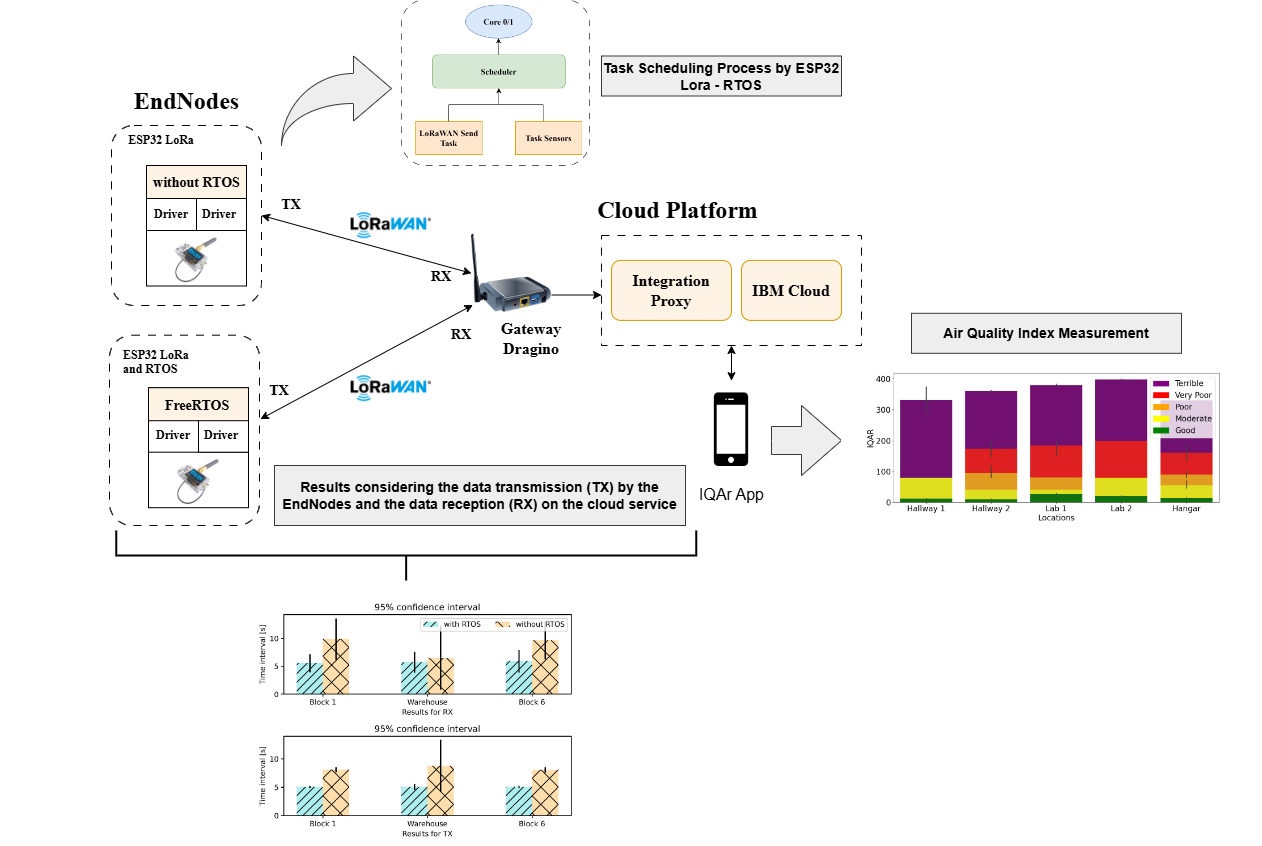
Monitoring air quality in smart campuses is essential for safeguarding the health of the academic community, as air pollution in university environments can lead to respiratory and cardiac issues. While the Internet of Things (IoT) offers a suitable solution for monitoring and notifying about air quality in smart campuses, it is of paramount importance that these notifications occur in real-time to ensure information reaches users with minimal latency. This paper presents an architecture for collecting, storing, and notifying about atmospheric pollutants in a smart campus and analyzes the use of Real-Time Operating Systems (RTOS) for managing the system. The evaluation focuses on IoT technologies, represented by the end node, gateway, and cloud server. The experimental results show that using RTOS reduces the average transmission interval by 37.5% and achieves higher transmission and reception throughput compared to non-real-time operating systems. For instance, in a monitored location, the transmission and reception throughput reached approximately 178.23 and 164.18 with RTOS, compared to 110.97 and 99.41 without RTOS, respectively.
Downloads
References
H. Mokrani et al., “Air quality monitoring using iot: A survey” in IEEE International Conference on Smart Internet of Things (SmartIoT). IEEE, 2019, pp. 127-134. doi: 10.1109/SmartIoT.2019.00028.
R. dos Anjos Gomes, R. B. de Lima, T. do Vale Brsil, ” Impact of the fires in the amazon with the incidence of cases of respiratory problems in the population” in Revista Foco, vol. 17, n. 12, pp. 1-19, 2024. doi: https://doi.org/10.54751/revistafoco.v17n12-004.
S. Kumar and A. Jasuja, ”Air quality monitoring system based on IoT using Raspberry Pi” in International conference on computing, communication and automation (ICCCA). IEEE, 2017. p. 1341-1346. doi: 10.1109/CCAA.2017.8230005.
M. H. A. Abdelsamea, M. Zorkany and N. Abdelkader, ”Real Time Operating Systems for the Internet of Things, Vision, Architecture and Research Directions” in World Symposium on Computer Applications
& Research (WSCAR). IEEE, 2016, pp. 72-77. doi: 10.1109/WSCAR.2016.21.
N. Min-Allah and S. Alrashed, ”Smart campus—A sketch”, Sustain. Cities Soc., vol. 59,p. 102231, 2020. doi: https://doi.org/10.1016/j.scs.2020.102231.
M. Liu and L. Li, ”The construction of smart campus in universities and the practical innovation of student work” in Proceedings of the 1st International Conference on Information Management and Management Science, 2018, pp. 154-157. doi: https://doi.org/10.1145/3277139.3278307.
T. Kumar and A. Doss, ”AIRO: Development of an Intelligent IoT-based Air Quality Monitoring Solution for Urban Ar eas”,Procedia Computer Science, vol. 218, pp. 262-273, 2023. doi:
https://doi.org/10.1016/j.procs.2023.01.008.
M. Simoni, S. Baldacci, S. Maio, S. Cerrai, G. Sarno and G. Viegi, ”Adverse effects of outdoor pollution in the elderly”, Journal of thoracic disease, 2015, vol. 7, no. 1, pp.34. doi: 10.3978/j.issn.2072-1439.2014.12.10.
F. Fatemi, A. Dehdashti and M. Jannati, ”Implementation of Chemical Health, Safety, and Environmental Risk Assessment in Laboratories: A Case-Series Study”, Journal of Occupational Hygiene Engineering, 2018, vol. 5, no. 2 p. 20-27, 2018. doi:10.3389/fpubh.2022.898826.
N. Cunha et al.” Arquitetura de Monitoramento de Qualidade de Ar baseada no LoraWAN e FIWARE em um Campus Universit´ ario”, in Anais do XV Workshop de Computac¸˜ ao Aplicada `a Gest˜ ao do Meio
Ambiente e Recursos Naturais, Bras´ılia/DF, 2024, pp. 169-178, doi: https://doi.org/10.5753/wcama.2024.3038.
B. S. N. Reddy et al. ”A Comprehensive Review on Functional Analysis of Real-Time Operating Systems”, in 3rd International Conference on Innovative Mechanisms for Industry Applications (ICIMIA). IEEE, 2023. p. 1098-1102. doi: 10.1109/ICIMIA60377.2023.10426594.
P. Hambarde, R. Varma and S. Jha, ”The survey of real time operating system: RTOS” in International Conference on Electronic Systems, Signal Processing and Computing Technologies. IEEE, 2014. pp. 34-39. doi: 10.1109/ICESC.2014.15.
B. Septian, M. Misbahuddin and F. Arkan, ”Freertos based air quality monitoring system using secure internet of things”, Jurnal Teknik Informatika (JUTIF), vol. 3, n. 1, p. 147-153, 2022. doi:
https://doi.org/10.20884/1.jutif.2022.3.1.172.
T. S. Gunawan, M. F. Sabar, H. Nasir, M. Kartiwi and S. M. A. Motakabber, ”Development of smart chicken poultry farm using RTOS on Arduino” in IEEE International Conference on Smart Instrumentation, Measurement and Application (ICSIMA). IEEE, 2019, pp. 1-5. doi:
1109/ICSIMA47653.2019.9057310.
L. D. O. Turci, “Real-Time Operating System FreeRTOS Application for Fire Alarm Project in Reduced Scale,” International Journal of Computing and Digital Systems, 2017, vol. 6, no. 4, pp. 198-204. doi:
http://dx.doi.org/10.12785/IJCDS/060405.
H. Wang, J. Huo, J. Hu and T. Wang, ”Research on Real-time Monitoring System of Multiscenario Health Data Based on Internet of Things” in 3rd International Conference on Digital Soci
ety and Intelligent Systems (DSInS). IEEE, 2023, pp. 332-336. doi: 10.1109/DSInS60115.2023.10455560.
Janeera, D. A., et al. ”Smart embedded framework using arduino and IoT for real-time noise and air pollution monitoring and alert system.” 2021 International conference on artificial intelligence and smart systems (ICAIS). IEEE, 2021. doi: 10.1109/ICAIS50930.2021.9396041.
L. F. Ugarte, M. C. Garcia, E. O. Rocheti and E. L. Jr, ”LoRa communication as a solution for real-time monitoring of IoT devices at UNICAMP” in International Conference on Smart Energy Systems and Tech
nologies (SEST). IEEE, 2019, pp. 1-6. doi: 10.1109/SEST.2019.8849100.
Benammar, Mohieddine, et al. ”A modular IoT platform for real time indoor air quality monitoring.” Sensors 18.2 (2018): 581. doi: https://doi.org/10.3390/s18020581