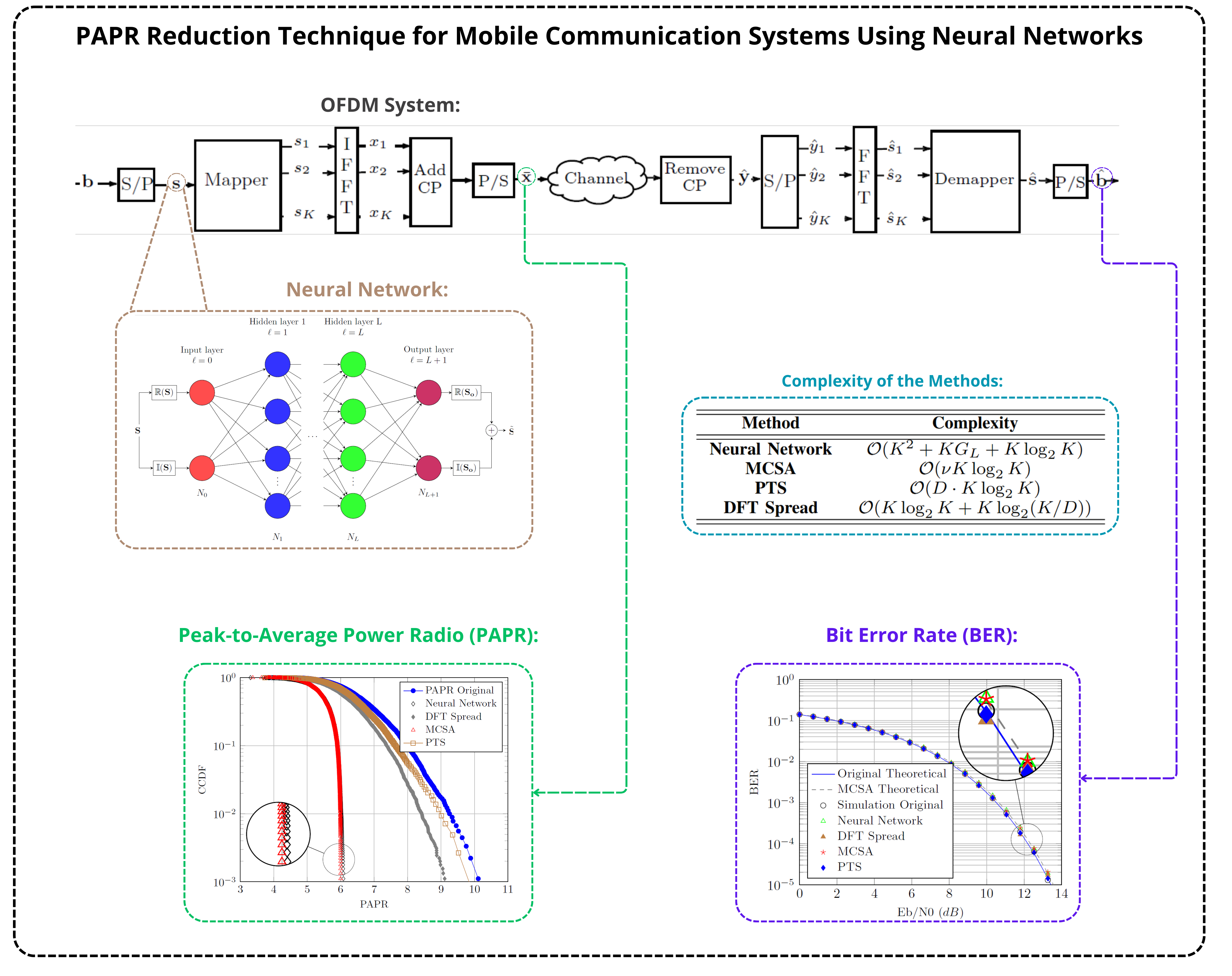
PAPR Reduction Technique for Mobile Communication Systems Using Neural Networks
Keywords:
Neural Network, OFDM, PAPR reductionAbstract
This work proposes a new solution to reduce the PAPR in OFDM systems using NN. The NN leverages a training dataset generated by the MCSA, which fine-tunes the NN for attaining a similar PAPR reduction of the MCSA. Compared to traditional techniques such as the PTS, the proposed solution offers superior performance by achieving a PAPR reduction of up to 4 dB. Nevertheless, a significant advantage is that the trained NN presents a lower computational complexity compared to the MCSA, without compromising its PAPR reduction capabilities
Downloads
References
Nandana Rajatheva, Italo Atzeni, Emil Bj¨ornson, Andre
Bourdoux, Stefano Buzzi, Jean-Baptiste Dor´e, Serhan
Erkucuk, Manuel Fuentes, Kainan Guan, Yuanwei Hu,
Xiaoli Huang, Jarno Hulkkonen, Josep Miquel Jornet,
Marcos Katz, Rickard Nilsson, Erdal Panayirci, Khaled
Rabie, Nuwan Rajapaksha, Mohsen Salehi, and Wenxu
Xu. White Paper on Broadband Connectivity in 6G. 6G
Research Visions, No. 10. University of Oulu, 2020. doi:
http://urn.fi/urn:isbn:9789526226798.
Aarno P¨arssinen, Mohamed-Slim Alouini, Markus Berg,
Thomas Kuerner, Pekka Ky¨osti, Marko E. Leinonen,
Marja Matinmikko-Blue, Earl McCune, Ulrich Pfeiffer,
and Piet Wambacq. White Paper on RF Enabling 6G
– Opportunities and Challenges from Technology to
Spectrum. 6G Research Visions, No. 13. University of
Oulu, 2020. doi: http://urn.fi/urn:isbn:9789526228419.
Anatel. Resoluc¸ ˜ao nº 190, 2021. URL https://pesquisa.
in.gov.br/imprensa/jsp/visualiza/index.jsp?data=06/10/
&jornal=515&pagina=25&totalArquivos=181.
Gabriel Porto Villardi, Giuseppe Thadeu Freitas de
Abreu, and Hiroshi Harada. Tv white space technology:
Interference in portable cognitive emergency network.
IEEE Vehicular Technology Magazine, pages 47–53,
doi: 10.1109/MVT.2012.2190221.
Mohsin Khalil, Junaid Qadir, Oluwakayode Onireti,
Muhammad Ali Imran, and Shahzad Younis. Feasibility,
architecture and cost considerations of using tvws for
rural internet access in 5g. In 2017 20th Conference
on Innovations in Clouds, Internet and Networks (ICIN),
pages 23–30, 2017. doi: 10.1109/ICIN.2017.7899245.
Chin-Sean Sum, Hiroshi Harada, Fumihide Kojima, Zhou
Lan, and Ryuhei Funada. Smart utility networks in tv
white space. IEEE Communications Magazine, pages
–139, 2011. doi: 10.1109/MCOM.2011.5936166.
Dejin Kong, Xing Zheng, Yali Yang, Yue Zhang, and
Tao Jiang. A Novel DFT-Based Scheme for PAPR
Reduction in FBMC/OQAM Systems. IEEE Wireless
Communications Letters, 10(1):161–165, 2021. doi:
1109/LWC.2020.3024179.
R. van Nee and A. de Wild. Reducing the peak-to-
average power ratio of ofdm. In VTC ’98. 48th IEEE
Vehicular Technology Conference. Pathway to Global
Wireless Revolution (Cat. No.98CH36151), pages 2072–
vol.3, 1998. doi: 10.1109/VETEC.1998.686121.
Stephen J. Shellhammer, Ahmed K. Sadek, and Wenyi
Zhang. Technical challenges for cognitive radio in the
tv white space spectrum. In 2009 Information Theory
and Applications Workshop, pages 323–333, 2009. doi:
1109/ITA.2009.5044964.
Yasir Rahmatallah and Seshadri Mohan. Peak-to-average
power ratio reduction in OFDM systems: A survey and
taxonomy. IEEE communications surveys and tutorials,
pages 1567–1592, 2013. doi: 10.1109/SURV.2013.021313.00164.
Dae-Woon Lim, Seok-Joong Heo, and Jong-Seon No.
An overview of peak-to-average power ratio reduction
schemes for OFDM signals. journal of communications
and networks, pages 229–239, 2009. doi: 10.1109/JCN.
6391327.
Aleksei Kalinov, Roman Bychkov, Andrey Ivanov,
Alexander Osinsky, and Dmitry Yarotsky. Machine
Learning-Assisted PAPR Reduction in Massive MIMO.
IEEE Wireless Communications Letters, pages 537–541,
doi: 10.1109/LWC.2020.3036909.
Sumit Chakravarty and Arun Kumar. PAPR Reduction of
GFDM Signals Using Encoder-Decoder Neural Network
(Autoencoder). National Academy Science Letters, pages
–217, 2023. doi: 10.1007/s40009-023-01230-1.
Zhijun Liu, Xin Hu, Kang Han, Sun Zhang, Linlin
Sun, Lexi Xu, Weidong Wang, and Fadhel M Ghan-
nouchi. Low-complexity PAPR reduction method for
OFDM systems based on real-valued neural networks.
IEEE Wireless Communications Letters, pages 1840–
, 2020. doi: 10.1109/LWC.2020.3005656.
Selahattin G¨okceli, Taneli Riihonen, Toni Levanen, and
Mikko Valkama. Machine learning based tuner for
frequency-selective PAPR reduction. IEEE Transactions
on Vehicular Technology, pages 5378–5383, 2022. doi:
1109/TVT.2022.3223157.
Nikos A Mitsiou, Panagiotis D Diamantoulakis, Panagio-
tis G Sarigiannidis, and George K Karagiannidis. Energy
Efficient OFDM with Intelligent PAPR-aware Adaptive
Modulation. IEEE Communications Letters, 2023. doi:
1109/LCOMM.2023.3324137.
Minh-Thang Nguyen, Georges Kaddoum, Bassant Selim,
KV Srinivas, and Paulo Freitas de Araujo-Filho. Deep
Unfolding Network for PAPR Reduction in Multicarrier
OFDM Systems. IEEE Communications Letters, pages
–2620, 2022. doi: 10.1109/LCOMM.2022.3195042.
Muhammad Shahmeer Omar, Jun Qi, and Xiaoli Ma.
Mitigating Clipping Distortion in Multicarrier Transmis-
sions Using Tensor-Train Deep Neural Networks. IEEE
Transactions on Wireless Communications, pages 2127–
, 2022. doi: 10.1109/TWC.2022.3209188.
Fayc¸al Ait Aoudia and Jakob Hoydis. Waveform learn-
ing for next-generation wireless communication systems.
IEEE Transactions on Communications, pages 3804–
, 2022. doi: 10.1109/TCOMM.2022.3164060.
Songlin Sun, Yanhong Ju, and Yasushi Yamao. Overlay
cognitive radio OFDM system for 4G cellular networks.
IEEE Wireless Communications, pages 68–73, 2013. doi:
1109/MWC.2013.6507396.
Ning Li, Mingjin Li, and Zhongliang Deng. A modified
hadamard based slm without side information for papr
reduction in ofdm systems. China Communications,
pages 124–131, 2019. doi: 10.23919/JCC.2019.12.009.
Zheng Du, Norman C. Beaulieu, and Jinkang Zhu. Se-
lective time-domain filtering for reduced-complexity papr
reduction in ofdm. IEEE Transactions on Vehicular
Technology, pages 1170–1176, 2009. doi: 10.1109/TVT.
918716.
Yasir Amer Jawhar, Lukman Audah, Montadar Abas
Taher, Khairun Nidzam Ramli, Nor Shahida Mohd Shah,
Mustafa Musa, and Mustafa Sami Ahmed. A Review
of Partial Transmit Sequence for PAPR Reduction in
the OFDM Systems. IEEE Access, pages 18021–18041,
doi: 10.1109/ACCESS.2019.2894527.
Gerhard Wunder, Robert F.H. Fischer, Holger Boche,
Simon Litsyn, and Jong-Seon No. The papr problem
in ofdm transmission: New directions for a long-lasting
problem. IEEE Signal Processing Magazine, pages 130–
, 2013. doi: 10.1109/MSP.2012.2218138.
Bo Tang, Kaiyu Qin, Xiangyin Zhang, and Changwei
Chen. A clipping-noise compression method to reduce
papr of ofdm signals. IEEE Communications Letters,
pages 1389–1392, 2019. doi: 10.1109/LCOMM.2019.
Dae-Woon Lim, Seok-Joong Heo, Jong-Seon No, and
Habong Chung. A new pts ofdm scheme with low
complexity for papr reduction. IEEE Transactions on
Broadcasting, pages 77–82, 2006. doi: 10.1109/TBC.
861605.
Yasir Rahmatallah and Seshadri Mohan. Peak-to-average
power ratio reduction in ofdm systems: A survey and
taxonomy. IEEE Communications Surveys and Tutori-
als, pages 1567–1592, 2013. doi: 10.1109/SURV.2013.
00164.
Bianca S.de C. da Silva, Mariana B. de Mello, and
Luciano L. Mendes. Papr reduction technique for mobile
communications system based on pattern learning. In
19th International Symposium on Wireless Com-
munication Systems (ISWCS), pages 1–6, 2024. doi:
1109/ISWCS61526.2024.10639125.
Shuping Dang, Jiashen Tang, Jun Li, Miaowen Wen,
Salwani Abdullah, and Chengzhong Li. Combined relay
selection enabled by supervised machine learning. IEEE
Transactions on Vehicular Technology, 70(4):3938–3943,
doi: 10.1109/TVT.2021.3065074.
Kalpesh Hiray and K Vinoth Babu. A neural network
based channel estimation scheme for ofdm system. In
International Conference on Communication and
Signal Processing (ICCSP), pages 0438–0441. IEEE,
doi: 10.1109/ICCSP.2016.7754174.
Pedro HC De Souza, Luciano Leonel Mendes, and
Marwa Chafii. Compressive learning in communica-
tion systems: a neural network receiver for detecting
compressed signals in ofdm systems. IEEE Access,
:122397–122411, 2021. doi: 10.1109/ACCESS.2021.
Luiz AM Pereira, Luciano L Mendes, Carmelo JA
Bastos-Filho, and Arismar Cerqueira S Jr. Machine
learning-based linearization schemes for radio over fiber
systems. IEEE Photonics Journal, pages 1–10, 2022. doi:
1109/JPHOT.2022.3210454.
Seung Hee Han and Jae Hong Lee. PAPR reduction of
OFDM signals using a reduced complexity PTS tech-
nique. IEEE Signal Processing Letters, pages 887–890,
doi: 10.1109/LSP.2004.833490.
Dayan Adionel Guimaraes. Digital transmission:
a simulation-aided introduction with VisSim/Comm.
Springer Science & Business Media, 2010.