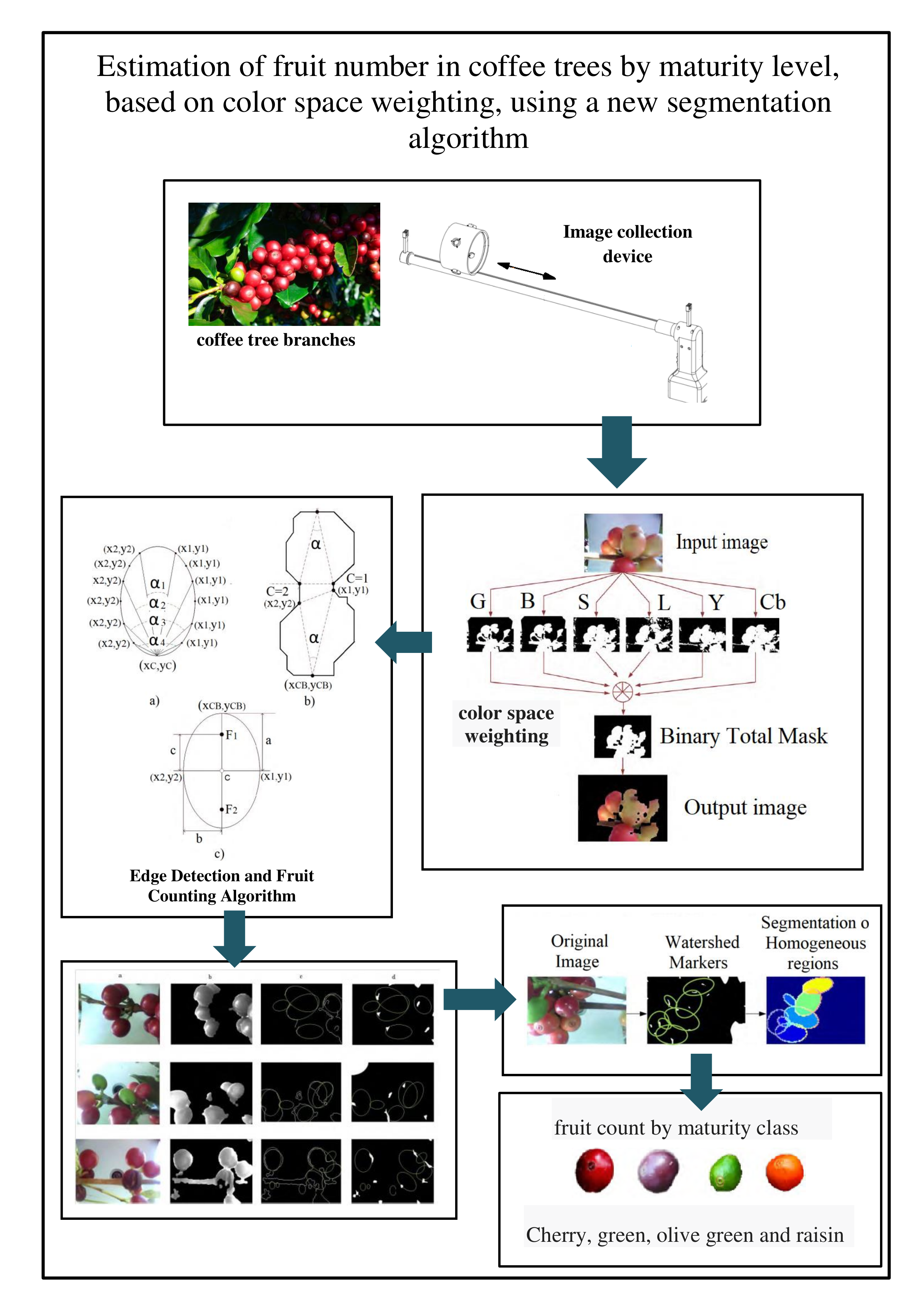
Estimation of fruit number in coffee trees by maturity level, based on color space weighting, using a new segmentation algorithm
Keywords:
Coffee fruit estimating, Computer Vision, Image Processing.Abstract
Computer vision systems are essential for automating agricultural tasks such as disease detection and fruit defect identification. However, their application in coffee farming faces significant challenges due to environmental variability and the complex structure of coffee trees, which complicate image acquisition. Thus, this study addresses two key questions: 1) Can low-cost, user-friendly equipment adapt to crop conditions while ensuring image quality? 2) Can a computer vision algorithm accurately count and classify coffee beans with over 80% accuracy using data from low-cost cameras? To answer these questions, an image acquisition system was developed based on the phenological characteristics of coffee plants, ensuring focused and consistent image capture. Additionally, a novel algorithm was created, utilizing statistical analysis of color spaces to effectively separate fruits from the background, segment images, and count fruits. The algorithm achieved accuracy rates, when compared with a traditional approach, within the desired range for each coffee fruit class: green (83%), green-olive (79%), cherry (86%), and raisin (80%). These results demonstrate the potential of this approach for accurate and efficient fruit processing in coffee farming, particularly when images are captured directly from tree branches.
Downloads
References
L. Kouadio, P. Tixier, V. Byrareddy, T. Marcussen, S. Mushtaq, B. Rapidel and R. Stone. "Performance of a process-based model for predicting robusta coffee yield at te regional scale in Vietnam". Ecological
Modelling, vol. 443, 2021. Available: 10.1016/j.ecolmodel.2021.109469
C. Brunn, P. Laderach, O. O. Rivera and D. Kirschke. "A bitter cup: climate change profile of global production of Arabica and Robusta coffee". Climatic Change, vol. 129, pp.89-101, 2015. Available: 10.1007/s10584-014-1306-x
V. Byrareddy, L. Kouadio, S. Mushtaq and R. Stone. "Sustainable Production of Robusta Coffee under a Change Climate: A 10-Year Monitoring of Fertilizer Management in Coffee Farms in Vietnam and Indonesia". Agronomy vol. 9, pp. 1-19, 2019. Available: 10.3390/agronomy9090499
M. K. V. Carr. "The water relations and irrigation requirements of coffee". Experimental Agriculture, vol. 37, pp. 1-36, 2001. Available: 10.1017/S0014479701001090
S. Castro-Tanzi, M. Flores, N. Wanner, T. V. Dietsch, J. Banks, N. Ureña-Retana and M. Chandler. "Evaluation of a non-destructive sampling method and a statistical model for predicting fruit load on individual coffee (coffea arabica) trees". Scientia Horticulturae, vol. 167, pp. 117-126, 2014. Available: 10.1016/j.scienta.2013.12.013.
H. M. R. Alves, M. M. L. Volpato, T. G. C. Vieira, D. A. Maciel, T. G. Gonçalves and M. F. Dantas. "Characterization and spectral monitoring of coffee lands in Brazil". International Archives of the Photogrammetry, Remote Sensing and Spatial Information Sciences - ISPRS Archives, vol.
, July, pp. 801-803, 2016. Available: 10.5194/isprsarchives-XLI-B8-801-2016
M. A. Zanella, R. N. Martins, F. M. Silva, L. C. C. Carvalho, M. C. Alves and J. T. F. Rosas. "Coffee yield prediction using high-resolution satellite imagery and crop nutritional status in Southeast Brazil". Remote Sensing Applications: Society and Environment, vol. 33, pp. 1-12, 2024. Available: 10.1016/j.rsase.2023.101092
D. M. Tsai and W. L. Chen. "Coffee plantation area recognition in satellite images using Fourier transform". Computers and Electronics in Agriculture, vol. 135, pp. 115-127, 2017. Available:
1016/j.compag.2016.12.020
Q. Zeng. "Algorithm based on marker-controlled watershed transform for overlapping plant fruit segmentation". Optical Engineering, vol. 48, no. 2, 2009. Available: 10.1117/1.3076212
R. Xiang, H. Jiang, Y. Peng, Y. Ying and J. Li. "Research on Recognition Method for Overlapping Tomatoes Based on Depth Map". Conference paper - American Society of Agricultural and Biological Engineers, no. 11, 2011. Available: 10.13031/2013.37754
J. C. Pastranaand T. Rath. "Novel image processing approach for solving the overlapping problem in agriculture". Biosystems Engineering, vol. 115, no. 1, pp. 106–115, 2013. Available:
1016/j.biosystemseng.2012.12.006
R. Xiang, H. Jiang and Y. Ying. "Recognition of clustered tomatoes based on binocular stereo vision". Computers and electronics in agriculture, vol. 106, pp. 75-90, 2014. Available: 10.1016/j.compag.2014.05.006
T. Pahikkala, K. Kari, H. Mattila, A. Lepisto, J. Teuhola, O. S. Nevalainen and E. Tyystjärvi. "Classification of plant species from images of overlapping leaves". Computers and Electronics in Agriculture, vol. 118, pp. 186–192, 2015. Available: 10.1016/j.compag.2015.09.003
M. Stein, S. Bargoti and J. Underwood. "Image Based Mango Fruit Detection, Localisation and Yield Estimation Using Multiple View Geometry". Sensors, vol. 16, no. 11, 2016. Available: 10.3390/s16111915
P. J. Ramos, F. A. Prieto, C. Montoya anbd C. E. Oliveros. "Automatic fruit count on coffee branches using computer vision". Computers and Electronics in Agriculture, vol. 137, pp. 9–22, 2017. Available:
1016/j.compag.2017.03.010
L. Yu, J. Xiong, X. Fang, Z. Yang, Y. Chen, X. Lin and S. Chen. "A litchi fruit recognition method in a natural environment using rgb-d images". Biosystems Engineering, vol. 204, pp. 50–63, 2021. Available:
1016/j.biosystemseng.2021.01.015
J. P. Rodriguez, D. C. Corrales, J. N. Aubertot and J. C. Corrales. "A computer vision system for automatic cherry beans detection on coffee trees". Pattern Recognition Letters, vol. 136, pp. 142–153, 2020. Available: 10.1016/j.patrec.2020.05.034
H. C. Bazame, J. P. Molin, D. Althoff and M. Martello, M. "Detection, classification, and mapping of coffee fruits during harvest with computer vision". Computers and Electronics in Agriculture, vol. 183, 2021. Available: 10.1016/j.compag.2021.106066
P. J. Ramos, J. Avendano and F. A. Prieto, F. A. "Measurement of the ripening rate on coffee branches by using 3d images in outdoor environments". Computers in Industry, vol. 99, pp. 83–95, 2018. Available: 10.1016/j.compind.2018.03.024