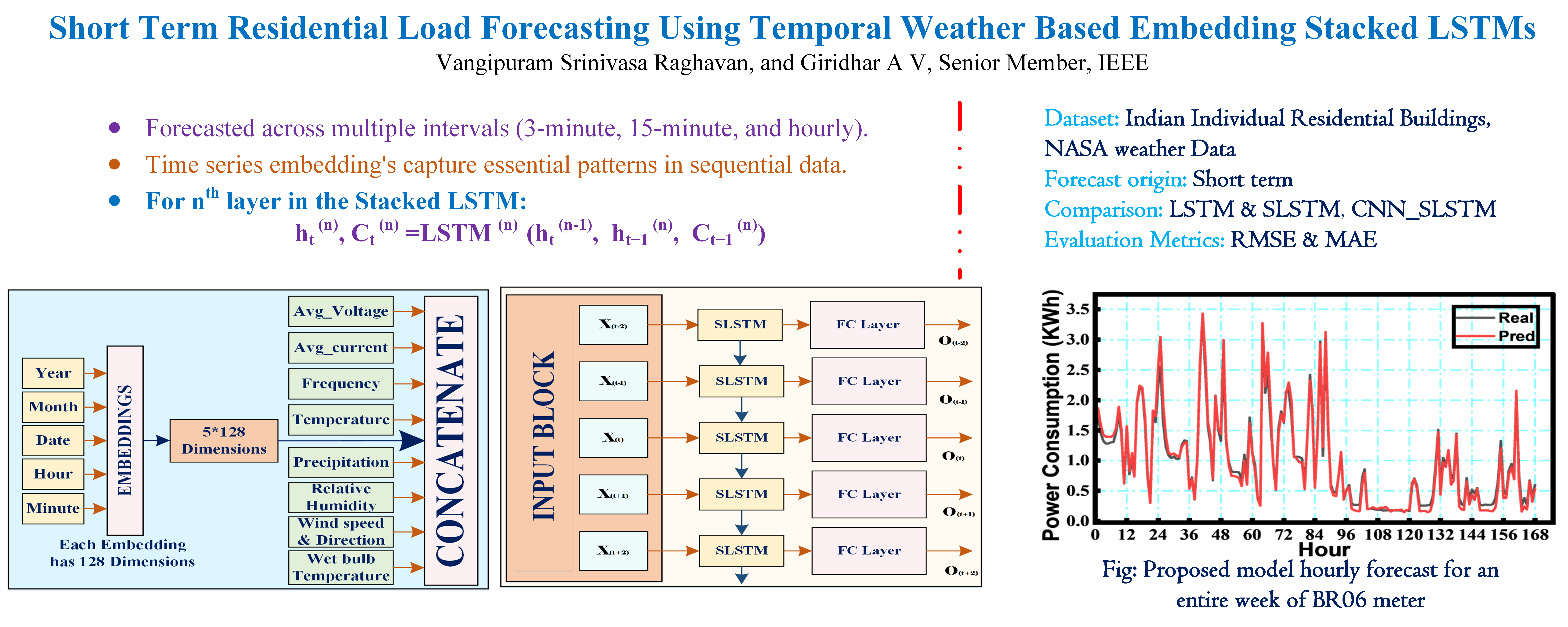
Short Term Residential Load Forecasting Using Temporal Weather Based Embedding Stacked LSTMs
Keywords:
Building Energy Management, Electricity Load, short-term Forecasting, Neural Networks, Time Series EmbeddingsAbstract
Resource management is crucial to balance human needs with sustainability, prevent overuse, and preserve natural resources like water, forests, and minerals for future generations. Managing electricity at the root of human usage can be a crucial first step, helping us move toward better resource management and reducing the strain on natural resources. Superior forecasting approaches are needed to determine usage patterns. Accurate predictions can serve as key input to the Home Energy Management Systems (HEMS) mechanisms in optimizing electricity operation, reducing energy waste, and increasing resource utilization.
Neural network-based methods are being developed to forecast electricity usage in residential buildings by learning behavioral patterns over time. These approaches leverage historical data to identify trends and predict future consumption, offering a promising direction for more accurate forecasting methods. Although still evolving, they provide a foundation for optimizing energy management by anticipating demand and enabling more efficient resource allocation.
However, these approaches primarily rely on historical patterns to predict future electricity usage, often overlooking the impact of daily weather conditions. In this paper, we explore a method that incorporates weather information to enhance electricity usage predictions.
We propose a simple Stacked LSTM-based neural network that integrates historical usage data and weather information as learned inputs for more effective electricity usage prediction. Our approach demonstrates improved prediction performance compared to methods that do not account for weather factors and the CNN-SLSTM model. For the BR04 hourly test dataset, our proposed model achieves a 56% and 67% reduction in RMSE compared to the SLSTM with weather and CNN-SLSTM models, respectively.
Downloads
References
L. Strezoski, ”Distributed energy resource management systems (DERMS): State of the art and how to move forward”, WIREs Energy and Environment, vol. 12, no. 1, 2022. https://doi.org/10.1002/wene.460
Mahapatra, B., Nayyar, A. Home energy management system (HEMS): concept, architecture, infrastructure, challenges and energy management schemes. Energy Syst 13, 643–669 (2022). https://doi.org/10.1007/s12667-019-00364-w
International Energy Agency (IEA), Key indicators in India as a percentage of global averages, 2000 and 2019 [Online]. Paris, France: IEA, 2022. Available: https://www.iea.org/data-and-statistics/charts/key- indicators-in-india-as-a-percentage-of-global-averages-2000-and-2019.
A. Garulli, S. Paoletti and A. Vicino, ”Models and Techniques for Electric Load Forecasting in the Presence of Demand Response,” in IEEE Transactions on Control Systems Technology, vol. 23, no. 3, pp. 1087- 1097, May 2015, doi: 10.1109/TCST.2014.2361807.
S. Khuntia, J. Rueda, & M. Meijden, “Forecasting the load of electrical power systems in mid- and long-term horizons: a review”, IET Generation, Transmission &Amp; Distribution, vol. 10, no. 16, p. 3971-3977, 2016. https://doi.org/10.1049/iet-gtd.2016.0340
J. Yuan, S. -Z. Chen, S. S. Yu, G. Zhang, Z. Chen and Y. Zhang, ”A Kernel-Based Real-Time Adaptive Dynamic Programming Method for Economic Household Energy Systems,” in IEEE Transactions on Industrial Informatics, vol. 19, no. 3, pp. 2374-2384, March 2023, doi: 10.1109/TII.2022.3181034.
Zulfiqar Ahmad Khan, Amin Ullah, Ijaz Ul Haq, Mohamed Hamdy, Gerardo Maria Mauro, Khan Muhammad, Mohammad Hijji, Sung Wook Baik, Efficient Short-Term Electricity Load Forecasting for Effective Energy Management, Sustainable Energy Technologies and Assessments, Volume 53, Part A, 2022, 102337, ISSN 2213-1388, https://doi.org/10.1016/j.seta.2022.102337.
D. Hadjout, J.F. Torres, A. Troncoso, A. Sebaa, F. Mart´ınez- ´Alvarez, Electricity consumption forecasting based on ensemble deep learning with application to the Algerian market, Energy, Volume 243, 2022, 123060, ISSN 0360-5442, https://doi.org/10.1016/j.energy.2021.123060.
Son H, Kim C. A Deep Learning Approach to Forecasting Monthly Demand for Residential–Sector Electricity. Sustainability. 2020; 12(8):3103. https://doi.org/10.3390/su12083103.
Sourabh Shastri, Kuljeet Singh, Sachin Kumar, Paramjit Kour, Vibhakar Mansotra, Time series forecasting of Covid-19 using deep learning models: India-USA comparative case study, Chaos, Solitons & Fractals, Volume 140, 2020, 110227, ISSN 0960-0779, https://doi.org/10.1016/j.chaos.2020.110227.
Moradzadeh A, Mansour-Saatloo A, Mohammadi-Ivatloo B, Anvari-Moghaddam A. Performance Evaluation of Two Machine Learning Techniques in Heating and Cooling Loads Forecasting of Residential Buildings. Applied Sciences. 2020; 10(11):3829. https://doi.org/10.3390/app10113829.
M. Q. Raza, N. Mithulananthan, J. Li and K. Y. Lee, ”Multivariate Ensemble Forecast Framework for Demand Prediction of Anomalous Days,” in IEEE Transactions on Sustainable Energy, vol. 11, no. 1, pp. 27-36, Jan. 2020, doi: 10.1109/TSTE.2018.2883393.
R. Zhang, Y. Xu, Z. Y. Dong, W. Kong and K. P. Wong, ”A composite k-nearest neighbor model for day-ahead load forecasting with limited temperature forecasts,” 2016 IEEE Power and Energy Society General Meeting (PESGM), Boston, MA, USA, 2016, pp. 1-5, doi: 10.1109/PESGM.2016.7741097.
S. H. Rafi, Nahid-Al-Masood, S. R. Deeba and E. Hossain, ”A Short- Term Load Forecasting Method Using Integrated CNN and LSTM Network,” in IEEE Access, vol. 9, pp. 32436-32448, 2021, doi: 10.1109/ACCESS.2021.3060654.
G. Dudek, P. Pełka and S. Smyl, ”A Hybrid Residual Dilated LSTM and Exponential Smoothing Model for Midterm Electric Load Forecasting,” in IEEE Transactions on Neural Networks and Learning Systems, vol. 33, no. 7, pp. 2879-2891, July 2022, doi: 10.1109/TNNLS.2020.3046629.
Sara Abedi, Soongeol Kwon, Rolling-horizon optimization integrated with recurrent neural network-driven forecasting for residential battery energy storage operations, International Journal of Electrical Power & Energy Systems, Volume 145, 2023, 108589, ISSN 0142-0615, https://doi.org/10.1016/j.ijepes.2022.108589.
Arash Moradzadeh, Hamed Moayyed, Kazem Zare, Behnam Mohammadi-Ivatloo, Short-term electricity demand forecasting via variational autoencoders and batch training-based bidirectional long short-term memory, Sustainable Energy Technologies and Assessments, Volume 52, Part C, 2022, 102209, ISSN 2213-1388, https://doi.org/10.1016/j.seta.2022.102209.
D. L. Marino, K. Amarasinghe and M. Manic, ”Building energy load forecasting using Deep Neural Networks,” IECON 2016 - 42nd Annual Conference of the IEEE Industrial Electronics Society, Florence, Italy, 2016, pp. 7046-7051, doi: 10.1109/IECON.2016.7793413.
H. Shi, M. Xu and R. Li, ”Deep Learning for Household Load Forecast- ing—A Novel Pooling Deep RNN,” in IEEE Transactions on Smart Grid, vol. 9, no. 5, pp. 5271-5280, Sept. 2018, doi: 10.1109/TSG.2017.2686012.
B. Farsi, M. Amayri, N. Bouguila and U. Eicker, ”On Short-Term Load Forecasting Using Machine Learning Techniques and a Novel Parallel Deep LSTM-CNN Approach,” in IEEE Access, vol. 9, pp. 31191-31212, 2021, doi: 10.1109/ACCESS.2021.3060290.
M. Alhussein, K. Aurangzeb and S. I. Haider, ”Hybrid CNN-LSTM Model for Short-Term Individual Household Load Forecasting,” in IEEE Access, vol. 8, pp. 180544-180557, 2020, doi: 10.1109/ACCESS.2020.3028281.
Charan Sekhar, Ratna Dahiya, Robust framework based on hybrid deep learning approach for short term load forecasting of building electricity demand, Energy, Volume 268, 2023, 126660, ISSN 0360-5442, https://doi.org/10.1016/j.energy.2023.126660.
O. Rubasinghe, X. Zhang, T. K. Chau, Y. H. Chow, T. Fernando and H. H. -C. Iu, ”A Novel Sequence to Sequence Data Modelling Based CNN-LSTM Algorithm for Three Years Ahead Monthly Peak Load Forecasting,” in IEEE Transactions on Power Systems, vol. 39, no. 1, pp. 1932-1947, Jan. 2024, doi: 10.1109/TPWRS.2023.3271325.
Khan ZA, Hussain T, Ullah A, Rho S, Lee M, Baik SW. Towards Efficient Electricity Forecasting in Residential and Commercial Buildings: A Novel Hybrid CNN with a LSTM-AE based Framework. Sensors. 2020; 20(5):1399. https://doi.org/10.3390/s20051399
Xiaolei Liu, Zi Lin, Impact of Covid-19 pandemic on electricity demand in the UK based on multivariate time series forecasting with Bidirectional Long Short Term Memory, Energy, Volume 227, 2021, 120455, ISSN 0360-5442, https://doi.org/10.1016/j.energy.2021.120455.
Ji X, Huang H, Chen D, Yin K, Zuo Y, Chen Z, Bai R. A Hybrid Residential Short-Term Load Forecasting Method Using Attention Mechanism and Deep Learning. Buildings. 2023; 13(1):72. https://doi.org/10.3390/buildings13010072
K. Amarasinghe, D. L. Marino and M. Manic, ”Deep neural networks for energy load forecasting,” 2017 IEEE 26th International Symposium on Industrial Electronics (ISIE), Edinburgh, UK, 2017, pp. 1483-1488, doi: 10.1109/ISIE.2017.8001465.
S. Hochreiter and J. Schmidhuber, ”Long Short-Term Memory,” in Neural Computation, vol. 9, no. 8, pp. 1735-1780, 15 Nov. 1997, doi: 10.1162/neco.1997.9.8.1735.
Kyunghyun Cho, Bart van Merri¨enboer, Caglar Gulcehre, Dzmitry Bahdanau, Fethi Bougares, Holger Schwenk, and Yoshua Bengio. 2014. Learning Phrase Representations using RNN Encoder–Decoder for Statistical Machine Translation. In Proceedings of the 2014 Conference on Empirical Methods in Natural Language Processing (EMNLP), pages 1724–1734, Doha, Qatar. Association for Computational Linguistics, doi: 10.3115/v1/D14-1179.
Chang, C., Chan, C. T., Wang, W. Y., Peng, W. C., & Chen, T. F. (2024, May). TimeDRL: Disentangled Representation Learning for Multivariate Time-Series. In 2024 IEEE 40th International Conference on Data Engineering (ICDE) (pp. 625-638). IEEE.
Alves, D., Mendonc¸a, F., Mostafa, S.S. et al. Time-Series Embeddings from Language Models: A Tool for Wind Direction Nowcasting. J Meteorol Res 38, 558–569 (2024). https://doi.org/10.1007/s13351-024- 3151-9
Y. LeCun et al., ”Handwritten digit recognition with a back-propagation network”, Proc. Int. Conf. Adv. Neural Inf. Process. Syst., vol. 2, pp. 399-402, 1989.
Mustaqeem, M. Ishaq and S. Kwon, ”Short-Term Energy Fore- casting Framework Using an Ensemble Deep Learning Approach,” in IEEE Access, vol. 9, pp. 94262-94271, 2021, doi: 10.1109/ACCESS.2021.3093053.
W. Kong, Z. Y. Dong, Y. Jia, D. J. Hill, Y. Xu and Y. Zhang, ”Short- Term Residential Load Forecasting Based on LSTM Recurrent Neural Network,” in IEEE Transactions on Smart Grid, vol. 10, no. 1, pp. 841- 851, Jan. 2019, doi: 10.1109/TSG.2017.2753802.
Fan Liang, Austin Yu, William G. Hatcher, Wei Yu, Chao Lu, Deep Learning-Based Power Usage Forecast Modeling and Evaluation, Procedia Computer Science, Volume 154, 2019, Pages 102-108, ISSN 1877- 0509, https://doi.org/10.1016/j.procs.2019.06.016.
Zahra Fazlipour, Elaheh Mashhour, Mahmood Joorabian, A deep model for short-term load forecasting applying a stacked autoencoder based on LSTM supported by a multi-stage attention mechanism, Applied Energy, Volume 327, 2022, 120063, ISSN 0306-2619, https://doi.org/10.1016/j.apenergy.2022.120063.
X. Lin, R. Zamora, C. A. Baguley and A. K. Srivastava, ”A Hybrid Short-Term Load Forecasting Approach for Individual Residential Customer,” in IEEE Transactions on Power Delivery, vol. 38, no. 1, pp. 26-37, Feb. 2023, doi: 10.1109/TPWRD.2022.3178822.
C. S. Lai et al., ”Multi-View Neural Network Ensemble for Short and Mid-Term Load Forecasting,” in IEEE Transactions on Power Systems, vol. 36, no. 4, pp. 2992-3003, July 2021, doi: 10.1109/TP- WRS.2020.3042389.
Tjøstheim, Dag and Jullum, Martin and Løland, Anders, Some re- cent trends in embeddings of time series and dynamic networks, Journal of Time Series Analysis, vol. 44, no. 5-6, pp. 686-709, 2023, https://doi.org/10.1111/jtsa.12677.
Chuyuan Wei, Dechang Pi, Mingtian Ping, Haopeng Zhang, Short-term load forecasting using spatial-temporal embedding graph neural network, Electric Power Systems Research, Volume 225, 2023, 109873, ISSN 0378-7796, https://doi.org/10.1016/j.epsr.2023.109873.
Rob J. Hyndman, Anne B. Koehler, Another look at measures of forecast accuracy, International Journal of Forecasting, Volume 22, Issue 4, 2006, Pages 679-688, ISSN 0169-2070, https://doi.org/10.1016/j.ijforecast.2006.03.001.
Sammut, Claude, and Geoffrey I. Webb. ”Mean absolute error.” Encyclopedia of Machine Learning 652 (2010).
Meng Zhou, Junqi Yu, Fukang Sun, Meng Wang, Forecasting of short term electric power consumption for different types buildings using improved transfer learning: A case study of primary school in China, Journal of Building Engineering, Volume 78, 2023, 107618, ISSN 2352- 7102, https://doi.org/10.1016/j.jobe.2023.107618.
Agrawal, Shalu; Mani, Sunil; Ganesan, Karthik; Jain, Abhishek, 2021, “High frequency smart meter data from two districts in India (Mathura and Bareilly)”, https://doi.org/10.7910/DVN/GOCHJH, Harvard Dataverse, V2.
National Aeronautics and Space Administration (NASA) POWER [Power Prediction of Worldwide Energy Resources]. Retrieved from https://power.larc.nasa.gov/data-access-viewer/