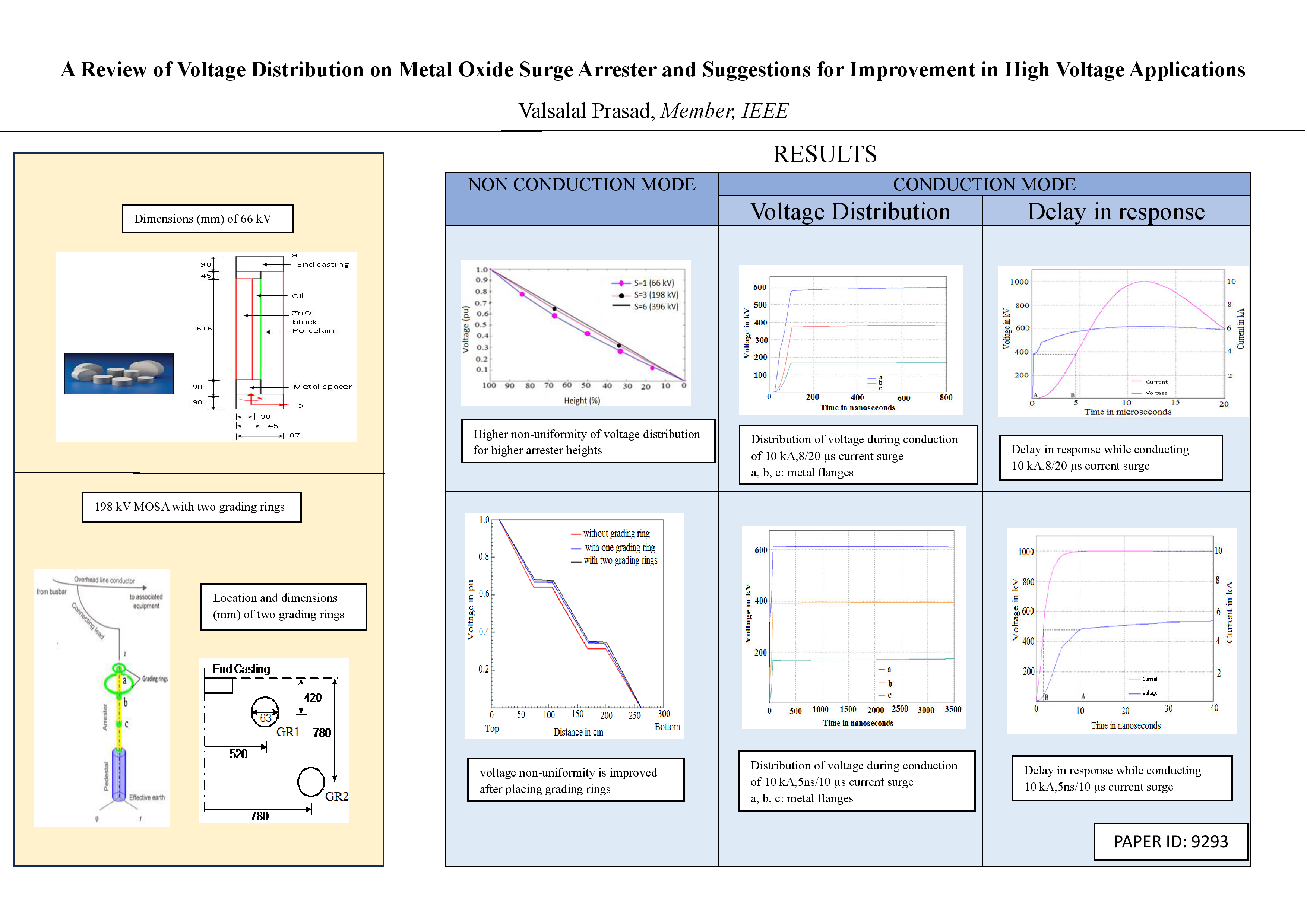
A Review of Voltage Distribution on Metal Oxide Surge Arrester and Suggestions for Improvement in High Voltage Applications
Keywords:
Block capacitance, Conduction mode, Metal oxide surge arrester (MOSA), Non-conduction mode, Very fast transient overvoltage (VFTO), Stray Capacitance.Abstract
Stray capacitive effect of MOSA may cause non-uniform voltage distribution in both non-conduction and conduction modes. Also, during conduction, there is a delay in operation of arrester, particularly when faced with very fast transient overvoltages (VFTOs). Consequently,
there is a necessity to reduce stray capacitive effect for improvement in voltage distribution and reduce delay in response of arrester for VFTOs. One approach is placement of grading rings with appropriate number and size. Numerous researchers have conducted extensive studies on causes of non-uniform voltage distribution, computation of stray capacitances and remedial measures to achieve a more
uniform voltage distribution. Further, this investigation holds great significance in polluted environments, damaged arresters and broken sheds, as proper operation of surge arresters relies on environmental conditions, material properties, and shapes of arrester assembly. This paper provides a summary of research conducted by various researchers from the year 1970 and also offers suggestions
for further studies of achieving a more uniform voltage distribution and reducing response delay of MOSAs.
Downloads
References
P.Valsalal, S.Usa, K.Udayakumar, "Effect of Stray Capacitance on Surge
Arrester Performance", Proceedings of the World Congress on
Engineering and Computer Science WCECS, vol. I, 2009. ISBN:978-988-
-6-8
P.Valsalal, S.Usa, K.Udayakumar, “Modelling of metal oxide arrester for
very fast transients”, IET Sci Meas & Technol., vol.5, no.4, pp. 140-146,
doi: 10.1049/iet-smt.2010.0129
P.Valsalal, S.Usa, K.Udayakumar, “Response of metal oxide arrester in
gas insulated substation and methods to improve its dynamic
characteristics”, IET Sci Meas & Technol., vol. 6, no.4, pp. 222-228, 2012.
doi: 10.1049/iet-smt.2011.0051
Valsalal Prasad, “Possible Measures to Enhance the Performance of
Metal–Oxide Arresters in the EHV Network Under Very Fast Transients”,
IEEE Trans Power Deliv., Vol. 30, no. 2, pp. 783-790, 2015.
doi: 10.1109/TPWRD.2014.2346533
Kannadasan Raju, Valsalal Prasad, Rajvikram Madurai Elavarasan,
Umashankar Subramaniam, Dhafer J. Almakhles, “Development of High
Gradient ZnO Arrester Material for High Voltage Applications”, IEEE
Access, vol. 8, pp. 115685-115893, 2020.
doi:10.1109/ACCESS.2020.3003817