Automatic Detection of Dynamic Wind Conditions in Mexican California: A Machine Learning-Driven Advancement in Wind Management
Keywords:
wind energy, gaussian mixture model, machine learning, wind state detection, climate modeling, Renewable energy predictionAbstract
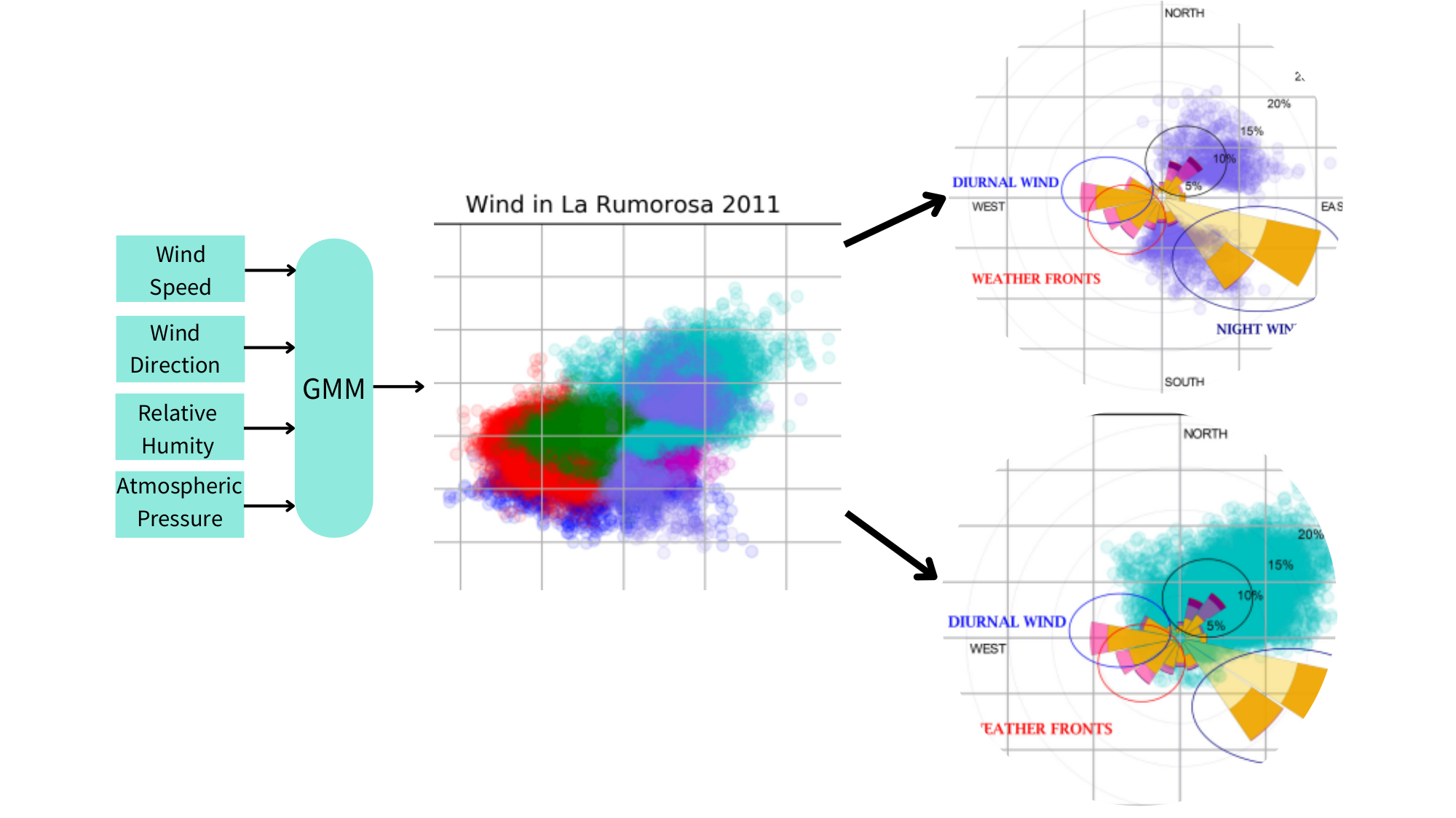
Accurate detection and classification of wind states is crucial for accurately assessing and predicting wind energy production, fire spread behavior, air quality monitoring, and understanding complex meteorological phenomena. The complex nature of wind necessitates advanced data analysis techniques to extract meaningful patterns from meteorological datasets. This study presents a stochastic wind classification and identification analysis based on a Gaussian Mixture Model (GMM) clustering method applied to a case study in ``La Rumorosa'', Mexican California. By analyzing four meteorological variables (relative humidity, atmospheric pressure, wind speed, and wind direction) over five years, the method automatically identifies distinct wind conditions that can be defined as climate states, including well-known regional phenomena like Santa Ana winds and local orographic winds. Accurate detection of wind states enables better forecasting of wind energy potential at favorable sites, wildfire risk management through predicted fire behavior and monitoring pollutant/allergen dispersal patterns. The proposed approach offers a reliable, computationally efficient method for detecting wind patterns, extending to different geographical regions impacted by diverse wind phenomena.
Downloads
References
S. Buhan, Y. Ozkazanc, and I. Çadirci, “Wind pattern recognition and
reference wind mast data correlations with nwp for improved wind-
electric power forecasts,” IEEE Transactions on Industrial Informatics,
vol. 12, no. 3, pp. 991–1004, June 2016. [Online]. Available:
https://doi.org/10.1109/TII.2016.25430046
J. Liu, M. Zhu, Z. Lin, and S. Chen, “A dynamic clustering model
of wind farm based on the operation data,” Journal of Renewable and
Sustainable Energy, vol. 7, no. 4, p. 043111, 2015. [Online]. Available:
https://doi.org/10.1063/1.4926906
D. Alves, F. Mendonça, S. S. Mostafa, and F. Morgado-Dias, “The
potential of machine learning for wind speed and direction short-term
forecasting: A systematic review,” Computers, vol. 12, no. 10, 2023.
[Online]. Available: https://www.mdpi.com/2073-431X/12/10/206
A. K. Jain, “Data clustering: 50 years beyond k-means,” Pattern
Recognition Letters, vol. 31, no. 8, pp. 651–666, 2010. [Online].
Available: http://dx.doi.org/10.1016/j.patrec.2009.09.011
A. Clifton and J. K. Lundquist, “Data clustering reveals climate im-
pacts on local wind phenomena,” Journal of Applied Meteorology and
Climatology, vol. 51, no. 8, pp. 1547–1557, 2012.
M. Ester, H. P. Kriegel, J. Sander, and X. Xu, “A density-based
algorithm for discovering clusters in large spatial databases with noise,”
in Proceedings of the 2nd International Conference on Knowledge
Discovery and Data Mining, 1996, pp. 226–231.
R. Najafi-Silab, A. Soleymanzadeh, P. Kolah-kaj, and S. Kord,
“Electrical rock typing using gaussian mixture model to determine
cementation factor,” Journal of Petroleum Exploration and Production
Technology, vol. 13, pp. 1329–1344, 2023. [Online]. Available:
https://doi.org/10.1007/s13202-023-01612-7
S. Konishi and G. Kitagawa, Information Criteria and Statistical Mod-
eling. Springer, 2007.
G. Claeskens and N. L. Hjort, “Akaike’s information criterion,” in Model
Selection and Model Averaging:. Cambridge: Cambridge University
Press, 2001, pp. 22–69.
M. Arellano-Vázquez, C. Minutti-Martinez, and M. Zamora-Machado,
“Automated characterization and prediction of wind conditions using
gaussian mixtures,” vol. 12468, pp. 158–168, 2020. [Online]. Available:
1007/978-3-030-60884-2 12
A.-V. Magali, Z.-M. Marlene, M. Robles, and O. A. Jaramillo,
“Favorable wind states in wind energy production at la rumorosa i
wind farm,” Journal of Physics: Conference Series, vol. 1618, no. 6,
p. 062071, sep 2020. [Online]. Available: https://dx.doi.org/10.1088/
-6596/1618/6/062071
R. Marcille, M. Thiébaut, P. Tandeo, and J.-F. Filipot, “Gaussian
mixture models for the optimal sparse sampling of offshore wind
resource,” Wind Energy Science, vol. 8, no. 5, pp. 771–786, 2023.
[Online]. Available: https://wes.copernicus.org/articles/8/771/2023/
W. Huang, X. Zhu, H. Xia, and K. Wu, “Offshore wind energy
assessment with a clustering approach to mixture model parameter
estimation,” Journal of Marine Science and Engineering, vol. 11,
no. 11, 2023. [Online]. Available: https://www.mdpi.com/2077-1312/
/11/2060
T.-G. R. Reyes-Coca S., El Niño Oscilación del Sur” y los fenómenos
hidrometeorológicos en Baja California: el evento de 1997/98, 2001.
E. J. Lutgens F. K., Tarbuck, Atmosphere, The: An Introduction to
Meteorology, 12th Edition. Prentice Hall, 2013.
F. Cannon, L. M. Carvalho, C. Jones, T. Hall, D. Gomberg, J. Dumas,
and M. Jackson, “Wrf simulation of downslope wind events in coastal
santa barbara county,” Atmospheric Research, vol. 191, pp. 57–73, 2017.
[Online]. Available: https://doi.org/10.1016/j.atmosres.2017.03.010
L. M. Sheridan, R. Krishnamurthy, G. Garcı́a Medina, B. J. Gaudet,
W. I. Gustafson Jr., A. M. Mahon, W. J. Shaw, R. K. Newsom,
M. Pekour, and Z. Yang, “Offshore reanalysis wind speed assessment
across the wind turbine rotor layer off the united states pacific coast,”
Wind Energy Science, vol. 7, no. 5, pp. 2059–2084, 2022. [Online].
Available: https://wes.copernicus.org/articles/7/2059/2022/
M. Zamora-Machado, A. A. Lambert-Arista, O. R. Garcı́a-Cueto,
O. A. Jaramillo-Salgado, E. Leyva-Sánchez, R. C. Reynaga-López,
J. R. Herrera-Garcı́a, N. Lizárraga-Osuna, and R. C. Anguiano-
Cota, “Classification of santa ana winds for the evaluation of
their wind potential in la rumorosa, baja california, mexico,”
Ciencias Marinas, vol. 49, Aug. 2023. [Online]. Available: https:
//www.cienciasmarinas.com.mx/index.php/cmarinas/article/view/3358
J. Guzman-Morales, A. Gershunov, J. Theiss, H. Li, and D. Cayan,
“Santa ana winds of southern california: Their climatology, extremes,
and behavior spanning six and a half decades,” Geophysical Research
Letters, vol. 43, no. 6, pp. 2827–2834, 2016.
A. Langford, R. Pierce, and P. Schultz, “Stratospheric intrusions, the
santa ana winds, and wildland fires in southern california,” Geophysical
Research Letters, vol. 42, no. 14, pp. 6091–6097, 2015.
M. Raphael and J. Finley, “The relationship between el niño and the
duration and frequency of the santa ana winds of southern california,”
The Professional Geographer, vol. 59, no. 2, pp. 184–192, 2007.
T. Rolinski, S. B. Capps, and W. Zhuang, “Santa ana winds: A
descriptive climatology,” Weather and Forecasting, vol. 34, no. 2, pp.
–275, 2019.
M. Z. Machado, “Variabilidad del potencial eólico y su relación con
fenómenos meteorológicos en baja california,” Ph.D. dissertation, Uni-
versidad Autónoma de Baja California, 1 2016.
S. Conil and A. Hall, “Local regimes of atmospheric variability:
A case study of southern california,” Journal of Climate, vol. 19,
no. 17, pp. 4308–4325, 2006. [Online]. Available: https://doi.org/10.
/JCLI3837.1
R. Castro, A. Mascarenhas, A. Martı́nez-Dı́az-de León, R. Durazo,
and E. Gil-Silva, “Spatial influence and oceanic thermal response
to santa ana events along the baja california peninsula,” Atmósfera,
vol. 19, no. 3, pp. 195–211, 2006. [Online]. Available: https:
//www.redalyc.org/articulo.oa?id=56519304
A. Bytnerowicz, D. Cayan, P. Riggan, S. Schilling, P. Dawson,
M. Tyree, L. Wolden, R. Tissell, and H. Preisler, “Analysis of the
effects of combustion emissions and santa ana winds on ambient ozone
during the october 2007 southern california wildfires,” Atmospheric
Environment, vol. 44, no. 5, pp. 678–687, 2010. [Online]. Available:
http://dx.doi.org/10.1016/j.atmosenv.2009.11.014
M. N. Raphael, “The Santa Ana Winds of California,” Earth
Interactions, vol. 7, no. 8, pp. 1–13, 2003. [Online]. Available:
1175/1087-3562(2003)007⟨0001:TSAWOC⟩2.0.CO;2
A. Félix-Bermúdez, F. Delgadillo-Hinojosa, M. A. Huerta-Diaz,
V. Camacho-Ibar, and E. V. Torres-Delgado, “Atmospheric inputs of
iron and manganese to coastal waters of the southern california current
system: Seasonality, santa ana winds, and biogeochemical implications,”
Journal of Geophysical Research: Oceans, vol. 122, no. 11, pp. 9230–
, 2017. [Online]. Available: https://doi.org/10.1002/2017JC013224
Y. Jin, J. T. Randerson, N. Faivre, S. Capps, A. Hall, and M. L.
Goulden, “Contrasting controls on wildland fires in southern california
during periods with and without santa ana winds,” Journal of
Geophysical Research: Biogeosciences, vol. 119, no. 3, pp. 432–450,
[Online]. Available: https://doi.org/10.1002/2013JG002541
H. Hu and W. Timothy Liu, “Oceanic thermal and biological responses
to santa ana winds,” Geophysical Research Letters, vol. 30, no. 11, 2003.
R. Fovell and Y. Cao, “The santa ana winds of southern california:
Winds, gusts, and the 2007 witch fire,” Wind and Structures An
International Journal, vol. 24, pp. 529–564, 06 2017. [Online].
Available: https://doi.org/10.12989/was.2017.24.6.529
P. A. Sánchez-Pérez, M. Robles, and O. A. Jaramillo, “Real time markov
chains: Wind states in anemometric data,” Journal of Renewable and
Sustainable Energy, vol. 8, no. 2, p. 023304, 3 2016.
S. Carreón-Sierra, A. Salcido, T. Castro, and A.-T. Celada-Murillo,
“Cluster analysis of the wind events and seasonal wind circulation
patterns in the mexico city region,” Atmosphere, vol. 6, no. 8, pp. 1006–
, 2015.
L. Dong, L. Wang, S. F. Khahro, S. Gao, and X. Liao, “Wind
power day-ahead prediction with cluster analysis of nwp,” Renewable
and Sustainable Energy Reviews, vol. 60, pp. 1206–1212, 2016.
[Online]. Available: https://www.sciencedirect.com/science/article/pii/
S1364032116001362
A. Trasviña, M. Ortiz-Figueroa, H. Herrera, M. A. Cosı́o, and
E. González, “’Santa Ana winds’ and upwelling filaments off
northern Baja California,” Dynamics of Atmospheres and Oceans,
vol. 37, no. 2, pp. 113–129, 2003. [Online]. Available: http:
//dx.doi.org/10.1016/S0377-0265(03)00018-6
J. O. I. Castro, A. A. Ramirez, M. Z. Machado, M. A. Vazquez, and
N. L. Osuna, “Wind states and power curve modeling: A case study
for la rumorosa i wind farm,” Wind and Structures, vol. 39, no. 3, pp.
–174, 2024.
P. Kaufmann and C. D. Whiteman, “Cluster-analysis classification of
wintertime wind patterns in the grand canyon region,” Journal of Applied
Meteorology, vol. 38, no. 8, pp. 1131–1147, 1999.
S. Konishi and G. Kitagawa, Information Criteria and Statistical Mod-
eling, 1st ed. Springer Publishing Company, Incorporated, 2007.
G. Claeskens and N. L. Hjort, “The Bayesian information criterion,”
in Model Selection and Model Averaging.
Cambridge: Cambridge
University Press, 2001, pp. 70–98.
S. Conil and A. Hall, “Local regimes of atmospheric variability: A
case study of southern california,” Journal of Climate, vol. 19, no. 17,
pp. 4308–4325, 2006. [Online]. Available: 10.1175/JCLI3837.1
R. Castro, A. Parés-Sierra, and S. G. Marinone, “Evolution and
extension of the santa ana winds of february 2002 over the
ocean, off california and the baja california peninsula,” Ciencias
Marinas, vol. 29, no. 3, pp. 275–281, 2003. [Online]. Available: http:
//www.cienciasmarinas.com.mx/index.php/cmarinas/article/view/158
M. Arellano, C. Minutti, and A. Huerta, “WindC1IA,” 08 2022. [Online].
Available: https://github.com/estudiovientos/saw/tree/Versi%C3%B3n-2