Artificial Neural Network Applied to Virtual Commissioning and Control of a Robotic Cell
Keywords:
Machine learning, Digital Manufacturing, Virtualization, Industry 4.0, Programmable logic controllerAbstract
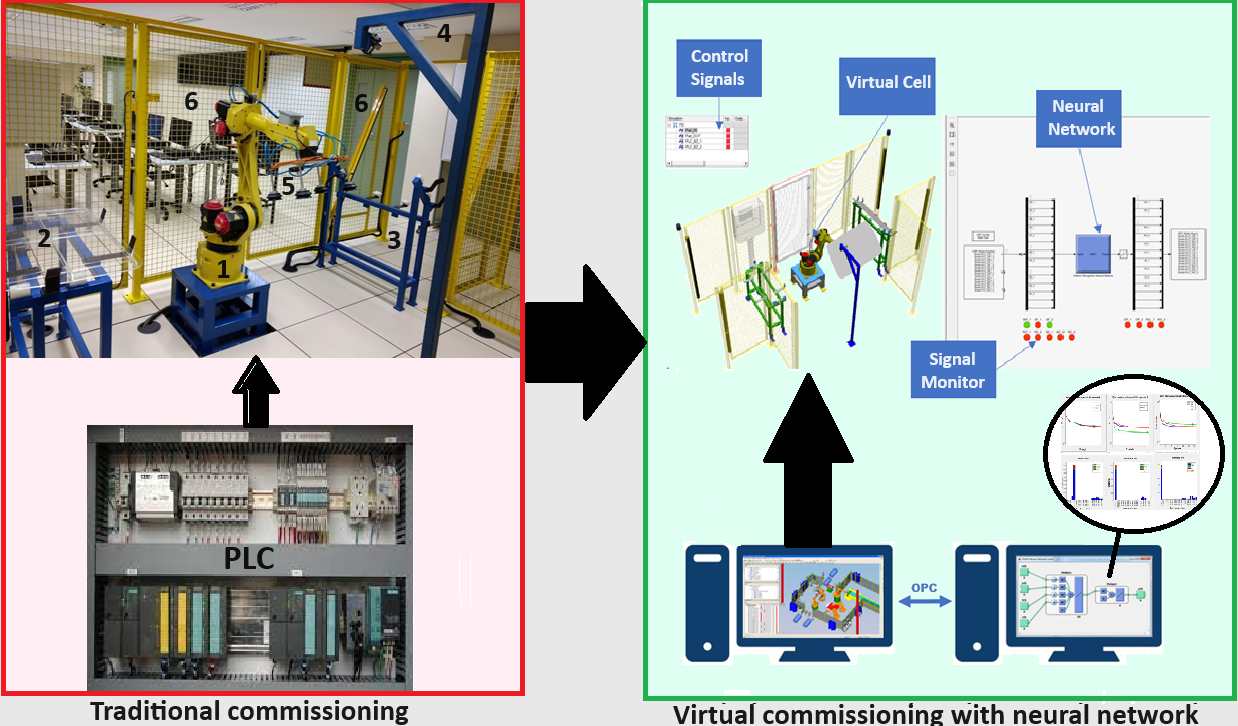
The world is undergoing significant changes in information technologies and industrial processes. The rise of Industry 4.0 and the advancement of artificial intelligence are creating new opportunities and challenges for industries. This study investigates the feasibility of substituting a traditional programmable logic controller (PLC) with a neural network-based control system for discrete event management within a robotic cell. The research assesses the feasibility of this replacement, analyzing the associated challenges, limitations, and advantages compared to traditional methods. Digital manufacturing software is employed for simulating and validating the proposed model through a Virtual Comissioning (VC). The control system of the proposed model utilizes artificial neural networks, trained using data derived from a Boolean logic model. The results indicate that it is possible to swiftly train an artificial neural network (ANN) to take over cell control. This approach opens up the possibility of implementing low-cost hardware, aligning the system with
the concepts of Industry 4.0. Additionally, the virtual modeling conducted using digital manufacturing software paves the way for a future implementation of a digital twin. Findings indicate that the neural network control approach is feasible and offers operational advantages over traditional programming methods.
Downloads
References
K. Wang, “Intelligent predictive maintenance (ipdm) system
– industry 4.0 scenario,” WIT Transactions on Engineering
Sciences, vol. 113, pp. 260–268, 2016. [Online]. Available:
https://doi.org/10.2495/IWAMA150301
J. Qin, Y. Liu, and R. Grosvenor, “A categorical framework
of manufacturing for industry 4.0 and beyond,” Procedia
CIRP, vol. 52, pp. 173–178, 2016. [Online]. Available:
https://doi.org/10.1016/j.procir.2016.08.005
P. Leit˜ao, F. Pires, S. Karnouskos, and A. W. Colombo, “Quo vadis
industry 4.0? position, trends, and challenges,” IEEE Open Journal of
the Industrial Electronics Society, vol. 1, pp. 298–310, 2020. [Online].
Available: https://doi.org/10.1109/OJIES.2020.3031660
T. Wuest, D. Weimer, C. Irgens, and K.-D. Thoben, “Machine learning
in manufacturing: advantages, challenges, and applications,” Production
& Manufacturing Research, vol. 4, no. 1, pp. 23–45, 2016. [Online].
Available: https://doi.org/10.1080/21693277.2016.1192517
W. Lee, C. Cheung, and J. Li, “Applications of virtual
manufacturing in materials processing,” Journal of Materials Processing
Technology, vol. 113, no. 1, pp. 416–423, 2001. [Online]. Available:
https://doi.org/10.1016/S0924-0136(01)00668-9
B. Xu, M. R. Guertler, and N. Sick, “Analyzing industry 4.0 adoption
barriers of small and medium-sized enterprises and existing support,”
in 2023 IEEE Engineering Informatics, 2023, pp. 1–10. [Online].
Available: https://doi.org/10.1109/IEEECONF58110.2023.10520600
Z. Jan, F. Ahamed, W. Mayer, N. Patel, G. Grossmann, M. Stumptner,
and A. Kuusk, “Artificial intelligence for industry 4.0: Systematic
review of applications, challenges, and opportunities,” Expert Systems
with Applications, vol. 216, p. 119456, 2023. [Online]. Available:
https://doi.org/10.1016/j.eswa.2022.119456
A. Khan and K. Turowski, “A perspective on industry
0: From challenges to opportunities in production systems,”
Proceedings of the International Conference on Internet of
Things and Big Data, p. 441–448, 2016. [Online]. Available:
https://doi.org/10.5220/0005929704410448
K. Schwab, The Fourth Industrial Revolution. Crown Currency, 2017.
F. J. Huertos, B. Chicote, M. Masenlle, and M. Ayuso, “A novel
architecture for cyber-physical production systems in industry 4.0,”
in 2021 IEEE 17th International Conference on Automation Science
and Engineering (CASE), 2021, pp. 645–650. [Online]. Available:
https://doi.org/10.1109/CASE49439.2021.9551464
A. Rani, V. K. Mishra, A. K. Mishra, V. Kumar, and N. K. Pandey, “Role
and significance of internet of things (iot) in industry 4.0,” in 2024 3rd
International conference on Power Electronics and IoT Applications
in Renewable Energy and its Control (PARC), 2024, pp. 199–202.
[Online]. Available: https://doi.org/10.1109/PARC59193.2024.10486519
M. Sharifzadeha, H. Malekpoura, and E. Shojab, Cloud Computing
and Its Impact on Industry 4.0, 2022, pp. 99–120. [Online]. Available:
https://doi.org/10.1002/9781119695868.ch4
F. Pires, A. Cachada, J. Barbosa, A. P. Moreira, and P. Leit˜ao,
“Digital twin in industry 4.0: Technologies, applications and
challenges,” in 2019 IEEE 17th International Conference on Industrial
Informatics (INDIN), vol. 1, 2019, pp. 721–726. [Online]. Available:
https://doi.org/10.1109/INDIN41052.2019.8972134
Q. Qi and F. Tao, “Digital twin and big data towards
smart manufacturing and industry 4.0: 360 degree comparison,”
IEEE Access, vol. 6, pp. 3585–3593, 2018. [Online]. Available:
https://doi.org/10.1109/ACCESS.2018.2793265
S. Manickam, L. Yarlagadda, S. P. Gopalan, and C. L. Chowdhary,
“Unlocking the potential of digital twins: A comprehensive
review of concepts, frameworks, and industrial applications,” IEEE
Access, vol. 11, pp. 135 147–135 158, 2023. [Online]. Available:
https://doi.org/10.1109/ACCESS.2023.3338530
R. Y. Zhong, X. Xu, E. Klotz, and S. T. Newman, “Intelligent
manufacturing in the context of industry 4.0: A review,”
Engineering, vol. 3, no. 5, pp. 616–630, 2017. [Online]. Available:
https://doi.org/10.1016/J.ENG.2017.05.015
G. Chryssolouris, D. Mavrikios, N. Papakostas, D. Mourtzis,
G. Michalos, and K. Georgoulias, “Digital manufacturing: History,
perspectives, and outlook,” Proceedings of the Institution of
Mechanical Engineers, Part B: Journal of Engineering Manufacture,
vol. 223, no. 5, pp. 451–462, 2009. [Online]. Available:
https://doi.org/10.1243/09544054JEM1241
Z. Bi, A. Mikkola, A. W. H. Ip, K. L. Yung, and C. Luo,
“Virtual verification and validation to enhance sustainability
of manufacturing systems,” IEEE Transactions on Automation
Science and Engineering, pp. 1–10, 2024. [Online]. Available:
https://doi.org/10.1109/TASE.2024.3370053
B. hu Li, B. cun Hou, W. tao Yu, X. bing Lu, and C. wei Yang,
“Applications of artificial intelligence in intelligent manufacturing: a
review,” Frontiers Inf Technol Electronic Eng, vol. 18, pp. 86–96, 2017.
[Online]. Available: https://doi.org/10.1631/FITEE.1601885
S. S. Sheuly, M. U. Ahmed, S. Begum, and M. Osbakk,
“Explainable machine learning to improve assembly line automation,”
in 2021 4th International Conference on Artificial Intelligence
for Industries (AI4I), 2021, pp. 81–85. [Online]. Available:
https://doi.org/10.1109/AI4I51902.2021.00028
B. Maschler and M. Weyrich, “Deep transfer learning for
industrial automation: A review and discussion of new techniques
for data-driven machine learning,” IEEE Industrial Electronics
Magazine, vol. 15, no. 2, pp. 65–75, 2021. [Online]. Available:
https://doi.org/10.1109/MIE.2020.3034884
I. N. da Silva, D. H. Spatti, R. A. Flauzino, L. H. B. Liboni, and S. F. dos
Reis Alves, Artificial Neural Networks: A Practical Course. Springer,
H. Abdi, A. Salami, and A. Ahmadi, “Implementation of a new
neural network function block to programmable logic controllers
library function,” International Journal of Computer and Systems
Engineering, vol. 1, no. 5, pp. 745–748, 2007. [Online]. Available:
https://doi.org/10.5281/zenodo.1062844
M. Ko, E. Ahn, and S. C. Park, “A concurrent design methodology
of a production system for virtual commissioning,” Concurrent
Engineering, vol. 21, no. 2, pp. 129–140, 2013. [Online]. Available:
https://doi.org/10.1177/1063293X13476070
M. Dahl, K. Bengtsson, P. Bergag˚ard, M. Fabian, and P. Falkman,
“Integrated virtual preparation and commissioning: supporting formal
methods during automation systems development,” IFAC-PapersOnLine,
vol. 49, no. 12, pp. 1939–1944, 2016, 8th IFAC Conference on
Manufacturing Modelling, Management and Control MIM 2016.
[Online]. Available: https://doi.org/10.1016/j.ifacol.2016.07.914
A. Aras, M. Ayaz, E. Ozdemir, and N. Abut, “Investigation on
industry 4.0 and virtual commissioning,” International Journal of Engineering Technologies-IJET, vol. 4, no. 2, pp. 107–113, 2018.
[Online]. Available: https://doi:10.19072/ijet.412125
R. Drath, P. Weber, and N. Mauser, “An evolutionary approach
for the industrial introduction of virtual commissioning,” in
IEEE International Conference on Emerging Technologies
and Factory Automation, 2008, pp. 5–8. [Online]. Available:
https://doi.org/10.1109/ETFA.2008.4638359
P. Blanco, M. Poli, and M. Barretto, “Opc and corba in manufacturing
execution systems: a review,” in EFTA 2003. 2003 IEEE Conference
on Emerging Technologies and Factory Automation. Proceedings (Cat.
No.03TH8696), vol. 2, 2003, pp. 50–57 vol.2. [Online]. Available:
https://doi.org/10.1109/ETFA.2003.1248669
M. A. Sehr, M. Lohstroh, M. Weber, I. Ugalde, M. Witte, J. Neidig,
S. Hoeme, M. Niknami, and E. A. Lee, “Programmable logic controllers
in the context of industry 4.0,” IEEE Transactions on Industrial Informatics,
vol. 17, no. 5, pp. 3523–3533, 2021.
M. d. M. Fernandes, J. A. Bigheti, R. P. Pontarolli, and E. P. Godoy,
“Industrial automation as a service: A new application to industry 4.0,”
IEEE Latin America Transactions, vol. 19, no. 12, pp. 2046–2053,
[Online]. Available: https://doi.org/10.1109/TLA.2021.9480146
K. Tebani, R. Plateaux, C. Puyenchet, O. Penas, C. Baroux, and
S. Limou, “Real-time communication between plc and dymola for virtual
commissioning application,” in 2020 4th International Conference on
Advanced Systems and Emergent Technologies, 2020, pp. 83–88.
S. Bysko, S. Bysko, M. Fratczak, P. Nowak, T. Klopot, J. Czeczot,
K. Stebel, and P. Laszczyk, “Pid controller tuning by virtual commissioning
- a step to industry 4.0,” Journal of Physics: Conference Series,
vol. 2198, pp. 1–12, 2022.
T. Alves, R. Das, and T. Morris, “Embedding encryption and
machine learning intrusion prevention systems on programmable logic
controllers,” IEEE Embedded Systems Letters, vol. 10, no. 3, pp. 99–102,
[Online]. Available: https://doi.org/10.1109/LES.2018.2823906
D. Chivilikhin, S. Patil, K. Chukharev, A. Cordonnier, and V. Vyatkin,
“Automatic state machine reconstruction from legacy programmable
logic controller using data collection and sat solver,” IEEE Transactions
on Industrial Informatics, vol. 16, no. 12, pp. 7821–7831, 2020.
[Online]. Available: https://doi.org/10.1109/TII.2020.2992235
A. Canedo, P. Goyal, D. Huang, A. Pandey, and G. Quiros, “Arducode:
Predictive framework for automation engineering,” IEEE Transactions
on Automation Science and Engineering, vol. 18, no. 3, pp. 1417–1428,
[Online]. Available: https://doi.org/10.1109/TASE.2020.3008055
K. S. Kiangala and Z. Wang, “An adaptive framework for configuration
of parameters in an industry 4.0 manufacturing scada system
by merging machine learning techniques,” in 2020 International
Conference on Artificial Intelligence, Big Data, Computing and Data
Communication Systems (icABCD), 2020, pp. 1–6. [Online]. Available:
https://doi.org/10.1109/icABCD49160.2020.9183818
S. S. Chaudhari, K. S. Bhole, and S. Rane, “An application of iiot
framework in system design, performance monitoring and control
for industrial process heater,” International Journal on Interactive
Design and Manufacturing (IJIDeM), 2023. [Online]. Available:
https://doi.org/10.1007/s12008-023-01235-6
Siemens. Tecnomatix process simulate. [Online]. Available:
https://plm.sw.siemens.com/en-US/tecnomatix/products/processsimulate-
software/
Mathworks. Matlab. [Online]. Available:
https://www.mathworks.com/products/matlab-online.html
——. Simulink. [Online]. Available: