Spectral coherence as a method for evaluating adaptive filtering techniques in photoplethysmography
Keywords:
photoplethysmography, adaptive filtering, motion artifacts, spectral coherence, power spectral densityAbstract
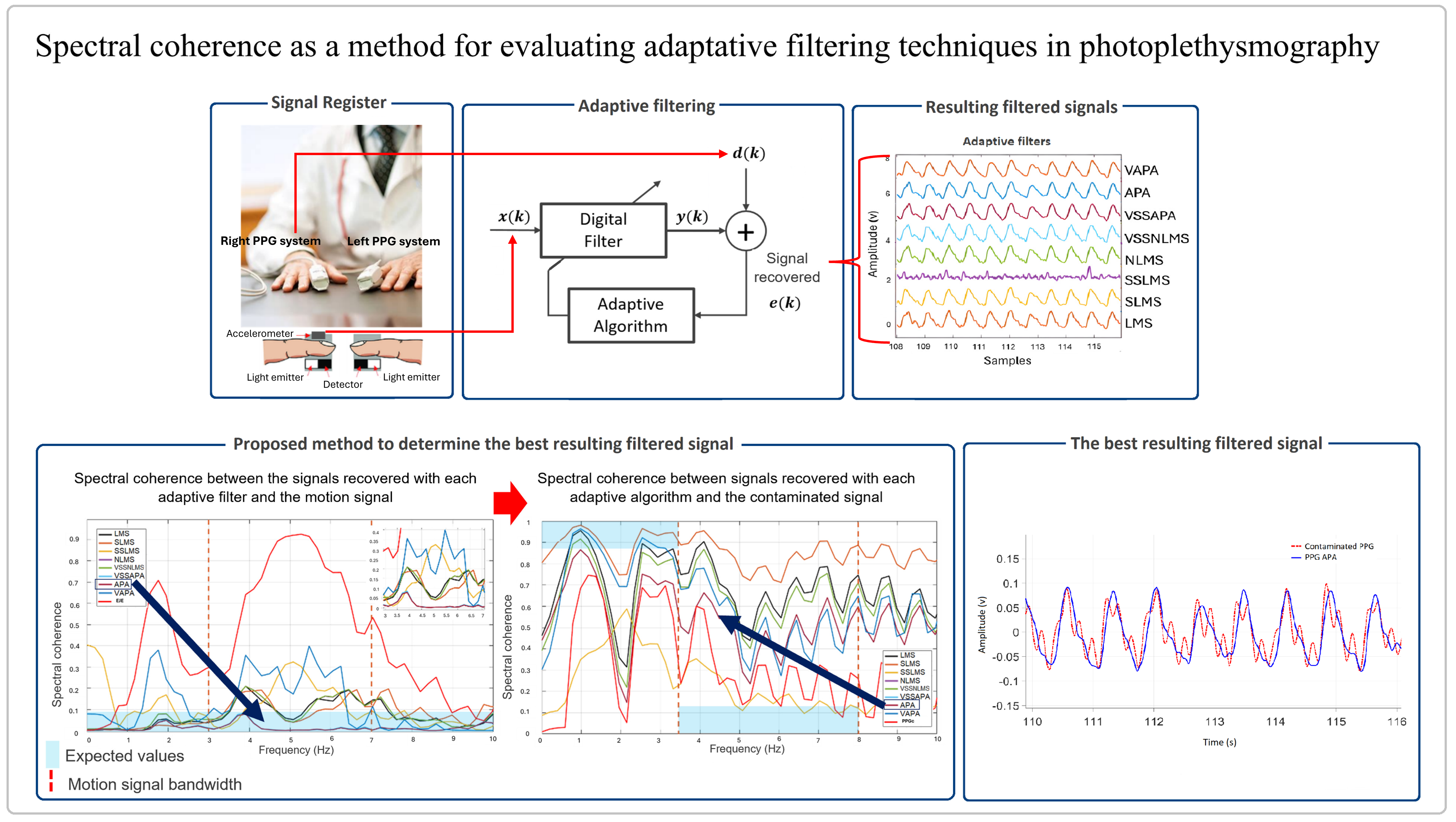
In this study, we introduce a method that utilizes spectral coherence as a metric for assessing the restoration of the photoplethysmographic (PPG) pulse signal morphology when filtering myokinetic noise using adaptive filtering techniques. Unlike other approaches that simply focus on detecting peaks and valleys after filtering, our research concentrates on recovering most of the components of the PPG pulse curve, as these reveal highly important information about cardiovascular health status, and which is essential for a proper diagnosis. To record PPG signals, a photoplethysmography system was placed on both hands of the subjects. On one hand, a three-axis accelerometer was also attached to capture the myokinetic motion, while the other hand remained stationary, allowing the PPG system to record a motion-free signal. After capturing the PPG signals with and without motion, we conducted an analysis by calculating the spectral coherence of the contaminated and recovered signals after adaptive filtering. We compared noisy PPG signals with the reference signal (myokinetic motion-free PPG signal). Based on the spectral coherence criterion, the affine projection algorithm and the variable step-size affine projection algorithm were found to be the most effective for filtering a PPG signal contaminated by myokinetic noise, achieving similarity scores of 94.25% and 94.67%, respectively, between the filtered signal and the motion-free pulse signal.
Downloads
References
A. A. Alian and K. H. Shelley, "Photoplethysmography," Best Practice & Research Clinical Anaesthesiology, vol. 28, 2014, doi: 10.1016/j.bpa.2014.08.006.
B. Becerra-Luna, R. Martínez-Memije, J. C. Sánchez, and O. Infante, "Miokinetic noise attenuation in photoplethysmographic pulse signals by LMS adaptive filtering with adequacy of the input signals," in VI Latin American Congress on Biomedical Engineering CLAIB 2014, Paraná, Argentina, 29-31 October 2014, Springer International Publishing, 2015, pp. 128-131, doi: 10.1007/978-3-319-13117-7_33.
Y. Chen, Y. Zheng, S. Johnson, et al., "A comparative study of accuracy in major adaptive filters for motion artifact removal in sleep apnea tests," Medical & Biological Engineering & Computing, vol. 62, no. 4, pp. 829-842, 2024, doi: 10.1007/s11517-023-02979-9.
Y. Ye, Y. Cheng, W. He, M. Hou, and Z. Zhang, "Combining nonlinear adaptive filtering and signal decomposition for motion artifact removal in wearable photoplethysmography," IEEE Sensors Journal, vol. 16, no. 19, pp. 7133-7141, 2016, doi: 10.1109/jsen.2016.2597265.
S. Fallet and J. M. Vesin, "Robust heart rate estimation using wrist-type photoplethysmographic signals during physical exercise: an approach based on adaptive filtering," Physiological Measurement, vol. 38, no. 2, pp. 155, 2017, doi: 10.1088/1361-6579/38/2/155.
C. Wan, D. Chen, and J. Yang, "Pulse rate estimation from forehead photoplethysmograph signal using RLS adaptive filtering with dynamical reference signal," Biomedical Signal Processing and Control, vol. 71, pp. 103189, 2022, doi: 10.1016/j.bspc.2021.103189.
K. R. Arunkumar and M. Bhaskar, "Heart rate estimation from photoplethysmography signal for wearable health monitoring devices," Biomedical Signal Processing and Control, vol. 50, pp. 1-9, 2019, doi: 10.1016/j.bspc.2019.01.021.
M. R. Ram, K. V. Madhav, E. H. Krishna, N. R. Komalla, and K. A. Reddy, "A Novel Approach for Motion Artifact Reduction in PPG Signals Based on AS-LMS Adaptive Filter," IEEE Transactions on Instrumentation and Measurement, vol. 61, no. 5, pp. 1445-1457, May 2012, doi: 10.1109/tim.2011.2175832.
K. R. Arunkumar, R. Srivathsa, and M. Bhaskar, "Improved heart rate estimation from photoplethysmography during physical exercise using combination of NLMS and RLS adaptive filters," in TENCON 2018-2018 IEEE Region 10 Conference, 2018, pp. 0420-0424, doi: 10.1109/tencon.2018.8650495.
P. Kumar, A. Komaragiri, and M. Kumar, "A review on computation methods used in photoplethysmography signal analysis for heart rate estimation," Archives of Computational Methods in Engineering, vol. 29, no. 2, pp. 921-940, 2022, doi: 10.1007/s11831-021-09597-4.
S. Ismail, U. Akram, and I. Siddiqi, "Heart rate tracking in photoplethysmography signals affected by motion artifacts: A review," EURASIP Journal on Advances in Signal Processing, vol. 2021, no. 1, p. 5, 2021, doi: 10.1186/s13634-020-00714-2.
M. Elgendi, "On the analysis of fingertip photoplethysmogram signals," Curr Cardiol Rev., vol. 8, no. 1, pp. 14-25, Feb. 2012, doi: 10.2174/157340312801215782.
D. E. M. Taylor, "Blood Flow in Arteries," 2nd ed. Edward Arnold, London, Quarterly Journal of Experimental Physiology And Cognate Medical Sciences, vol. 60, no. 1, p. 65, 1975. doi: 10.1113/expphysiol.1975.sp002291.
W. B. Gu, C. C. Y. Poon, and Y. T. Zhang, "A novel parameter from PPG dicrotic notch for estimation of systolic blood pressure using pulse transit time," 2008 5th International Summer School and Symposium on Medical Devices and Biosensors, Hong Kong, vol. 86, no. 1, p. 88, 2008. doi: 10.1109/ISSMDBS.2008.4575023.
Q. Yousef, M. B. I. Reaz, and M. A. M. Ali, "The Analysis of PPG Morphology: Investigating the Effects of Aging on Arterial Compliance," International Journal of Electronics and Telecommunications, vol. 58, no. 4, pp. 266–271, Dec. 2012. doi: 10.2478/v10048-012-0036-3.
J. W. Cunningham, P. Di Achille, V. N. Morrill, L.-C. Weng, S. H. Choi, S. Khurshid, V. Nauffal, and S. A. Lubitz, "Machine learning to understand genetic and clinical factors associated with the pulse waveform dicrotic notch," Circulation: Genomic and Precision Medicine, vol. 16, no. 1, 2023. doi: 10.1161/CIRCGEN.121.003676.
S. Tarantino, F. Clemente, D. Barone, et al., "The myokinetic control interface: tracking implanted magnets as a means for prosthetic control," Scientific Reports, vol. 7, no. 1, p. 17149, 2017. doi: 10.1038/s41598-017-17464-1.
J. Allen, "Photoplethysmography and its application in clinical physiological measurement," Physiological Measurement, vol. 28, no. 3, pp. R1-R39, 2007, doi: 10.1088/0967-3334/28/3/r01.
P. H. Charlton, P. A. Kyriacou, J. Mant, V. Marozas, P. Chowienczyk, and J. Alastruey, "Wearable Photoplethysmography for Cardiovascular Monitoring," Proceedings of the IEEE, vol. 110, 2022, doi: 10.1109/jproc.2022.3149785.
T. Collins, S. I. Woolley, S. Oniani et al., "Version Reporting and Assessment Approaches for New and Updated Activity and Heart Rate Monitors," Sensors (Basel), vol. 7, 2019, doi: 10.3390/s19071705.
J. Park, H. S. Seok, S. S. Kim, and H. Shin, "Photoplethysmogram Analysis and Applications: An Integrative Review," Frontiers in Physiology, vol. 12, 2022, doi: 10.3389/fphys.2021.808451.
R. Sahni, "Noninvasive Monitoring by Photoplethysmography," Clinics in Perinatology, vol. 39, 2012, doi: 10.1016/j.clp.2012.06.012.
P. H. Charlton, K. Pilt, and P. A. Kyriacou, "Establishing best practices in photoplethysmography signal acquisition and processing," Physiological Measurement, vol. 43, no. 5, May 2022. doi: 10.1088/1361-6579/ac6cc4.
J. Gerardo, J. C., and J. Velazquez, ‘Applications of Adaptive Filtering’, Adaptive Filtering Applications. InTech, Jun. 24, 2011. doi: 10.5772/16873.
C. Zong and R. Jafari, "Robust heart rate estimation using wrist-based PPG signals in the presence of intense physical activities," in 37th Annual International Conference of the IEEE Engineering in Medicine and Biology Society (EMBC), 2015, doi: 10.1109/embc.2015.7320268.
P. S. R. Diniz, Adaptive Filtering: Algorithms and Practical Implementation, 4th ed., Springer, 2013.
B. Widrow and M. E. Hoff, "Adaptive switching circuits," IRE WESCON Convention Record, vol. 4, pp. 96–104, 1960.
M. Z. A. Bhotto and A. Antoniou, "Affine-Projection-Like Adaptive-Filtering Algorithms Using Gradient-Based Step Size," IEEE Transactions on Circuits and Systems I: Regular Papers, vol. 61, no. 7, pp. 2048-2056, July 2014, doi: 10.1109/tcsi.2014.2304665.
H. C. Shin and W. J. Song, "Variable step-size NLMS and affine projection algorithms," IEEE Signal Processing Letters, vol. 11, 2004, doi: 10.1109/lsp.2003.821722.
R. Cassani, P. Mejia, J. A. Tavares, J. C. Sanchez, and R. Martinez, "Adaptive filtering for respiration influence reduction on Heart Rate Variability," in 8th International Conference on Electrical Engineering, Computing Science and Automatic Control, 2011, doi: 10.1109/iceee.2011.6106707.
P. M. Mohan, A. A. Nisha, V. Nagarajan, and E. S. J. Jothi, "Measurement of arterial oxygen saturation (SpO2) using PPG optical sensor," 2016 International Conference on Communication and Signal Processing (ICCSP), pp. 1136–1140, 2016. doi: 10.1109/ICCSP.2016.7754330.
B. Becerra, R. Martínez, R. Cartas, and O. Infante, "Increase in the effectiveness of identifying peaks and feet in the photoplethysmographic pulse by reconstructing it through adaptive filtering," Archivos de Cardiología de México, vol. 87, 2017, doi: 10.1016/j.acmx.2016.10.005.
P. Welch, "The use of fast Fourier transform for the estimation of power spectra: A method based on time averaging over short, modified periodograms," IEEE Transactions on Audio and Electroacoustics, vol. 15, 1967, doi: 10.1109/tau.1967.1161901.
L. B. White and B. Boashash, "Cross spectral analysis of nonstationary processes," IEEE Transactions on Information Theory, vol. 36, no. 4, pp. 830-835, 1990, doi: 10.1109/18.53742.
P. Stoica and R. L. Moses, Spectral analysis of signals, Prentice Hall, 2005.
B. Becerra-Luna, J. C. Sánchez, R. Martínez-Memije, and O. Infante, "Photoplethysmographic fingertip with miokinetic noise attenuation using an accelerometer and adaptive filtering techniques," in Proc. 2013 Pan American Health Care Exchanges (PAHCE), Medellin, Colombia, 2013, pp. 1–5. doi: 10.1109/PAHCE.2013.6568307.
X. Zheng, V. M. Dwyer, L. A. Barrett, M. Derakhshani, and S. Hu, "Adaptive notch-filtration to effectively recover photoplethysmographic signals during physical activity," Biomedical Signal Processing and Control, vol. 72, 2022, doi: 10.1016/j.bspc.2021.103303.
C. C. Wu, I. W. Chen, and W. C. Fang, "An implementation of motion artifacts elimination for PPG signal processing based on recursive least squares adaptive filter," in 2017 IEEE Biomedical Circuits and Systems Conference (BioCAS), Turin, Italy, 2017, doi: 10.1109/biocas.2017.8325141.
S. Ismail, U. Akram, and I. Siddiqi, "Heart rate tracking in photoplethysmography signals affected by motion artifacts: a review," EURASIP Journal on Advances in Signal Processing, vol. 2021, no. 5, 2021. doi: 10.1186/s13634-020-00714-2.
M. Vázquez, J. C. Sánchez, G. Avalos, and B. Becerra, "Filtering of photoplethysmographic pulse signals with downward gradient algorithms," 2022 IEEE International Conference on Engineering Veracruz (ICEV), Boca del Río, Veracruz, Mexico, 2022, pp. 1-6, doi: 10.1109/ICEV56253.2022.9959719.
Peng et al., "Motion artifact removal from photoplethysmographic signals by combining temporally constrained independent component analysis and adaptive filter," BioMedical Engineering OnLine, vol. 13, p. 50, 2014. doi: 10.1186/1475-925X-13-50.
M. R. Ram, K. V. Madhav, E. H. Krishna, N. R. Komalla and K. A. Reddy, "On the performance of AS-LMS based adaptive filter for reduction of motion artifacts from PPG signals," 2011 IEEE International Instrumentation and Measurement Technology Conference, Hangzhou, China, 2011, pp. 1-4, doi: 10.1109/IMTC.2011.5944259.
L. Zhang, X. Yu, H. Xie, J. Lin and Z. Wang, "Removal of Motion Artifacts in PPG Signals Based on the CEEMDAN-MPE and VS_LMS Adaptive Filter," in IEEE Transactions on Instrumentation and Measurement, vol. 73, pp. 1-10, 2024, Art no. 4010610, doi: 10.1109/TIM.2024.3453341.