Enhancing Cu2ZnSnS4 Solar Cell Efficiency through Antimony Substitution for Tin: A SCAPS-1D Simulation Study
Keywords:
Photovoltaic cell, SCAPS-1D,CZTS, CdS, ZnO, Thin film.Abstract
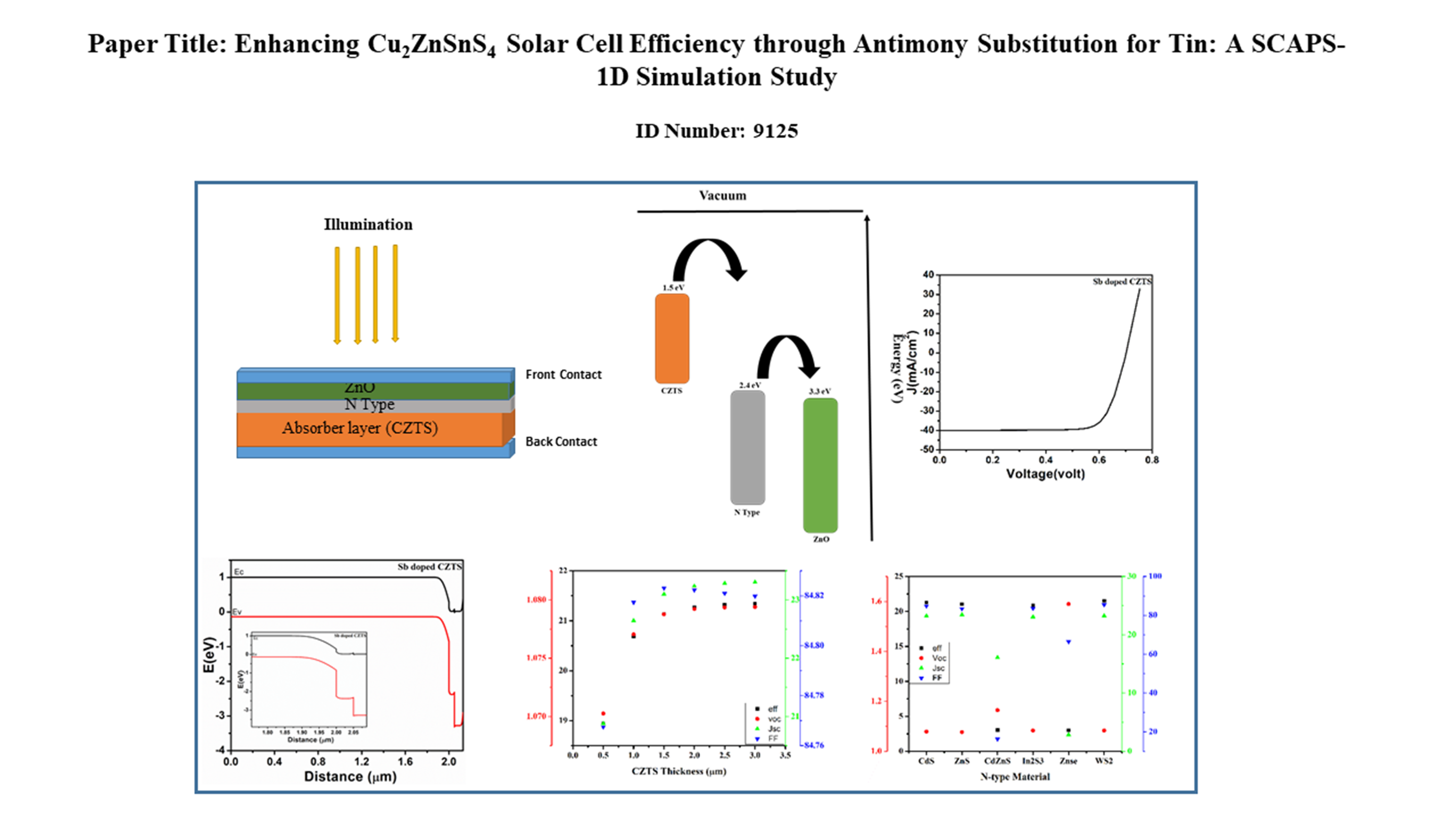
SCAPS-1D, a one-dimensional solar cell simulator, provides a valuable tool for predicting device performance based on layer-by-layer material properties. Copper Zinc Tin Sulfide (CZTS) has emerged as a promising absorber material due to its exceptional light absorption coefficient and the abundance and non-toxic nature of its constituent elements. This study leverages SCAPS-1D to investigate the working mechanism of CZTS-based solar cells. We simulate a Mo/CZTS/CdS/ZnO device structure under AM 1.5 spectrum illumination and 300 K temperature, analyzing the impact of individual layer thickness on photovoltaic performance. Further, a comparative analysis explores the influence of various n-type materials.. In addition, the introduction of antimony (Sb) doping into CZTS leads to a significant change in efficiency of the cell. The efficiency of Sbdoping CZTS attained 21.90%, while there was a great improvement by 3% via reduced recombination losses and enhanced photocurrent. This work gives an insight into the possibility of Sb doping for the improvement in the performance of thin-film solar cells.
Downloads
References
Élodie de l’Épine and Ignacio Landivar, “2024 PV Trends: Global growth and challenges,” PV Magazine International, Nov. 12, 2024. [Online]. Available: https://www.pv-magazine.com/2024/11/12/2024-pv-trendsglobal-growth-and-challenges.
S. H. Zyoud et al., “Effect of Absorber (Acceptor) and Buffer (Donor) Layers Thickness on Mo/CdTe/CdS/ITO Thin Film Solar Cell Performance: SCAPS-1D Simulation Aspect,” I.RE.MO.S., vol. 14 (1), pp. 10-17, Aprl 2021. doi:https://doi.org/10.15866/iremos.v14i1.19953
S. H. Zyoud et al., “Numerical Modelling Analysis for Carrier Concentration Level Optimization of CdTe Heterojunction Thin Film– Based Solar Cell with Different Non–Toxic Metal Chalcogenide Buffer
Layers Replacements: Using SCAPS–1D Software,” Crystals, vol. 11 (12), pp. 1454, Dec 2021.
https://doi.org/10.3390/cryst11121454https://doi.org/10.3390/cryst11121454
S. H. Zyoud et al., “Simulation and Numerical Investigation of the Effect of Temperature and Defect on ZnTe/ZnSe/ZnO Thin-Film Photovoltaic Solar Cell Performance Efficiency,” IREA, vol. 11, pp. 1-10 Jan 2023. https://doi.org/10.15866/irea.v11i1.20839
M. S. Aljuboori et al., ‘’Enhancing Photoconversion Efficiency by Optimization of Electron/Hole Transport Interlayers in Antimony Sulfide Solar Cell using SCAPS-1D Simulation,’’ JSESD, vol. 13 (1), pp. 97-113 Jun 2024. https://doi.org/10.51646/jsesd.v13i1.175
Mubarak H. O. et al., “Simulation Analysis for the Efficiency Enhancement of Sb₂S₃ Solar Cell Using SCAPS-1D,” CMMS, vol. 23 (4), pp. 19-29 2023. https://doi.org/10.7494/cmms.2023.4.0817
S. H. Zyoud et al., “Numerical Simulation for Optimization of ZnTe-Based Thin-Film Heterojunction Solar Cells with Different Metal Chalcogenide Buffer Layers Replacements: SCAPS-1D Simulation Program,” I.RE.MO.S., Vol. 14 (2), pp. 79-88 Aprl 2021. https://doi.org/10.15866/iremos.v14i2.19954
S. H. Zyoud et al., “Investigating the impact of temperature and interlayer defects on the efficiency of Mo/ZnTe/ZnSe/SnO₂ heterojunction thin-film solar cells: A SCAPS-1D simulation study,” I.RE.MO.S., vol. 16(3), pp. 120-128 June 2023. https://doi.org/10.15866/iremos.v16i3.22739
S. H. Zyoud et al., “Numerical Modeling of High Conversion Efficiency FTO/ZnO/CdS/CZTS/MO Thin Film-Based Solar Cells: Using SCAPS-1D Software,” Crystals, vol. 11, pp. 1468 (1-21) Nov 2021.
https://doi.org/10.3390/cryst11121468
Xin Cui et al., “Cd-Free Cu2ZnSnS4 solar cell with an efficiency greater than 10% enabled by Al2O3 passivation layers,” Energy Environ. Sci., vol. 12, pp. 2751-2764 July 2019. https://doi.org/10.1039/C9EE01726G
Wei Wang et al., “Device Characteristics of CZTSSe Thin-Film Solar Cells with 12.6% Efficiency,” Adv Energy Mater., vol. 4(7), pp. 1301465 (1-5) Nov 2013. https://doi.org/10.1002/aenm.201301465
H.-Q. Xiao et al., “Boosting the efficiency of solution-based CZTSSe solar cells by supercritical carbon dioxide treatment,” Green Chem., vol. 22, pp. 3597-3607 May 2020. https://doi.org/10.1039/D0GC01355B
S. Zhuk et al., “Critical review on sputter-deposited Cu₂ZnSnS₄ (CZTS) based thin-film photovoltaic technology focusing on device architecture and absorber quality on the solar cells performance,” Sol. Energy Mater. Sol. Cells, vol. 171, pp. 239-252 Nov 2017. https://doi.org/10.1016/j.solmat.2017.05.064.
Kannan P. K. et al., “Detailed investigations on influence of precursor stacking and sulfurization for Cu₂ZnSnS₄ film formation,” Thin Solid Films, vol. 649, pp. 81-88 Mar 2018. https://doi.org/10.1016/j.tsf.2018.01.038.
Kannan P. K. et al., “Effect of anionic substitution of S by Se in CZTSSe films prepared from electron beam evaporation,” Mater. Today Proc., vol. 21 (4), pp. 1787-1792 2020. https://doi.org/10.1016/j.matpr.2020.01.232.
S. Chaudhari et al., “Investigation of optimum annealing parameters for formation of dip-coated Cu₂ZnSnS₄ thin film,” Thin Solid Films, vol. 612, pp. 456-462 Aug 2016. https://doi.org/10.1016/j.tsf.2016.06.046.
S. Chaudhari et al., “Influence of stabilizing agent on dip coating of Cu₂ZnSnS₄ thin film,” Thin Solid Films, vol. 636, pp. 144-149 Aug 2017. https://doi.org/10.1016/j.tsf.2017.05.045.
S. Chaudhari et al., “Formulation of selenium-rich Cu₂ZnSn(SₓSe1-ₓ)₄ film through non-vacuum dip coating technique,” J. Mater. Sci.: Mater. Electron., vol. 32, pp. 19102-19109 July 2021.
https://doi.org/10.1007/s10854-021-06427-y.
K. Madhuri et al., “Investigations on treatments on CIGS formation using spin-coated CIG precursor,” J. Mater. Sci.: Mater. Electron., vol. 32, pp. 1521-1527 Jan 2021. https://doi.org/10.1007/s10854-020-04921-3.
S. Chaudhari et al., “Pulsed electrodeposition of Cu₂ZnSnS₄ absorber layer precursor for photovoltaic application,” Thin Solid Films, vol. 600, pp. 169-174 Feb 2016. https://doi.org/10.1016/j.tsf.2016.01.021.
S. H. Zyoud et al., “Influence of the redox couple concentration and activity of a NaOH/Na₂S/S electrolyte on the performance of CdS thin-film photoelectrochemical cells,” Chem. Eng. J., vol. 10, pp. 100864 (1-9) Dec 2024. https://doi.org/10.1016/j.cscee.2024.100864.
A. Zyoud et al., “Enhanced PEC characteristics of pre-annealed CuS film electrodes by metalloporphyrin/polymer matrices,” Solar Energy Mater. Solar Cells, vol. 144, pp. 429-437 Jan 2016.
https://doi.org/10.1016/j.solmat.2015.09.034.
A. Zyoud et al., “High PEC conversion efficiencies from CuSe film electrodes modified with metalloporphyrin/polyethylene matrices,” Electrochimica Acta, vol. 174, pp. 472-479 Aug 2015.
https://doi.org/10.1016/j.electacta.2015.05.125.
H. Sabri et al., “Enhancement of CdSe film electrode PEC characteristics by metalloporphyrin/polysiloxane matrices,” Electrochimica Acta, vol. 136, pp. 138-145, Aug 2014.
https://doi.org/10.1016/j.electacta.2014.05.071.
A. Zyoud et al., “Enhanced PEC characteristics for CdSe polycrystalline film electrodes prepared by combined electrochemical/chemical bath depositions,” J. Electroanal. Chem., vol. 774, pp. 7-13, Aug 2016. https://doi.org/10.1016/j.jelechem.2016.04.048.
Xiaoli Zhang, Miaomiao Han, Zhi Zeng and Yuhua Duan, “The role of Sb in solar cell material Cu2ZnSnS4,” J. Mater. Chem A, vol. 5, pp. 6606-6612 Mar 2017. https://doi.org/10.1039/C7TA01090G
Kannan P.K. and Mariappan Anandkumar, “A theoretical investigation to boost the efficiency of CZTS solar cells using SCAPS-1D,” Optik, vol. 288, pp. 171214 Oct 2023. https://doi.org/10.1016/j.ijleo.2023.171214.
S. Siebentritt, “Why are kesterite solar cells not 20% efficient?,” Thin Solid Films, vol 535, pp. 1-4 May 2013. https://doi.org/10.1016/j.tsf.2012.12.089
Touria Ouslimane, Lhoussayne Et-taya, Lahoucine Elmaimouni, Abdellah Benami, “Impact of absorber layer thickness, defect density, and operating temperature on the performance of MAPbI3 solar cells based on ZnO electron transporting material,” Heliyon, vol. 7, pp. e06379 (1-6) Mar 2021.
https://doi.org/10.1016/j.heliyon.2021.e06379
Maykel Courel, J A Andrade-Arvizu and O Vigil-Galán, “The role of buffer/kesterite interface recombination and minority carrier lifetime on kesterite thin film solar cells, ” Mater. Res. Express vol. 3 pp. 095501 (1-15) Sep 2016. https://doi.org/ 10.1088/2053-1591/3/9/095501