COVID-19 impact in the Brazilian Multiplex Air Transportation Network
Keywords:
Complex networks, Multiplex networks, Air transportation, Airports concession, COVID-19Abstract
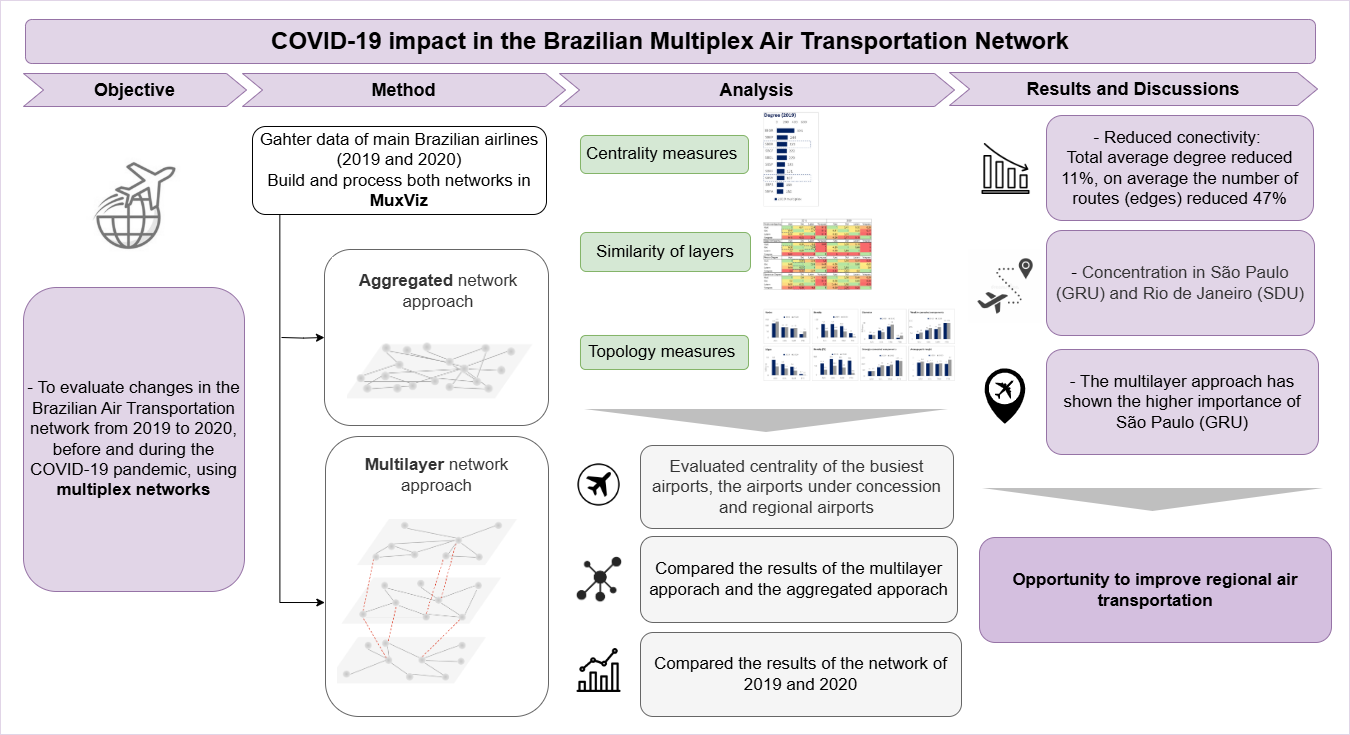
The Brazilian Air Transportation Network has been changing in the last years, due to an economic recession since 2016, the concession of the main airports and the impact of the COVID-19 pandemic. Air transportation is a complex infrastructure system, in which each airline represents a different layer. Adding the weight of interactions combined with a multilayer approach can make the network description even more detailed than a single-layer analysis, because important network features emerge from the multilayer character. The multilayer approach for complex networks is yet new in the literature. As far as the authors know, there are no studies yet applying multiplex network to analyze domestic and international Brazilian air network to improve the understanding of complex systems and investigate macroeconomic effects of the economic recession and COVID-19 pandemic in the air network. The objective of this paper is to evaluate changes in the Brazilian Air Transportation network from 2019 to 2020, before and during the COVID-19 pandemic, using topology measures for network characterization. We compared the network topology and evaluated COVID-19 impact on airports under concession and on regional aviation, also comparing with the aggregated approach. Results show a network concentration during this period in hub airports, reduced connectivity and reduced density resulting in a sparser network. The airlines strategies were different over this period and the multilayer approach changed the importance ranking of airports compared with the aggregated approach. These analyses indicate an opportunity to improve regional air transportation and the need to enhance regional airport’s versatility.
Downloads
References
I. M. Oliveira, L. C. Carpi, and A. Atman, “The multiplex efficiency index: unveiling the brazilian air transportation multiplex network—batmn,” Scientific reports, vol. 10, no. 1, p. 13339, 2020, https://doi.org/10.1038/s41598-020-69974-0.
D.-D. Han, J.-H. Qian, and J.-G. Liu, “Network topology and correlation features affiliated with european airline companies,” Physica A:
Statistical Mechanics and its Applications, vol. 388, no. 1, pp. 71–81, 2009, https://doi.org/10.1016/j.physa.2008.09.021
M. De Domenico, A. Solé-Ribalta, E. Omodei, S. Gómez, and A. Arenas, “Ranking in interconnected multilayer networks reveals versatile nodes,” Nature communications, vol. 6, no. 1, p. 6868, 2015, https://doi.org/10.1038/ncomms7868.
Y. Zhou, S. Li, T. Kundu, X. Bai, and W. Qin, “The impact of network topology on air transportation robustness to pandemics,” IEEE Transactions on Network Science and Engineering, vol. 8, no. 3, pp. 2249–2261, 2021, DOI: 10.1109/TNSE.2021.3085818.
K. Demertzis, D. Tsiotas, and L. Magafas, “Modeling and forecasting the covid-19 temporal spread in greece: An exploratory approach
based on complex network defined splines,” International Journal of Environmental Research and Public Health, vol. 17, no. 13, p. 4693,
, https://doi.org/10.3390/ijerph17134693.
S. P. Ribeiro, A. C. e Silva, W. Dáttilo, A. B. Reis, A. Góes-Neto, L. C. J. Alcantara, M. Giovanetti, W. Coura-Vital, G. W. Fernandes, and
V. A. C. Azevedo, “Severe airport sanitarian control could slow down the spreading of covid-19 pandemics in brazil,” PeerJ, vol. 8, p. e9446,
, https://doi.org/10.7717/peerj.9446.
X. Sun, S. Wandelt, and A. Zhang, “How did covid-19 impact air transportation? a first peek through the lens of complex networks,”
Journal of Air Transport Management, vol. 89, p. 101928, 2020, https://doi.org/10.1016
A. Cardillo, J. Gómez-Gardenes, M. Zanin, M. Romance, D. Papo, F. d. Pozo, and S. Boccaletti, “Emergence of network features
from multiplexity,” Scientific reports, vol. 3, no. 1, p. 1344, 2013, https://doi.org/10.1038/srep01344.
D. D. S. PEREIRA, J. C. C. B. S. DE, et al., “Brazilian airports network evaluation,” Brazilian Journal Of Operations & Production Management, vol. 17, no. 1, pp. 1–10, 2020, https://doi.org/10.14488/BJOPM.2020.008.
D. D. S. Pereira, J. C. C. B. S. De, et al., “Comparative evaluation of the brazilian air transport system centrality,” Case Studies on Transport Policy, vol. 9, no. 4, pp. 1672–1676, 2021, https://doi.org/10.1016/j.cstp.2021.08.012.
M. De Domenico, A. Solé-Ribalta, E. Cozzo, M. Kivelä, Y. Moreno, M. A. Porter, S. Gómez, and A. Arenas, “Mathematical formulation of
multilayer networks,” Physical Review X, vol. 3, no. 4, p. 041022, 2013, https://doi.org/10.1103/PhysRevX.3.041022.
M. De Domenico, M. A. Porter, and A. Arenas, “Muxviz: a tool for multilayer analysis and visualization of networks,” Journal of Complex Networks, vol. 3, no. 2, pp. 159–176, 2015, https://doi.org/10.1093/comnet/cnu038.
C. J. L. e Silva, M. O. de Andrade, V. A. Falcão, C. Fabrício, and A. da Silva, “Subsidized regional airlines as a sustainable development mechanism for remote locations heavily dependent on air transportation,” Journal of Sustainable Development, vol. 14, no. 4,
, doi:10.5539/jsd.v14n4p108.
R. V. Ventura, M. Cabo, R. Caixeta, E. Fernandes, and V. Aprigliano Fernandes, “Air transportation income and price elasticities in remote areas: the case of the brazilian amazon region,” Sustainability, vol. 12, no. 15, p. 6039, 2020, https://doi.org/10.3390/su12156039.
M. Abate, P. Christidis, and A. J. Purwanto, “Government support to airlines in the aftermath of the covid-19 pandemic,” Journal of air transport management, vol. 89, p. 101931, 2020, https://doi.org/10.1016/j.jairtraman.2020.101931.