
An experimental alternative of microwave signal generation through an optical heterodyning technique using a multimode laser diode and a tunable DFB laser

Authors

Keywords:

Fiber Bragg Grating, Microwave Signal Generation, Optical Beating, Optical Heterodyning, Tunable Distributed Feedback Laser.

Abstract

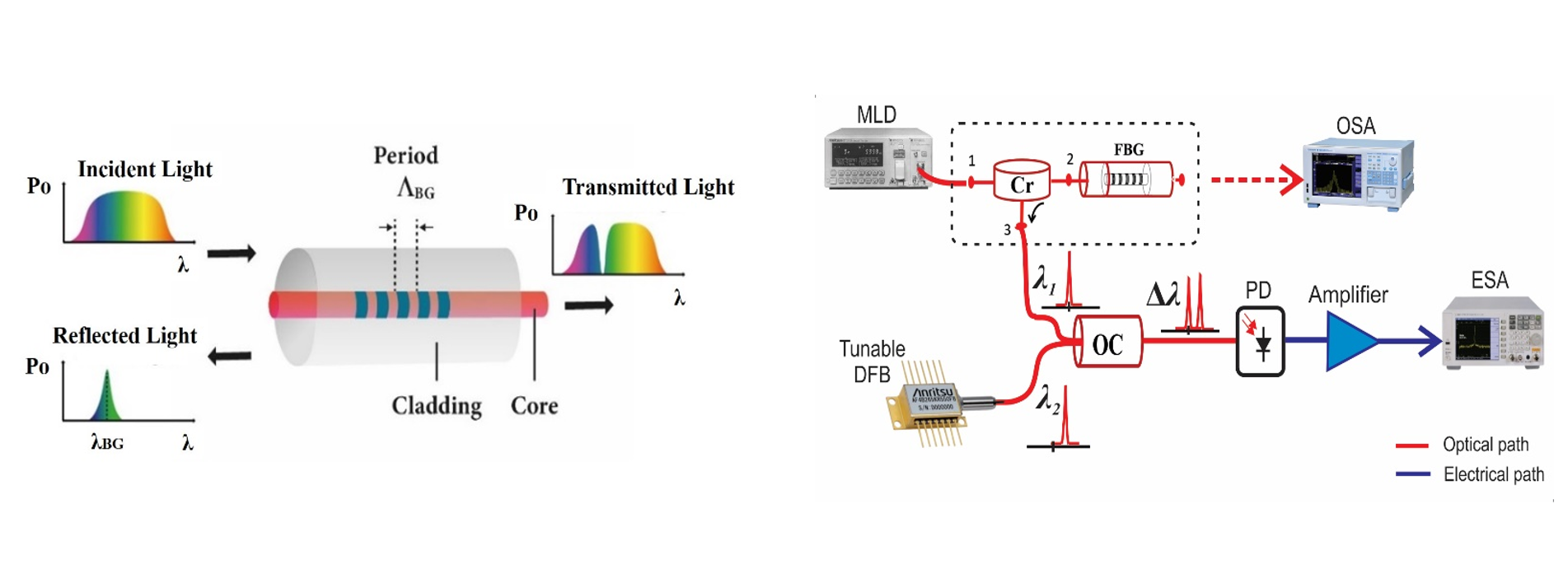
It is experimentally demonstrated as an alternative to one of the classical optical heterodyning techniques for generating microwave (MW) signals. The originality of this work resides in the use of a Multimode Laser Diode (MLD) associated with a Fiber Bragg Grating (FBG) and a tunable Distributed Feedback laser (DFB), instead of two DFBs. As an optical filter, the FBG selects a single mode among various provided by the MLD signal. The selected single-mode signal is used as a reference in the optical beating together with the signal of the tunable DFB. The tunability is achieved by varying the DFB wavelength to modify the wavelength spacing (Δλ) between the two optical signals. The experimental results are corroborated with those obtained theoretically and by simulations. The system performance evaluation is achieved through the Signal-to-Noise Ratio (SNR) and the Phase Noise (PN) measurements

Downloads

Download data is not yet available.

Author Biographies

Ignacio Enrique Zaldívar-Huerta, Instituto Nacional de Astrofísica, Óptica y Electrónica (INAOE)

Ignacio Enrique Zaldívar-Huerta received his BS degree (Electronic Engineering) from Universidad Autónoma de Puebla, México in 1992; the MS degree in microelectronics from the Instituto Nacional de Astrofísica, Óptica y Electrónica (INAOE) Puebla, Mexico in 1995; and, the PhD Degree in Sciences for Engineering from the Université de Franche Comté, Besançon, France, in 2001. Since 2002, he has been with the Electronics Department at the INAOE Currently, he is Titular Researcher. His main research interests are subjects related to optical communications. He has published over 40 articles in international peer-reviewed journals, and 58 papers in international peer-reviewed conferences. He has supervised 30 research graduate students to completion, with 11 at the PhD level and 21 at the Master’s level. Since 2002 and 2006, is a member of IEEE and SPIE, respectively. Since 2014 he is a Senior Member of IEEE. He was the Chair of the Communications Society of the IEEE Latin America Region 9, Chapter Puebla, and Chair of the IEEE Puebla Section, México.

Blaise Tshibangu Mbuebue, Instituto Nacional de Astrofisica, Optica y Electronica (INAOE)

Blaise Tshibangu Mbuebue received a B.E. degree in electrical engineering, in the option of computing applied science from the Institut Supérieur de Techniques Appliquées (ISTA/Ndolo), Kinshasa, Congo D.R., in 2010; the M.S. degree in electrical engineering, in the option of instrumentation and digital systems from Universidad de Guanajuato, México, in 2019; and the Ph.D. degree in science with a specialty in electronics at the Instituto Nacional de Astrofísica, Óptica y Electrónica (INAOE), Puebla, México in 2024. His research interests include optical communication system implementations, optical techniques for information transmission through optical fibers, and microwave signal generation. Aspiring member of AMO (Mexican Academy of Optic) in 2019, and IEEE graduate student member of Puebla section since 2021.

Alejandro García-Juárez , Universidad de Sonora

Alejandro García-Juárez was born in Tierra Blanca, Veracruz, México. He received his B.S degree in Electronic Engineering from Universidad Autónoma de Puebla, México in 1998, and his M.S and Ph.D. degrees in Optics with a specialty in optoelectronic systems from the Instituto Nacional de Astrofísica, Óptica y Electrónica, Tonantzintla, México in 1999 and 2005, respectively. He is currently a titular professor-researcher with the Department of Research in Physics of the Universidad de Sonora, México. His current research interests are primarily in optical fiber communication systems, microwave photonics, wideband antennas, microwave filters, electronics, and optoelectronic systems.

Edgard-Yvon Tshishimbi Kanyinda, Institut Superieur de Téchniques Appliquées

Edgard Yvon Tshishimbi Kanyinda is an engineer in electrical engineering and computer Science option from the Institut Supérieur de Techniques Appliquées (ISTA/Ndolo), experienced computer scientist who built his 11 years of experience within the Central Bank of Congo in the field of computer networks and Telecommunications. Currently teaching at Université Reverend Kim and ISTA/Ndolo, teaching the Computer Networks course. With his experience in the field of computer networks, he has developed his knowledge in the design, implementation, deployment, and security of corporate computer networks on several transmission media (optical fiber, UTP cable, coaxial cable, etc.) thus wireless.

Roberto Rojas-Laguna, Universidad de Guanajuato

Roberto Rojas-Laguna is a Professor of Calculus, Linear Algebra, Electromagnetic Theory, and Optical Fiber Applications at the Department of Electronic Engineering at División de Ingenierías, Campus Irapuato-Salamanca of Universidad de Guanajuato, Mexico. He is conducting projects on optical fiber sensors, rare-earth-doped fiber lasers, and simulation of non-linear phenomena in optical fibers.

Min W. Lee, Université Sorbonne Paris Nord

Min Won Lee received the MSc degree from Ajou University, Suwon, South Korea in 1998 and the Ph.D. degree from the Université de Franche-Comté, Besançon, France in 2002. His doctoral research was concerned with chaotic dynamics behavior, chaos synchronization, optical telecommunications, and chaos encryption. After his Ph.D., he worked in the Optoelectronic group at Bangor University, United Kingdom from 2002 to 2008.  He was involved in the development of chaos communications systems using external-cavity laser diodes. He joined FEMTO-ST Institute, Besançon, France in 2009. His research interests included fiber optical parametric amplifiers, Raman fiber lasers, and Brillouin sensing applications using photonic crystal fibers. He joined as a Lecturer the Laboratoire de Physique des Lasers at the University of Paris 13 in 2011, received a research habilitation (HDR), and became a Senior Lecturer in 2018. His current research interests include semiconductor laser dynamics.

References

S. Pan, D. Zhu, S. Liu, K. Xu, Y. Dai, T. Wang, J. Liu, N. Zhu, Y. Xue, N. Liu, "Satellite Payloads Pay Off," in IEEE Microwave Magazine, vol. 16, no. 8, pp. 61-73, Sept. 2015, doi: 10.1109/MMM.2015.2441619.

X. Zou, B. Lu, W. Pan, L. Yan, A. Stöhr, J. Yao, “Photonics for microwave measurements,” Laser Photonics Rev. 10(5)/Sept. 2016, https://doi.org/10.1002/lpor.201670056.

E. Calvanese Strinati, S. Barbarossa, J.L. Gonzalez-Jimenez, D. Ktenas, N. Cassiau, L. Maret, C. Dehos, “6G: the next frontier: from holographic messaging to artificial intelligence using subterahertz and visible light communication,” IEEE Veh Technol Mag. 2019;14(3):42–50. https://doi.org/10.1109/MVT.2019.2921162.

Telefonaktiebolaget LM Ericsson 1994-2023, “Mobile data traffic outlook,” [Online]. Available: https://www.ericsson.com/en/reports-and-papers/mobility-report/dataforecasts/mobile-traffic-forecast

Jianping Yao “Microwave Photonics”, Journal of Lightwave Technology, Vol. 27, No. 3, February 1, 2009, doi: 10.1109/JLT.2008.2009551

Jianping Yao, “Photonic Generation of Microwave and Millimeter-wave Signals”, International Journal of Microwave and Optical Technology, vol.5 no.1, January 2010.

R.P. Braun, G. Grosskopf, D. Rohde, F. Schmidt, "Fiber Optic Millimeter-wave Generation and Bandwidth Efficient Data Transmission for Broadband Mobile 18-20 and 60 GHz-band Communications," International Topical Meeting on Microwave Photonics (MWP1997), 1997, pp. 235-238, doi: 10.1109/MWP.1997.740270.

R.P. Braun, G. Grosskopf, D. Rohde, F. Schmidt, "Low-phase-noise millimeter-wave generation at 64 GHz and data transmission using optical sideband injection locking," in IEEE Photonics Technology Letters, vol. 10, no. 5, pp. 728-730, May 1998, doi: 10.1109/68.669405.

L. Goldberg, H. F. Taylor, J. F. Weller, D. M. Bloom, “Microwave signal generation with injection-locked laser diodes”, Electron. Lett., vol. 19, no. 13, pp. 491-493, Jun 1983, doi: 10.1049/el:19830333

K.R.Y. Prasad, T. Srinivas, D.V. Ramana, “Design and demonstration of hardware efficient OPLL for generation of stable microwave signals by optical heterodyning”, J Opt 44, 103–118 (2015). https://doi.org/10.1007/s12596-015-0235-z

X. Chen, Z. Deng, and J. P. Yao, “Photonic generation of microwave signal using a dual-wavelength single longitudinal mode fiber ring laser,” IEEE Trans. Microw. Theory Tech., vol.54, no. 2, pp. 804-809, Feb. 2006.

https://www.vpiphotonics.com/index.php

R. Sardiñas-Fernández, A. García-Juárez, I. E. Zaldívar-Huerta, L. A. González-Mondrangón, L. J. Quintero-Rodríguez, E. Avilez-Valenzuela, “Generation of microwave signals by heterodyning and multiplication techniques: a comparison”, Proc. SPIE 10917, Terahertz, RF, Millimeter, and Submillimeter-Wave Technology and Applications XII, 109171O (1 March 2019); doi: 10.1117/12.2506430.

P. Dherbecourt, O. Latry, E. Joubert, P. Dibin, M. Ketata, “Achieving of an optical very high frequency modulated wave source using heterodyne technique”, Optics Communications, 202, pp. 81-90, February 2002, Elsevier. https://doi.org/10.1016/S0030-4018(02)01071-4

John Canning, “Fiber gratings and devices for sensors and lasers”, Laser & Photon. Rev. 2, No. 4, 275–289 (2008), https://doi.org/10.1002/lpor.200810010.

T. Erdogan, “Fiber grating spectra”, Journal of Lightwave Technology, vol. 15, no. 8, pp. 1277-1294, Aug. 1997, doi: 10.1109/50.618322.

Published

2024-05-15

How to Cite

Zaldívar-Huerta, I. E., Tshibangu Mbuebue, B., García-Juárez , A., Tshishimbi Kanyinda, E.-Y., Rojas-Laguna, R., & Lee, M. W. (2024). An experimental alternative of microwave signal generation through an optical heterodyning technique using a multimode laser diode and a tunable DFB laser. IEEE Latin America Transactions, 22(6), 512–518. Retrieved from https://latamt.ieeer9.org/index.php/transactions/article/view/8596

Issue

Section

Electronics