Time frequency distribution and deep neural network for automated identification of insomnia using single channel EEG-signals
Keywords:
Sleep, Insomnia, EEG, Deep LearningAbstract
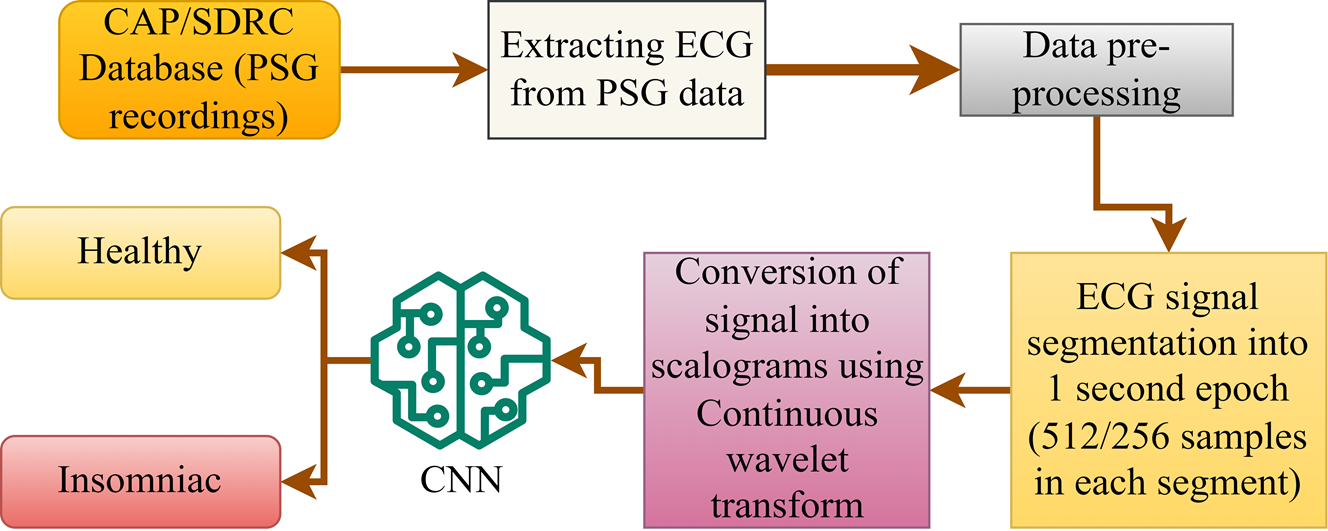
It is essential to have enough sleep for a healthy life; otherwise, it may lead to sleep disorders such as apnea, narcolepsy, insomnia, and periodic leg movements. A polysomnogram (PSG) is typically used to analyze sleep and identify different sleep disorders. This work proposes a novel convolutional neural network (CNN)-based technique for insomnia detection using single-channel electroencephalogram (EEG) signals instead of complex PSG. Morlet wavelet-based continuous wavelet transforms and smoothed pseudo-Wigner-Ville distribution (SPWVD) are explored in the proposed method to obtain scalograms of EEG signals of duration 1s along with convolutional layers for features extraction and image classification. The Morlet transform is found to be a better time-frequency distribution. We have developed Morlet wavelet-based CNN (MWTCNNet) for the classification of healthy and insomniac patients using cyclic alternating pattern (CAP) and sleep disorder research centre (SDRC) databases with C4-A1 single-channel EEG derivation. We have used multiple cohorts/settings of the CAP and SDRC databases to analyse the performance of proposed model. The proposed MWTCNNet achieved an accuracy, sensitivity, and specificity of 98.9%, 99.03%, and 98.66%, respectively, using the CAP database, and 99.03%, 99.20%, and 98.87%, respectively, with the SDRC database. Our proposed model performs better than existing state-of-the-art models and can be tested on a vast, diverse database before being installed for clinical application.
Downloads
References
E.Mignot,“Whywesleep:thetemporalorganizationofrecovery,”PLoS biology, vol. 6, no. 4, p. e106, 2008.
M. Sharma, K. Kumar, P. Kumar, R.-S. Tan, and U. R. Acharya, “Pulse oximetry SpO sub2/sub signal for automated identification of sleep apnea: a review and future trends,” Physiological Measurement, vol. 43, p. 11TR01, Nov. 2022.
V. M. Crabtree, A. Ivanenko, L. M. O’Brien, and D. Gozal, “Periodic limb movement disorder of sleep in children,” Journal of Sleep Research, vol. 12, no. 1, pp. 73–81, 2003.
S. C. Bos and A. F. Macedo, “Literature review on insomnia (2010– 2016),” Biological rhythm research, vol. 50, no. 1, pp. 94–163, 2019.
M.Sharma,J.Tiwari,andU.R.Acharya,“Automaticsleep-stagescoring in healthy and sleep disorder patients using optimal wavelet filter bank technique with eeg signals,” International Journal of Environmental Research and Public Health, vol. 18, no. 6, p. 3087, 2021.
T. Roth, “Insomnia: definition, prevalence, etiology, and consequences,” Journal of clinical sleep medicine, vol. 3, no. 5 suppl, pp. S7–S10, 2007.
D. Mazzotti, S. Garbuio, M. Ferri, S. Tufik, and C. Ferri, “Insomnia and mortality among older people in five latin american countries: a population based cohort study,” Sleep Medicine, vol. 14, pp. e203–e204,
Dec. 2013.
M. Sharma, V. Patel, and U. R. Acharya, “Automated identification
of insomnia using optimal bi-orthogonal wavelet transform technique with single-channel eeg signals,” Knowledge-Based Systems, vol. 224, p. 107078, 2021.
M. Shahbakhti, M. Beiramvand, T. Eigirdas, J. Sole-Casals, M. Wierz- chon, A. Broniec-Wojcik, P. Augustyniak, and V. Marozas, “Discrimi- nation of wakefulness from sleep stage i using nonlinear features of a single frontal EEG channel,” IEEE Sensors Journal, vol. 22, pp. 6975– 6984, Apr. 2022.
U. Budak, V. Bajaj, Y. Akbulut, O. Atila, and A. Sengur, “An effective hybrid model for EEG-based drowsiness detection,” IEEE Sensors Journal, vol. 19, pp. 7624–7631, Sept. 2019.
C.-J. Lin, C. Wu, and W. A. Chaovalitwongse, “Integrating human behavior modeling and data mining techniques to predict human errors in numerical typing,” IEEE Transactions on Human-Machine Systems, vol. 45, pp. 39–50, Feb. 2015.
J.Du,Y.Tai,F.Li,Z.Chen,X.Ren,andC.Li,“Usingbetarhythmfrom eeg to assess physicians’ operative skills in virtual surgical training,” IEEE Transactions on Human-Machine Systems, pp. 1–9, 2023.
Y. Liu, Y. Yu, Z. Ye, M. Li, Y. Zhang, Z. Zhou, D. Hu, and L.-L. Zeng, “Fusion of spatial, temporal, and spectral eeg signatures improves multilevel cognitive load prediction,” IEEE Transactions on Human- Machine Systems, vol. 53, no. 2, pp. 357–366, 2023.
S. Aydın, H. M. Saraogˇlu, and S. Kara, “Singular spectrum analysis of sleep eeg in insomnia,” Journal of medical systems, vol. 35, no. 4, pp. 457–461, 2011.
H. Abdullah, T. Penzel, and D. Cvetkovic, “Detection of insomnia from eeg and ecg,” in The 15th International Conference on Biomedical Engineering, pp. 687–690, Springer, 2014.
H. Abdullah, C. R. Patti, C. Dissanyaka, T. Penzel, and D. Cvetkovic, “Support vector machine classification of eeg nonlinear features for pri- mary insomnia,” in International Conference for Innovation in Biomed- ical Engineering and Life Sciences, pp. 161–164, Springer, 2017.
S. T.-B. Hamida, B. Ahmed, and T. Penzel, “A novel insomnia identifi- cation method based on hjorth parameters,” in 2015 IEEE International Symposium on Signal Processing and Information Technology (ISSPIT), pp. 548–552, IEEE, 2015.
A.Malik,S.Z.H.Naqvi,S.Aziz,M.U.Khan,T.Hussain,andF.Hasan, “Detection of insomnia using electrocardiography and electromyogra- phy,” in 2021 International Conference on Artificial Intelligence (ICAI), pp. 234–239, IEEE, 2021.
M. Shahin, B. Ahmed, S. T.-B. Hamida, F. L. Mulaffer, M. Glos, and T. Penzel, “Deep learning and insomnia: assisting clinicians with their diagnosis,” IEEE journal of biomedical and health informatics, vol. 21, no. 6, pp. 1546–1553, 2017.
S. Biswal, H. Sun, B. Goparaju, M. B. Westover, J. Sun, and M. T. Bianchi, “Expert-level sleep scoring with deep neural networks,” Journal of the American Medical Informatics Association, vol. 25, pp. 1643– 1650, Nov. 2018.
M. G. Terzano, L. Parrino, A. Sherieri, R. Chervin, S. Chokroverty, C. Guilleminault, M. Hirshkowitz, M. Mahowald, H. Moldofsky, A. Rosa, R. Thomas, and A. Walters, “Atlas, rules, and recording techniques for the scoring of cyclic alternating pattern (CAP) in human sleep,” Sleep Medicine, vol. 2, pp. 537–553, Nov. 2001.
M. Rezaei, “Eeg/eog/emg data from a cross sectional study on psy- chophysiological insomnia and normal sleep subjects,” 2017.
A. N. Olesen, P. J. Jennum, E. Mignot, and H. B. D. Sorensen, “Automatic sleep stage classification with deep residual networks in a mixed-cohort setting,” Sleep, vol. 44, Aug. 2020.
S. K. Khare, V. Bajaj, and U. R. Acharya, “Spwvd-cnn for automated de- tection of schizophrenia patients using eeg signals,” IEEE Transactions on Instrumentation and Measurement, vol. 70, pp. 1–9, 2021.
A. Grossmann, R. Kronland-Martinet, and J. Morlet, “Reading and understanding continuous wavelet transforms,” in Wavelets, pp. 2–20, Springer, 1990.
F.Zhuang,Z.Qi,K.Duan,D.Xi,Y.Zhu,H.Zhu,H.Xiong,andQ.He, “A comprehensive survey on transfer learning,” 2019.
A. Krizhevsky, I. Sutskever, and G. E. Hinton, “ImageNet classification with deep convolutional neural networks,” Communications of the ACM, vol. 60, pp. 84–90, May 2017.
C.Szegedy,W.Liu,Y.Jia,P.Sermanet,S.Reed,D.Anguelov,D.Erhan, V. Vanhoucke, and A. Rabinovich, “Going deeper with convolutions,” 2014.
K. Simonyan and A. Zisserman, “Very deep convolutional networks for large-scale image recognition,” 2014.
K. He, X. Zhang, S. Ren, and J. Sun, “Deep residual learning for image recognition,” 2015.
M. Sandler, A. Howard, M. Zhu, A. Zhmoginov, and L.-C. Chen, “Mobilenetv2: Inverted residuals and linear bottlenecks,” 2018.
M. Z. Alom, T. M. Taha, C. Yakopcic, S. Westberg, P. Sidike, M. S. Nasrin, B. C. Van Esesn, A. A. S. Awwal, and V. K. Asari, “The history began from alexnet: A comprehensive survey on deep learning approaches,” arXiv preprint arXiv:1803.01164, 2018.
Y. LeCun, Y. Bengio, and G. Hinton, “Deep learning,” Nature, vol. 521, pp. 436–444, May 2015.
E. R. Widasari, K. Tanno, and H. Tamura, “Automatic sleep disorders classification using ensemble of bagged tree based on sleep quality features,” Electronics, vol. 9, p. 512, Mar. 2020.
M. Sharma, J. Tiwari, V. Patel, and U. R. Acharya, “Automated identification of sleep disorder types using triplet half-band filter and ensemble machine learning techniques with EEG signals,” Electronics, vol. 10, p. 1531, June 2021.
S. T.-B. Hamida, M. Glos, T. Penzel, and B. Ahmed, “How many sleep stages do we need for an efficient automatic insomnia diagnosis?,” in 2016 38th Annual International Conference of the IEEE Engineering in Medicine and Biology Society (EMBC), IEEE, Aug. 2016.
W. Qu, C.-H. Kao, H. Hong, Z. Chi, R. Grunstein, C. Gordon, and Z. Wang, “Single-channel eeg based insomnia detection with domain adaptation,” Computers in Biology and Medicine, vol. 139, p. 104989, 2021.
S. M. I. Niroshana, X. Zhu, K. Nakamura, and W. Chen, “A fused- image-based approach to detect obstructive sleep apnea using a single- lead ECG and a 2d convolutional neural network,” PLOS ONE, vol. 16, p. e0250618, Apr. 2021.
J. Koh, C. P. Ooi, N. S. Lim-Ashworth, J. Vicnesh, H. T. Tor, O. S. Lih, R.-S. Tan, U. Acharya, and D. S. S. Fung, “Automated classification of attention deficit hyperactivity disorder and conduct disorder using entropy features with ECG signals,” Computers in Biology and Medicine, vol. 140, p. 105120, Jan. 2022.
P. Tripathi, M. A. Ansari, T. K. Gandhi, R. Mehrotra, M. B. B. Heyat, F. Akhtar, C. C. Ukwuoma, A. Y. Muaad, Y. M. Kadah, M. A. Al- Antari, and J. P. Li, “Ensemble computational intelligent for insomnia sleep stage detection via the sleep ecg signal,” IEEE Access, vol. 10, pp. 108710–108721, 2022.