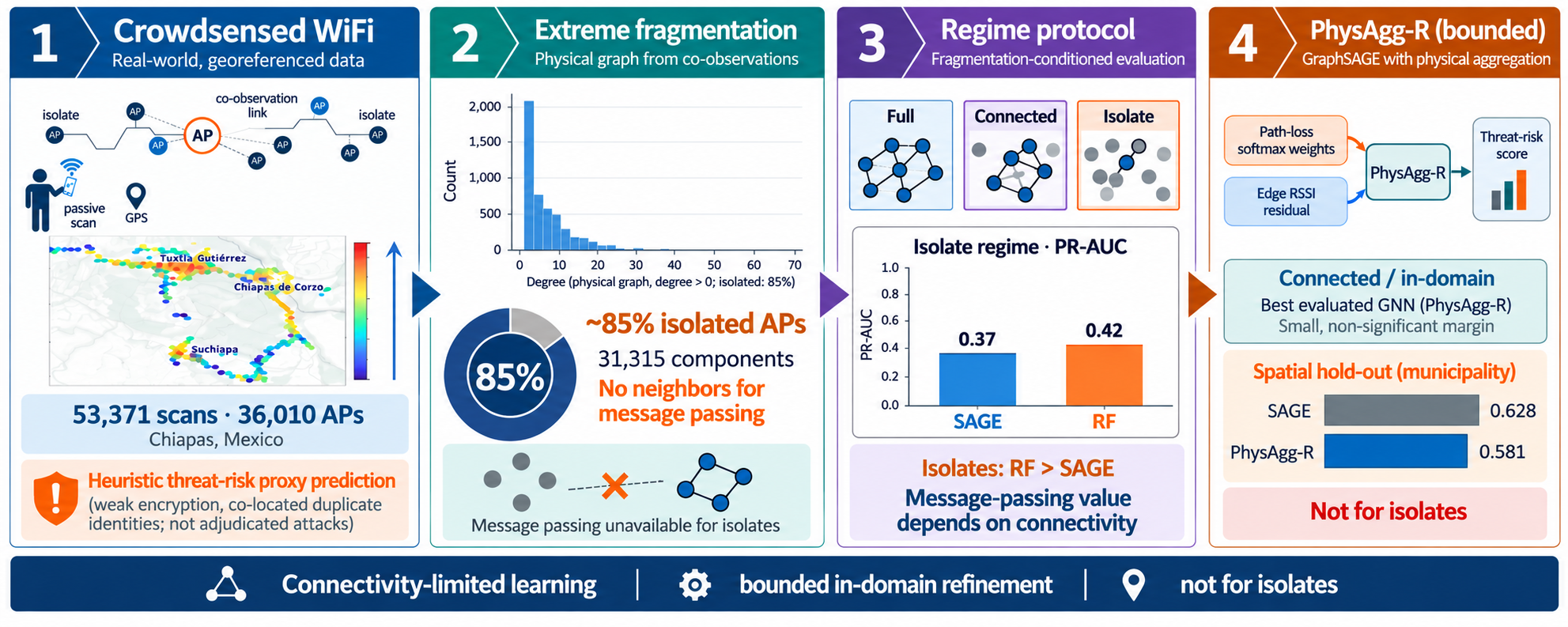
Fragmentation-Conditioned WiFi Threat Detection under Crowdsensing
Keywords:
WiFi security, mobile crowdsensing, graph fragmentation, graph neural networks, path loss, physics-informed learning, connectivity-limited learningAbstract
Passive WiFi crowdsensing is increasingly used to audit wireless exposure at urban scale, yet the proximity graphs built from sparse RSSI co-observations are rarely connected. On a field corpus of 53,371 georeferenced scans from Chiapas, Mexico (36,010 access points), about 85% of nodes are isolated after physical graph construction, and threat targets are assigned by heuristic pseudo-labels for weak encryption and co-located duplicate identities. Under a fragmentation-conditioned protocol that scores the full graph, the connected subgraph, and isolates separately, and that includes municipality hold-out, tabular forests outperform graph neural networks on the full graph and on isolates, whereas neighborhood aggregation helps mainly where edges exist. In that connected regime, PhysAgg-R (GraphSAGE with path-loss softmax aggregation and an edge RSSI residual) attains the strongest in-distribution GNN PR-AUC among GraphSAGE and nodal-physics ablations across five seeds, but the margin is small and not McNemar-significant, spatial transfer favors GraphSAGE, and isolates remain a tabular problem. These results support connectivity-limited learning as the primary finding: message-passing value must be reported by connectivity regime, while RF-anchored operators offer only bounded in-domain refinement rather than a general substitute for denser sensing or isolate-aware detectors.
Downloads
References
S. Zhu, L. Li, X. Wang, Q. Ni, Y. Jiang, H. Gao, Z. Han, and R. Gao, "Large-Scale Indoor Localization via Outdoor Crowdsourcing Trajectories on Ride-Hailing Platform," Proceedings of the ACM on Interactive, Mobile, Wearable and Ubiquitous Technologies, vol. 9, no. 2, pp. 1-23, 2025. [Online]. Available: https://doi.org/10.1145/3729498
D. Cicek and B. Kantarci, "Use of Mobile Crowdsensing in Disaster Management: A Systematic Review, Challenges, and Open Issues," Sensors, vol. 23, no. 3, p. 1699, 2023. [Online]. Available: https://doi.org/10.3390/s23031699
K. H. Chiu, H. Yin, W. Zhuo, C.-H. Lee, and S.-H. G. Chan, "Graph-based Fingerprint Update Using Unlabelled WiFi Signals," Proceedings of the ACM on Interactive, Mobile, Wearable and Ubiquitous Technologies, vol. 9, no. 1, pp. 1-26, 2025. [Online]. Available: https://doi.org/10.1145/3712277
W. L. Hamilton, R. Ying, and J. Leskovec, "Inductive Representation Learning on Large Graphs," Advances in Neural Information Processing Systems, vol. 30, 2017. [Online]. Available: https://doi.org/10.48550/arXiv.1706.02216
Q. McNemar, "Note on the Sampling Error of the Difference Between Correlated Proportions or Percentages," Psychometrika, vol. 12, no. 2, pp. 153-157, 1947. [Online]. Available: https://doi.org/10.1007/BF02295996
S. Shang and L. Wang, "Overview of WiFi fingerprinting-based indoor positioning," IET Communications, vol. 16, no. 7, pp. 725-733, 2022. [Online]. Available: https://doi.org/10.1049/cmu2.12386
X. Feng, K. A. Nguyen, and Z. Luo, "A Survey on Data Augmentation for WiFi Fingerprinting Indoor Positioning," IEEE Sensors Reviews, vol. 2, pp. 246-264, 2025. [Online]. Available: https://doi.org/10.1109/sr.2025.3577579
L. Xiao, P. Ghafoorpoor Yazdi, and S. Thiede, "A zone-based Wi-Fi fingerprinting indoor positioning system for factory noise mapping," Journal of Intelligent Manufacturing, vol. 37, no. 7, pp. 2697-2716, 2026. [Online]. Available: https://doi.org/10.1007/s10845-025-02660-y
Q. Liang, G. Zhang, and L.-T. Hsu, "Accurate Wi-Fi RTT Indoor Positioning With NLOS Mitigation by Floor Map: A Multiwall Modeling Approach," IEEE Transactions on Instrumentation and Measurement, vol. 75, p. 9522316, 2026. [Online]. Available: https://doi.org/10.1109/tim.2024.3436101
T. Amano, H. Yamaguchi, and T. Higashino, "Reference-Free 3D WiFi AP Localization by Outdoor-to-Indoor Bridging," IEEE Open Journal of the Computer Society, vol. 6, pp. 688-700, 2025. [Online]. Available: https://doi.org/10.1109/ojcs.2025.3566774
A. Abdeddine, L. Mekouar, and Y. Iraqi, "A Generic Framework for Mobile Crowdsensing: A Comprehensive Survey," IEEE Access, vol. 13, pp. 9134-9170, 2025. [Online]. Available: https://doi.org/10.1109/access.2025.3526739
M. Ribeiro, D. Teixeira, P. Barbosa, and N. J. Nunes, "Using passive Wi-Fi for community crowd sensing during the COVID-19 pandemic," Journal of Big Data, vol. 10, no. 1, 2023. [Online]. Available: https://doi.org/10.1186/s40537-022-00675-3
R. Lu, L. Shi, Y. Liu, and Z. Dang, "A Novel Crowdsourcing-Assisted 5G Wireless Signal Ranging Technique in MEC Architecture," Future Internet, vol. 17, no. 5, p. 220, 2025. [Online]. Available: https://doi.org/10.3390/fi17050220
M. A. Bermejo-Agueda, P. Callejo, R. Cuevas, A. Cuevas, R. Durairajan, R. Rejaie, and A. Mayol, "Unveiling Network Performance in the Wild: An Ad-Driven Analysis of Mobile Download Speeds," Proceedings of the ACM on Web Conference 2025, pp. 4841-4852, 2025. [Online]. Available: https://doi.org/10.1145/3696410.3714761
E. de Armas, G. Diaz, I. Sobron, I. Eizmendi, I. Landa, J. M. Matias, and M. Velez, "EHUNAM, a WiFi CSI-based dataset for human and machine sensing," Scientific Data, vol. 12, no. 1, 2025. [Online]. Available: https://doi.org/10.1038/s41597-025-06238-4
I. Ahmad, A. Ullah, and W. Choi, "WiFi-Based Human Sensing With Deep Learning: Recent Advances, Challenges, and Opportunities," IEEE Open Journal of the Communications Society, vol. 5, pp. 3595-3623, 2024. [Online]. Available: https://doi.org/10.1109/ojcoms.2024.3411529
Y. Ren, Z. Wang, Y. Wang, S. Tan, Y. Chen, and J. Yang, "GoPose," Proceedings of the ACM on Interactive, Mobile, Wearable and Ubiquitous Technologies, vol. 6, no. 2, pp. 1-25, 2022. [Online]. Available: https://doi.org/10.1145/3534605
M. Saldana-Perez, Y. Contreras-Jimenez, M. Torres-Ruiz, and C. Palma-Preciado, "Advances in technology for healthcare monitoring in Latin America: A systematic review," Digital Tools and Data for Innovative Healthcare, pp. 173-198, 2025. [Online]. Available: https://doi.org/10.1016/b978-0-443-27444-2.00012-5
J. Lorente-Lopez, I. Rodriguez-Rodriguez, J.-V. Rodriguez, and J. Maria Molina-Garcia-Pardo, "Discretized Urban Path Loss Modeling at 3.5 GHz Using Geospatial Features and Machine Learning Techniques: From Regression to Classification," IEEE Access, vol. 13, pp. 178961-178980, 2025. [Online]. Available: https://doi.org/10.1109/access.2025.3620996
J. Lorente-Lopez, I. Rodriguez-Rodriguez, J.-V. Rodriguez, J. Maria Molina Garcia-Pardo, and J. Aznar-Poveda, "Machine-Learning-Based Urban Path Loss Prediction at 900 MHz: Principal Component Analysis, Clustering, Feature Importance and Regression," IEEE Open Journal of Antennas and Propagation, vol. 7, no. 1, pp. 40-56, 2026. [Online]. Available: https://doi.org/10.1109/ojap.2025.3629578
A. Robles, J.-M. Poyanco, and M. E. Diago-Mosquera, "Large-scale analysis in LoS-NLoS indoor corridor at 18 GHz," Scientific Reports, 2026. [Online]. Available: https://doi.org/10.1038/s41598-026-59673-7
N. M. Obiri and K. Van Laerhoven, "Environment-aware indoor LoRaWAN path loss: parametric regression comparisons, shadow fading, and calibrated fade margins," Journal on Wireless Communications and Networking, vol. 2026, no. 1, 2026. [Online]. Available: https://doi.org/10.1186/s13638-026-02607-8
T. H. H. Soe, M. T. Soe, K. S. Linn, S. Teerasujaritpong, and C. Wechtaisong, "Enhanced Indoor Localization Using RSSI and SNR-Based Regression Models with Particle Filter Optimization in LoRaWAN," Proceedings of the 2026 15th International Conference on Informatics, Environment, Energy and Applications, pp. 30-36, 2026. [Online]. Available: https://doi.org/10.1145/3803833.3803838
P. Perdomo-Reyes, G. M. Galvan-Tejada, and A. Meneses-Viveros, "Path Loss Dataset from Field Measurements at 3.5 GHz for the Fifth Generation of Wireless Communications in Indoor Environments," Scientific Data, vol. 13, no. 1, 2026. [Online]. Available: https://doi.org/10.1038/s41597-026-06650-4
Z. Wang, J. A. Zhang, K. Wu, and Y. J. Guo, "Rethinking RSSI for WiFi sensing," npj Wireless Technology, vol. 2, no. 1, 2026. [Online]. Available: https://doi.org/10.1038/s44459-026-00053-y
X. Liu, X. Meng, H. Duan, Z. Hu, and M. Wang, "A Survey on Secure WiFi Sensing Technology: Attacks and Defenses," Sensors, vol. 25, no. 6, p. 1913, 2025. [Online]. Available: https://doi.org/10.3390/s25061913
M. Cunha, R. Mendes, Y.-A. de Montjoye, and J. P. Vilela, "WiFi-Based Location Tracking: A Still Open Door on Laptops," IEEE Open Journal of the Computer Society, vol. 6, pp. 822-833, 2025. [Online]. Available: https://doi.org/10.1109/ojcs.2025.3569437
"Fragile Frames: Wi-Fi's Fraught Fight Against FragAttacks," 2021. [Online]. Available: https://doi.org/10.1145/3734477.3734478
L. Breiman, "Random Forests," Machine Learning, vol. 45, no. 1, pp. 5-32, 2001. [Online]. Available: https://doi.org/10.1023/A:1010933404324
T. Chen and C. Guestrin, "XGBoost: A Scalable Tree Boosting System," Proceedings of the 22nd ACM SIGKDD International Conference on Knowledge Discovery and Data Mining, pp. 785-794, 2016. [Online]. Available: https://doi.org/10.1145/2939672.2939785