Low-Cost Cyber-Physical Architecture for Monitoring Industrial DC Electrical Signals
Keywords:
ANSI/ISA 50.00.01 standard, Cyber-physical systems, Data acquisition, Remote monitoring, Low-costAbstract
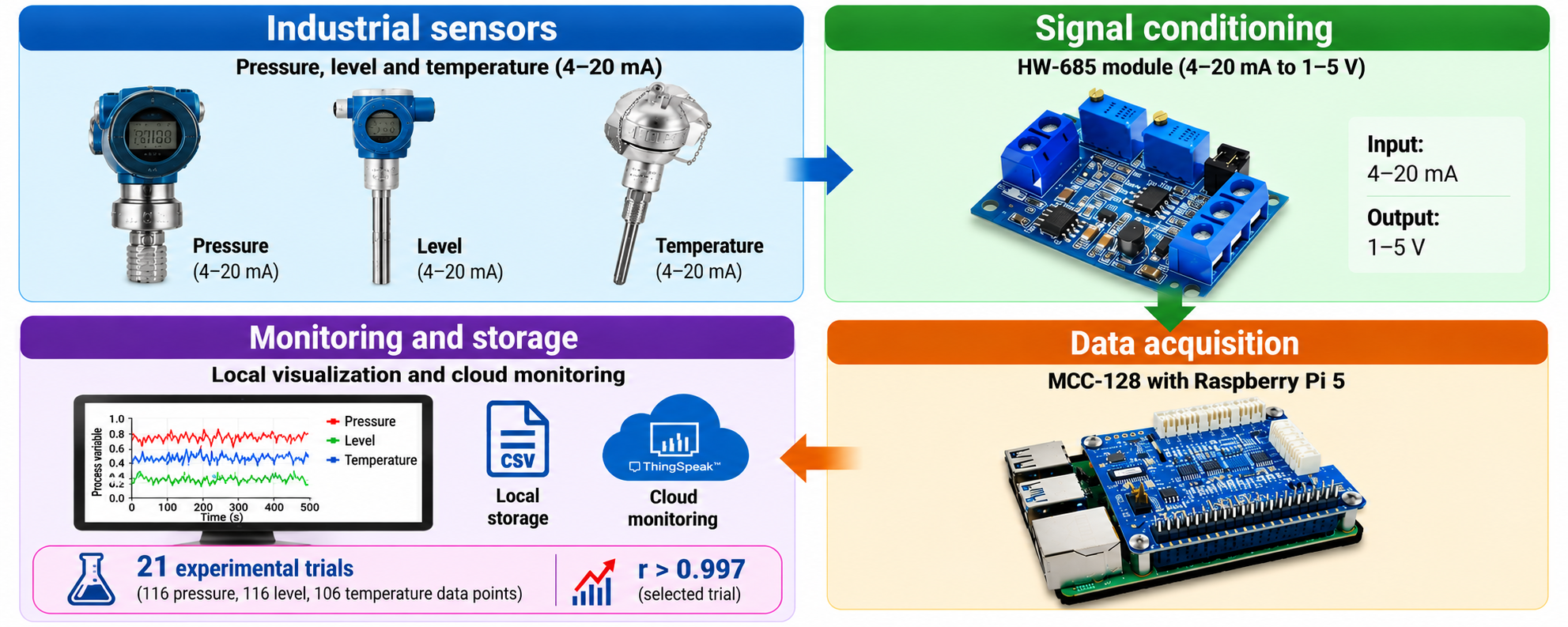
The article describes the development and pilot testing of a low-cost platform for industrial power direct current signal monitoring using open technologies and instrumentation-compatible standards. The solution is based on a Raspberry Pi 5 processor, MCC-128 DAQ-HAT acquisition module, HW-685 universal transducers, and ThingSpeak as a cloud platform for data visualization. The proposed measurement system has been tested in a pilot plant using industrial pressure, temperature, and level sensors. The accuracy of the measurements was within ± 0.5 physical units with a correlation coefficient of more than 99.7%. The results of the research confirm the possibility of using the developed system as a cost-effective and easily scalable solution in technical facilities with limited resources for industrialization, technical education, and applied research.
Downloads
References
[1] R. Sharma, “Enhancing industrial automation and safety through real-time monitoring and control systems,” J. Smart Sustain. Intell. Comput., vol. 1, no. 2, pp. 1–20, 2024, doi: 10.63503/j.ijssic.2024.30.
[2] A. Aderamo, H. Olisakwe, Y. Adebayo, and A. Esiri, “AI-enabled predictive safeguards for offshore oil facilities: Enhancing safety and operational efficiency,” Compr. Res. Rev. Eng. Technol., vol. 2, no. 1, pp. 23–43, 2024, doi: 10.57219/crret.2024.2.1.0060.
[3] E. Peterson and A. Lavin, “Physical computing for materials acceleration platforms,” Matter, vol. 5, no. 11, pp. 3586–3596, 2022, doi: 10.1016/j.matt.2022.09.022.
[4] L. Kumar, R. K. Sharma, “Exploring Research Issues and Potential
Future Directions in Industry 4.0 Adoption in SMEs: A Comprehensive Analysis and Integration,” FIIB Business Review, 2023. doi: 10.1177/23197145231203512.
[5] K. Niehaus and A. Westhoff, “An open-source data acquisition system for laboratory and industrial scale applications,” Meas. Sci. Technol., vol. 34, no. 2, Art. no. 027001, 2022, Art. no. 027001, doi: 10.1088/1361-6501/ac9994.
[6] J. Jolles, “Broad-scale applications of the Raspberry Pi: A review and guide for biologists,” Methods Ecol. Evol., vol. 12, no. 9, pp. 1562–1579, 2021. doi: 10.1111/2041-210X.13652.
[7] A. Martikkala, J. David, A. Lobov, and M. Lanz, “Trends for low-cost and open-source IoT solutions development for Industry 4.0,” Procedia Manuf., vol. 55, pp. 298–305, 2021, doi: 10.1016/j.promfg.2021.10.042.
[8] M. Gushev, “Dew computing architecture for cyber-physical systems and IoT,” Internet Things, vol. 11, 2020, Art. no. 100186, doi: 10.1016/j.iot.2020.100186.
[9] K. Feichtinger, K. Meixner, F. Rinker, I. Koren, H. Eichelberger, T. Heinemann, J. Holtmann, M. Konersmann, J. Michael, E.-M. Neumann, J. Pfeiffer, R. Rabiser, M. Riebisch, and K. Schmid, “Industry voices on software engineering challenges in cyber-physical production systems engineering,” in Proc. IEEE 27th Int. Conf. Emerg. Technol. Factory Autom. (ETFA), Stuttgart, Germany, 2022, pp. 1–8, doi: 10.1109/ETFA52439.2022.9921568.
[10] C. C. Chung and S. J. Lou, “Physical computing strategy to support students’ coding literacy: An educational experiment with Arduino boards,” Appl. Sci., vol. 11, no. 4, 2021, Art. no. 1830, doi: 10.3390/app11041830.
[11] T. Chen, L. Xu, and K. Zhu, “FritzBot: A data-driven conversational agent for physical-computing system design,” Int. J. Hum. Comput. Stud., vol. 155, 2021, Art. no. 102699, doi: 10.1016/j.ijhcs.2021.102699.
[12] I. Ullah, R. K. Haldkar, and I. A. Parinov, “Prioritizing the barriers to the adoption of cyber-physical systems in manufacturing organizations using fuzzy AHP,” in Physics and Mechanics of New Materials and Their Applications, Springer Proceedings in Materials, vol. 20. Cham, Switzerland: Springer, 2023, doi: 10.1007/978-3-031-21572-8_49.
[13] X. Bampoula, G. Siaterlis, N. Nikolakis, and K. Alexopoulos, “A deep learning model for predictive maintenance in cyber-physical production systems using LSTM autoencoders,” Sensors, vol. 21, no. 3, 2021, Art. no. 972, doi: 10.3390/s21030972.
[14] A. Lewis, M. Campbell, and P. Stavroulakis, “Performance evaluation of a cheap, open source, digital environmental monitor based on the Raspberry Pi,” Measurement, vol. 87, pp. 228–235, 2016, doi: 10.1016/j.measurement.2016.03.023.
[15] G. Song, J. Ou, Y. Cao, and Y. Wang, “An energy auditing system based on learnable positional embedding and edge computing for in-situ monitoring of 3D printing processes,” Int. J. Adv. Manuf. Technol., vol. 139, no. 2, pp. 3493–3509, 2025, doi: 10.1007/s00170-025-16098-2.
[16] P. Khatri, K. Gupta, and R. Gupta, “Raspberry Pi-based smart sensing platform for drinking-water quality monitoring system: A Python framework approach,” Drink. Water Eng. Sci., vol. 12, no. 1, pp. 31–37, 2019, doi: 10.5194/dwes-12-31-2019.
[17] K. Xu, Y. Li, C. Liu, X. Liu, X. Hao, J. Gao, and P. Maropoulos, “Advanced data collection and analysis in data-driven manufacturing process,” Chin. J. Mech. Eng., vol. 33, 2020, Art. no. 43, doi: 10.1186/s10033-020-00459-x.