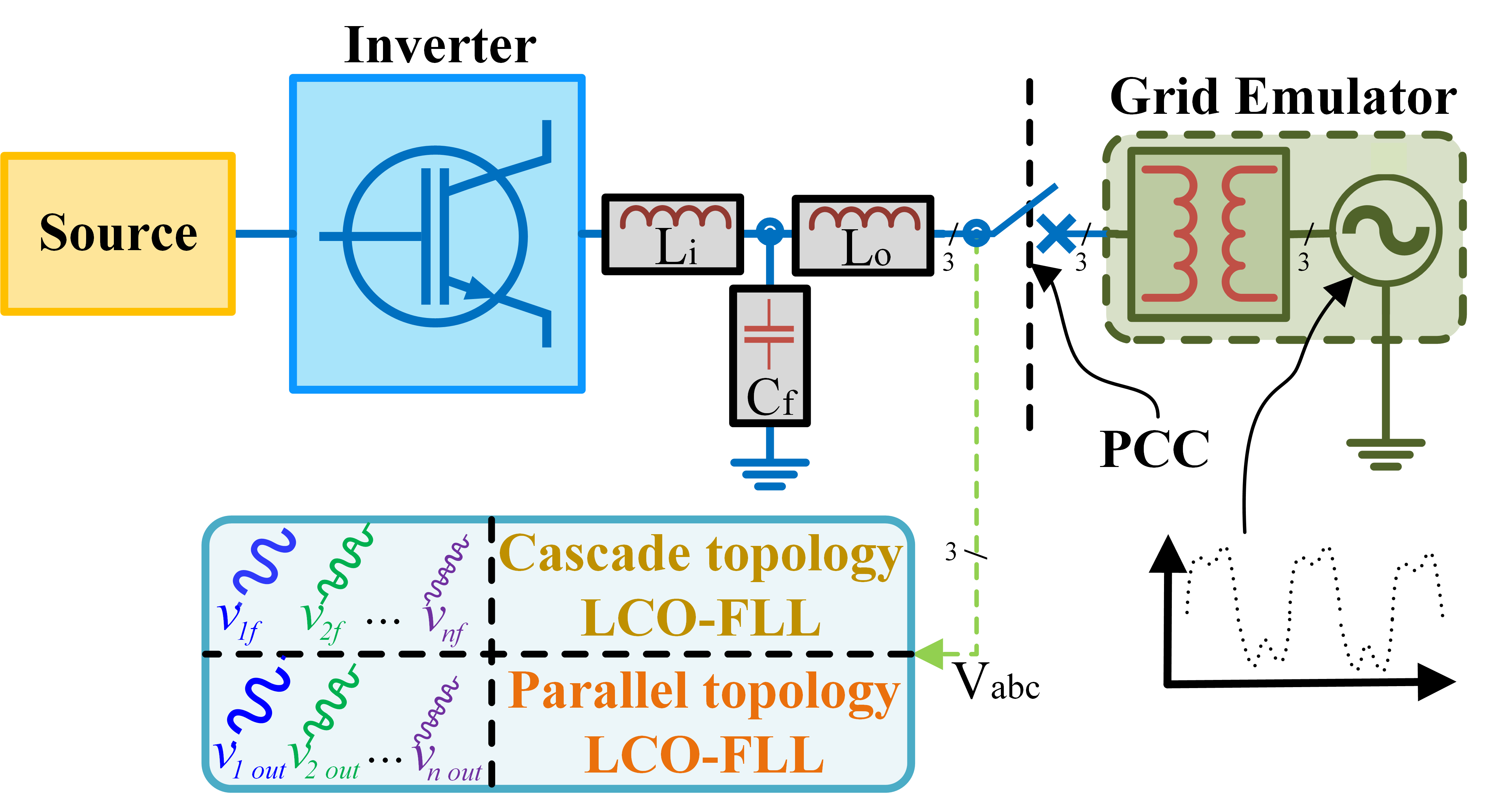
A Comparative Study of Harmonic and Inter-Harmonic Detection Using Parallel- and Cascade-Connected Nonlinear Limit Cycle Oscillators
Keywords:
Harmonic detection, Inter-harmonic detection, Limit Cycle Oscillators, Frequency-Locked LoopAbstract
The accurate detection of harmonics and inter-harmonics is critical for power quality monitoring, yet challenging due to the complex, multi-component nature of electrical signals. This paper investigates and compares two detection methodologies based on networks of nonlinear Limit Cycle Oscillators (LCOs). A systematic performance evaluation assesses the ability of both parallel- and cascade-connected LCO structures to precisely estimate the frequency, magnitude, and phase of individual harmonic and inter-harmonic components. The findings, validated through experimental tests, highlight the comparative advantages and limitations of each architecture, providing practical insights for their application in enhancing energy efficiency within power systems.
Downloads
References
Ł. Michalec et al., “Impact of harmonic currents of nonlinear loads on power quality of a low voltage network–review and case study,” Energies, vol. 14, no. 12, 2021, ISSN: 1996-1073. DOI: 10.3390/en14123665.
O. Avalos et al., “Kernel recursive least square approach for power system harmonic estimation,” Electric Power Components and Systems, vol. 48, no. 16-17, pp. 1708-1721, 2020. DOI: 10.1080/15325008.2021.1908457.
B. Hu and H. Gharavi, “A fast recursive algorithm for spectrum tracking in power grid systems,” IEEE Transactions on Smart Grid, vol. 10, no. 3, pp. 2882–2891, 2019. DOI: 10.1109/TSG.2018.2813881.
S. Yin et al., “Multi-harmonic sources identification and evaluation method based on cloud-edge-end collaboration,” International Journal of Electrical Power and Energy Systems, vol. 156, p. 109 681, 2024. DOI: https://doi.org/10.1016/j.ijepes.2023.109681.
F. Safargholi, K. Malekian, and W. Schufft, ““voltage-current ratio difference” concept for identifying the dominant harmonic source,” International Journal of Electrical Power and Energy Systems, vol. 121, p. 106 147, 2020, ISSN: 0142-0615. DOI: https :/ / doi.org/10.1016/j.ijepes.2020.106147.
K. Daniel et al., “A review of harmonic detection, suppression, aggregation, and estimation techniques,” Applied Sciences, vol. 14, no. 23, 2024, ISSN: 2076-3417. DOI: 10.3390/app142310966.
C.-I. Chen and Y.-C. Chen, “Comparative study of harmonic and interharmonic estimation methods for stationary and time-varying signals,” IEEE Transactions on Industrial Electronics, vol. 61, no. 1, pp. 397–404, 2014. DOI: 10.1109/TIE.2013.2242419.
M. Valtierra-Rodriguez, R. de Jesus Romero-Troncoso, R. A. Osornio-Rios, and A. Garcia-Perez, “Detection and classification of single and combined power quality disturbances using neural networks,” IEEE Transactions on Industrial Electronics, vol. 61, no. 5, pp. 2473–2482, 2014. DOI: 10.1109/TIE.2013.2272276.
X. Li and W. Xu, “A novel filter to mitigate interharmonic problems caused by variable frequency drives,” in 2017 IEEE 12th International Conference on Power Electronics and Drive Systems (PEDS), 2017, pp. 887–892. DOI: 10.1109/PEDS.2017.8289144.
S. Jana and S. Srinivas, “A computationally efficient harmonic extraction algorithm for grid applications,” IEEE Transactions on Power Delivery, vol. 37, no. 1, pp. 146–154, 2022. DOI: 10 .1109/TPWRD.2021.3054554.
A. Bagheri, M. Mardaneh, A. Rajaei, and A. Rahideh, “Detection of grid voltage fundamental and harmonic components using kalman filter and generalized averaging method,” IEEE Transactions on Power Electronics, vol. 31, no. 2, pp. 1064–1073, 2016. DOI: 10 .1109 / TPEL.2015.2418271.
H. Ero˘glu et al., “Harmonic problems in renewable and sustainable energy systems: A comprehensive review,” Sustainable Energy Technologies and Assessments, vol. 48, p. 101 566, 2021, ISSN: 2213-1388. DOI: https://doi.org/10.1016/j.seta.2021.101566.
E. A. Bulycheva and S. A. Yanchenko, “Real-time harmonic identification under varying grid conditions,” Serbian Journal of Electrical Engineering, vol. 18, no. 1, pp. 29–48, 2021. DOI: https://doi.org/10.2298/SJEE2101029B.
G. Arena et al., “A comprehensive review on dc fast charging stations for electric vehicles: Standards, power conversion technologies, architectures, energy management, and cybersecurity,” IEEE Open Journal of Power Electronics, vol. 5, pp. 1573–1611, 2024. DOI: 10.1109/OJPEL.2024.3466936.
S. Soliman, Electric Power Systems Harmonics - Identification and Measurements. IntechOpen, 2011, ISBN: 978-953-307-335-4.
A. Hoevenaars, M. Farbis, and M. McGraw, “Active harmonic mitigation: What the manufacturers don’t tell you,” IEEE Industry Applications Magazine, vol. 26, no. 5, pp. 41–51, 2020. DOI: 10 .1109/MIAS .2020.2982484.
P. Dattaray, D. Chakravorty, P. Wall, J. Yu, and V. Terzija, “A novel control strategy for subsynchronous resonance mitigation using 11 kv vfd-based auxiliary power plant loads,” IEEE Transactions on Power Delivery, vol. 33, no. 2, pp. 728–740, 2018. DOI: 10.1109/TPWRD.2017.2711624.
R. Tao et al., “A phase compensation method combined with power correction for suppressing sub-synchronous resonance of wind generation under weak grid,” International Journal of Electrical Power and Energy Systems, vol. 151, p. 109 115, 2023. DOI: https://doi.org/10.1016/j.ijepes.2023.109115.
N. Verma, N. Kumar, S. Gupta, H. Malik, and F. P. Garc´ıa M´arquez, “Review of sub-synchronous interaction in wind integrated power systems: Classification, challenges, and mitigation techniques,” Protection and Control of Modern Power Systems, vol. 8, no. 2, pp. 1–26, 2023. DOI: 10.1186/s41601-023-00291-0.
F. Zhang, J. Liu, W. Hu, W. Gao, and J. He, “An enhanced synchrophasor trajectory fitting technique for parameter identification of sub-/super-synchronous oscillations,” CSEE Journal of Power and Energy Systems, pp. 1–12, 2025. DOI: 10.17775/CSEEJPES.2023.02240.
IPCC, “Energy systems,” in Climate Change 2022: Mitigation of Climate Change. Contribution of Working Group III to the Sixth Assessment Report of the Inter-governmental Panel on Climate Change, P. R. Shukla et al., Eds., Cambridge, UK and New York, NY, USA: Cambridge University Press, 2022, ch. 6. DOI: 10.1017/9781009157926.008. [Online]. Available: https://www.ipcc.ch/report/ar6/wg3/chapter/chapter-6/.
D. D. A. Snehal R. Durdhavale, “A review of harmonics detection and measurement in power system,” International Journal of Computer Applications, vol. 143, no. 10, pp. 42–45, Jun. 2016. DOI: 10.5120/ijca2016910394.
G. Carpinelli et al., “A new advanced method for an accurate assessment of harmonic and supraharmonic distortion in power system waveforms,” IEEE Access, vol. 9, pp. 88 685–88 698, 2021. DOI: 10.1109/ACCESS.2021.3090245.
S. Shelar, D. Bankar, and S. Bakre, “Review of revisions of ieee 519 standard on power system harmonics (1981 to 2022),” pp. 415–420, 2024. DOI: 10 .1109/ICHQP61174.2024.10768696.
Z. Zhang et al., “Harmonic measurement method and system design based on self-compensating fft,” IEEE Sensors Journal, vol. 25, no. 13, pp. 24 588–24 597, 2025. DOI: 10.1109/JSEN.2025.3571745.
S. Sharma, Digital signal processing. KHANNA PUBLISHING HOUSE, 2025, ISBN: 978-93-55386-57-1.
J. Enayati and Z. Moravej, “Real-time harmonic estimation using a novel hybrid technique for embedded system implementation,” International Transactions on Electrical Energy Systems, vol. 27, no. 12, pp. 24–28, 2017. DOI: https://doi.org/10.1002/etep.2428.
A. E. Biju et al., “Dynamics of minimal networks of limit cycle oscillators,” Nonlinear Dynamics, vol. 112, no. 13, pp. 11 329–11 348, 2024. DOI: 10.1007/s11071-024-09641-5.
P. Li, W. Jin, R. Li, and M. Guan, “Harmonics detection via input observer with grid frequency fluctuation,” International Journal of Electrical Power and Energy Systems, vol. 115, p. 105 461, 2020, ISSN: 0142-0615. DOI: https://doi.org/10.1016/j.ijepes.2019.105461.
E. Oviedo, N. V´azquez, and R. Femat, “Synchronization technique of grid-connected power converters based on a limit cycle oscillator,” IEEE Transactions on Industrial Electronics, vol. 65, no. 1, pp. 709–717, 2018. DOI: 10.1109/TIE.2017.2703655.
R. Lautenbacher, J. R¨ohrig, K. Ochs, and R. K¨ohl, “A sufficient synchronization condition for oscillators coupled diffusively by nonlinear passive systems,” Discover Applied Sciences, vol. 7, no. 6, p. 643, 2025. DOI: 10.1007/s42452-025-07140-9.
S. Golestan, J. M. Guerrero, F. Musavi, and J. C. Vasquez, “Single-phase frequency-locked loops: A comprehensive review,” IEEE Transactions on Power Electronics, vol. 34, no. 12, pp. 11 791–11 812, 2019. DOI: 10.1109/TPEL.2019.2910247.
Y. Zuo et al., “An adaptive active disturbance rejection control strategy for speed-sensorless induction motor drives,” IEEE Transactions on Transportation Electrification, vol. 8, no. 3, pp. 3336–3348, 2022. DOI: 10.1109/TTE.2022.3148412.
T. Trummel, Z. Liu, and O. Stursberg, “Analysis of synchronization errors for differently parametrized limit cycle oscillators subject to bounded disturbances,” SN Computer Science, vol. 6, no. 7, p. 871, 2025. DOI: 10.1007/s42979-025-04378-3.
E. Vazquez, J. Roldan-Perez, and M. Prodanovic, “Detection of harmonics by using parallel-connected nonlinear limit cycle oscillators,” pp. 70–75, 2023. DOI: 10.1109/SDEMPED54949.2023.10271417.
E. Vazquez, J. Roldan-Perez, and M. Prodanovic, “Detection of harmonics and interharmonics by using cascaded limit cycle oscillators,” pp. 1–6, 2023. DOI: 10.1109/CPE-POWERENG58103.2023.10227428.
S. Sastry, Nonlinear Systems: Analysis, Stability, and Control (Interdisciplinary Applied Mathematics). New York: Springer, 1999, ISBN: 9780387985138.
A. K. Verma, C. Subramanian, R. K. Jarial, and P. Roncero-S´anchez, “An enhanced discrete-time oscillator-based pll-less estimation of single-phase grid voltage parameters,” IEEE Transactions on Industrial Electronics, vol. 69, no. 4, pp. 3977–3987, 2021. DOI: 10.1109/TIE.2021.3071690.
D. Gallo, R. Langella, and A. Testa, “Light flicker prediction based on voltage interharmonics assessment,” IEEE Transactions on Power Delivery, vol. 20, no. 4,
pp. 2397–2407, 2005. DOI: 10.1109/TPWRD.2005 .852377.
R. F. Brcich, Y. J. Zhang, and A. M. Zoubir, “Estimation of harmonic and interharmonic frequencies using esprit,” IEEE Transactions on Power Delivery, vol. 24,
no. 2, pp. 493–501, 2009. DOI: 10.1109/TPWRD.2008.2002970.
P. K. Dash, A. K. Pradhan, and G. Panda, “Frequency estimation of distorted power system signals using extended complex kalman filter,” IEEE Transactions on Power Delivery, vol. 14, no. 3, pp. 761–766, 1999. DOI: 10.1109/61.772312.
S. Chandra and P. Kumar, “Detection and classification of harmonics and interharmonics using wavelet-based techniques,” IEEE Transactions on Industrial Electronics, vol. 61, no. 8, pp. 4233–4242, 2014. DOI: 10.1109/TIE.2013.2281165.
W.-C. Lin and C.-H. Chen, “A hybrid neural network and particle swarm optimization approach for interharmonic parameter identification,” IEEE Transactions on Power Electronics, vol. 34, no. 7, pp. 6124–6135, 2019. DOI: 10.1109/TPEL.2018.2875112.