Dual-Band MIMO Antenna with Enhanced Isolation for Sub-6 GHz 5G and Wi-Fi Applications
Keywords:
Dual-band, high isolation, MIMO, WiFi, compact, single layerAbstract
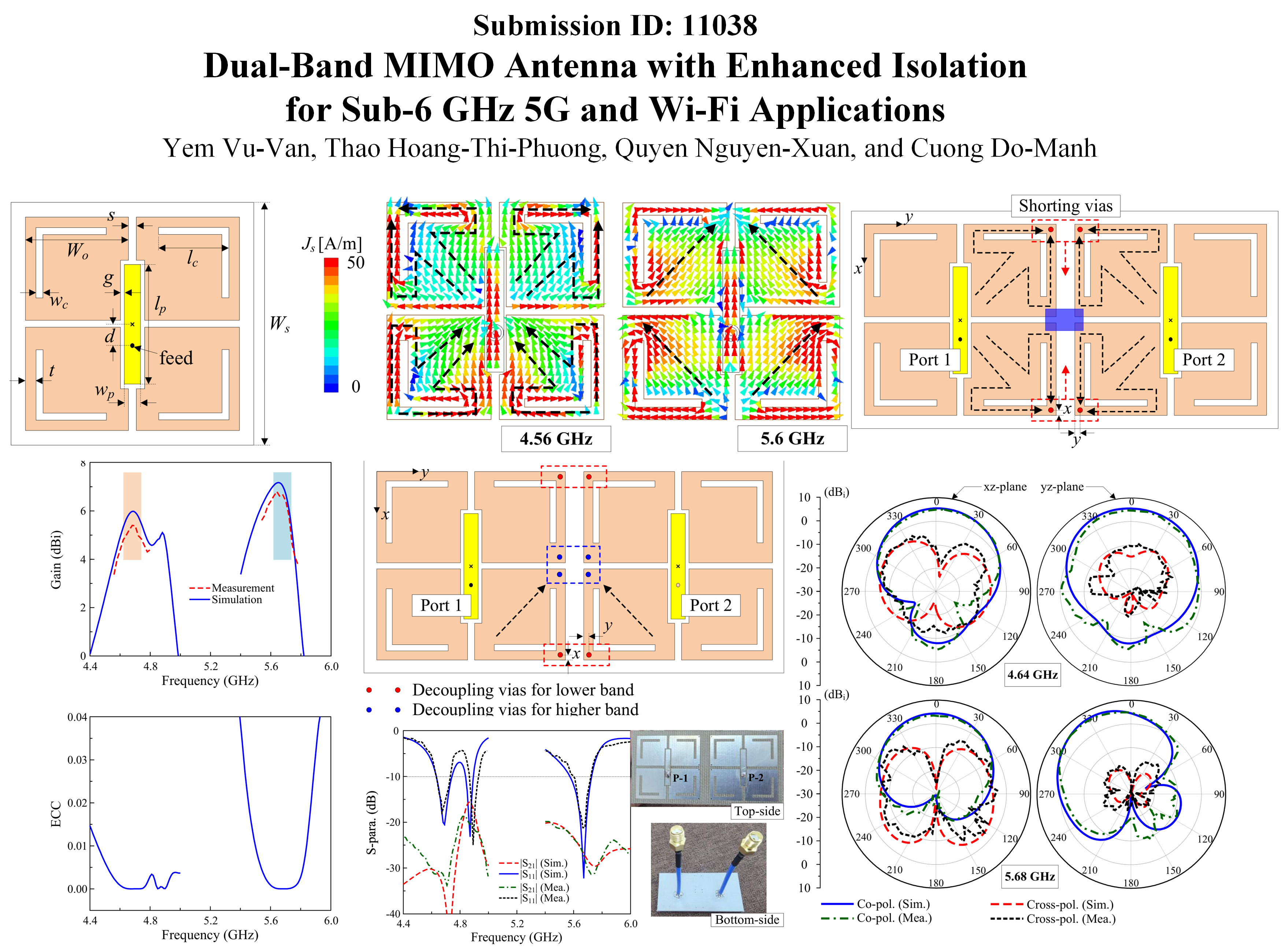
This paper presents a single-layer dual-band multiple-input-multiple-output (MIMO) antenna with high isolation characteristics for the Sub-6 GHz n79 5G NR band (4.4–5.0 GHz) and 5-GHz Wi-Fi applications. The dual-band MIMO element consists of four-square patches with embedded slots, which are capacitively excited by a probe-fed patch at the center. To achieve high isolation, shorting vias are employed to produce a transmission zero for mutual coupling reduction at both operating frequency bands. The proposed two-port antenna achieves an overall size of 0.94λ×0.47λ×0.02λ at the lowest band of 4.6 GHz. Experimental results show measured bandwidths of 2.8% (4.62 - 4.75 GHz) and 3.9% (5.50 - 5.72 GHz) for the lower and upper bands, respectively. The antenna consistently provides more than 25 dB isolation, together with gains of 4.8–5.4 dBi for the 4.6 GHz band and 5.2–6.8 dBi for the 5.6 GHz band at both individual ports. The proposed design effectively covers the 4.62–4.75 GHz portion of the n79 band and the 5.50–5.72 GHz range for 5-GHz Wi-Fi, accommodating channel bandwidths up to 100 and 160 MHz, respectively.
Downloads
References
3GPP, “NR; User Equipment (UE) radio transmission and reception; Part 1: Range 1 Standalone,” Technical Specification (TS) 38.101-1.
IEEE, “IEEE Standard for Information technology–Telecommunications and information exchange between systems–Local and metropolitan area networks–Specific requirements–Part 11: Wireless LAN MAC and PHY Specifications–Amendment 4: Enhancements for Very High Throughput for Operation in Bands below 6 GHz,” Tech. Rep. IEEE Std 802.11ac-2013, 2013.
H.-L. Peng, R. Tao, W.-Y. Yin, and J.-F. Mao, “A novel compact dualband antenna array with high isolations realized using the neutralization technique,” IEEE Transactions on Antennas and Propagation, vol. 61, no. 4, pp. 1956–1962, Apr. 2013. doi: 10.1109/tap.2012.2234714
J.-H. Xun, L.-F. Shi, W.-R. Liu, G.-X. Liu, and S. Chen, “Compact dual-band decoupling structure for improving mutual coupling of closely placed pifas,” IEEE Antennas and Wireless Propagation Letters, vol. 16, pp. 1985–1989, 2017. doi: 10.1109/lawp.2017.2691716
X. Shen, F. Liu, L. Zhao, G.-L. Huang, X. Shi, Q. Huang, and A. Chen, “Decoupling of two strongly coupled dual-band antennas with reactively loaded dummy element array,” IEEE Access, vol. 7, pp. 154 672–154 682, 2019. doi: 10.1109/access.2019.2948897
J. Sui and K.-L. Wu, “A general t-stub circuit for decoupling of two dual-band antennas,” IEEE Transactions on Microwave Theory and Techniques, vol. 65, no. 6, pp. 2111–2121, 2017. doi: 10.1109/tmtt.2017.2647951
K.-D. Xu, H. Luyen, and N. Behdad, “A decoupling and matching network design for single- and dual-band two-element antenna arrays,” IEEE Transactions on Microwave Theory and Techniques, vol. 68, no. 9, pp. 3986–3999, 2020. doi: 10.1109/tmtt.2020.2989120
L. Zhao and K.-L. Wu, “A dual-band coupled resonator decoupling network for two coupled antennas,” IEEE Transactions on Antennas and Propagation, vol. 63, no. 7, pp. 2843–2850, 2015. doi: 10.1109/tap.2015.24219736
C. Munusami and R. Venkatesan, “A compact boat shaped dualband mimo antenna with enhanced isolation for 5g/wlan application,” IEEE Access, vol. 12, pp. 11 631–11 641, 2024. doi: 10.1109/access.2024.3356078
J. Liu, H. Liu, X. Dou, Y. Tang, C. Zhang, L. Wang, R. Tang, and Y. Yin, “A low profile, dual-band, dual-polarized patch antenna with antennafilter functions and its application in mimo systems,” IEEE Access, vol. 9, pp. 101 164–101 171, 2021. doi: 10.1109/access.2021.3096969
Z. Niu, H. Zhang, Q. Chen, and T. Zhong, “Isolation enhancement in closely coupled dual-band mimo patch antennas,” IEEE Antennas and Wireless Propagation Letters, vol. 18, no. 8, pp. 1686–1690, Aug. 2019. doi: 10.1109/lawp.2019.2928230
A. E. Farahat and K. F. A. Hussein, “Dual-band (28/38 ghz) wideband mimo antenna for 5g mobile applications,” IEEE Access, vol. 10, pp. 32 213–32 223, 2022. doi: 10.1109/access.2022.3160724
Z. Zahid, G. Sun, H. Li, H. Chen, K.-Y. Jung, H. Wang, and L. Qu, “Dual-band single-patch mimo antenna with capacitor-loaded shorting posts (clsps) as modal tuners,” IEEE Antennas and Wireless Propagation Letters, vol. 24, no. 6, pp. 1482–1486, 2025. doi: 10.1109/lawp.2025.3540870
F. Liu, J. Guo, L. Zhao, G.-L. Huang, Y. Li, and Y. Yin, “Dual-band metasurface-based decoupling method for two closely packed dual-band antennas,” IEEE Transactions on Antennas and Propagation, vol. 68, no. 1, pp. 552–557, Jan. 2020. doi: 10.1109/tap.2019.2940316
W. Zhang, Y. Li, K. Wei, and Z. Zhang, “A dual-band mimo antenna system for 2.4/5 ghz wlan applications,” IEEE Transactions on Antennas and Propagation, vol. 71, no. 7, pp. 5749–5758, 2023. doi: 10.1109/tap.2023.3277208
A. Boukarkar, X. Q. Lin, Y. Jiang, L. Y. Nie, P. Mei, and Y. Q. Yu, “A miniaturized extremely close-spaced four-element dual-band mimo antenna system with polarization and pattern diversity,” IEEE Antennas and Wireless Propagation Letters, vol. 17, no. 1, pp. 134–137, Jan. 2018. doi: 10.1109/lawp.2017.2777839
N. Ojaroudi Parchin, Y. I. A. Al-Yasir, H. J. Basherlou, and R. A. Abd-Alhameed, “A closely spaced dual-band mimo patch antenna with reduced mutual coupling for 4g/5g applications,” Progress In Electromagnetics Research C, vol. 101, pp. 71–80, 2020. doi: 10.2528/pierc20013001
B. L. Dhevi, K. S. Vishvaksenan, and K. Rajakani, “Isolation enhancement in dual-band microstrip antenna array using asymmetric loop resonator,” IEEE Antennas and Wireless Propagation Letters, vol. 17, no. 2, pp. 238–241, Feb. 2018. doi: 10.1109/lawp.2017.2781907
J. C. Dash and D. Sarkar, “A four-port csrr-loaded dual-band mimo antenna with suppressed higher order modes,” IEEE Access, vol. 10, pp. 30 770–30 778, 2022. doi: 10.1109/access.2022.3160831
X.-H. Ding, Z. Tan, and S. N. Burokur, “A compact single layer dual band microstrip patch antenna for 5g terminal applications,” Scientific Reports, vol. 15, no. 1, Mar. 2025. doi: 10.1038/s41598-025-93592-3
W. A. Awan, A. Abbas, D. Choi, N. Hussain, H. Lee, D. Sim, and N. Kim, “Compact and directional dual band antenna with low mutual coupling mimo configuration for mm-wave communication,” Results in Engineering, vol. 26, p. 105457, 2025. doi: 10.1016/j.rineng.2025.105457
T. Dao-Duc, N. Truong-Quang, T. Le-Tuan, and H. Tran-Huy, “High front-to-back ratio metasurface antenna with single-layer and compact size for wlan applications,” PLOS One, vol. 20, no. 5, p. e0321603, May 2025. doi: 10.1371/journal.pone.0321603