A Low-Cost IoT System Development for Real-Time Residential Water Monitoring
Keywords:
Water monitoring, Internet of Things, Water resources, Pressure sensors, Flow sensors, ESP32Abstract
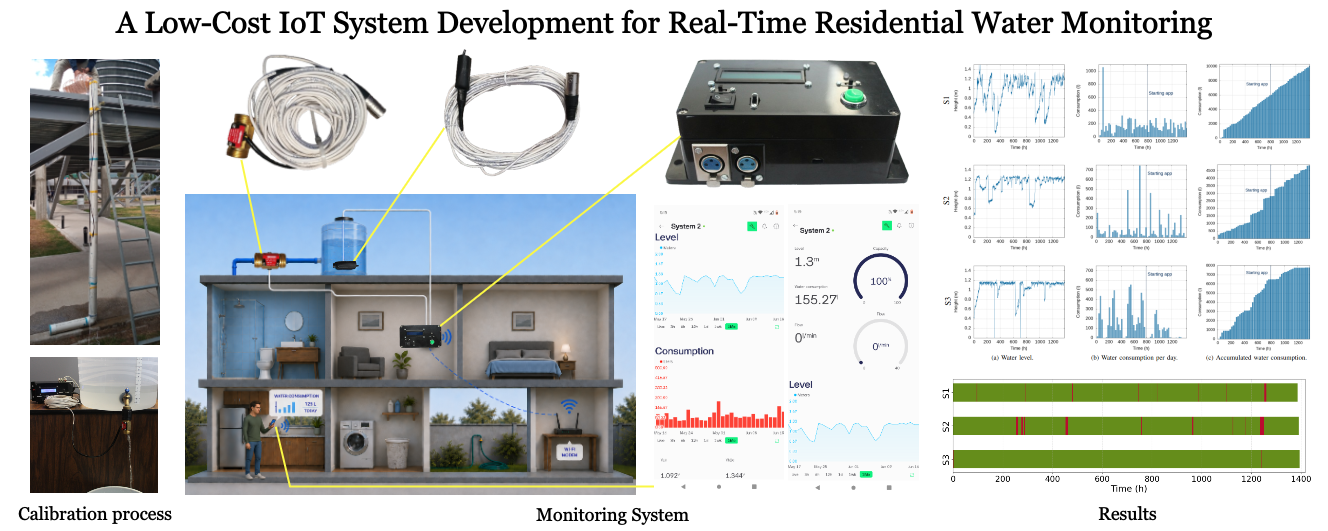
Water, as a natural resource, faces increasing pressure globally due to climate change, urbanization, and poor management, highlighting the need for accessible technological solutions for its monitoring. In this paper, we present the design of a low-cost system, that uses Internet of Things (IoT), for real-time monitoring of water consumption and level in residential environments (applicable to infrastructure in Mexico). The IoT system integrates a Hall-effect-based sensor for flow measurement, a level sensor based on a pressure difference, and a data acquisition and cloud communication unit. Additionally, an interface was developed to enable real-time monitoring of water consumption, allowing users to understand and modify their consumption habits. The experimental results demonstrate the viability and effectiveness of the proposed solution as a scalable, low-cost alternative for smart water monitoring in urban environments.
Downloads
References
J. S. Famiglietti and G. Ferguson, “The hidden crisis beneath our feet,” Science, vol. 372, no. 6540, pp. 344–345, 2021. doi: 10.1126/science.abh2867
B. Scanlon, S. Fakhreddine, A. Rateb et al., “Global water resources and the role of groundwater in a resilient water future,” Nature Reviews Earth & Environment, vol. 4, no. 6540, pp. 87–101, 2023. doi: 10.1038/s43017-022-00378-6
United Nations, “Transforming our World: The 2030 Agenda for Sustainable Development,”
New York, NY, USA, 2015, (Accessed:2026-02-23). [Online]. Available: https://sdgs.un.org/sites/default/files/publications/21252030%20Agenda%20for%20Sustainable%20Development%20web.pdf
United Nations Department of Economic and Social Affairs, “The Sustainable Development Goals Report 2025,” New York, NY, USA, 2025, (Accessed:2026-02-23). [Online]. Available: https://unstats.un.org/sdgs/report/2025/The-Sustainable-Development-Goals-Report-2025.pdf
H. A. Chandanpurkar, J. S. Famiglietti, K. Gopalan, D. N. Wiese, Y. Wada, K. Kakinuma, J. T. Reager, and F. Zhang, “Unprecedented continental drying, shrinking freshwater availability, and increasing land contributions to sea level rise,” Science Advances, vol. 11, no. 30, 2025. doi: 10.1126/sciadv.adx0298
Comisión Nacional del Agua, “Estadísticas del agua en México 2023,” México, 2023, (Accessed: 2026-05-28). [Online]. Available: https://sinav30.conagua.gob.mx:8080/portpublicaciones.html
——, “Numeragua 2022,” México, 2022, (Accessed: 2026-04-07). [Online]. Available: https://files.conagua.gob.mx/conagua/publicaciones/Publicaciones/Numeragua%202022.pdf
J. A. M.-N. Lilia Rodríguez-Tapia, Daniel A. Revollo-Fernández, “Household 's perception of water quality and willingness to pay for clean water in Mexico City,” Economies, vol. 5, no. 12, 2017. doi: 10.3390/economies5020012
M. L. P. Felipe I. Arreguín Cortés and H. M. Mogollón, “Mexico’s water challenges for the 21st century,” in Water Resources in Mexico: Scarcity, Degradation, Stress, Conflicts, Management, and Policy, Úrsula Oswald Spring, Ed. Springer Berlin, Heidelberg, 2011.
United Nations, The United Nations World Water Development Report 2023: Partnerships and Cooperation for Water. Paris, France: UNESCO, 2023.
B. R. Rosenzweig, P. Herreros Cantis, Y. Kim, A. Cohn, K. Grove, J. Brock et al., “The value of urban flood modeling,” Earth’s Future, vol. 9, 2021. doi: 10.1029/2020EF001739
A. C. da Silva Júnior, R. Munoz, M. d. l. Á. Quezada, A. V. Lira Neto, M. M. Hassan, and V. H. C. de Albuquerque, “Internet of water things: A remote raw water monitoring and control system,” IEEE Access, vol. 9, pp. 36 505–36 519, 2021. doi: 10.1109/ACCESS.2021.3062094
S. Catsamas, B. Shi, M. Wang, J. Xiao, P. Kolotelo, and D. McCarthy, “A low-cost radar-based IoT sensor for noncontact measurements of water surface velocity and depth,” Sensors, vol. 23, no. 14, 2023. doi: 10.3390/s23146314
M. K. Benhaoua, A. Dahane, R. Benameur, I. B. Benziane, H. E. Zahaf, A. Benhariga, A. Elouissi, C. Boudia, and S. Souihi, “SW3T-IoT: Smart water monitoring based on a three-tier IoT architecture,” IEEE Access, vol. 13, pp. 206 331–206 354, 2025. doi: 10.1109/ACCESS.2025.3640507
G. M. Domingues Filho, C. M. Ranieri, S. Neves Matos, R. Ipolito Meneguette, and J. Ueyama, “Deep learning and object detection for water level measurement using patterned visual markers,” IEEE Latin America Transactions, vol. 22, no. 11, pp. 892–898, 2024. doi: 10.1109/TLA.2024.10738344
M. Pilotto Figueiredo and L. de Souza Oliveira, “AquOculus: A cost-effective advanced metering infrastructure for urban water distribution systems,” IEEE Latin America Transactions, vol. 24, no. 2, pp. 174–186, 2026. doi: 10.1109/TLA.2026.11369472
L. Bo, Y. Liu, Z. Zhang, D. Zhu, and Y. Wang, “Research on an online monitoring system for efficient and accurate monitoring of mine water,” IEEE Access, vol. 10, pp. 18 743–18 756, 2022. doi: 10.1109/ACCESS.2022.3151244
K. Chan, D. N. Schillereff, A. C. Baas, M. A. Chadwick, B. Main, M. Mulligan, F. T. O’Shea, R. Pearce, T. E. L. Smith, A. van Soesbergen, E. Tebbs, and J. Thompson, “Low-cost electronic sensors for environmental research: Pitfalls and opportunities,” Progress in Physical Geography: Earth and Environment, vol. 45, no. 3, pp. 305–338, 2020. doi: 10.1177/0309133320956567
F. Frisk and O. Johansson, “Comparative evaluation of water level forecasting using IoT sensor data: Hydrodynamic Model SWMM vs. Machine Learning Models Based on NARX Framework,” Water, vol. 16, no. 19, 2024. doi: 10.3390/w16192776
D. B. Krklješ, G. V. Kitić, C. M. Petes, S. S. Birgermajer, J. D. Stanojev, B. M. Bajac, M. N. Panić, V. M. Radonić, I. D. Brčeski, R. M. Štravs, N. N. Janković, and J. B. Matović, “Multiparameter water quality monitoring system for continuous monitoring of fresh waters,” IEEE Sensors Journal, vol. 24, no. 7, pp. 11 246–11 260, 2024. doi: 10.1109/JSEN.2024.3368560
T. P. Lambrou, C. C. Anastasiou, C. G. Panayiotou, and M. M. Polycarpou, “A low-cost sensor network for real-time monitoring and contamination detection in drinking water distribution systems,” IEEE Sensors Journal, vol. 14, no. 8, pp. 2765–2772, 2014. doi: 10.1109/JSEN.2014.2316414
R. Yauri, M. Rios, and J. Lezama, “Water quality monitoring of Peruvian Amazon based in the Internet of Things,” in 2017 IEEE XXIV International Conference on Electronics, Electrical Engineering and Computing (INTERCON), 2017. doi: 10.1109/INTERCON.2017.8079651 pp. 1–4.
S. H. Abdulhussain, B. M. Mahmmod, A. Alwhelat, D. Shehada, Z. I. Shihab, H. J. Mohammed, T. H. Abdulameer, M. Alsabah, M. H. Fadel, S. K. Ali, G. H. Abbood, Z. A. Asker, and A. Hussain, “A comprehensive review of sensor technologies in IoT: Technical aspects, challenges, and future directions,” Computers, vol. 14, no. 8, 2025. doi: 10.3390/computers14080342
F. Leischner, T. Mietzel, N. Gerner, and S. Heldt, “A comparison between low-cost single-parameter IoT sensors and traditional high-cost monitoring stations for stream water quality assessment,” Environmental Technology & Innovation, vol. 41, p. 104788, 2026. doi: 10.1016/j.eti.2026.104788
R. D. Harmel, H. E. Preisendanz, K. W. King, D. Busch, F. Birgand, and D. Sahoo, “A review of data quality and cost considerations for water quality monitoring at the field scale and in small watersheds,” Water, vol. 15, no. 17, 2023. doi: 10.3390/w15173110
P. Hamel, N. Ding, F. Cherqui, Q. Zhu, N. Walcker, J.-L. Bertrand-Krajewski, P. Champrasert, T. D. Fletcher, D. T. McCarthy, O. Navratil, and B. Shi, “Low-cost monitoring systems for urban water management: Lessons from the field,” Water Research X, vol. 22, p. 100212, 2024. doi: 10.1016/j.wroa.2024.100212
A. Ray and S. Goswami, “IoT and cloud computing based smart water metering system,” in 2020 International Conference on Power Electronics & IoT Applications in Renewable Energy and its Control (PARC), 2020. doi: 10.1109/PARC49193.2020.236616 pp. 308–313.
L. Pereira, V. Aguiar, and F. Vasconcelos, “FIKWater: A water consumption dataset from three restaurant kitchens in Portugal,” Data, vol. 6, no. 3, 2021. doi: 10.3390/data6030026
S. C. Olisa, C. N. Asiegbu, J. E. Olisa, B. O. Ekengwu, A. A. Shittu, and M. C. Eze, “Smart two-tank water quality and level detection system via IoT,” Heliyon, vol. 7, no. 8, 2021. doi: https://doi.org/10.1016/j.heliyon.2021.e07651
Grupo Rotoplas S.A.B. de C.V. , “Water Level Meter with Ultrasonic Sensor,” 2026, (Accessed: 2026-08-30). [Online]. Available: https://rotoplas.com.mx/product/Medidordeniveldeaguaconsensorultrasnicosolar_312378/
MASTER, “Smart Water Level Sensor,” 2025, (Accessed: 2026-09-01). [Online]. Available: https://lix.li/fhfCDC
Restmo Innovations Inc., “Smart Wi-Fi Flow Meter,” 2026, (Accessed: 2026-08-30). [Online]. Available: https://restmo.org/
F. Jan, N. Min-Allah, S. Saeed, S. Z. Iqbal, and R. Ahmed, “IoT-based solutions to monitor water level, leakage, and motor control for smart water tanks,” Water, vol. 14, no. 3, 2022. doi: 10.3390/w14030309
NXP Semiconductors, Inc., “MPX4250AP manifold absolute pressure sensor,” 2005, (Accessed: 2026-05-19). [Online]. Available: https://www.nxp.com/part/MPX4250AP#/
A. Abeysekara and et al. (HAWC Collaboration), “The High-Altitude Water Cherenkov (HAWC) observatory in México: The primary detector,” Nuclear Instruments and Methods in Physics Research Section A: Accelerators, Spectrometers, Detectors and Associated Equipment, vol.1052, p. 168253, 2023. doi: 10.1016/j.nima.2023.168253
Seeed Studio, “Water flow sensor YF-B5,” 2026, (Accessed: 2026-03-09). [Online]. Available: https://www.seeedstudio.com/Water-Flow-Sensor-YF-B5-p-2882.html