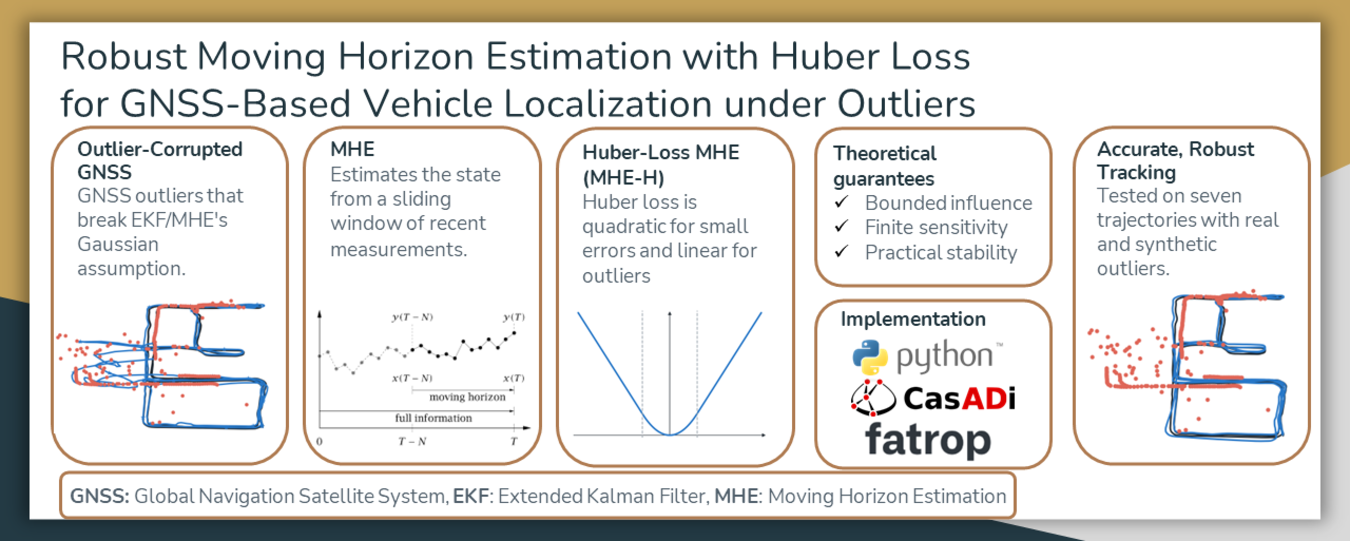
Robust Moving Horizon Estimation with Huber Loss for GNSS-Based Vehicle Localization under Outliers
Keywords:
moving horizon estimation, state-estimation, outliers, Huber-lossAbstract
This work presents a robust state estimation strategy based on the Moving Horizon Estimation (MHE) framework, incorporating the Huber loss function (MHE-H) to improve its robustness to outliers. Traditional MHE often degrades its accuracy when measurements are disturbed by large deviations. To address this limitation, the MHE-H method replaces the quadratic penalty on measurement residuals with the Huber loss function, which preserves sensitivity to small errors while limiting the impact of outliers. The robustness and stability of the resulting estimator are analyzed, and guidelines for selecting the Huber parameter are presented. The approach is validated through two case studies: a nonlinear simulation example and an experimental dataset obtained from GNSS/IMU measurements with artificially injected outliers. Results demonstrate that MHE-H significantly reduces the estimation error compared to EKF and standard MHE, while maintaining an acceptable computational cost for real-time applications, making MHE-H a promising alternative for robust estimation in uncertain and noisy environments.
Downloads
References
M. Khodarahmi and V. Maihami, “A review on kalman filter models,” Archives of Computational Methods in Engineering, vol. 30, no. 1, pp. 727–747, 2023, doi: 10.1007/s11831-022-09815-7.
M. Speekenbrink, “A tutorial on particle filters,” Journal of Mathematical Psychology, vol. 73, pp. 140–152, 2016, doi: 10.1016/j.jmp.2016.05.006.
J. B. Rawlings and D. A. Allan, “Moving horizon estimation,” in Encyclopedia of Systems and Control. Springer, 2021, pp. 1352–1358, doi: 10.1007/978-3-030-44184-5_4.
D. Simon, Optimal state estimation: Kalman, H infinity, and nonlinear approaches. John Wiley & Sons, 2006.
A. Alessandri and M. Awawdeh, “Moving-horizon estimation for discrete-time linear systems with measurements subject to outliers,” in 53rd IEEE conference on decision and control. IEEE, 2014, pp. 2591–2596, doi: 10.1109/CDC.2014.7039785.
A. Alessandri and M. Awawdeh, “Moving-horizon estimation with guaranteed robustness for discrete-time linear systems and measurements subject to outliers,” Automatica, vol. 67, pp. 85–93, 2016, doi: 10.1016/j.automatica.2016.01.015.
M. J. Awawdeh, T. Faisal, A. Bashir, A. I. N. Alshbatat, and R. T. Momani, “Moving-horizon estimation approach for nonlinear systems with measurement contaminated by outliers,” TELKOMNIKA (Telecommunication Computing Electronics and Control), vol. 22, no. 1, pp. 219–231, 2024, doi: 10.12928/telkomnika.v22i1.25230.
W. Cao, C. Liu, Z. Lan, S. E. Li, W. Pan, and A. Alessandri, “Robust bayesian inference for moving horizon estimation,” Automatica, vol. 173, p. 112108, 2025, doi: 10.1016/j.automatica.2024.112108.
N. Haverbeke, “Efficient numerical methods for moving horizon estimation,” Diss., Katholieke Universiteit Leuven, Heverlee, Belgium, 2011.
K. Geebelen, A. Wagner, S. Gros, J. Swevers, and M. Diehl, “Moving horizon estimation with a huber penalty function for robust pose estimation of tethered airplanes,” in 2013 American Control Conference. IEEE, 2013, pp. 6169–6174, doi: 10.1109/ACC.2013.6580805.
T. Sandy, L. Stadelmann, S. Kerscher, and J. Buchli, “Confusion: Sensor fusion for complex robotic systems using nonlinear optimization,” IEEE Robotics and Automation Letters, vol. 4, no. 2, pp. 1093–1100, 2019, doi: 10.1109/LRA.2019.2894168.
J. Dichgans, J. Kallwies, and H.-J. Wuensche, “Robust vehicle tracking with monocular vision using convolutional neuronal networks,” in 2020 IEEE International Conference on Multisensor Fusion and Integration for Intelligent Systems (MFI). IEEE, 2020, pp. 297–302, doi: 10.1109/MFI49285.2020.9235213.
Y. Guo, P. Ji, Y. Zheng, X. Sun, and F. Ma, “Rmhe-enhanced mpc for eye-in-hand visual servoing under measurement outliers and dynamic disturbances,” in Journal of Physics: Conference Series, vol. 3176, no. 1. IOP Publishing, 2026, p. 012018, doi: 10.1088/1742-6596/3176/1/012018.
N. Deniz, M. Murillo, G. Sanchez, and L. Giovanini, “Robust stability of moving horizon estimation for non-linear systems with bounded disturbances using adaptive arrival cost,” IET Control Theory & Applications, vol. 14, no. 18, pp. 2879–2888, 2020, doi: 10.1049/iet-cta.2019.0523.
J. D. Schiller, S. Muntwiler, J. Köhler, M. N. Zeilinger, and M. A. Müller, “A lyapunov function for robust stability of moving horizon estimation,” IEEE Transactions on Automatic Control, vol. 68, no. 12, pp. 7466–7481, 2023, doi: 10.1109/TAC.2023.3280344.
I. Krauss, V. G. Lopez, and M. A. Müller, “Sample-based moving horizon estimation,” in 2026 European Control Conference (ECC). IEEE, 2026, pp. 870–875, doi: 10.48550/arXiv.2510.24191.
P. J. Huber, “Robust estimation of a location parameter,” in Breakthroughs in statistics: Methodology and distribution. Springer, 1992, pp. 492–518, doi: 10.1007/978-1-4612-4380-9_35.
Q. Wang, Y. Ma, K. Zhao, and Y. Tian, “A comprehensive survey of loss functions in machine learning,” Annals of Data Science, pp. 1–26, 2020, doi: 10.1007/s40745-020-00253-5.
W. Hu, “Generic stability implication from full information estimation to moving-horizon estimation,” IEEE Transactions on Automatic Control, vol. 69, no. 2, pp. 1164–1170, 2023, doi: 10.1109/TAC.2023.3277315.
F. R. Hampel, “The influence curve and its role in robust estimation,” Journal of the American Statistical Association, vol. 69, no. 346, pp. 383–393, 1974, doi: 10.1080/01621459.1974.10482962.
C. V. Rao, J. B. Rawlings, and D. Q. Mayne, “Constrained state estimation for nonlinear discrete-time systems: Stability and moving horizon approximations,” IEEE Transactions on Automatic Control, vol. 48, no. 2, pp. 246–258, 2003, doi: 10.1109/TAC.2002.808470.
C. V. Rao, J. B. Rawlings, and J. H. Lee, “Constrained linear state estimation—a moving horizon approach,” Automatica, vol. 37, no. 10, pp. 1619–1628, 2001, doi: 10.1016/S0005-1098(01)00115-7.
D. A. Allan and J. B. Rawlings, “Robust stability of full information estimation,” SIAM Journal on Control and Optimization, vol. 59, no. 5, pp. 3472–3497, 2021, doi: 10.1137/20M1329135.
H. Tang, T. Zhang, L. Wang, X. Ding, M. Yuan, Z. Xiang, J. Chen, Y. Bian, S. Liu, Y. Wang et al., “i2nav-robot: A largescale indoor-outdoor robot dataset for multi-sensor fusion navigation and mapping,” arXiv preprint arXiv:2508.11485, 2025, doi: 10.48550/arXiv.2508.11485.
X. Zhou, M. Zhang, J. Hu, L. Li, and X. Guan, “A robust in-motion coarse alignment method for low-accuracy sins and gps integrated system,” IEEE/ASME Transactions on Mechatronics, vol. 30, no. 1, pp. 611–622, 2024, doi: 10.1109/TMECH.2024.3397244.
N. N. Deniz, G. M. Sanchez, F. A. A. Cheein, and L. L. Giovanini, “Robust moving horizon estimation for autonomous agricultural vehicles with gnss outliers using a robust loss function,” IEEE Robotics and Automation Letters, 2025, doi: 10.1109/LRA.2025.3606377.
U. S. D. M. Agency, Department of Defense World Geodetic System 1984: its definition and relationships with local geodetic systems. Defense Mapping Agency, 1987, vol. 8350.
M. Zhi, C. Deng, H. Zhang, H. Tang, J. Wu, and B. Li, “Rngcviwo: Robust neural gyroscope calibration aided visual-inertial-wheel odometry for autonomous vehicle,” Remote Sensing, vol. 15, no. 17, p. 4292, 2023, doi: 10.3390/rs15174292.
J. A. Andersson, J. Gillis, G. Horn, J. B. Rawlings, and M. Diehl, “Casadi: a software framework for nonlinear optimization and optimal control,” Mathematical Programming Computation, vol. 11, pp. 1–36, 2019, doi: 10.1007/s12532-018-0139-4.
L. Vanroye, A. Sathya, J. De Schutter, and W. Decré, “Fatrop: A fast constrained optimal control problem solver for robot trajectory optimization and control,” in 2023 IEEE/RSJ International Conference on Intelligent Robots and Systems (IROS). IEEE, 2023, pp. 10 036–10 043, doi: 10.1109/IROS55552.2023.10342336.
B. Wang, Z. Ma, S. Lai, and L. Zhao, “Neural moving horizon estimation for robust flight control,” IEEE Transactions on Robotics, vol. 40, pp. 639–659, 2023, doi: 10.1109/TRO.2023.3331064.
B. Wang, X. Chen, and L. Zhao, “Trust-region neural moving horizon estimation for robots,” in 2024 IEEE International Conference on Robotics and Automation (ICRA). IEEE, 2024, pp. 2059–2065, doi: 10.1109/ICRA57147.2024.10611703.