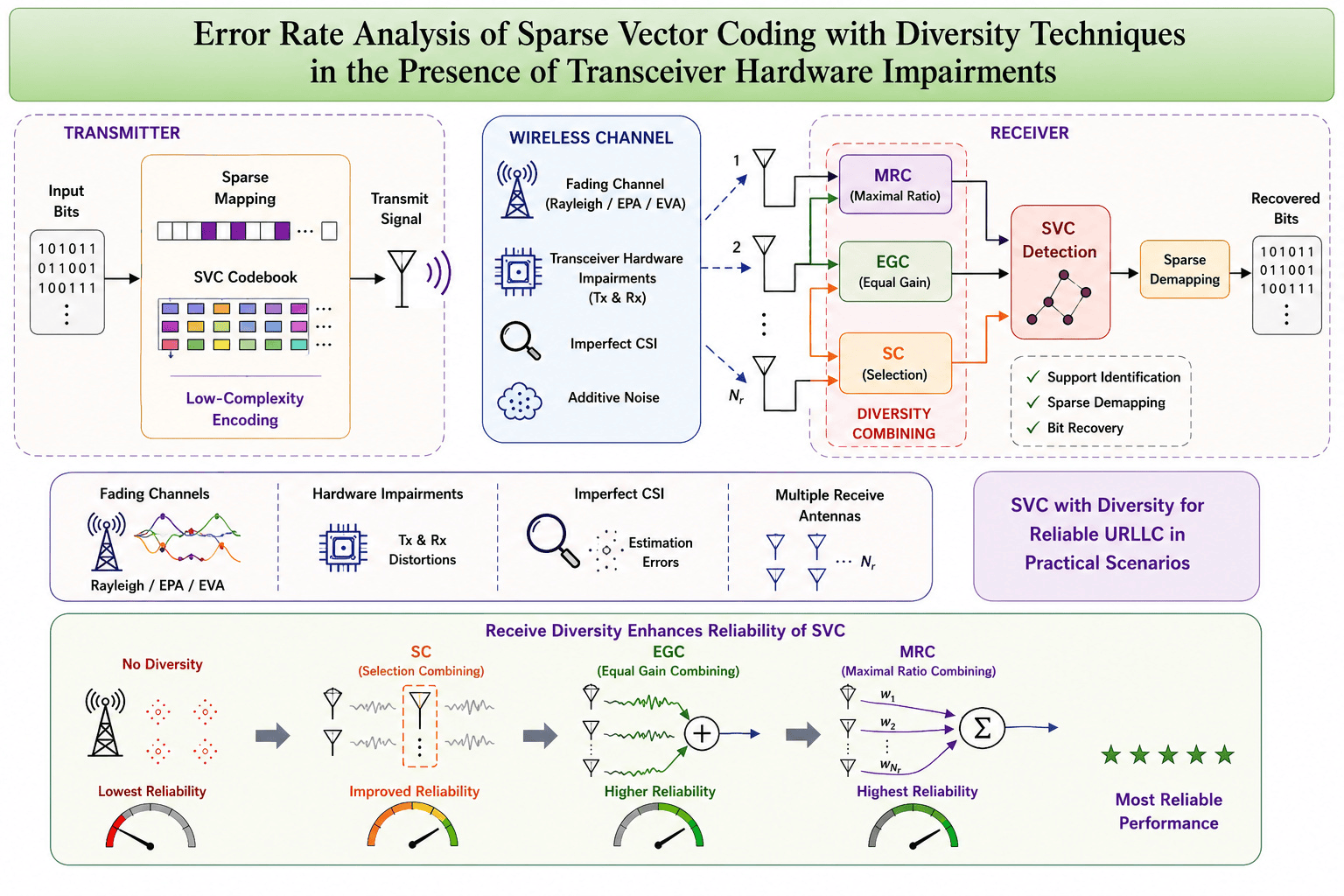
Error Rate Analysis of Sparse Vector Coding with Diversity Techniques in the Presence of Transceiver Hardware Impairments
Keywords:
ultra-reliability, sparse vector coding, diversity schemes, multipath matching pursuit, block error rateAbstract
Ultra-reliable and low-latency communication (URLLC) is essential for mission-critical applications in 6G, necessitating stringent reliability and latency requirements. Sparse vector coding (SVC) seems to be a suitable candidate for ultra-reliable short-packet communications in future wireless systems. In this paper, we propose an integration of SVC with receiver diversity schemes, namely maximal ratio combining (MRC), equal gain combining (EGC), and selection combining (SC), in the presence of non-ideal transceiver hardware impairments. The key idea is to weight the received signal with weighting coefficients such that the reliability of the SVC transmission is further enhanced. The packet error rate (PER) is assessed and compared with that of the conventional SVC scheme without diversity under the Extended Pedestrian A (EPA) and Extended Vehicular A (EVA) standard channel models. The findings demonstrate that all diversity schemes substantially outperform the conventional method, with MRC providing the highest performance due to its optimal combining strategy. Hardware impairments (HWI) are incorporated using a signal-dependent distortion model at both the transmitter and receiver. Results suggest that the improved reliability of the proposed system model and adverse HWI effects can be traded off against the number of receiving antennas.
Downloads
References
C. A. Gutierrez, O. Caicedo, and D. U. Campos-Delgado, “5g and
beyond: Past, present and future of the mobile communications,”
IEEE Lat. Am. Trans., vol. 19, no. 10, pp. 1702–1736, 2021,
doi:10.1109/TLA.2021.9477273.
M. U. A. Siddiqui, H. Abumarshoud, L. Bariah, S. Muhaidat, M. A.
Imran, and L. Mohjazi, “Urllc in beyond 5g and 6g networks: An
interference management perspective,” IEEE Access, vol. 11, pp. 54639
, 2023, doi:10.1109/ACCESS.2023.3282363.
P. Boopathy, N. Deepa, P. K. R. Maddikunta, N. Victor, T. R. Gadekallu,
G. Yenduri, W. Wang, Q.-V. Pham, T. Huynh-The, and M. Liyanage,
“The metaverse for industry 5.0 in nextg communications: Potential
applications and future challenges,” IEEE open j. Comput. Soc., vol. 6,
pp. 4–24, 2025, doi:10.1109/OJCS.2024.3497335.
L. Fanari, E. Iradier, I. Bilbao, R. Cabrera, J. Montalban, and
P. Angueira, “Comparison between different channel coding techniques
for ieee 802.11be within factory automation scenarios,” Sensors, vol. 21,
no. 21, 2021, doi: https://doi.org/10.3390/s21217209.
H. Ji, S. Park, and B. Shim, “Sparse vector coding for ultra reliable and
low latency communications,” IEEE Trans. Wirel. Commun., vol. 17,
no. 10, pp. 6693–6706, 2018, doi:10.1109/TWC.2018.2863286.
H. Ji, W. Kim, and B. Shim, “Pilot-less sparse vector coding for short
packet transmission,” IEEE Wirel. Commun. Lett, vol. 8, no. 4, pp. 1036
, 2019, doi:10.1109/LWC.2019.2904685.
W. Kim, S. K. Bandari, and B. Shim, “Enhanced sparse vec
tor coding for ultra-reliable and low latency communications,”
IEEE Trans. Veh. Technol., vol. 69, no. 5, pp. 5698–5702, 2020,
doi:10.1109/TVT.2020.2982943.
X. Zhang, D. Zhang, B. Shim, G. Han, D. Zhang, and T. Sato, “Sparse
superimposed coding for short-packet urllc,” IEEE Internet Things J,
vol. 9, no. 7, pp. 5275–5289, 2022, doi:10.1109/JIOT.2021.3108161.
L. Yang and P. Fan, “Multiple-mode sparse superposed code with low
block error rate for short packet urllc,” IEEE Commun. Lett., vol. 28,
no. 2, pp. 248–252, 2024, doi:10.1109/LCOMM.2023.3348570.
Y. Yang, C. Chen, and P. Zhu, “Enhanced codebook of sparse
vector coding based on mean-variance trade-off model for urllc,”
IEEE Commun. Lett., vol. 29, no. 6, pp. 1310–1314, 2025,
doi:10.1109/LCOMM.2025.3559985.
E. Arslan, A. T. Dogukan, and E. Basar, “Sparse-encoded codebook
index modulation,” IEEE Trans. Veh. Technol., vol. 69, no. 8, pp. 9126
, 2020, doi:10.1109/TVT.2020.2996023.
R. Zhang, B. Shim, Y. Lou, S. Jia, and W. Wu, “Sparse vector
coding aided ultra-reliable and low-latency communications in multi
user massive mimo systems,” IEEE Trans. Veh. Technol., vol. 70, no. 1,
pp. 1019–1024, 2021, doi:10.1109/TVT.2020.3044190.
H. Ji, Y. Kim, T. Kim, and J. Oh, “Compressed otfs transmission
over millimeter-wave and terahertz spectrum,” in IEEE International
Conference on Communications Workshops (ICC Workshops), 2021, pp.
–6, doi:10.1109/ICCWorkshops50388.2021.9473720.
R. Zhang, B. Shim, W. Yuan, M. D. Renzo, X. Dang, and W. Wu, “Inte
grated sensing and communication waveform design with sparse vector
coding: Low sidelobes and ultra reliability,” IEEE Trans. Veh. Technol.,
vol. 71, no. 4, pp. 4489–4494, 2022, doi:10.1109/TVT.2022.3146280.
I. Bilbao, L. Fanari, E. Iradier, P. Angueira, and J. Montalban, “Sparse
vector coding for short-packet transmission on industrial communica
tions: Reference architecture and design challenges,” IEEE Open J. Ind.
Electron. Soc., vol. 4, pp. 1–13, 2023, doi:10.1109/OJIES.2022.3230142.
S. Sabapathy, S. Maruthu, and D. N. K. Jayakody, “Rate
splitting sparse vector code for next-generation urllc systems,”
IEEE Wirel. Commun. Lett., vol. 13, no. 7, pp. 1993–1997, 2024,
doi:10.1109/LWC.2024.3400452.
D. Kumari, M. Chaudhary, and S. K. Bandari, “Intelligent reflect
ing surface assisted sparse vector coding based short packet com
munication for 6g wireless networks,” AEU- International Jour
nal of Electronics and Communications, vol. 194, p. 155751, 2025,
doi:https://doi.org/10.1016/j.aeue.2025.155751.
A. Awasthi, M. Kumar, S. K. Bandari, and V. Mani, “Maximal ratio
sparse vector coding for short packet transmission,” in IEEE Inter
national Conference on Advanced Networks and Telecommunications
Systems (ANTS). IEEE, 2021, pp. 1–4.
D. Kumari, M. Chaudhary, R. Doley, and S. K. Bandari, “Improved relia
bility of enhanced sparse vector coding using maximal ratio transmission
for short packet transmission,” in IEEE International Conference on
Advanced Networks and Telecommunications Systems (ANTS). IEEE,
, pp. 1–5.
T. Schenk, RF Imperfections in High-rate Wireless Systems: Impact
and Digital Compensation, 1st ed. Springer Publishing Company, Incorporated, 2008.
A. Bouhlel, M. M. Alsmadi, E. Saleh, S. Ikki, and A. Sakly, “Perfor
mance analysis of ris-ssk in the presence of hardware impairments,”
in IEEE 32nd Annual International Symposium on Personal, Indoor
and Mobile Radio Communications (PIMRC), 2021, pp. 537–542,
doi:10.1109/PIMRC50174.2021.9569436.
A. E. Canbilen, E. Basar, and S. S. Ikki, “On the performance
of ris-assisted space shift keying: Ideal and non-ideal transceivers,”
IEEE Trans. Commun., vol. 70, no.