Machine Learning-Based Wi-Fi RSS Fingerprinting for Indoor Zone Classification of Biomedical Assets in Hospitals
Keywords:
Wi-Fi RSS fingerprinting, indoor zone classification, biomedical asset tracking, healthcare facilities, machine learningAbstract
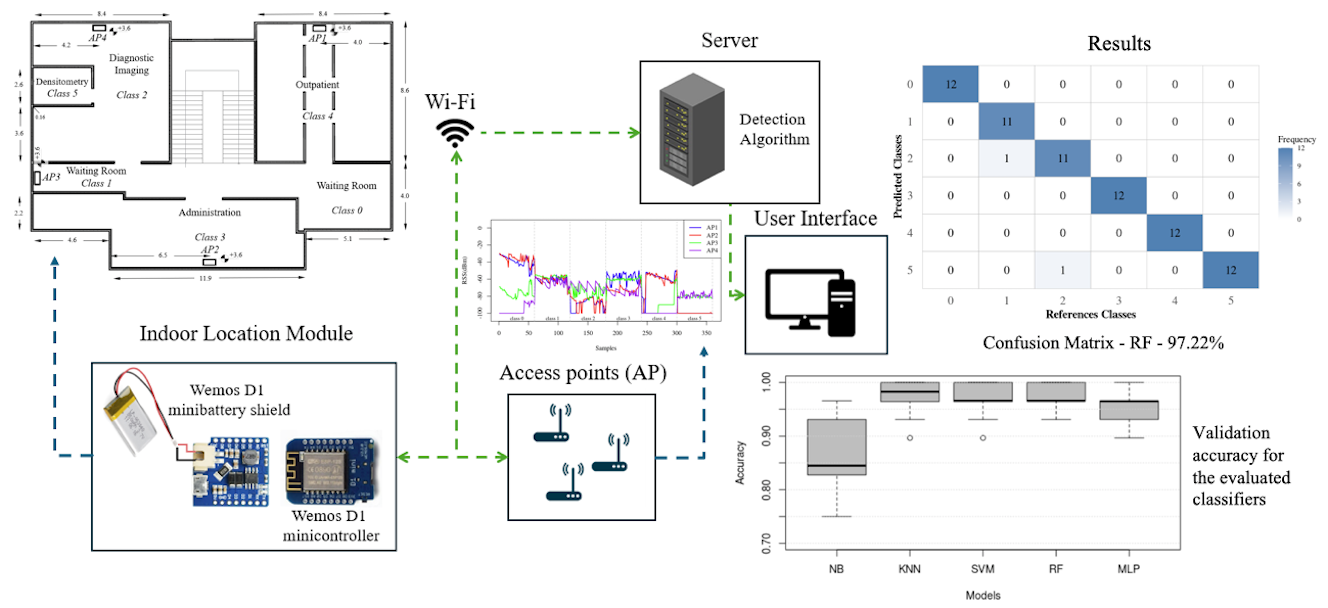
The frequent relocation of biomedical equipment in healthcare facilities delays maintenance and reduces operational efficiency. While dedicated positioning infrastructure can mitigate these delays, its deployment often incurs high financial costs. This work proposes an indoor zone classification system that leverages existing Wi-Fi received signal strength (RSS) fingerprints and machine learning. The methodology evaluates five supervised classifiers (Naive Bayes, K-Nearest Neighbors, Support Vector Machine, Random Forest, and Multilayer Perceptron) using an empirical dataset of 360 observations. These RSS measurements were collected by an ESP8266-based sensing module across six functional zones covered by four access points. Under a 5-fold stratified cross-validation protocol, the Random Forest model achieved a mean validation accuracy of 97.57%. These results demonstrate that existing Wi-Fi infrastructure combined with low-cost edge sensing provides a viable solution for biomedical asset tracking in hospitals.
Downloads
References
M. A. C. Alvarado and J. C. S. Delgado, “Sistemas y tecnolog´ıas que facilitan el posicionamiento indoor,” Pensamiento Actual, vol. 17, no. 29, pp. 132–144, 2017.
N. Singh, S. Choe, and R. Punmiya, “Machine learning based indoor localization using Wi-Fi RSSI fingerprints: An overview,” IEEE Access, vol. 9, pp. 127 150–127 174, 2021.
H. Attar, W. S. Ismail, M. Hafez, S. Bahaa, M. A. Deif, M. Khosravi, and H. Youssry, “Machine learning in indoor localization prediction using received signal strength indicator and wi-fi network,” International Journal of Intelligent Networks, vol. 6, pp. 233–243, 2025.
B. Ezhumalai, M. Song, and K. Park, “An efficient indoor positioning method based on Wi-Fi RSS fingerprint and classification algorithm,”Sensors, vol. 21, no. 10, p. 3418, 2021.
L. Polak, S. Rozum, M. Slanina, T. Bravenec, T. Fryza, and A. Pikrakis, “Received signal strength fingerprinting-based indoor location estimation employing machine learning,” Sensors, vol. 21, no. 13, 2021.
M. F. S. van der Ham, S. Zlatanova, E. Verbree, and R. Voˆute, “Real time localization of assets in hospitals using Quuppa indoor positioning technology,” Remote Sensing and Spatial Information Sciences, vol. IV-4/W1, pp. 105–106, 2016.
J. Wichmann, “Indoor positioning systems in hospitals: A scoping review,” Digital Health, vol. 8, 2022.
D. Zhang, L. T. Yang, M. Chen, S. Zhao, M. Guo, and Y. Zhang, “Real-time locating systems using active RFID for internet of things,” IEEE Systems Journal, vol. 10, no. 3, pp. 1226–1235, 2016.
A. Kapoor, M. Enayati, A. Chaudhry, N. Z. Farahani, S. P. Arunachalam, D. Nestler, and K. Pasupathy, “Estimating physical workload on ed clinicians and staff using real-time location systems,” IEEE Journal of Radio Frequency Identification, vol. 5, no. 3, pp. 331–334, 2021.
J. Maneesilp, C. Wang, H. Wu, and N.-F. Tzeng, “RFID support for accurate 3D localization,” IEEE Transactions on Computers, vol. 62, no. 7, pp. 1447–1459, 2013.
Y. ´Alvarez L´opez, J. Franssen, G. ´Alvarez Narciandi, J. Pagnozzi, I. G.-P. Arrillaga, and F. L.-H. Andr´es, “RFID technology for management and tracking: e-health applications,” Sensors, vol. 18, no. 8, p. 2663, 2018.
A.-M.-S. Chong, B.-C. Yeo, and W.-S. Lim, “Integration of uwb rss to Wi-Fi RSS fingerprinting-based indoor positioning system,” Cogent Engineering, vol. 9, no. 1, 2022.
M. W. P. Maduranga, V. Tilwari, and R. Abeysekera, “Improved rssi indoor localization in iot systems with machine learning algorithms,”Signals, vol. 4, no. 4, pp. 651–668, 2023.
G. Li, E. Geng, Z. Ye, Y. Xu, J. Lin, and Y. Pang, “Indoor positioning algorithm based on the improved RSSI distance model,” Sensors, vol. 18, no. 9, 2018.
C. Du, B. Peng, Z. Zhang, W. Xue, and M. Guan, “KF-KNN: Low-cost and high-accurate fm-based indoor localization model via fingerprint technology,” IEEE Access, vol. 8, pp. 197 523–197 531, 2020.
S.-H. Lee, C.-H. Cheng, T.-H. Huang, and Y.-F. Huang, “Machine learning-based indoor positioning systems using multi-channel information,” Journal of Engineering and Technological Sciences, vol. 55, no. 4, pp. 373–383, 2023.
Y. Cheng, K. Zhang, B. Zheng, K. Long, Y. Zhou, M. Jin, and J. He, “Indoor wifi fingerprint localization based on dual population pso of stacked autoencoder and multi label classification,” Scientific Reports, vol. 15, no. 32941, 2025.
Z. Tang, S. Li, K. S. Kim, and J. S. Smith, “Multi-dimensional wi-fi received signal strength indicator data augmentation based on multioutput gaussian process for large-scale indoor localization,” Sensors, vol. 24, no. 1026, 2024.
J. Yoo, “Wi-fi fingerprint indoor localization by semi-supervised generative adversarial network,” Sensors, vol. 24, no. 5698, 2024.
M. Nasir, K. Esguerra, I. Faye, T. B. Tang, M. Yahya, A. Tumian, and E. T. W. Ho, “Hytra: Hyperclass transformer for wifi fingerprinting-based indoor localization,” Transactions on Energy Systems and Engineering Applications, vol. 5, no. 1, p. 1–24, 2024. [Online]. Available: https://revistas.utb.edu.co/tesea/article/view/542
S. C. Narasimman and A. Alphones, “Dumbloc: Dumb indoor localization framework using wi-fi fingerprinting,” IEEE Sensors Journal, vol. 24, no. 9, pp. 14 623–14 630, 2024.
J. Bi, Y. Wang, B. Yu, H. Cao, C. Liu, and Z. Yuan, “Supplementary open dataset for WiFi indoor localization based on received signal strength,” Satellite Navigation, vol. 3, no. 1, p. 25, 2022. [Online]. Available: https://doi.org/10.1186/s43020-022-00086-y
T. Alhmiedat, “Fingerprint-based localization approach for wsn using machine learning models,” Applied Sciences, vol. 13, no. 5, 2023. [Online]. Available: https://www.mdpi.com/2076-3417/13/5/3037
Y. Wang, C. Xiu, X. Zhang, and D. Yang, “WiFi Indoor Localization with CSI Fingerprinting-Based Random Forest,” Sensors, vol. 18, no. 9, p. 2869, 2018.
S. Amirisoori, S. Mohd Daud, N. A. Ahmad, N. S. N. Abd Aziz, N. I. Mohd Sa’at, and N. Q. Mohd Noor, “WI-FI Based Indoor Positioning Using Fingerprinting Methods (KNN Algorithm) in Real Environment,” International Journal of Future Generation Communication and Networking, vol. 10, no. 9, pp. 23–36, 2017.