A SAT-Based Exact Approach for the Minimum Order Frequency Assignment Problem
Keywords:
Frequency Assignment Problem, MO-FAP, SAT Encoding, Incremental SAT SolvingAbstract
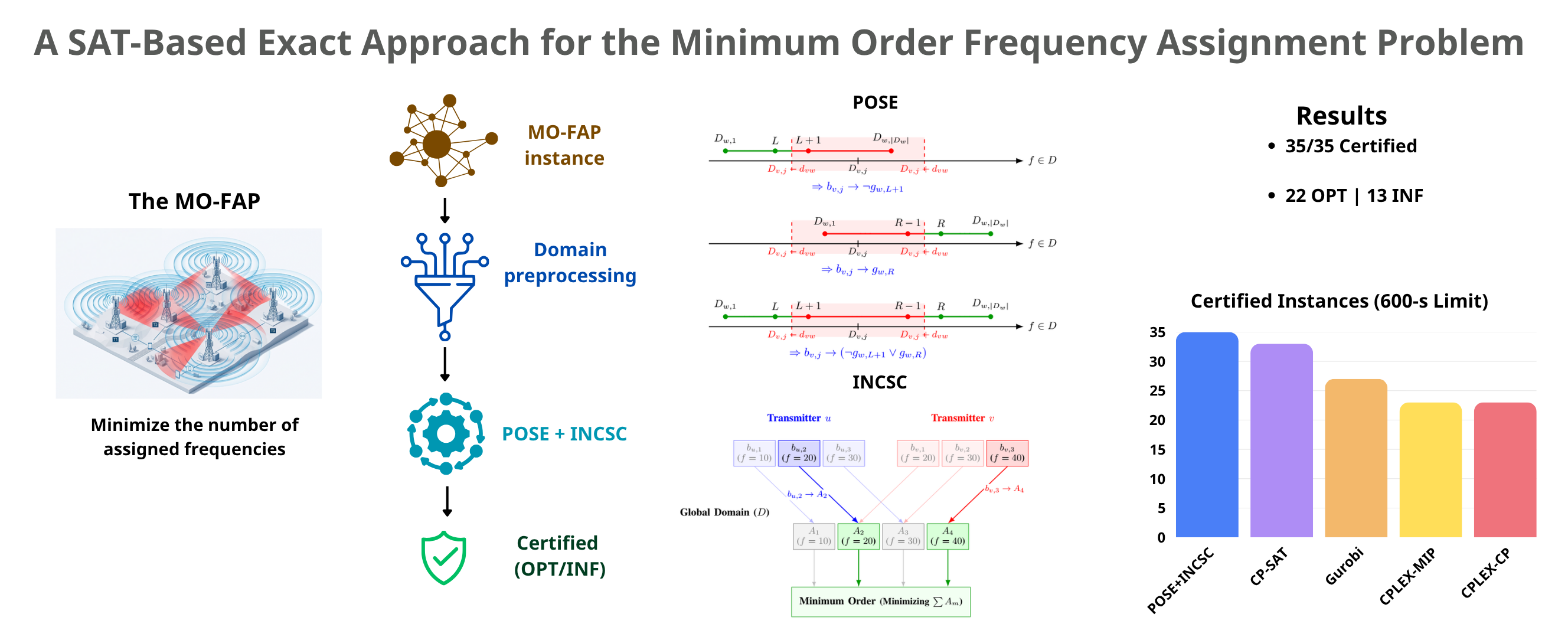
The Minimum Order Frequency Assignment Problem (MO-FAP) is a fundamental NP-hard problem in spectrum management, where the objective is to minimize the number of assigned frequencies while satisfying interference constraints between transmitters. Current metaheuristic methods typically do not provide optimality certificates, while traditional exact methods can struggle on heavily constrained instances. This study proposes an exact framework based on Boolean Satisfiability (SAT) for solving MO-FAP. The key idea is to use standard order variables to reformulate pairwise interference constraints as interval-boundary constraints in a proposed encoding called POSE, thereby reducing the number of explicit conflict clauses relative to a direct SAT encoding. In addition, the framework includes an incremental SAT solving strategy (INCSC) based on Sequential Counter encoding, where the clause construction is designed to support incremental solving and clause reuse across iterations without rebuilding the formula. Experiments on 35 CALMA and DUTtest benchmark instances from the FAP database show that the proposed approach certifies optimality or infeasibility for every tested instance within a 600-second time limit. On the tested benchmark set, it certifies more instances than the considered exact baselines and reduces solving time on several instances where the baselines reach the time limit. These results show that the proposed SAT-based framework provides exact certification with competitive runtime on the tested MO-FAP benchmark instances.
Downloads
References
R. A. Murphey, P. M. Pardalos, and M. G. C. Resende, Frequency assignment problems. Boston, MA: Springer US, 1999, pp. 295-377, doi: 10.1007/978-1-4757-3023-4_6.
K. I. Aardal, S. P. M. van Hoesel, A. M. C. A. Koster, C. Mannino, and A. Sassano, "Models and solution techniques for frequency assignment problems," Annals of Operations Research, vol. 153, no. 1, pp. 79-129, 2007, doi: 10.1007/s10479-007-0178-0.
A. Mahmoudi, Y. Mahmoudi, K. Benatchba, A. Rezgui, and N. Zioui, "Towards optimal frequency plans: A survey of frequency assignment strategies, models, and methods," ENP Engineering Science Journal, vol. 3, pp. 41-54, Dec. 2023, doi: 10.53907/enpesj.v3i2.249.
S. Mondal, M. P. Dutta, and S. K. Chakraborty, "Dynamic spectrum management and spectrum sharing techniques in 5G networks: A survey," Journal of Mobile Multimedia, vol. 20, no. 5, pp. 997-1038, 2024, doi: 10.13052/jmm1550-4646.2052.
D. Cuellar, M. Sallal, and C. Williams, "BSM-6G: Blockchain-based dynamic spectrum management for 6G networks: Addressing interoperability and scalability," IEEE Access, vol. 12, pp. 59643-59664, 2024, doi: 10.1109/ACCESS.2024.3393288.
N. Alhussien and T. A. Gulliver, "Toward AI-enabled green 6G networks: A resource management perspective," IEEE Access, vol. 12, pp. 132972-132995, Sep. 2024, doi: 10.1109/ACCESS.2024.3460656.
P. Gomez-Meneses and H. Ayala, "Extremal optimization applied to the minimum order frequency assignment problem," IEEE Latin America Transactions, vol. 21, pp. 466-474, Mar. 2023, doi: 10.1109/TLA.2023.10068851.
S. Ceschia, L. Di Gaspero, R. M. Rosati, and A. Schaerf, "Multi-neighborhood simulated annealing for the minimum interference frequency assignment problem," EURO Journal on Computational Optimization, vol. 10, p. 100024, 2022, doi: 10.1016/j.ejco.2021.100024.
K.-H. Lee, H.-W. Lee, and B. C. Jung, "Minimum span frequency allocation problem: A vector bin packing approach," AIMS Mathematics, vol. 10, pp. 13278-13295, Jan. 2025, doi: 10.3934/math.2025595.
M. Dib, A. Caminada, and H. Mabed, "A fast algorithm to solve the frequency assignment problem," in Integration of AI and OR Techniques in Constraint Programming for Combinatorial Optimization Problems, ser. Lecture Notes in Computer Science, vol. 5547. Springer, May 2009, pp. 316-318, doi: 10.1007/978-3-642-01929-6_26.
K. Alrajhi and W. Padungwech, "A dynamic tabu search approach for solving the static frequency assignment problem," in Advances in Computational Intelligence Systems, ser. Advances in Intelligent Systems and Computing, vol. 513. Springer, Jan. 2017, pp. 59-70, doi: 10.1007/978-3-319-46562-3_5.
K. Alrajhi, J. Thompson, and W. Padungwech, "Tabu search hybridized with multiple neighborhood structures for the frequency assignment problem," in Hybrid Metaheuristics, ser. Lecture Notes in Computer Science, vol. 9668. Springer, Jun. 2016, pp. 157-170, doi: 10.1007/978-3-319-39636-1_12.
K. Alrajhi, "Ant metaheuristic algorithm for the frequency assignment problem," International Journal of Computational and Applied Mathematics & Computer Science, vol. 3, pp. 98-103, Nov. 2023, doi: 10.37394/232028.2023.3.11.
K. Alrajhi, "A dynamic ant colony optimization for solving the static frequency assignment problem," International Journal of Applied Sciences & Development, vol. 2, pp. 169-176, 2023, doi: 10.37394/232029.2023.2.18.
K. Alrajhi, "A dynamic hyper heuristic approach for solving the static frequency assignment problem," in Advances in Computational Intelligence Systems, ser. Advances in Intelligent Systems and Computing (AISC), vol. 1453. Springer Nature Switzerland, 2024, pp. 336-347, doi: 10.1007/978-3-031-47508-5_27.
K. Alrajhi, "Dynamic multiple neighborhood structures for the static frequency assignment problem," International Journal of Applied Mathematics, Computational Science and Systems Engineering, vol. 5, pp. 185-193, Nov. 2023, doi: 10.37394/232026.2023.5.17.
C. Sinz, "Towards an optimal CNF encoding of boolean cardinality constraints," in Principles and Practice of Constraint Programming - CP 2005, P. van Beek, Ed. Berlin, Heidelberg: Springer Berlin Heidelberg, 2005, pp. 827-831, doi: 10.1007/11564751_73.
I. Baybars, "Optimal assignment of broadcasting frequencies," European Journal of Operational Research, vol. 9, no. 3, pp. 257-263, 1982, doi: 10.1016/0377-2217(82)90033-9.
B. Jansen, K. Aardal, C. P. M. van Hoesel, and A. Hipolito, "A branch-and-cut algorithm for the frequency assignment problem," METEOR, Maastricht University School of Business and Economics, Tech. Rep. 011, Jan. 1996, doi: 10.26481/umamet.1996011.
M. Fischetti, C. Lepschy, G. Minerva, G. Romanin-Jacur, and E. Toto, "Frequency assignment in mobile radio systems using branch-and-cut techniques," European Journal of Operational Research, vol. 123, no. 2, pp. 241-255, 2000, doi: 10.1016/S0377-2217(99)00254-4.
A. M. C. A. Koster, S. P. M. van Hoesel, and A. W. J. Kolen, "The partial constraint satisfaction problem: Facets and lifting theorems," Operations Research Letters, vol. 23, no. 3-5, pp. 89-97, 1998, doi: 10.1016/S0167-6377(98)00043-1.
C. Mannino and A. Sassano, "An enumerative algorithm for the frequency assignment problem," Discrete Applied Mathematics, vol. 129, no. 1, pp. 155-169, 2003, doi: 10.1016/S0166-218X(02)00239-1.
D. Král', "An exact algorithm for the channel assignment problem," Discrete Applied Mathematics, vol. 145, no. 2, pp. 326-331, 2005, doi: 10.1016/j.dam.2004.01.020.
G. S. Uyanik, M. J. Abdel-Rahman, and M. Krunz, "Optimal channel assignment with aggregation in multi-channel systems: A resilient approach to adjacent-channel interference," Ad Hoc Networks, vol. 20, pp. 64-76, 2014, doi: 10.1016/j.adhoc.2014.03.007.
J. K. Fichte, D. L. Berre, M. Hecher, and S. Szeider, "The silent (r) evolution of SAT," Communications of the ACM, vol. 66, no. 6, pp. 64-72, 2023, doi: 10.1145/3560469.
G. Glorian, J.-M. Lagniez, V. Montmirail, and N. Szczepanski, "An incremental SAT-based approach to the graph colouring problem," in International Conference on Principles and Practice of Constraint Programming. Springer, 2019, pp. 213-231, doi: 10.1007/978-3-030-30048-7_13.
D. Faber, A. Jabrayilov, and P. Mutzel, "SAT encoding of partial ordering models for graph coloring problems," in 27th International Conference on Theory and Applications of Satisfiability Testing (SAT 2024). Schloss Dagstuhl-Leibniz-Zentrum für Informatik, 2024, pp. 12:1-12:20, doi: 10.4230/LIPIcs.SAT.2024.12.
A. Ignatiev, A. Morgado, and J. Marques-Silva, "PySAT: A Python toolkit for prototyping with SAT oracles," in SAT, 2018, pp. 428-437, doi: 10.1007/978-3-319-94144-8_26.
A. Ignatiev, Z. L. Tan, and C. Karamanos, "Towards universally accessible SAT technology," in SAT, 2024, pp. 16:1-16:11, doi: 10.4230/LIPIcs.SAT.2024.16.
J. M. Crawford and A. B. Baker, "Experimental results on the application of satisfiability algorithms to scheduling problems," in Proceedings of the Twelfth AAAI National Conference on Artificial Intelligence, ser. AAAI'94. AAAI Press, 1994, pp. 1092-1097. [Online]. Available: https://dl.acm.org/doi/10.5555/2891730.2891899
N. Tamura, A. Taga, S. Kitagawa, and M. Banbara, "Compiling finite linear CSP into SAT," Constraints, vol. 14, no. 2, pp. 254-272, 2009, doi: 10.1007/s10601-008-9061-0.
J. Petke and P. Jeavons, "The order encoding: From tractable CSP to tractable SAT," in Theory and Applications of Satisfiability Testing - SAT 2011, vol. 6695, Jun. 2011, pp. 371-372, doi: 10.1007/978-3-642-21581-0_34.
I. Abío and P. J. Stuckey, "Encoding linear constraints into SAT," in Principles and Practice of Constraint Programming, B. O'Sullivan, Ed. Cham: Springer International Publishing, 2014, pp. 75-91, doi: 10.1007/978-3-319-10428-7_9.
R. Martins, S. Joshi, V. Manquinho, and I. Lynce, "Incremental cardinality constraints for MaxSAT," in Principles and Practice of Constraint Programming, B. O'Sullivan, Ed. Cham: Springer International Publishing, 2014, pp. 531-548, doi: 10.1007/978-3-319-10428-7_39.
O. Bailleux and Y. Boufkhad, "Efficient CNF encoding of boolean cardinality constraints," in Principles and Practice of Constraint Programming - CP 2003, vol. 2833, Sep. 2003, pp. 108-122, doi: 10.1007/978-3-540-45193-8_8.