Predicting Travel Intention Using Machine Learning and SHAP-Based Explainability: A Virtual Tourism Approach
Keywords:
Travel Intention Prediction, Tourist eXperience, Virtual Reality in Tourism, XGBoost and Neural Networks, Explainable Artificial Intelligence, Machine Learning in TourismAbstract
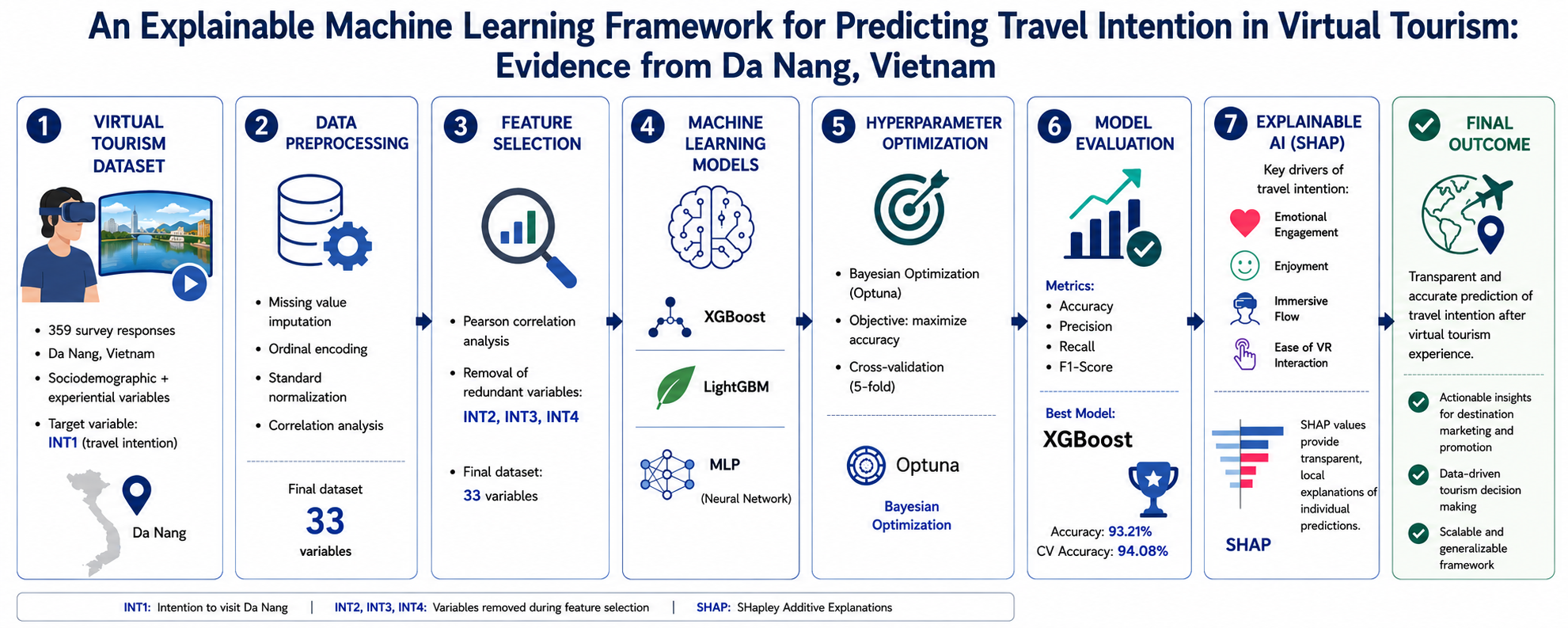
Virtual tourism is transforming the way users explore and evaluate travel destinations, yet accurately predicting the intention to visit after engaging in virtual experiences remains a challenge. Existing approaches often lack predictive accuracy and interpretability, limiting their application in tourism decision making. To address this, we develop a machine learning framework that integrates explainable artificial intelligence (XAI) to predict the intention to travel after experience with high accuracy and transparency. We implement eXtreme Gradient Boosting (XGBoost), Light Gradient Boosting Machine (LightGBM), and Multilayer Perceptron (MLP), applying cross-validation for robustness and Optuna-based Bayesian optimization to maximize model performance. To ensure interpretability, we employ SHapley Additive Explanations (SHAP). Our results show that XGBoost outperforms all models, achieving an accuracy of 93.21% and a cross-validation accuracy of 94.08%, validating its
robustness. SHAP analysis reveals that psychological engagement, such as emotional involvement, enjoyment, and immersive flow states, are key drivers of travel intention, with individual SHAP values further elucidating user-specific decision patterns. These findings align with consumer behavior theories, reinforcing the role of psychological and experiential factors in travel decisions. Our study presents a highly accurate, interpretable, and scalable predictive model that advances virtual tourism analytics, providing actionable insights for destination marketing and strategic tourism management. Future research should explore real-time user interactions, adaptive learning techniques, and external variables (social sentiment, economic conditions) to improve predictive accuracy and practical applicability.
Downloads
References
Pencarelli, T., "The digital revolution in the travel and tourism indus-
try," Information technology & tourism, 22(3), 455-476, 2020, DOI:
1007/s40558-019-00160-3.
Fan, X., Jiang, X., & Deng, N., "Immersive technology: A meta-
analysis of augmented/virtual reality applications and their impact on
tourism experience" Tourism Management, 91, 104534, 2022, DOI:
1016/j.tourman.2022.104534.
Buhalis, D., Leung, D., & Lin, M., "Metaverse as a disruptive technology
revolutionising tourism management and marketing" Tourism Manage-
ment, 97, 104724, 2023, DOI: 10.1016/j.tourman.2023.104724.
Talwar, S., Srivastava, S., Sakashita, M., Islam, N., & Dhir, A., "Person-
ality and travel intentions during and after the COVID-19 pandemic: An
artificial neural network (ANN) approach" Journal of Business Research,
, 400-411, 2022, DOI: 10.1016/j.jbusres.2021.12.002.
Cuomo, M. T., Tortora, D., Foroudi, P., Giordano, A., Festa, G., &
Metallo, G., "Digital transformation and tourist experience co-design: Big
social data for planning cultural tourism" Technological Forecasting and
Social Change, 162, 120345, 2021, DOI: 10.1016/j.techfore.2020.120345.
Acheampong, R. A., & Siiba, A., "Modelling the determinants of car-
sharing adoption intentions among young adults: the role of attitude, per-
ceived benefits, travel expectations and socio-demographic factors" Trans-
portation, 47(5), 2557-2580, 2020, DOI:10.1007/s11116-019-10029-3.
Das, S. S., & Tiwari, A. K., "Understanding international and domestic
travel intention of Indian travellers during COVID-19 using a Bayesian
approach" Tourism Recreation Research, 46(2), 228-244, 2021, DOI:
1080/02508281.2020.1830341.
Zhao, D., Hu, Z., & Yang, Y, "Tourist trajectory prediction based
on improved lightgbm" In International Conference on Statistics, Data
Science, and Computational Intelligence (CSDSCI 2022) (Vol. 12510,
pp. 54-59), 2023, DOI: 10.1117/12.2656788.
De Vos, J., Cheng, L., & Witlox, F., "Do changes in the residential loca-
tion lead to changes in travel attitudes? A structural equation modeling
approach" Transportation, 48(4), 2011-2034, 2021, DOI: 10.1007/s11116-
-10119-7.
Höpken, W., Eberle, T., Fuchs, M., & Lexhagen, M., "Improving
tourist arrival prediction: a big data and artificial neural network
approach" Journal of Travel Research, 60(5), 998-1017, 2021, DOI:
1177/0047287520921244.
Kashifi, M. T., Jamal, A., Kashefi, M. S., Almoshaogeh, M., & Rahman,
S. M., " Predicting the travel mode choice with interpretable machine
learning techniques: A comparative study" Travel Behaviour and Society,
, 279-296, 2022, DOI: 10.1016/j.tbs.2022.07.003.
Ye, D., Cho, D., Liu, F., Xu, Y., Jia, Z., & Chen, J., "Investigating the
impact of virtual tourism on travel intention during the post-COVID-19
era: evidence from China", Universal access in the information society,
(4), 1507-1523, 2024, DOI: 10.1007/s10209-022-00952-1.
Kieanwatana, K., & Vongvit, R, "Virtual reality in tourism:
The impact of virtual experiences and destination image on the
travel intention", Results in Engineering, 24, 103650, 2024, DOI:
1016/j.rineng.2024.103650.
Nag, A., & Mishra, S.,"Revitalizing mining heritage tourism: A machine
learning approach to tourism management"Journal of Mining and Envi-
ronment, 15(4), 1193-1225, 2024, DOI: 10.22044/jme.2024.13770.2554.
Mishra, D., Das, S., & Patnaik, R.,"Application of AI technology for
the development of destination tourism towards an intelligent information
system" Economic Affairs, 69(2), 1083-1095, 2024, DOI: 10.46852/0424-
3.2024.31.
Cheunkamon, E., Jomnonkwao, S., & Ratanavaraha, V.,"Determinant
factors influencing Thai tourists’ intentions to use social media for travel
planning" Sustainability, 12(18), 7252, 2020, DOI: 10.3390/su12187252.
Díaz-Rodriguez, N., & Pisoni, G.,"Accessible cultural heritage through
explainable artificial intelligence" In Adjunct Publication of the 28th
ACM Conference on User Modeling, Adaptation and Personalization, (pp.
-324), 2020, DOI: 10.1145/3386392.3399276.
Pisoni, G., Díaz-Rodríguez, N., Gijlers, H., & Tonolli, L.,"Human-
centered artificial intelligence for designing accessible cultural heritage"
Applied Sciences, 11(2), 870, 2021, DOI: 10.3390/app11020870.
Puh, K., & Bagi´ c Babac, M.,"Predicting sentiment and rating of tourist
reviews using machine learning" Journal of hospitality and tourism
insights, 6(3), 1188-1204, 2023, DOI: 10.1108/JHTI-02-2022-0078.
Nayak, K., & Panigrahy, S. K.," Application of machine learning to
improve tourism industry" In Design of intelligent applications using ma-
chine learning and deep learning techniques (pp. 289-308). Chapman and
Hall/CRC, 2021, Available: book chapter, DOI: 10.1201/9781003133681.
Martín, C. A., Torres, J. M., Aguilar, R. M., & Diaz, S.,"Using
deep learning to predict sentiments: case study in tourism" Complexity,
(1), 7408431, 2018, DOI: 10.1155/2018/7408431.
Koushik, A. N., Manoj, M., & Nezamuddin, N.,"Machine learning
applications in activity-travel behaviour research: a review" Transport
reviews, 40(3), 288-311, 2020, DOI: 10.1080/01441647.2019.1704307.
Neves, C.,"Tourism Demand Forecasting in Portugal’s Municipalities:
An Explainable Machine Learning Approach", 2024, Available online:
http://hdl.handle.net/10400.14/44861.
Bhandari, U.,"Roles of AI in digital transformation of tourism business",
, Available online: https://urn.fi/URN:NBN:fi:amk-202401071107.
Min, J.,"Ensemble Stacking and Optimisation For Annual Revenue
Prediction of Individual Airbnb Hosting: Italy", 2023, Available online:
https://norma.ncirl.ie/id/eprint/7213.
Ramadhan, N. G., & Putrada, A. G.,"XGBoost for predicting airline
customer satisfaction based on computational efficient questionnaire"
International Journal on Information and Communication Technology
(IJoICT), 9(2), 120-136, 2023, DOI: 10.21108/ijoict.v9i2.864.
Choudhury, A., Mondal, A., & Sarkar, S.,"Searches for the BSM scenar-
ios at the LHC using decision tree-based machine learning algorithms: a
comparative study and review of random forest, AdaBoost, XGBoost and
LightGBM frameworks" The European Physical Journal Special Topics,
(15), 2425-2463, 2024, DOI: 10.1140/epjs/s11734-024-01308-x.
Filieri, R., D’Amico, E., Destefanis, A., Paolucci, E., & Raguseo,
E.,"Artificial intelligence (AI) for tourism: an European-based study
on successful AI tourism start-ups" International Journal of Con-
temporary Hospitality Management, 33(11), 4099-4125, 2021, DOI:
1108/IJCHM-02-2021-0220.
Bulchand-Gidumal, J., William Secin, E., O’Connor, P., & Buhalis,
D.,"Artificial intelligence’s impact on hospitality and tourism
marketing: exploring key themes and addressing challenges"
Current Issues in Tourism, 27(14), 2345-2362, 2024, DOI:
1080/13683500.2023.2229480.
Kose, G., & Kose, U.,"XAI for Trustworthiness in Medical Tourism"
In Explainable Artificial Intelligence (XAI) in Healthcare (pp. 157-168).
CRC Press, Available: book chapter, DOI: 10.1201/9781003426073.
Oh, H., & Lee, S.,"Evaluation and interpretation of tourist satisfaction
for local Korean festivals using explainable AI" Sustainability, 13(19),
, 2021, DOI: 10.3390/su131910901.
Silva-Aravena, F., Morales, J., Jayabalan, M., Rana, M. E., &
Gutiérrez-Bahamondes, J. H.,"Dynamic Surgical Prioritization: A Ma-
chine Learning and XAI-Based Strategy" Technologies, 13(2), 72, 2025,
DOI:10.3390/technologies13020072.
Geng, L., Li, Y., & Xue, Y, "Will the interest triggered by virtual reality
(VR) turn into intention to travel (VR vs. Corporeal)? The moderating
effects of customer segmentation", Sustainability, 14(12), 7010, 2022,
DOI: 10.3390/su14127010.
El-Said, O., & Aziz, H, " Virtual tours a means to an end: An analysis of
virtual tours’ role in tourism recovery post COVID-19", Journal of Travel
Research, 61(3), 528-548, 2022, DOI: 10.1177/0047287521997567.
Nguyen, T. B. T., Le, T. B. N., & Chau, N. T, "How VR technological
features prompt tourists’ visiting intention: an integrated approach",
Sustainability, 15(6), 4765, DOI: 10.3390/su15064765.
Nguyen, T., Pham-Le, Q. V., and Chau, N. T, "Dataset of the relationship
between authentic virtual reality experiences and tourists’ visiting inten-
tions," Data in Brief, 57, 111129, 2024, DOI: 10.1016/j.dib.2024.111129.
Lee, J. W., & Manorungrueangrat, P., "Regression analysis with dummy
variables: Innovation and firm performance in the tourism industry",
Quantitative tourism research in Asia: Current status and future directions,
-130, 2019, DOI: 10.1007/978-981-13-2463-5_6.
Uyar, A., Kuzey, C., Koseoglu, M. A., & Karaman, A. S.,
"Travel and tourism competitiveness index and the tourism sector
development", Tourism Economics, 29(4), 1005-1031, 2023, DOI:
1177/13548166221080357.
Ladeira, W., Perin, M. G., & Santini, F., "Acceptance of service
robots: A meta-analysis in the hospitality and tourism industry", Journal
of Hospitality Marketing & Management, 32(6), 694-716, 2023, DOI:
1080/19368623.2023.2202168.
Dong, Y., Zhou, B., Yang, G., Hou, F., Hu, Z., & Ma, S., "A novel
model for tourism demand forecasting with spatial–temporal feature
enhancement and image-driven method", Neurocomputing, 556, 126663,
, DOI: 10.1016/j.neucom.2023.126663.
Chen, J., Ying, Z., Zhang, C., & Balezentis, T., "Forecasting tourism
demand with search engine data: A hybrid CNN-BiLSTM model based on
Boruta feature selection", Information Processing & Management, 61(3),
, 2024, DOI: 10.1016/j.ipm.2024.103699.
Hoffmann, F. J., Braesemann, F., & Teubner, T., "Measuring sustainable
tourism with online platform data", EPJ Data Science, 11(1), 41, 2022,
DOI: 10.1140/epjds/s13688-022-00354-6.
Liu, X., Chen, Y. N., Qiu, Z., & Chen, M. R., "Forecast of the tourist
volume of Sanya city by XGBoost model and GM model", International
Conference on Cyber-Enabled Distributed Computing and Knowledge
Discovery (CyberC) (pp. 166-173). IEEE, 2019, DOI: 10.1109/Cy-
berC.2019.00038.
Kang, J., Guo, X., Fang, L., Wang, X., & Fan, Z., "Integration of Internet
search data to predict tourism trends using spatial-temporal XGBoost
composite model", International journal of geographical information
science, 36(2), 236-252, 2022, DOI: 10.1080/13658816.2021.1934476.
Chtioui, S., Mouelhi, S., Saudrais, S., Azib, T., Ille, M., Morel, M.,
& Oru, F., " XGBoost in Public Transportation for multi-attribute data:
delay prediction in railway systems in real-time", IEEE Access, vol. 12,
pp. 143327-143342,2024, DOI: 10.1109/ACCESS.2024.3463022.
Aurnab, A., Choudhury, S., Ruhan, S. R., Rifaiya Abrar, S. M., & Hos-
sain Rabbi, S. M., "Comparative analysis of machine learning techniques
in optimal site selection (Doctoral dissertation, Brac University)", 2023,
Available online: http://hdl.handle.net/10361/19150.
Chapman, S., Mohammad, S., & Villegas, K., "Predicting List-
ing Prices In Dynamic Short Term Rental Markets Using Ma-
chine Learning Models", arXiv preprint arXiv:2308.06929, 2023, DOI:
48550/arXiv.2308.06929.
Iban, M. C., & Bilgilioglu, S. S., "Snow avalanche susceptibility
mapping using novel tree-based machine learning algorithms (XGBoost,
NGBoost, and LightGBM) with eXplainable Artificial Intelligence (XAI)
approach", Stochastic Environmental Research and Risk Assessment,
(6), 2243-2270, 2023, DOI: 10.1007/s00477-023-02392-6.
Nguyen, H. D., Dang, D. K., Nguyen, N. Y., Pham Van, C., Van Nguyen,
T. T., Nguyen, Q. H., ... & Bui, Q. T., "Integration of machine learning
and hydrodynamic modeling to solve the extrapolation problem in flood
depth estimation", Journal of Water and Climate Change, 15(1), 284-304,
, DOI: 10.2166/wcc.2023.573.
Kanber, B. M., Smadi, A. A., Noaman, N. F., Liu, B., Gou, S., &
Alsmadi, M. K., "Lightgbm: A leading force in breast cancer diagnosis
through machine learning and image processing", IEEE Access, vol. 12,
pp. 39811-39832,2024, DOI: 10.1109/ACCESS.2024.3375755.
Peng, T., Chen, J., Wang, C., & Cao, Y., " A forecast model of tourism
demand driven by social network data", IEEE Access, 9, 109488-109496,
, DOI: 10.1109/ACCESS.2021.3102616.
Le, Q. H., Mau, T. N., Tansuchat, R., & Huynh, V. N., "A multi-criteria
collaborative filtering approach using deep learning and Dempster-Shafer
theory for hotel recommendations", IEEE Access, 10, 37281-37293, 2022,
DOI: 10.1109/ACCESS.2022.3165310.
Razali, M. N., Tony, E. O. N., Ibrahim, A. A. A., Hanapi, R., &
Iswandono, Z., "Landmark recognition model for smart tourism using
lightweight deep learning and linear discriminant analysis", International
Journal of Advanced Computer Science and Applications, 14(2), 2023,
DOI: 10.14569/IJACSA.2023.0140225.
Win, T. A., & Sunat, K., "Optimizing Latent Space Representation for
Tourism Insights: A Metaheuristic Approach", Journal of Robotics and
Control (JRC), 5(2), 441-458, 2024, DOI: 10.18196/jrc.v5i2.21419.
Joy, J., & Selvan, M. P., " A comprehensive study on the performance
of different Multi-class Classification Algorithms and Hyperparameter
Tuning Techniques using Optuna", International Conference on Comput-
ing, Communication, Security and Intelligent Systems (IC3SIS) (pp. 1-5).
IEEE, 2022, DOI: 10.1109/IC3SIS54991.2022.9885695.
Watanabe, S., "Tree-structured parzen estimator: Understanding its algo-
rithm components and their roles for better empirical performance", arXiv
preprint arXiv:2304.11127., 2023, DOI: 10.48550/arXiv.2304.11127.
Cepeda-Pacheco, J. C., & Domingo, M. C., "Deep learning and Inter-
net of Things for tourist attraction recommendations in smart cities",
Neural Computing and Applications, 34(10), 7691-7709, 2022, DOI:
1007/s00521-023-09280-8.
Meng, L., "The convolutional neural network text classification algo-
rithm in the information management of smart tourism based on Internet
of Things", IEEE Access, 12, 3570-3580, 2024, DOI: 10.1109/AC-
CESS.2024.3349386.
Huda, C., Heryadi, Y., & Budiharto, W., "Smart Tourism Recommender
System Modeling Based on Hybrid Technique and Content Boosted
Collaborative Filtering", IEEE Access, vol. 12, pp. 131794-131808, 2024,
DOI: 10.1109/ACCESS.2024.3450882.
Wang, S., & Ahmad, N. S., "Robust classification of UWB NLOS/LOS
using combined FCE and XGBoost algorithms", vol. 12, pp. 151030-
, IEEE Access, 2024, DOI: 10.1109/ACCESS.2024.3480236.
Li, X., Wang, Y., Xie, G., Wang, S., & Law, R., "Tourism demand
forecasting with an enhanced interpretability framework", Current Issues
in Tourism, 1-24, 2025, DOI: 10.1080/13683500.2025.2466801.
Rachwał, A., Karczmarek, P., Rachwał, A., & St˛egierski, R„ "Iso-
lation forest with exclusion of attributes based on shapley index",
vol. 12, pp. 101797-101813, IEEE Access, 2024, DOI: 10.1109/AC-
CESS.2024.3432174.
Shao, D., & Zoh, K., "Study on the spatial distribution patterns and
formation mechanism of religious sites based on XGBoostSHAP and
spatial econometric models: a case study of the Yangtze River Delta,
China", Journal of Asian Architecture and Building Engineering, 1-22,
, DOI: 10.1080/13467581.2024.2431318.