Clinical Practice Guidelines as a JSON Service: A Proposed Architecture for Decision Support in Major Burning Management
Keywords:
burn management, clinical decision support, clinical practice guideline, FHIR, gram quemado, JSON, microservice, knowledge formalization, REST API, document-oriented database, microservice architectureAbstract
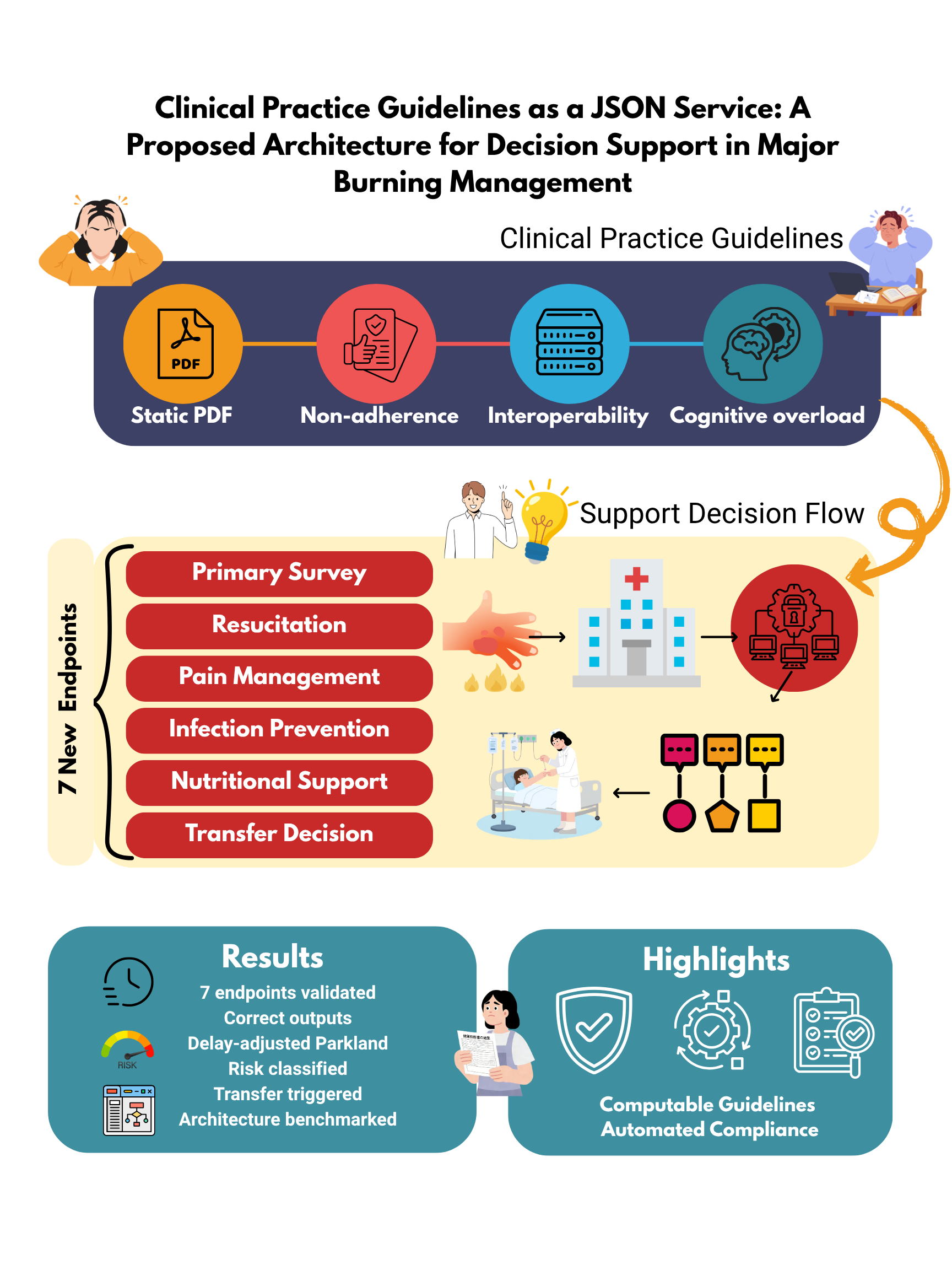
Clinical Practice Guidelines (CPGs) encode evidence-based clinical knowledge but are primarily distributed as unstructured PDF documents, making them inaccessible to automated clinical decision support (CDS) systems. This paper proposes a service-oriented architecture that formalizes the IMSS Clinical Practice Guideline for Major Burn Management (IMSS-375) as a versioned REST/JSON microservice. Seven clinical decision endpoints are defined, each encapsulating a specific GPC recommendation: burn classification, initial assessment, fluid resuscitation, pain management, infection prevention, nutritional support, and transfer criteria, following HL7 FHIR R4 interoperability standards. A mapping between GPC clinical rules (including the Parkland formula, Benaim scale, Curreri formula, and Baux prognostic index) and structured JSON request/response schemas is presented and evaluated against related formalization approaches and verified through structured schema-level invocations against a representative clinical scenario, including a detailed comparison of Mexico IMSS-375 standard properties against HL7 FHIR and OpenEHR. A deployment architecture is described covering hospital-level integration, a centralized service layer, and a non-relational persistence tier based on document-oriented storage for unstructured clinical data.
Downloads
References
G. Guyatt et al., "GRADE guidelines: 1. Introduction—GRADE evidence profiles and summary of findings tables," J. Clin. Epidemiol., vol. 64, no. 4, pp. 383–394, 2011. doi: 10.1016/j.jclinepi.2010.04.026
Instituto Mexicano del Seguro Social, "Intervenciones de enfermería para la atención del adulto gran quemado en el tercer nivel de atención," GPC IMSS-375-17, IMSS, Ciudad de México, 2017. [Online]. Available: https://www.imss.gob.mx
Instituto Mexicano del Seguro Social, "Informe de Labores 2022–2023," IMSS, Ciudad de México, 2023. [Online]. Available: https://www.imss.gob.mx
Office of the National Coordinator for Health Information Technology, "2023 Report to Congress: Health Information Technology," ONC, Washington DC, 2023. [Online]. Available: https://www.healthit.gov
European Commission, "European Health Data Space," Publications Office of the EU, Brussels, 2022. [Online]. Available: https://health.ec.europa.eu/ehealth-digital-health-and-care/european-health-data-space_en
D. G. Greenhalgh, "Management of burns," New Engl. J. Med., vol. 380, no. 24, pp. 2349–2359, Jun. 2019. doi: 10.1056/NEJMra1807442
A. Liberati et al., "Adherence to clinical practice guidelines in burn care: A systematic review," Burns, vol. 48, no. 3, pp. 512–524, May 2022. doi: 10.1016/j.burns.2021.08.012
K. D. Mandel et al., "SMART on FHIR: A standards-based, interoperable apps platform for electronic health records," J. Am. Med. Inform. Assoc., vol. 23, no. 5, pp. 899–908, 2016. doi: 10.1093/jamia/ocv189
H. Randolph, P. Haug, and P. Ferranti, "Arden Syntax for medical logic systems," in Proc. AMIA Symp., Washington DC, USA, 2022, pp. 1–9.
D. Bender and K. Sartipi, "HL7 FHIR: An agile and RESTful approach to healthcare information exchange," in Proc. 26th IEEE Int. Symp. Comput.-Based Med. Syst. (CBMS), Porto, Portugal, 2013, pp. 326–331. doi: 10.1109/CBMS.2013.6627810
R. Verborgh and M. De Wilde, "Using OpenRefine," Packt Publishing, Birmingham, UK, 2013.
M. A. Musen, S. W. Tu, A. Das, and Y. Shahar, "EON: A component-based approach to automation of protocol-directed therapy," J. Am. Med. Inform. Assoc., vol. 3, no. 6, pp. 367–388, 1996. doi: 10.1136/jamia.1996.97084510
B. Brandt, C. Moesel, and J. Brown, "Clinical Quality Language (CQL) specification release 1.5," HL7 International, Tech. Rep., 2020. [Online]. Available: https://cql.hl7.org
N. Al-Hadithy, S. Ghosh, and N. Moiemen, "A clinical decision support system to improve adherence to ISBI guidelines in burn management," Burns Open, vol. 6, no. 3, pp. 112–119, 2022. doi: 10.1016/j.burnso.2022.04.001
G. Tavares, M. Marques, and R. Ferreira, "Mobile clinical decision support for pre-hospital burn triage: Development and usability evaluation," Int. J. Med. Inform., vol. 162, Art. no. 104756, 2022. doi: 10.1016/j.ijmedinf.2022.104756
S. Hosseini, M. Almasi, and P. Rafiee, "Integrating burn care guidelines into a FHIR-based clinical decision support service," J. Biomed. Inform., vol. 138, Art. no. 104270, 2023. doi: 10.1016/j.jbi.2023.104270
V. Peleg et al., "OpenEHR archetypes for burn wound documentation: A semantic modeling study," J. Biomed. Semant., vol. 14, no. 1, Art. no. 8, 2023. doi: 10.1186/s13326-023-00287-z
D. Schwartz, N. Merin, and T. Leiba, "Guideline versioning in clinical decision support," Int. J. Med. Inform., vol. 170, Art. no. 104952, 2023. doi: 10.1016/j.ijmedinf.2022.104952
IMSS, "Informe al Ejecutivo Federal y al Congreso de la Unión 2022–2023," Instituto Mexicano del Seguro Social, Ciudad de México, 2023. [Online]. Available: https://www.imss.gob.mx
World Health Organization, "SMART Guidelines," Digital Health and Innovation, WHO, Geneva, 2023. [Online]. Available: https://www.who.int/teams/digital-health-and-innovation/smart-guidelines
Secretaría de Salud México, "NOM-024-SSA3-2012, Sistemas de información de registro electrónico para la salud," Diario Oficial de la Federación, México, 2012. (sin DOI — norma oficial)
European Commission, "Ethics guidelines for trustworthy AI," High-Level Expert Group on Artificial Intelligence, Brussels, Belgium, Tech. Rep., 2019. [Online]. Available: https://digital-strategy.ec.europa.eu/en/library/ethics-guidelines-trustworthy-ai
W. Baxter and A. Waitzman, "Fluid resuscitation errors in major burn injuries: A prospective observational study," Burns, vol. 49, no. 2, pp. 344–351, 2023. doi: 10.1016/j.burns.2022.07.015
COFEPRIS, "Criterios para la clasificación de software como dispositivo médico en México," Comisión Federal para la Protección contra Riesgos Sanitarios, Ciudad de México, 2023. (sin DOI — documento regulatorio)
J. Brooke, "SUS: A quick and dirty usability scale," in Usability Evaluation in Industry, P. W. Jordan, B. Thomas, B. A. Weerdmeester, and A. L. McClelland, Eds. London, U.K.: Taylor & Francis, 1996, pp. 189–194.
S. G. Hart and L. E. Staveland, "Development of NASA-TLX (Task Load Index): Results of empirical and theoretical research," in Human Mental Workload, P. A. Hancock and N. Meshkati, Eds. Amsterdam, The Netherlands: North-Holland, 1988, pp. 139–183.