A Neural Network-Based Impedance Synthesis for Multi-Probe Harmonic Tuners
Keywords:
Deep neural networks, harmonic impedance tuners, impedance synthesis, load-pull measurements, multi-probe tuners, RF measurement automationAbstract
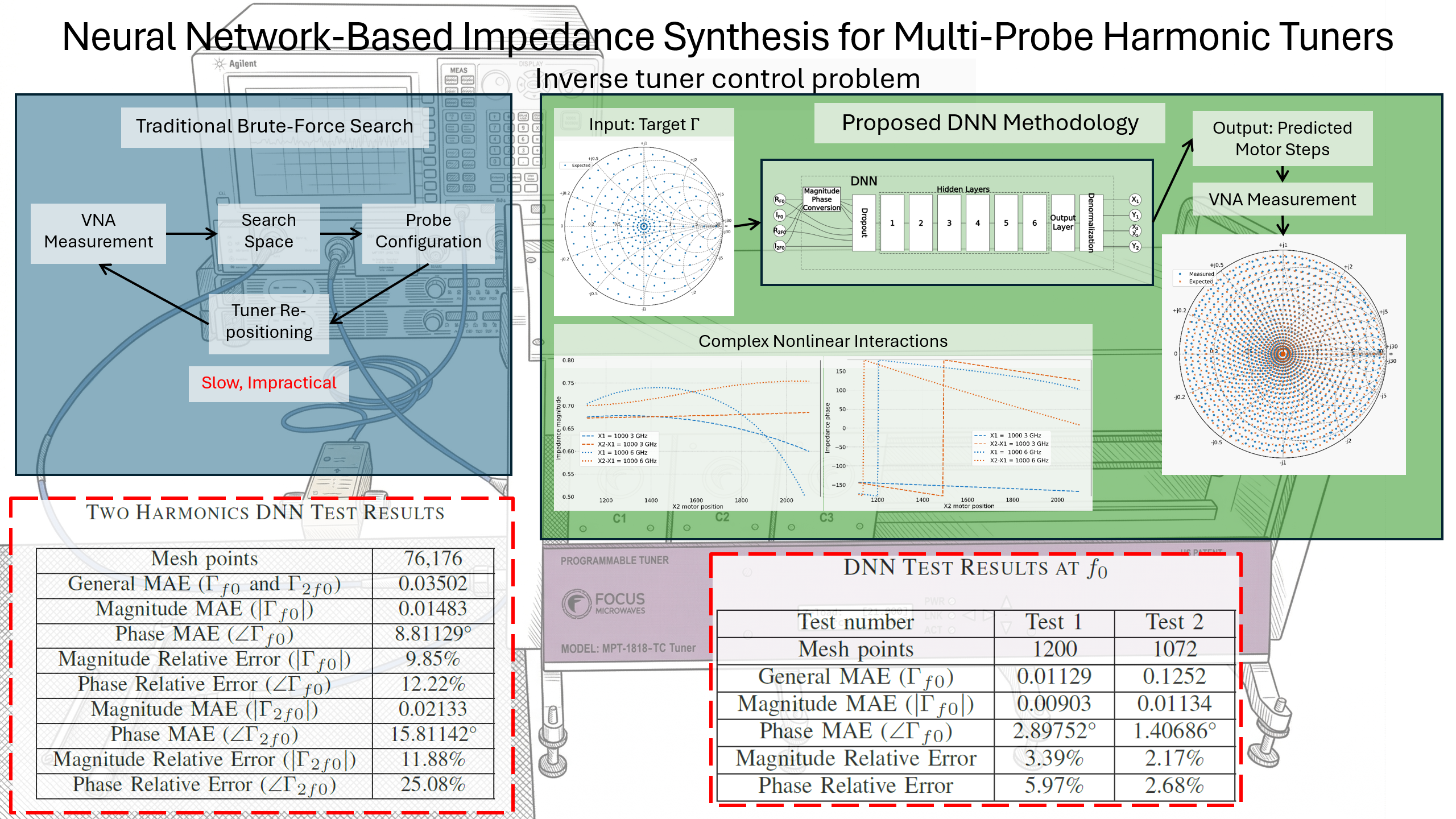
This work presents a deep neural network (DNN) approach to solve the inverse tuner control problem in multi-probe harmonic impedance tuners used in RF Load-Pull measurements. In this problem, the desired reflection coefficients at the tuner reference plane are specified and the corresponding probe positions must be determined. The proposed methodology addresses the complex nonlinear interactions inherent in multi-probe systems, where the movement of a single probe shifts the impedance across multiple harmonics, rendering traditional brute-force search methods impractical due to the large number of possible probe configurations. Two feedforward DNN architectures featuring six hidden layers were designed and trained to predict the motor steps required to synthesize target impedances at the tuner reference plane. Experimental validation using a Focus Microwaves iMPT-1818-TC tuner at a 3 GHz fundamental frequency demonstrated prediction accuracies of 96.61% in magnitude and 94.03% in phase. Furthermore, a multi-harmonic model simultaneously controlling 3 GHz and 6 GHz achieved accuracies of 90.15% in magnitude and 87.78% in phase at the fundamental, and 88.12% in magnitude and 74.92% in phase at the second harmonic. By replacing iterative VNA-based searches with a predictive model, the proposed approach significantly reduces tuner pre-characterization time and improves the efficiency of RF transistor Load-Pull measurements.
Downloads
References
- J. M. Cusack, S. M. Perlow and B. S. Perlman, ``Automatic Load Contour Mapping for Microwave Power Transistors'', in IEEE Transactions on Microwave Theory and Techniques, vol. 22, no. 12, pp. 1146-1152, Dec. 1974, doi: 10.1109/TMTT.1974.1128456.
- F. H. Raab, ``Class-F power amplifiers with maximally flat waveforms'', in IEEE Transactions on Microwave Theory and Techniques, vol. 45, no. 11, pp. 2007-2012, Nov. 1997, doi: 10.1109/22.644215.
- F. H. Raab, ``Class-E, Class-C, and Class-F power amplifiers based upon a finite number of harmonics'', in IEEE Transactions on Microwave Theory and Techniques, vol. 49, no. 8, pp. 1462-1468, Aug. 2001, doi: 10.1109/22.939927.
- S. K. Dhar et al., ``Input-Harmonic-Controlled Broadband Continuous Class-F Power Amplifiers for Sub-6-GHz 5G Applications'', in IEEE Transactions on Microwave Theory and Techniques, vol. 68, no. 7, pp. 3120-3133, July 2020, doi: 10.1109/TMTT.2020.2984603.
- M. Guidry et al., ``W-band passive load pull system for on-wafer characterization of high power density N-polar GaN devices based on output match and drive power requirements vs. gate width'', 2016 87th ARFTG Microwave Measurement Conference (ARFTG), San Francisco, CA, USA, 2016, pp. 1-4, doi: 10.1109/ARFTG.2016.7501955.
- D. Veit, M. Gadringer and E. Leitgeb, ``About Different Load Configurations for Mixed-Mode Load-Pull Measurements'', 2019 European Microwave Conference in Central Europe (EuMCE), Prague, Czech Republic, 2019, pp. 150-153.
- C. J. Clymore et al., ``First Comparison of Active and Passive Load Pull at W-Band'', 2023 101st ARFTG Microwave Measurement Conference (ARFTG), San Diego, CA, USA, 2023, pp. 1-4, doi: 10.1109/ARFTG57476.2023.10279609.
- A. Ben Ayed and S. Boumaiza, ``Millimeter-Wave Wideband Active Load—Pull System Using Vector Network Analyzer Frequency Extenders'', in IEEE Microwave and Wireless Technology Letters, vol. 35, no. 6, pp. 932-935, June 2025, doi: 10.1109/LMWT.2025.3564839.
- K. Lukasik, P. Barmuta, T. Nielsen, K. Madziar, D. Schreurs and A. Lewandowski, ``Hybrid load-pull system using a two-source nonlinear vector network analyzer'', 2015 Integrated Nonlinear Microwave and Millimetre-wave Circuits Workshop (INMMiC), Taormina, Italy, 2015, pp. 1-3, doi: 10.1109/INMMIC.2015.7330378.
- John F. Sevic, ``Automated Impedance Synthesis'', in The Load-pull Method of RF and Microwave Power Amplifier Design, Wiley, 2020, pp.17-43, doi: 10.1002/9781119078128.ch2.
- M. Wang, S. Yu, J. Dong, H. Luo and C. Xiao, ``Multiobjective Optimization of Antenna Inverse Design With Data Augmentation Based on K-Means-NN'', in IEEE Antennas and Wireless Propagation Letters, vol. 24, no. 9, pp. 3144-3148, Sept. 2025, doi: 10.1109/LAWP.2025.3584825.
- V. Miraftab and M. Yu, ``Innovative Combline RF/Microwave Filter EM Synthesis and Design Using Neural Networks'', 2007 International Symposium on Signals, Systems and Electronics, Montreal, QC, Canada, 2007, pp. 1-4, doi: 10.1109/ISSSE.2007.4294399.
- H. Luo, X. Yan, J. Zhang and Y. Guo, ``A Neural Network-Based Hybrid Physical Model for GaN HEMTs'', in IEEE Transactions on Microwave Theory and Techniques, vol. 70, no. 11, pp. 4816-4826, Nov. 2022, doi: 10.1109/TMTT.2022.3206442.
- M. El Mahalawy, N. Misljenovic and A. Fayed, ``A load-pull approach using multi-frequency harmonic tuners for enhancing PAE and device model accuracy'', 2014 IEEE 57th International Midwest Symposium on Circuits and Systems (MWSCAS), College Station, TX, USA, 2014, pp. 603-606, doi: 10.1109/MWSCAS.2014.6908487.
- T. B. Mader, E. W. Bryerton, M. Markovic, M. Forman and Z. Popovic, ``Switched-mode high-efficiency microwave power amplifiers in a free-space power-combiner array'', in IEEE Transactions on Microwave Theory and Techniques, vol. 46, no. 10, pp. 1391-1398, Oct. 1998, doi: 10.1109/22.721140.
- C. Roff, J. Graham, J. Sirois and B. Noori, ``A new technique for decreasing the characterization time of passive load-pull tuners to maximize measurement throughput'', 2008 72nd ARFTG Microwave Measurement Symposium, Portland, OR, USA, 2008, pp. 92-96, doi: 10.1109/ARFTG.2008.4804298.
- J. Apolinar Reynoso Hernández; Manuel Alejandro Pulido Gaytan, "Principles and Applications of Vector Network Analyzer Calibration Techniques", River Publishers, 2024, pp.i-xxx., doi:10.1201/9788770046350
- C. Morales Morales et al., ``Digital Artificial Neural Network Implementation on a FPGA for data classification'', in IEEE Latin America Transactions, vol. 13, no. 10, pp. 3216-3220, Oct. 2015, doi: 10.1109/TLA.2015.7387224.
- J. Salas, F. de Barros Vidal and F. Martinez-Trinidad, ``Deep Learning: Current State'', in IEEE Latin America Transactions, vol. 17, no. 12, pp. 1925-1945, December 2019, doi: 10.1109/TLA.2019.9011537.
- B. Shahriari, K. Swersky, Z. Wang, R. P. Adams and N. de Freitas, "Taking the Human Out of the Loop: A Review of Bayesian Optimization", in Proceedings of the IEEE, vol. 104, no. 1, pp. 148-175, Jan. 2016, doi:10.1109/JPROC.2015.2494218.